Showing posts with label media. Show all posts

Monday, 29 June 2026

Remember This? Seven News Sydney Promo (1986)


I came across a Seven News Sydney commercial from 1986 while viewing a video from the VHS Revue Channel on YouTube by  David M. Green.

According to David, the advertisement was screened during the miniseries Christopher Columbus on July 16, 1986, on Channel 7 (ATN-7).

The thirty-second commercial features the repeated jingle:

Sydney you deserve the best, Seven News

Towards the end, you hear Seven National News Presenter Ross Symonds say the following:

Sydney's a great city. It deserves the best news coverage

The final frame features the key presenters of its news programs (Clockwise from top):

  • Scott Lambert - Sports Presenter, Seven National News (Weekends)
  • Richard Zachariah - 11AM
  • Greg Grainger - Anchor, Seven National News (Weekends)
  • Terry Willesee - Terry Willesee Tonight
  • Ross Symonds - Anchor, Seven National News (Weeknights)
  • Rex Mossop - Sports Presenter 
  • Clive Robertson - Newsworld
I remember a second version of the commercial on YouTube, which is no longer around, but focuses on some of the presenters and how they would spend their leisure time, such as Clive Robertson washing his car and Terry Willesee teaching his son to play tennis. 

Below are screenshots of selected Sydney scenes featured in the advertisement.

Northbound approaches to the Sydney Harbour Bridge at Observatory Hill.


Martin Place Railway Station


Chinatown


View South from Australia Square.


Sydney Harbour


Monday, 23 February 2026

1963: 2SM's "Shark Danger" Advertisment

Since 2022, three people have died in Shark Attacks in Greater Sydney (two of which have occurred recently - September 2025 and January 2026). Prior to 2022, Sydney had gone fifty-nine years without a fatal shark attack.

On January 28 1963, actress Marcia Hathaway was killed by a shark in Middle Harbour at Sugarloaf Bay, Castle Cove. 

Any shark attack is bound to cause concern and panic amongst swimmers at beaches. We have seen it this summer, along with the increased monitoring of waters for sharks.

Sydneysiders had the same sentiments in 1963. 

Recently, David Lillicot posted a 1963 newspaper advertisement from radio station 2SM promoting its weekend beach and marine reports in the Facebook Group - Old Sydney Album. I got my own copy from the same publication (The Daily Mirror) on Microfiche at the State Library of NSW.

2SM Ad Shark Watch February 1 1963 Daily Mirror 8
Source: 2SM. 1963. "Shark Danger" (Advertisement). The Daily Mirror, February 1: 8. 

The advertisement screams out "Shark Danger" in capital letters at the top of the screen 

In addition to providing the usual weather, boating, marine, fishing, and beach forecasts, their patrol boat and plane would also monitor shark activity in Sydney waterways.

Let's move forward six decades...

Radio is considered legacy media, a traditional medium of communication alongside newspapers and television. It can still communicate important information to the community, especially during extreme weather and disasters.

The advertisement is a reminder of a time when radio stations could fund their own newsrooms and information services, even with sponsorship. With shrinking audiences and advertising dollars moving online, it is increasingly difficult for a radio station to support or justify providing such a service.

However, we have seen the influence of radio wane in terms of sourcing information, as there are more options available. The internet allows a person to find out what the weather, maritime and surf conditions could be. The Bureau of Meteorology has its own website that contains a wealth of weather information, constantly updated. The NSW Government operates a Beachwatch website providing full details of conditions at beaches across New South Wales.

Mobile apps on phones and other smart devices allow one to obtain that information in real time from anywhere. Want to know if sharks are in the water? The SharkSmart app will give you an answer. The Weather Bureau has its own app.

Aerial shark patrols still operate, but are also aided by drones.

Shark tagging allows us to monitor shark movements and also helps scientists research shark behaviour and movement. 

Monday, 29 January 2024

Remember This? 2SM Newspaper Advertisement (1966)

In the last entry of our current run of Remember This? comprises of a 1966 newspaper advertisement for radio station 2SM. 

  2SM Ad January 10 1966 daily mirror 12

Source: 2SM. 1966. "2SM goes king" (Advertisement). The Daily Mirror, January 10: 12. 

The weekday schedule was as follows:
  • Phil Haldeman (5 am to 9 am)
  • John Mahon (9 am to 1 pm)
  • "Big" Sam Kronia (1 pm to 4 pm)
  • Tony Murphy (4 pm to 7 pm)
  • Mike Walsh (7pm to 10 pm)
  • Dal Myles (10 pm - Midnight)
Haldeman was in his role alongside that of narrating newsreels for Cinesound. 

The most notable name on the lineup is Mike Walsh, whom would go onto a successful TV career during the 1970s and 1980s as the host of the Mike Walsh Show which ran on Channel Nine from 1973 to 1985.

Dal Myles and Tony Murphy also would eventually find their way onto TV Screens. Older readers may remember that Myles presented Ten Eyewitness News Nightcast alongside evening news updates during the 1980s at channel ten. Tony Murphy would succeed Jimmy Hannan as host of Saturday Date on TCN9 and cohosted Good Morning Australia alongside Kerri-Anne Kennerely and Candid Camera Australia on Channel Ten at the end of the 1980s and early 1990s. 

Monday, 14 November 2022

SYDNEY MEDIA: Rupert Murdoch buys "The Daily Telegraph" and "The Sunday Telegraph" (1972)

 "You will never get your grubby hands on my Telegraphs Rupert. You know that"

Sir Frank Packer in "Power Games" (2013).

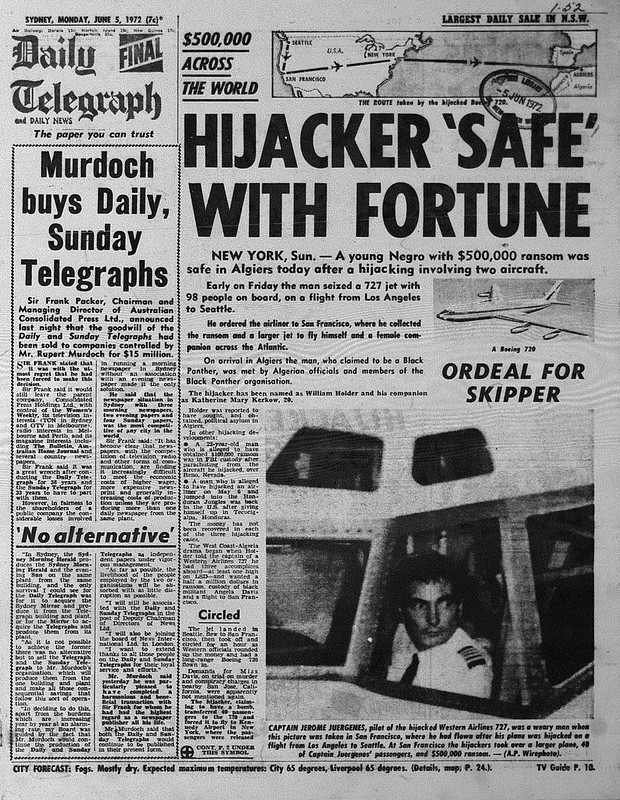
Packer sells Daily Telegraph June 5 1972 daily telegraph 1
Above: The Daily Telegraph becomes the news on 5 June 1972 on the front page of its own newspaper.

Whether or not the conversation happened is an unknown as per any TV Drama based on historical events, but it suggested for Rupert Murdoch, owning The Daily Telegraph would be his jewel in the crown and also control of Sydney's competitive newspaper market.

Murdoch began his newspaper empire with now defunct The News (Adelaide) in 1952. In 1960, he bought the ailing afternoon newspaper The Daily Mirror which was at the time owned by the Fairfax Family. Four years later, he founded The Australian, originally based in Canberra but moved its head office to Sydney in 1967.

By the mid 1960's The Daily Mirror had overtaken The Sun as Sydney's most circulated afternoon newspaper and was second overall in daily newspaper circulation in Sydney. The Daily Telegraph (morning newspaper) had a higher circulation but the margin had narrowed to 4000 by 1972. 

Between 1967 and 1972, The Daily Telegraph recorded a daily circulation drop of 24 000 copies daily. 

Why Sell?

The Daily Telegraph and The Sunday Telegraph were part of Sir Frank Packer's Consolidated Press Holdings which included the Nine Network (TCN9, Sydney & GTV9, Melbourne) magazines such as The Australian Women's Weekly and The Bulletin, along with a number of regional newspapers and radio stations. 

Unfortuantely, the "Telegraph's" were incurring financial losses in the early 1970's. Apart from rising costs of newsprint, wages and production costs, Consolidated Press Holdings did not own a evening newspaper which could have kept production costs down. Fairfax were producing both The Sydney Morning Herald and The Sun at Broadway, ensuring that the presses were constantly in use.

It meant that either Packer had to buy The Daily Mirror from Murdoch which was highly unlikely to in order to ensure The Daily Telegraph and The Sunday Telegraph could survive or sell his papers to Murdoch.

On 4 June 1972, Packer sold the papers to Murdoch for $15 million. Kerry Packer led the negotiations for the sale on behalf of his father.

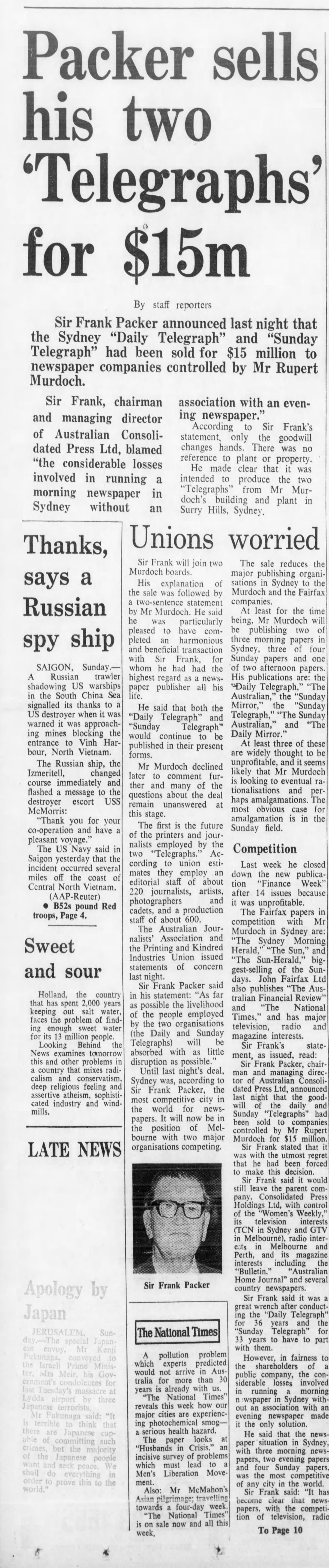
Daily Telegraph Sold to Murdoch June 5 1972 The Australian 1 enlarged Daily Telegraph Sold to Murdoch June 5 1972 The Australian 1  

The following day, it was revealed to the world. The Daily Telegraph (top of page) and The Australian (above) published identical articles to announce the sale. 

The Sydney Morning Herald also ran a major feature on Page 1 while The Daily Mirror kept it off Page 1. Interestingly, The Sun did not make a mention of it. 

Sale of Daily Telegraph June 5 1972 SMH 1 enlarged Sale of Daily Telegraph June 5 1972 SMH 1

Sale of Daily Telegraph June 5 1972 SMH 10 

  What happened next?

Daily telegraph relocates june 17 1972 daily telegraph 10 

From 19 June 1972, The Daily Telegraph and The Sunday Telegraph moved to 2 Holt Road, Surry Hills where they have remained to this day. In 1994, the printing presses were relocated to their present site at Chullora.


New Sunday Telegraph Ad June 9 1972 daily telegraph 10-11

The Sunday Australian was absorbed into The Sunday Telegraph. While the newspaper would remain a Sydney newspaper, the paper would be available nationally each Sunday. In 2022, The Sunday Telegraph is still printed and distributed in Victoria and Queensland in addition to NSW.


Monday, 19 July 2021

1988: The end of "The Sun" newspaper

Above: The decline in the circulation of afternoon newspapers in Australia at the time of the demise of The Sun in 1988.
Image sourced from: Wright, L. 1988. "Death in the afternoon: the slow slide of the tabloid daily". The Sydney Morning Herald, March 15: 6 . 

In 2015, I published an entry on the arrival of Sydney's first 24 hour newspaper - The Daily Telegraph Mirror (reverted to The Daily Telegraph in 1996) which was formed by the merger of two newspapers - The Daily Telegraph and The Daily Mirror in 1990.

Both titles were published by News Limited. The Daily Telegraph was a morning newspaper while The Daily Mirror was published in the afternoon.

For decades the main competitor for The Daily Mirror each afternoon was The Sun, published by Fairfax. There was intense competition between the two titles. It must be noted that The Daily Mirror was owned by Fairfax between 1958 and 1960 giving Fairfax a monopoly in the afternoon newspaper market.

When Rupert Murdoch acquired The Daily Mirror in 1960, he implemented changes to the format of the paper. It adopted a more sensationalist approach to reporting and circulation increased. The Sun was forced to compete. At the time of its closure, The Daily Mirror was outselling The Sun by 50 000 copies per day. The Sun also made changes in the 1980's to attract readers and differentiate the product from its competitor which was not successful. It also charged a higher cover price of forty cents and like The Sydney Morning Herald in this past decade, reduced the number of pages in the newspaper. 

As I noted in my 2015 entry, afternoon newspapers were faced with increasing challenges including:

  • Rise of travel by motor car as opposed to public transport.
  • Rise of television news which allowed viewers to watch events "live".
And as I pointed out in my 2015 entry, Rupert Murdoch's decision to merge The Daily Telegraph and The Daily Mirror reflected preferences by advertisers to advertise in morning newspapers, which allowed for exposure at all times of the day. Afternoon newspapers could not generate the "rivers of gold" that newspapers once received.

Sydney was also unique in the 1980's in that it was one of several cities globally that boasted of having two afternoon newspapers to serve its population. It was becoming unfeasible to provide two afternoon newspapers.

Those reasons along with mounting losses of $20 million per year were therefore behind the closure of The Sun in March 1988. It was the second evening newspaper in Australia to succumb to changing times in that year. The Telegraph in Brisbane had ceased circulation several weeks earlier. 

The Sun published its last edition on the day that Fairfax announced that it was ceasing publication - March 14 1988. Below is the front page from the last day along with accompanying article. Staff were asked to produce one final edition the following day. They refused. 500 people lost their jobs. 

Note that the other major article on Page 1 was the publication of a photo of two victims from the Luna Park Ghost Train fire of 1979 that was taken hours before they died. The photo taken by their mother, shows her two sons posting for a photo with a person dressed as a witchdoctor that was participating in a parade at Circular Quay. A colour version can be obtained online.

The Sun to shut down March 14 1988 The Sun 1-2 (1)

The Sun to shut down March 14 1988 The Sun 1-2 (2)

The Reaction
Rival papers were saddened by the departure of The Sun but had conceded that the newspaper had to close given the financial situation encountered by the paper. It had even survived for longer than it was meant to. Below are two feature articles from The Daily Telegraph and The Sun. Both features were published in their March 15, 1988 editions. 

The Daily Telegraph mentioned that editor John Benaud had suggested that The Sun could have become an upmarket morning newspaper. The Daily Mirror published an editorial which despite their regrets of the closure of The Sun, claimed victory in the afternoon newspaper wars. 


The Sydney Morning Herald provided special coverage in its edition of March 15 1988. It reinforced the coverage provided by The Sun. It reported on the reaction to the announcement by the now former employees of the newspaper. Former editor Derryn Hinch conceded that the newspaper could not compete against The Daily Mirror, and needed to focus on quality journalism like he emphasized when he was editor in 1976-1977. 

Monday, 5 July 2021

Remember this? Forecasting the weather

It's a common topic in conversations and can dictate how our day will proceed - the weather. The weather is a huge influence in our lives.

As I have been sorting out scanned articles to identify and prepare entries or viewed them on Microfiche, I have located some weather pages from various Sydney newspapers in various years. I may do another entry in the future.

They are interesting to view as they show one how weather forecasting has evolved but also how this is communicated to the wider community.

Weather pages do not have the prominence that they once may have had, even with additional weather information now available. The Australian removed the weather page altogether when the COVID-19 pandemic began.

We are fortunate to live in an age where access to weather forecasts are available such as websites and apps on our phones, but they have a place in mainstream media. For instance, publishing weather forecasts in a newspaper can also serve as a written record of the climatic and weather conditions of that time. Websites and phone apps cannot do this. Personally, I enjoy reading weather forecasts in a written newspaper. It can feel immersive. I can always draw on apps and the internet if I need to know specific details at a specific point in time e.g. storm warnings and current temperatures. 

Collecting climatic data and weather forecasting has become easier and more accurate with advancements in technology. Satellites in space also monitor weather patterns and have helped meteorologists with their observations and forecasts. Ultimately, it has meant that society has access to more information about weather and climate. This has been reflected in the samples that have been provided. 

In 1961, The Daily Mirror had the weather section blended in with general news and features on Page 6 in the edition dated September 21. No temperature statistics to be seen and a brief overview of the forecast for that evening. The weather map was state based. 


This one was published in The Daily Mirror on January 28 1970 (Page 70). There was no synoptic chart compared with 1961 and no mention of forecast temperatures for the remainder of that day or the following day. They did record observations for that morning.


By 1988, The Daily Mirror had allocated more space for its weather feature. Below is one from the edition of 25 January, 1988.


The Sydney Morning Herald in 1969 was wordy but note the space allocated to rainfall totals across NSW. There is a detailed synoptic map. This one was published on November 20, 1969 (page 15). 


In the 1980's The Daily Telegraph weather page was largely text based and without the visuals that would been seen in recent decades. They did have synoptic charts provided by the weather bureau. Apart from a metropolitan forecast, an overview of weather conditions for each region was also provided. Down the bottom, there was a long list of temperatures for world cities. 


The Daily Telegraph/The Daily Telegraph Mirror had full page weather forecasts from 1990, but during 2020, the space allocated was dramatically reduced. 

I was a big fan of them growing up and got better as colour was introduced. Satellite maps were also introduced. 


By 2000, there was a small weather feature produced by Don White that either provided an overview of climate trends or explained weather phenomena. Note the increased use of visuals to convey weather details. 


I thought The Sydney Morning Herald in the second half of the 1990's and 2000's had the best weather feature. It was comprehensive, not just with metropolitan forecasts but also forecasts for each region in NSW. I remember that country editions had less details for the metropolitan region and was tailored more specifically to them. A great balance between visuals and text and also kept a great record of weather observations for Sydney. This was published on September 23 1998. 


While these are samples, I will have to produce another set in the future but at least this gives us a general idea of how our newspapers have presented the weather.


Monday, 12 August 2019

Remember this? - Sydney Newspaper coverage of the moon landing (1969)

As a teacher librarian, I have created a display to mark fifty years since the Apollo 11 mission to the moon.

Apart from promoting books relating to space travel and astronomy, I have been sharing newspaper front pages from the mission to show students how Sydney's newspapers covered each day of the mission.

This week, I am going to share some newspaper front pages from this occasion which I have shared with the students.

Below are the front pages of the evening newspapers - The Daily Mirror and The Sun from July 21 1969.


Below are the front pages of the morning newspapers - The Australian, The Daily Telegraph and The Sydney Morning Herald from July 22 1969.


Update on proposed Westfield Miranda Series: I will have to defer this a little longer, but hopefully before the year is out. The material is great but have been short on time to collate it.

Monday, 28 November 2016

MILESTONE: ATN7 begins Transmission (1956)


This Friday (December 2), Channel Seven will celebrate 60 years of broadcasting in Sydney, under the callsign ATN7.

It was the third TV station to commence operations in Sydney following the opening of TCN9 in September 1956, and ABN2 (ABC) just a month before. The studios were located at Mobbs Lane, Epping, with the TV transmitter based at Gore Hill. ATN7 would remain at Epping until 2010 when they moved production facilities to the Australian Technology Park at Eveleigh. The original studios is now a housing estate. Several years before in 2004, its news department relocated to purpose-built studios at Martin Place. Local and national news bulletins and programs are produced there.


Source: Anon. 1956. Untitled (photograph). The Sun Herald, December 2:39. 

ATN7 was owned by Amalgamated Television Services comprising of a consortium of various radio, electrical and media interests including The Sydney Morning Herald and The Sun. It was a subsidiary of Fairfax. The channel would eventually become the flagship of the Seven Network, even though HSV7 in Melbourne was the first channel in the network to go to air in November 1956. ATN7 and HSV7 formed the Australian Television Network (Seven Network) in 1963. It would eventually be joined by BTQ7 (Brisbane), SAS7 (Adelaide) & TVW7 (Perth).

Fairfax would have ownership of ATN7 until 1987 when Quintex owned by Christopher Skase bought out the Seven Network. This was due to changes in Commonwealth media laws which stipulated that Fairfax could only own either print publications or television stations. Fairfax opted for print publications. Today, the Seven Network is currently part of Seven West Media, owned by Kerry Stokes.


Source: Anon. 1956. "Television Station ATN Channel 7 Opened by P. M. G.". The Sydney Morning Herald, December 3:1.  

The transmission on opening night (December 2 ) commenced at 7:30pm with the official opening of the channel by the Postmaster General - Mr. C. W. Davidson. This was followed by A Shower of Stars, which was a live studio program at 7:45pm. The first feature film - It's Folly To Be Wise screened at 9pm. A news bulletin at 10:30pm would close the first night's transmission, closing at 10:45pm.


Source: ATN7. 1956. Untitled (advertisement). The Sun Herald, December 2, 39. 

A special supplement was provided in the December 3 edition of The Sydney Morning Herald to mark its opening. Selected extracts feature below.


Initially, TV broadcasts on ATN7 commenced at 4:30pm with transmission closing at around 10:30pm. On weekends, broadcast times were shorter.

Early shows included:
  • Your Home featuring Del Cartwright
  • At Seven on 7 with Howard Craven
  • This I Believe with Eric Baume
  • Sydney Tonight with Keith Walshe
  • Caltex Theatre (Sunday Evening)

Below is a feature on its mobile broadcast unit (Click to enlarge).


Over the past sixty years, ATN7 has contributed significantly to the success of the Seven Network and bred stars of the small and eventually for some the big screen. Writing its achievements would need to be an essay. It has also been noted for pioneering programming formats on Australian television. For instance, Sydney Tonight was the first "tonight" show in Australia. Where would Graham Kennedy, Bert Newton and Don Lane be if it were not for this? At Seven on 7 was also the first current affairs show in Australia. ATN7 has also been an innovator. They were first with videotape equipment at Epping in the 1950s but also working with GTV9 in Melbourne to broadcast programs between Sydney and Melbourne with microwave links.

Seven Network Headquarters at Pyrmont. Photo was taken by the Author (2011).

Monday, 27 June 2016

1963: First live major TV News Event Broadcast between Sydney and Melbourne

On Saturday the entire nation is off to the polls. Recently, I came across advertisements from TCN9 which were published in The Daily Telegraph to promote its election coverage for the 1963 Federal Election.

The Coaxial Cable was actually switched on between Sydney and Melbourne in April 1962. This allowed for live transmission of television programs between the two cities and Canberra and could carry telecommunications traffic. In the first year, it generally relayed sporting events between the cities.

In November 1963, Australia went to the polls. The National Television Network (comprising of TCN9 Sydney and GTV9 Melbourne) was owned by Sir Frank Packer. He had entered into a two-year lease of one hundred thousand pounds a year.

Election Day was November 30, 1963, just seven days after the assassination of U.S. President John F. Kennedy (JFK) in Dallas. As part of election coverage, the first major broadcast of a news event across major Australia cities occurred, drawing on the coaxial link. TCN9 published these advertisements to promote the landmark coverage.

1.


2.


Sources:

1.  TCN-9. 1963. "TCN 9 Electoral Telecast Map Viewing Area" (Advertisement). The Daily Telegraph, November 29: 8

2.  TCN-9. 1963. "TCN 9 Electoral Telecast Map Metropolitan Area" (Advertisement). The Daily Telegraph, November 30: 8

Coverage would be anchored from the TCN9 studios at Willoughby with live crosses to the GTV9 studios in Melbourne, Canberra and The Sunday Telegraph Newsroom in Park Street, Sydney. Here is advertising material sourced from The Daily Telegraph in relation to its election broadcast. TCN9's viewing area stretched well beyond the boundaries that it is allowed to transmit into. Those in Newcastle, Wollongong and the Southern Highlands could also receive the broadcast.

It would set a precedent for the way we watched television. Programming could be instantly relayed from city to city. No longer would there be delays in having to wait for shows aired in other capital cities. A show recorded in Sydney could be relayed to Melbourne at the same time and vice versa. Programming in Australia tends to follow a common schedule these days.


Source: Southern Star (Firm) & John Edwards Production & National Nine Network (Australia). 2013. Power games : the Packer-Murdoch story.  

The mini-series Power Games (2013) takes a look at that election coverage from TCN9, though you might not want to take what you see seriously, especially Alan Reid's announcement that Menzies was back in power at 8:35pm, only 35 minutes after the close of polls.  In the film, Sir Frank Packer tells his son Clyde to "Sack the Computer" which had been bought in to predict the result. The computer itself was also a key feature in the promotion broadcast in order to predict the winner.

I also noticed that the front page of The Sunday Telegraph (December 1, 1963) was actually read out by Reid in the film. Need confirmation if Reid did actually say it. I may contact Channel Nine to follow up.


The way we watched news changed as a result because Australians could be informed of events happening across the country in real time and that information could be relayed instantly. It reflected the changing landscape in the relay of news in the 1960s as Satellites placed into orbit around the Earth, allowing events to be transmitted from one part of the world to another. The assassination of JFK one week earlier showed that.

And finally, it is believed (by some) that Sir Frank Packer decided to cause a fault in the coaxial cable in July 1964, so young media baron Rupert Murdoch could not relay the pages for the first edition of The Australian Newspaper from Canberra to Sydney. He had to fly the plates to Sydney for printing, which he managed to do despite heavy fog in Canberra.

For the record, Sir Robert Menzies Liberal/Country Coalition won the election with an increased majority winning 72 seats out of 122 seats. This was 10 seats more than in 1961. There was no Senate election in 1963.

There will be wall to wall coverage this Saturday on Channel Nine along with is competition at ATN7 (Seven Network ), ABC & Sky News. Yours truly won't be watching as he has to count the votes at a booth in southern Sydney and the networks will be dependent on me for the results.


Monday, 27 April 2015

1972: Sydney's Telenews Ticker

Our older readers might remember back in the 1970's when The Daily Telegraph had its own news ticker amongst the neon signs and street lights of Kings Cross. It was unveiled in 1972 on the podium of the Crest Hotel.


Source: Anonymous. 1972. "Times Square at the Cross". The Daily Telegraph, December 21: 5. 

I don't know when it got pulled down at this stage. But Channel Seven in late 2004, unveiled their own "telenews" ticker around its Sydney News Centre at 52 Martin Place allowing Sydneysiders to once again get their news while on the move. The ABC has one at the rear of its studios at Ultimo. In a fast-paced world, getting the news quickly is as important as ever.


Source: Anonymous. 2015 . Untitled [digital image]. April 26. http://cache4.asset-cache.net/gc/148654966-pedestrians-walk-past-a-news-ticker-gettyimages.jpg?v=1&c=IWSAsset&k=2&d=GkZZ8bf5zL1ZiijUmxa7QV16n1Y%2BV3aVQMc0PVGpTXnVAG9anZlY9l1ymFuHBJQ9

As for the Crest Hotel, there is a development application currently before Sydney City Council to convert the building into apartments.

The proposed design for the apartment complex to replace the Crest Hotel. It was posted by the forumer  Upwards on the Skyscrapercity.com forum. 


Wednesday, 19 November 2014

MILESTONE: The Sunday Telegraph turns 75

On this day in 1939, Sir Frank Packer launched The Sunday Telegraph as the sister paper to The Daily Telegraph. In 1939, it was a broadsheet and cost threepenny (2 cents). The media baron wanted to take on the Sunday market and got his wish.

Page One of the first edition on November 19, 1939.

Three years later (1942), it was converted to a tabloid to overcome rationing of newsprint. 

Packer reigned supreme over the paper until he made a decision to sell the paper and The Daily Telegraph to Rupert Murdoch and News Limited. it has been in his hands ever since. 

I recently managed to get a scan of the cover of its 50th Anniversary Edition in 1989, which happened to be November 19, 1989. 


From its beginning, in 1939 the paper has grown to be the biggest selling newspaper in Australia. As of mid-2014, approximately 488 500 copies are printed each week with a readership of 1.3 million people. 

While it is a Sydney newspaper, the paper itself is widely available on Sundays in the ACT, Victoria and Queensland. I believe that it stemmed from the merger of the paper with The Sunday Australian in 1972.