Showing posts with label 1988. Show all posts

Monday, 20 April 2026

NEVER BUILT SYDNEY: 109 Pitt Street (1988)

Pitt Street Office Tower February 23 1988 SMH 65 enlarged
Full citation below.
 
Never Built Sydney is back for another series. In this entry, I look at a 1988 proposal for a 26-level office tower at 105, 107, and 109 Pitt Street. The tower, which was to comprise 21,000 sq/m of office space, was never built. 

"Innovative engineering design" was to be a key feature of the tower, to be developed by Hooker Projects and the State Superannuation Board.

  Pitt Street Office Tower February 23 1988 SMH 65

Source: Anonymous. 1988. "City block will feature major innovations in building and design". The Sydney Morning Herald, February 23: 65. 

In 2002, I photographed a model of the tower prepared for the City of Sydney Model. Thank you to Richard Braddish (Sydney City Council) for organising it at the time. 

MVC-323X

105 Pitt Street, 107 Pitt Street and 15-25 Hunter Street are currently subject to an innovative development of its own - a 55 level office tower that when completed will be the worlds tallest hybrid building, It will beat the 39 level/183 metre Atlassian Central Tower at Central Station which when completed later this year or early next year will be the tallest hybrid timber tower in the world. As of April 2026, the demolition of buildings is in progress.

105-107 Pitt Street Render

Source: Anonymous. 2024. “A $370m skyrise building has been given the green light in the heart of Sydney’s CBD.” Image in “City of Sydney pushes limits to add another CBD skyscraper”. The Daily Telegraph, August 29. Accessed April 19, 2026. https://www.dailytelegraph.com.au/newslocal/central-sydney/1525-hunter-st-and-105107-pitt-st-development-gets-green-light-for-55storey-skyscraper/news-story/a423d0a5fb8e5a0e0247b4c6289c6317


Saturday, 7 March 2026

Property Advert of the Week: Hooker Housing Group Home Display Centre Ad (1988)

Below is a 1988 newspaper advertisement by the Hooker Housing Group promoting their Home Display Centres at Prospect, Casula and Castle Hill.

  Hooker Housing Ad March 5 1988 daily telegraph 15
Source: Hooker Housing Group. "Your first step to a richer family life" (Advertisement). The Daily Telegraph, March 5: 15. 

Monday, 30 June 2025

NEVER BUILT SYDNEY: Moore Park Trademart (1988)

This is my last entry in the current series of Never Built Sydney.

Did you know that the Moore Park Supa Centre was initially planned to be a Trademart? A trademart is where businesses can sell their products to other businesses. Therefore, the original plans for the site focused more on businesses as opposed to consumers. It was proposed by developer Sir Sid Londish, and his company Comreality

The decision to axe the trademart stemmed from the process of approving the third runway for Sydney Airport. For Londish, he wanted to capitalise on the opportunities associated with the increased capacity that a third runway would bring for Sydney Airport, i.e. increased tourism and business opportunities. The recent extension of Southern Cross Drive (1988) to connect it with Sydney Airport meant that South Dowling Street, which fed onto Southern Cross Drive, became a central transport corridor for those travelling to and from the airport.
 
Even though it was approved and completed (1994), Londish didn't see himself as a hypocrite and stood firm to his word. He would also sell the land. Fortunately, it also had approval for a bulky goods centre, which Londish could have pursued if he had not wanted to proceed with the Trademart. 

And out of the ashes would rise the Moore Park Supacenta, one of Sydney's first bulky goods centres. 

Moore Park Super Centre August 21 1988 Weekend Australian 45
Source: Howard, J. 1988. "Londish plans 'trade city' for wholesalers". The Weekend Australian, August 21: 45. 

Saturday, 21 June 2025

Property Advert of the Week: "The Big 3 in New Homes" (1988)

Landcom Ad June 18 1988 daily telegraph 21

Source: Anonymous. 1988. "The Big 3 in New Homes" (Advertisement). The Daily Telegraph, June 18: 21. 

In 1988, Landcom, Hooker Housing Group and the St George Building Society (Now St George Bank)  teamed up to provide a house and land package. Landcom provided the block, Hooker Housing Group would build the home and the St George Building Society provided the loan. Only 200 homes were on offer, priced from $69,950 to $109,500. 

Monday, 5 May 2025

NEVER BUILT SYDNEY: 40 Park Street (1988)

Pitt Street Metro North Site March 1 1988 SMH 28 enlarged
Full Citation Below

Did you know that a tower was once proposed to be built on the site of the recently completed Parkline Place tower in Park Street, directly above Gadigal Station, decades before heavy rail snaking underneath Pitt and Castlereagh Streets, and a metro station right on Park Street?

It happened in 1988.

Interestingly, the proposed tower was 40 storeys tall, just one storey higher than today's tower. The development would have comprised 4000 sq/m of retail space, 45,000 sq/m of space (similar to the current Parkline Place), a 2,500 sq/m space for a library, and a four-storey public atrium.

It was to be developed by developer Frank Theeman.

Pitt Street Metro North Site March 1 1988 SMH 28 OR 2s

Source: Chancellor, J. 1988. "Theeman catches key CBD sites". The Sydney Morning Herald, March 1: 28.

How would the Metro Station fit into the narrative had the tower been built?

This tower would have impacted plans for the Sydney Metro if they had to stick to what we see today. It would have created a barrier to building an entrance from Park Street. Consider that it was planned for Town Hall and Gadigal Stations not to be connected at all to avoid creating a "super station". Gadigal was also built to alleviate overcrowding at Town Hall Station. Data has shown that patronage at Town Hall has decreased by 10% since the CBD Metro opened. Options for a station entrance, particularly at the northern end, are limited, and Park Street is also a bus corridor for a number of bus services operating in central Sydney.

This tower would have likely been compulsorily acquired and demolished just like 39 Martin Place was for the construction of the metro platforms and entrances at Martin Place and the buildings in Elizabeth, Castlereagh and Hunter Streets that were located behind the Commonwealth Bank building. This would ultimately mean Parkline Place would be built, likely in a very similar form to the current tower and to at least the same number of floors and height, if not kept to the 40 floors. As for heights, Parkline Place may have ended up taller provided it could conform to solar access protections, meet design excellence standards and justify breaching height and planning limits.

This is a "never built" that did Sydney a favour, even if it was not back in the 1980s, because the acquisition of the tower for the Sydney CBD Metro would have increased construction costs and removed any barriers to placing a station entrance to Gadigal Station in Park Street. 

Above: Parkline Place as viewed from Park Street at Hyde Park. Photo taken by the Author (2025).

Sunday, 21 April 2024

Property Advert of the Week: Eastgate Gardens, Bondi Junction (1988)

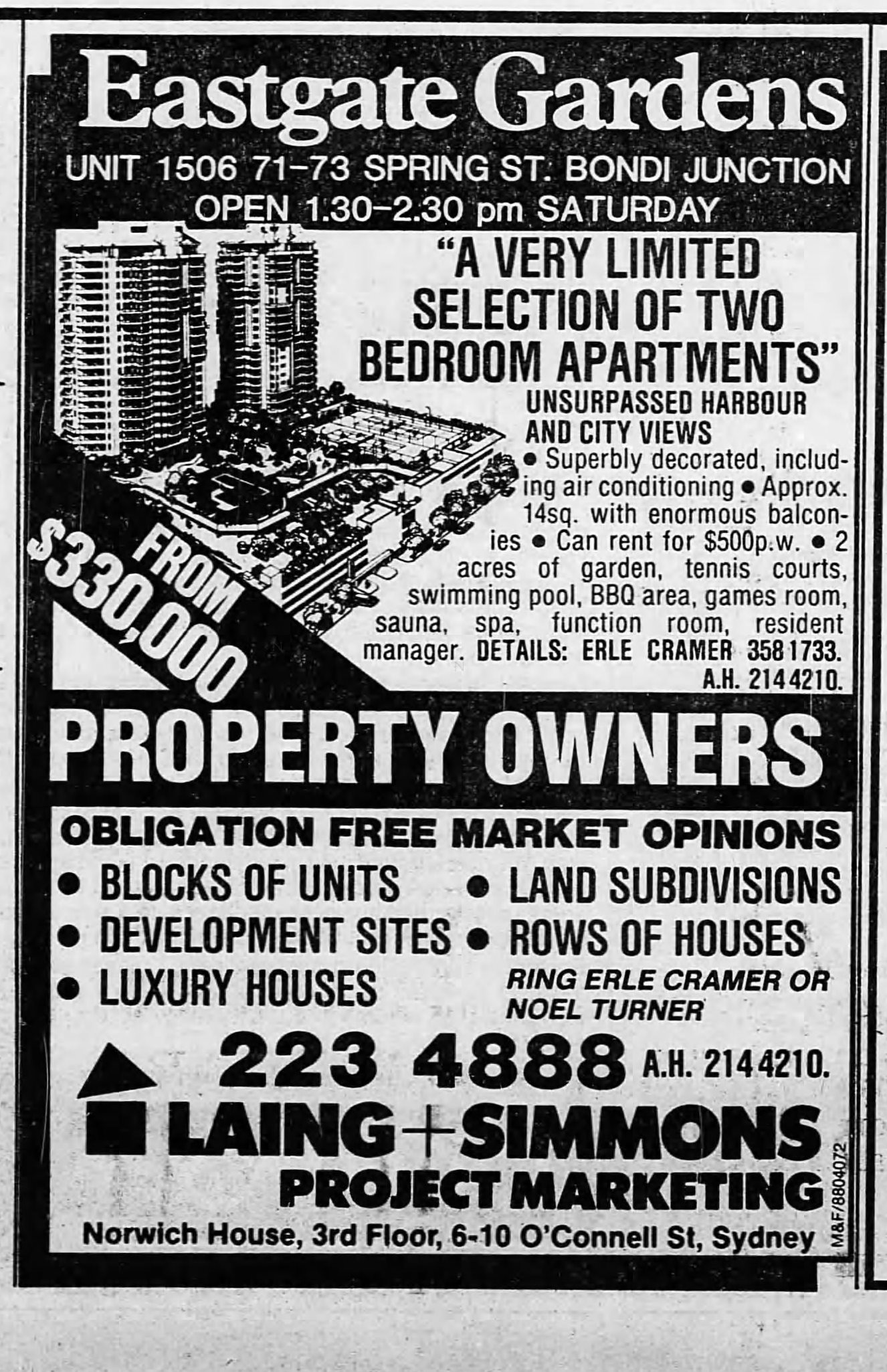
Below is a newspaper advertisement promoting apartments for sale in the Twin Tower Eastgate Gardens complex at Bondi Junction from 1988. Two-bedroom apartments were on offer from $330 000 but were "very limited".

Eastgate Gardens Ad April 23 1988 SMH 3
Source: Laing & Simmons Project Marketing. 1988. "Eastgate Gardens" (Advertisement). The Sydney Morning Herald, April 23: 3.

Related Entry

Monday, 26 June 2023

NEVER BUILT SYDNEY: Catholic Club Office Tower (1988)

This is the last entry in our current series of  "Never Builts".

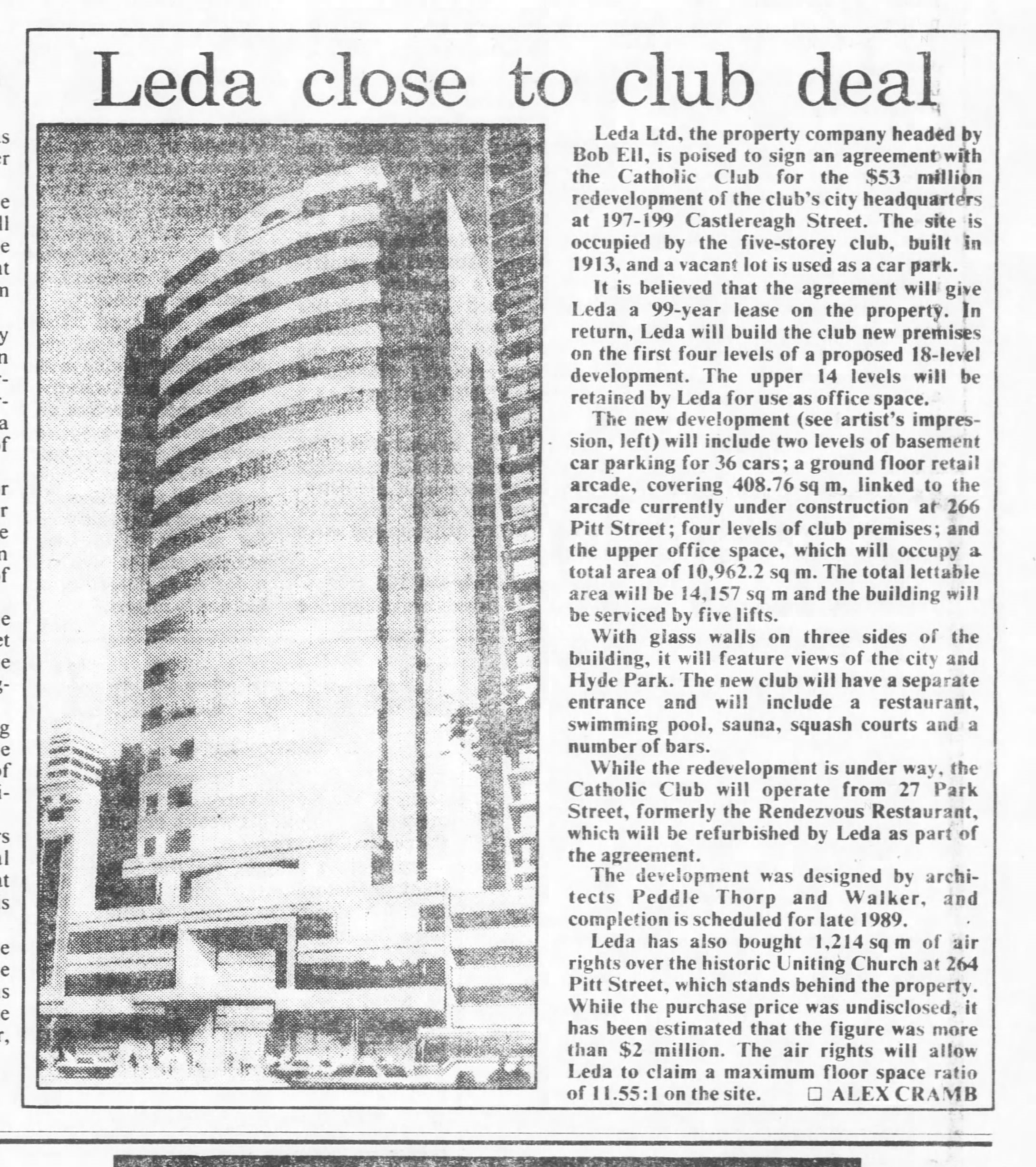
The Catholic Club sought to redevelop its Castlereagh Street site in the 1980s. In 1988, they teamed with Leda Ltd to design an 18-storey office tower to replace the five-storey building that had occupied the site since 1913. The Catholic Club would secure the first four levels of the building for their new premises, with the remaining levels to be leased as office space by Leda.
  Catholic Club Redevelopment November 22 1988 SMH 32 

Peddle Thorp Walker were the architects. The 1913 building was demolished the following year. Like many projects planned at the end of the 1980s in central Sydney, it became a victim of the crash of the property market and recession in the early 1990s.

In 1993, Sydney City Council approved Victoria Towers, which was also proposed by Leda. The change of use from office to residential reflected the state of the Sydney CBD office market, along with changes to planning guidelines that encouraged Sydney CBD residential development.

Related Entry:


Monday, 7 November 2022

1988: Early mention of a proposed North-West Rail Link.

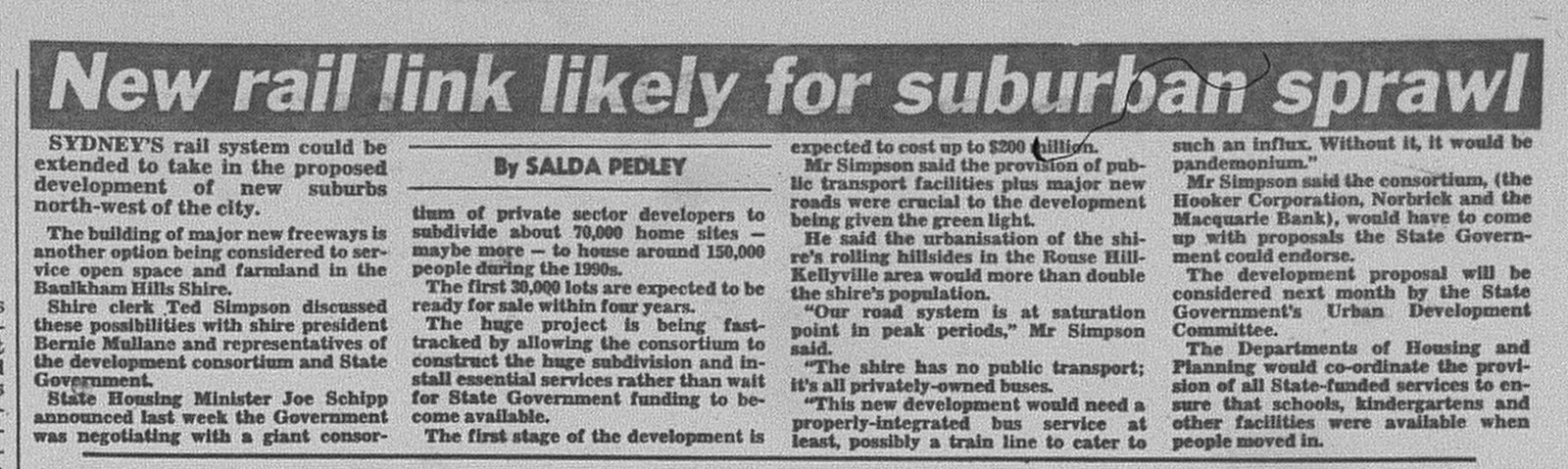
I found an article from The Sunday Telegraph that was published in 1988 focusing on transport options for our North-Western Suburbs including Rouse Hill and Kellyville. 

At the time, Rouse Hill and Kellyville were semi-rural suburbs with planning underway to develop them into new suburbs.

North West Rail Line October 23 1988 Sunday Telegraph 11

Source: Pedley, S. 1988. "New rail link likely for suburban sprawl". The Sunday Telegraph, October 23: 11. 

Baulkham Hills Shire Council (Hills Shire) had met with representatives of the NSW Government and property developers to discuss transport options to serve the new estates.

Being considered was construction of "major new freeways". This would have included construction of the Castlereagh Freeway which evolved to become the M2 Motorway and part of the Western Sydney Orbital. 

Also it mentioned that "Sydney's rail system could be extended to take in the proposed development of new suburbs north-west of the city".

I highlighted could because it meant that a rail line was a possibility. However no mention of possible routes is given.

Council was prepared to approve the developments subject to a commitment that the transport projects proceed.

As a minimum, council was prepared to accept a "property integrated bus service" to serve the new estates.

It was disappointing though, that there were no possible routes suggested for the rail link because that would have had the debate going.

Related entries

Monday, 12 September 2022

1987: When the NSWRL wanted to slug $32 per ticket at the Sydney Football Stadium

On August 28, the rebuilt Sydney Football Stadium was officially opened followed by the first sporting fixture on September 2 when the Sydney Roosters played the South Sydney Rabbitohs in Round 25 of the NRL Premiership Competition, before meeting again in an elimination final last weekend. 

Tickets for that match ranged from $40 through to $100 for adults 

That was very good value when compared with the $32 that the NSWRL wanted to slug fans for matches played at the original Sydney Football Stadium as part of the 1988 NSWRL Premiership. The price also applied to children. 

The RBA Inflation Calculator equates $32.00 to approximately $76.78 in todays money. 

SFS November 18 1987 daily telegraph


Source: Rothfield, P. 1987. "$32 To watch top league here". The Daily Telegraph, November 18: 1-2. 

Did the fans get good value for money? No

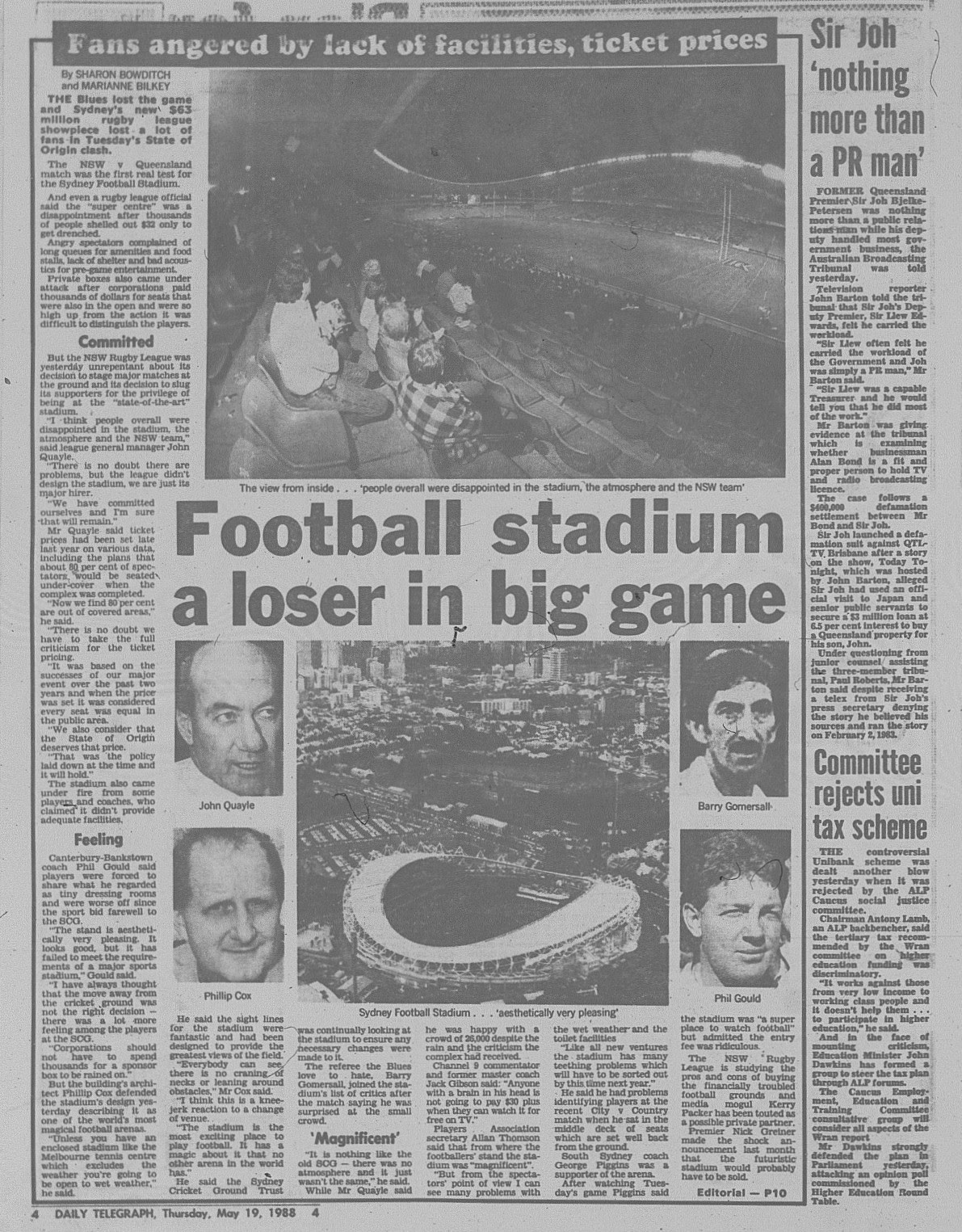
While the new Football Stadium had hosted regular season NSWRL matches, its first major sporting fixture was on May 17 1988 when 26 441 attended the first match of the State of Origin Series. Queensland defeated NSW 26-18. 

The crowd was down 16 000 on the previous fixture held at the SCG the previous year, suggesting that high ticket prices had turned them off. For the fans that turned up, they were unhappy at what $32 bought them. The facilities were underwhelming.

If you check out the footage of highlights from the game on Youtube, you will find that the areas behind the goalposts were deserted. 

SFS May 19 1988 daily telegraph

Source: Bowditch, S. & Bilkey, M. 1988. "Football stadium a loser in big game". The Daily Telegraph, May 19: 4. 

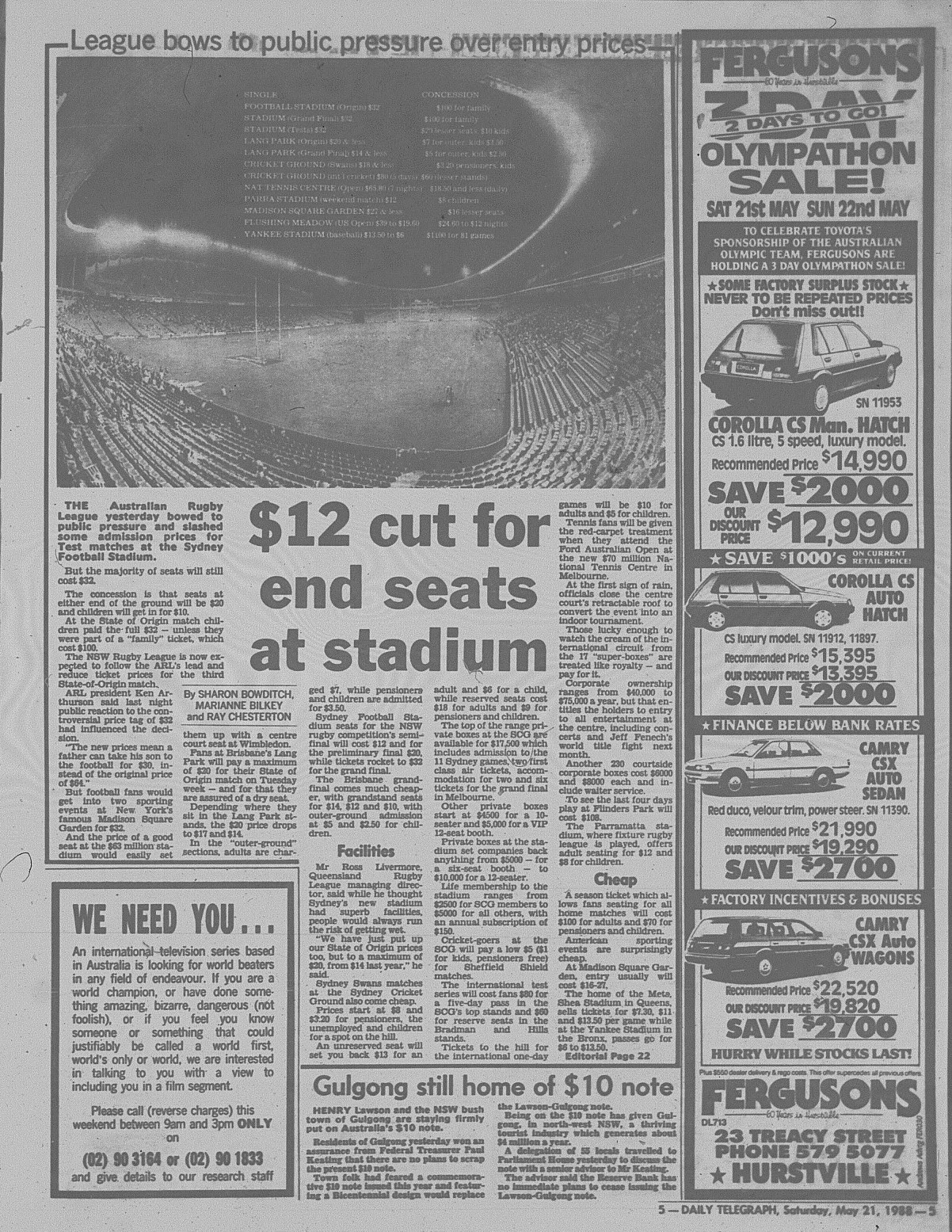
In the end they were forced to reduce prices - $20 for adults and $10 tickets for children for the upcoming rugby league tour by Great Britain. Compared to other sporting venues and codes, it was still high. The discounted tickets applied to seats on the wing or behind the goal posts. Sitting on the halfway line still cost patrons $32. Only 24 000 attended the First Test at the stadium on June 11 and and 16 000 for the third test. 

 SFS May 21 1988 daily telegraph

Source: Bowditch, S., Bilkey, M. & Chesterton, R. 1988. "$12 cut for end seats at stadium". The Daily Telegraph, May 21: 5. 


Saturday, 4 June 2022

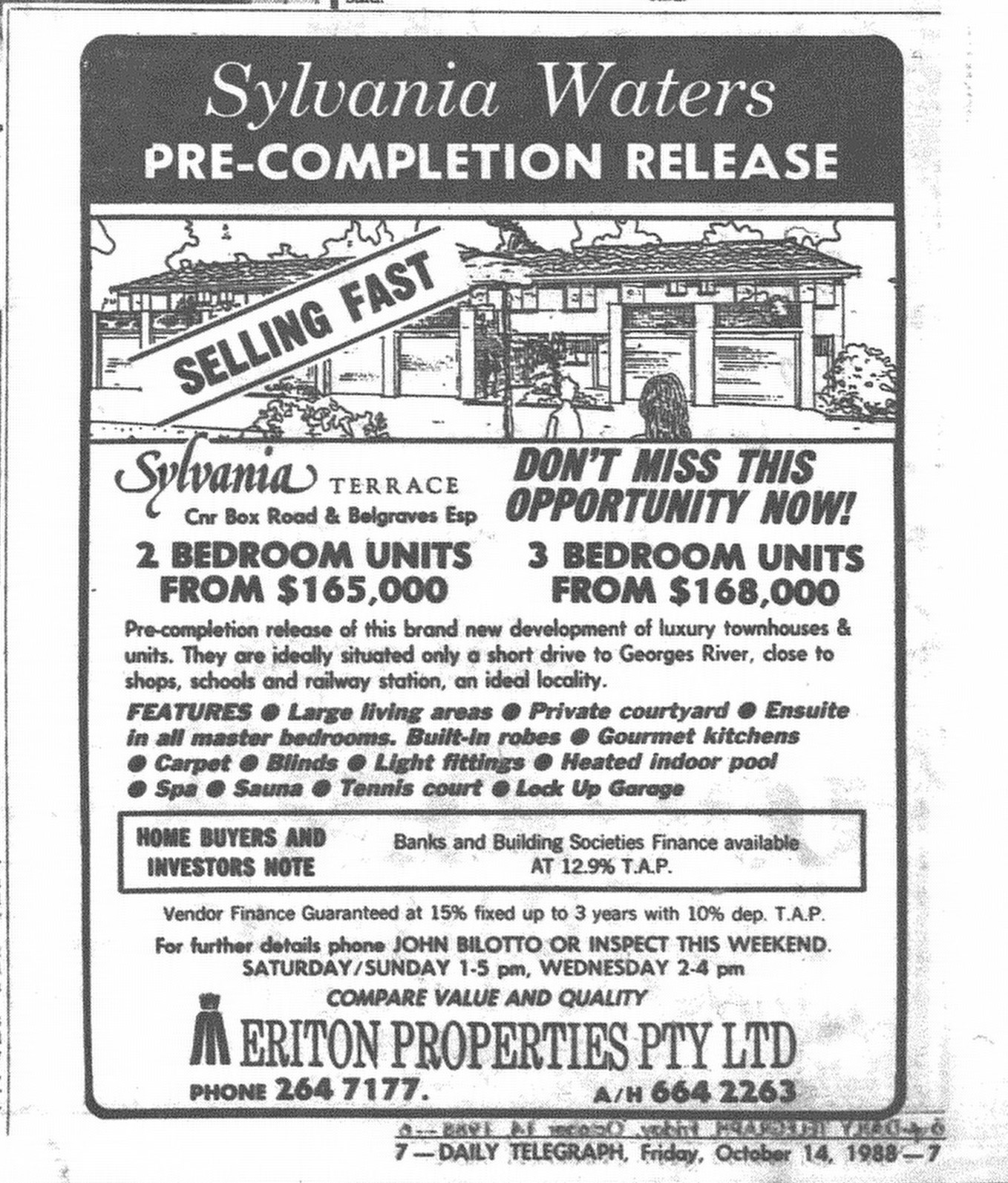
Property Advert of the Week: Sylvania Terrace, Sylvania Waters (1988)

Below is a 1988 newspaper advertisement by Meriton Properties (Apartments) promoting townhouses in their development at Sylvania Waters. It was advertised as being located at the corner of Box Road and Belgrave Esplanade. 


Meriton Sylvania Waters Ad October 14 1988 daily telegraph 7

Source: Meriton Properties Pty. Ltd. 1988. "Sylvania Terrace" (Advertisement). The Daily Telegraph, October 14: 7.


Monday, 7 February 2022

1988: The Sydney Football Stadium is offically opened

It has been hoped that the rebuilt Sydney Football Stadium will open its doors to the sporting public during this year.

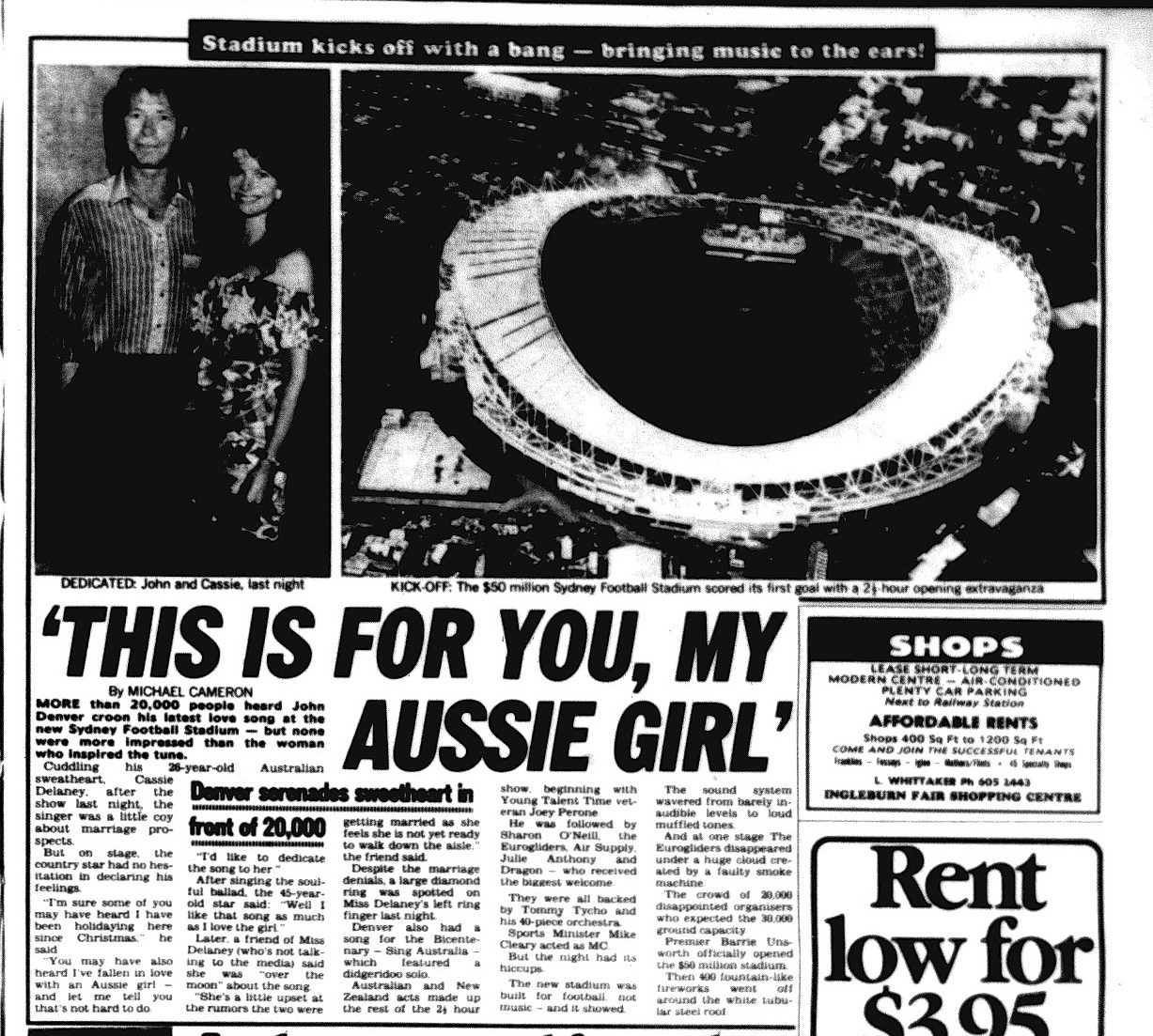
Our first regular entry for 2022 goes back to the previous Sydney Football Stadium and its first event, held on January 24, 1988. This was the same week that the nation held its Bicentennial celebrations. It was not a sporting event, but a concert headlined by American singer John Denver. The stadium was officially opened by NSW Premier Barrie Unsworth as part of the festivities. 

Tickets ranged from $15 to $25 dollars. 17 000 attended the concert which also included Air Supply, Eurogliders, Dragon and Sharon O'Neill backed by Tommy Tycho and The Sydney International Orchestra. This was down from the projected 30 000 that were expected to.

There was also criticism of the sound system along with an echo that could be heard by attendees.

John Denver also presented a special song that he wrote to mark the Bicentennary but also one for his girlfriend - Cassie Delaney who was also Australian. 

John Denver concert at SFS January 25 1988 daily mirror page unknown

Source: Cameron, M. 1988. "'This is for you, my Aussie girl'". The Daily Mirror, January 25: page unknown.

The first sporting event was on March 4 1988, when Eastern Suburbs played St George in the first game of the 1988 NSWRL season. Click Here to view an entry that I wrote in 2015. 

Monday, 4 October 2021

Real Estate Super Sales: Craig-y-Mor (1988)

As my collection of media clippings has grown, I have also managed to obtain a few articles relating to house sales at the top of the Sydney housing market or sales that may be of interest.

In 2021, Australia's most expensive dwelling is:

  • Located in Sydney
  • Located at Barangaroo
  • Under Construction
  • An apartment
The apartment is a penthouse in the One Sydney Harbour complex at the top of its tallest tower nearly 250 metres above street level with views that are unlikely to never be built out including the Sydney Harbour Bridge and Sydney Opera House. 

To own the penthouse, the buyer paid $140 million. 

Craig-y-mor sold for $12 million March 8 1988 daily telegraph 3
Source: Anon. 1988. "$12.3m for harbourside home". The Daily Telegraph, March 8: 3. 

In 1988, Sydney's property market as in 2021 was booming. That year Point Piper Mansion, Craig-y-Mor was sold for an then Australian record at the time - $12.3 million, which is less than one-tenth of the price paid to purchase the most expensive home in Australia today. 

The buyer was the Gary Rothwell of the Winten Property Group.

The estate covered 2600sq/m of land, which was subdivided. The mansion was sold for $7.14 million to Chris Corrigan and his wife Valerie in 1991.

A decade later (2001), stockbroker Rene Rivkin and his wife purchased it from Corrigan for $10.7 million. Three years later, Rivkin sold it to businessman Ben Tilley for $16.15 million.

Just four years later, the mansion set another record for the sale of a home in Australia, sold for $32.4 million to former Chinese vice-president Zeng​ Qinghong​, and wife Jiang Mei. Ownership was transfered to their son Zeng Wei in 2015.

Craig-y-Mor was demolished in 2014 and was replaced by a new four storey residence. 

Monday, 20 September 2021

1988: Monorail Test Runs

Sydney's Monorail network which connected central Sydney with Darling Harbour operated between 1988 and 2013. It was controversial from its conception, construction and while in operation.

The Monorail was supposed to have commenced service in January 1988 as part of Bicentennial Celebrations with Prince Charles and Princess Diana to be the first passengers, but delays saw the monorail commence service in July, 1988.

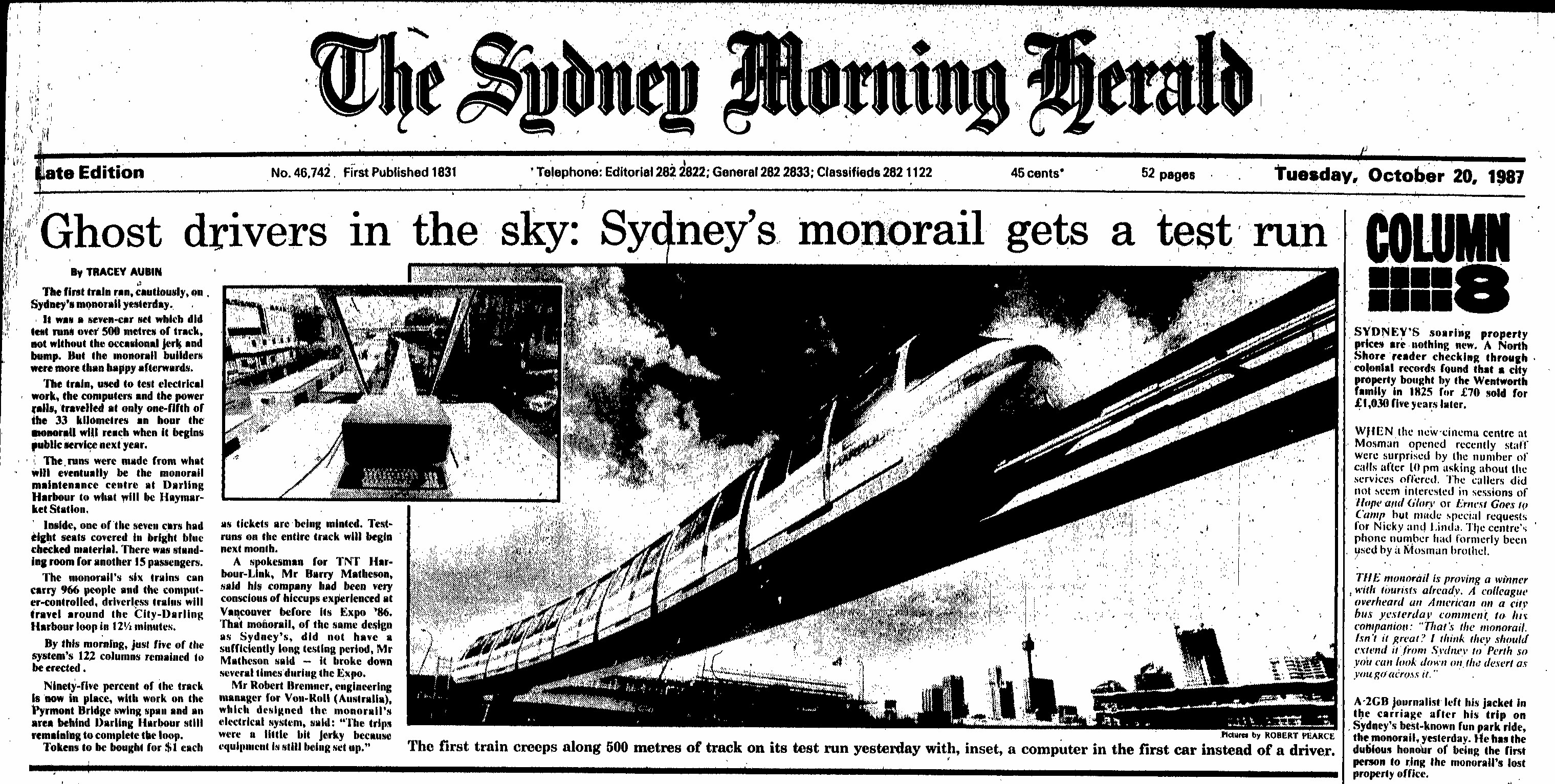
Monorail test run october 20 1987 SMH 1 closeup 

Source: Aubin, T. "Ghost drivers in the sky: Sydney's monorail gets a test run". The Sydney Morning Herald, October 20: 1. 

In October 1987, the Monorail trains began the first of their test runs, using the tracks at their Maintenance Centre at Ultimo and travelling to the Haymarket Station.

Test runs were meant to have been run on the route from November 1987, but did not occur until February 1988. The first test run was on February 13 1988 in Liverpool Street and featured on the front page of The Sun Herald on February 14, 1988 (below). At the time it was anticipated that passengers could use the line from April, three months behind schedule. This did not eventuate. 

 Monorail Test Run February 14 1988 Sun Herald 1 enlarged

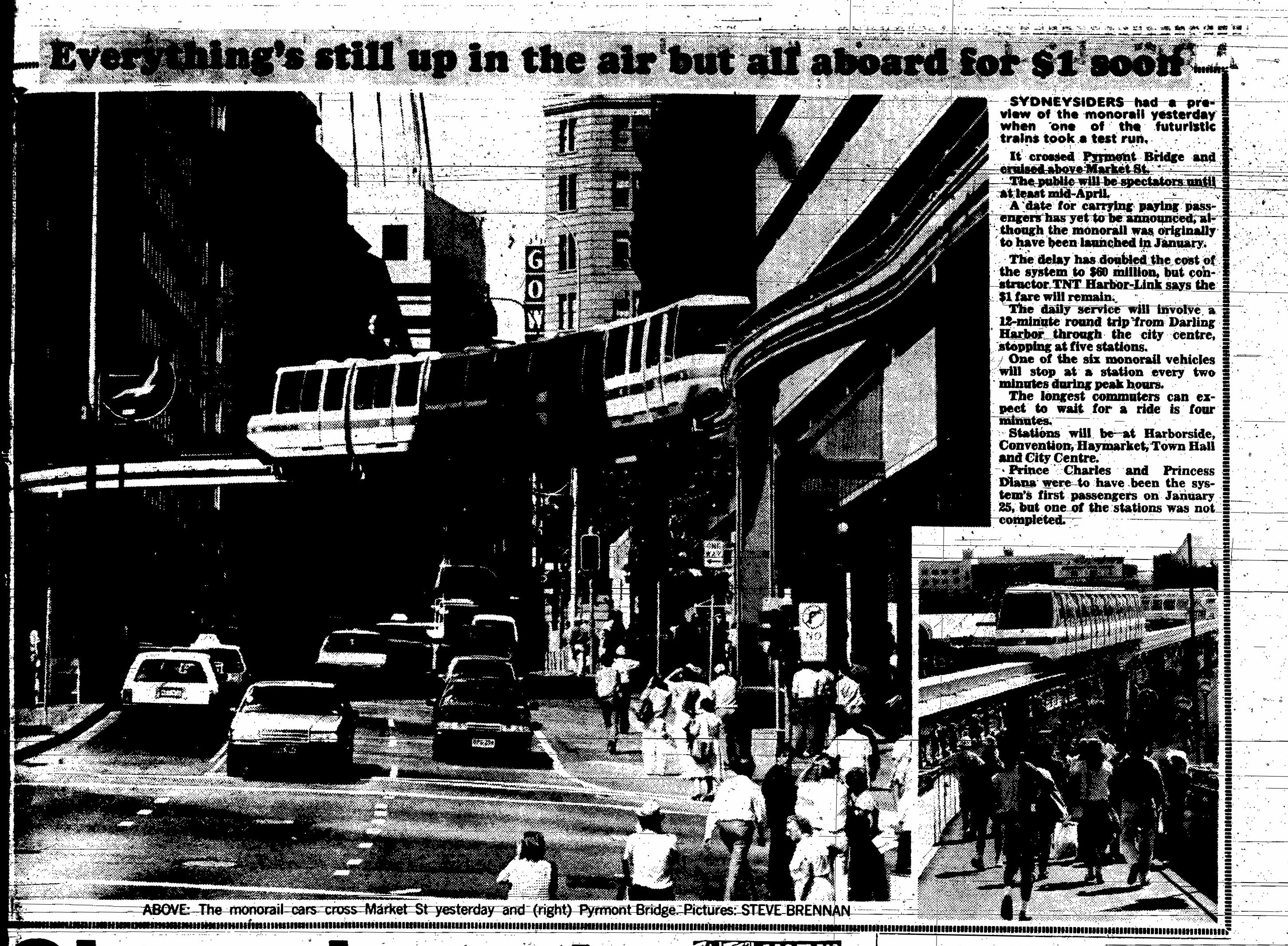
Below are another two newspaper clippings relating to test runs conducted soon after.

Monorail test february 27 1988 daily telegraph 3

Source: Anon. 1988. "Everything's still up in the air but all aboard for $1 soon". The Daily Telegraph, February 27: 3. 

Monorail Test Run February 24 1988 SMH 1 enlarged

Source: Stevens, R. 1988. Untitled (Photograph). The Sydney Morning Herald, February 24: 1. 

In May, 6000 people were provided with an opportunity to ride the circuit ahead of its opening. 

monorail test run May 16 1988 SMH page unknown


Source: Hewett, T. 1988. "A hum of satisfaction from above". The Sydney Morning Herald, May 16: page unknown. 

James Oram was one of the first journalists to ride the monorail and shared his insights.

monorail march 20 1988 sunday telegraph 17

Source: Oram, J. 1988. "Magic Carpet Ride at 33km/h". The Sunday Telegraph, March 30:17. 

Finally, I published an entry in 2018 that looked at the opening of the monorail in 1988. Click here to view the entry.

Monday, 19 July 2021

1988: The end of "The Sun" newspaper

Above: The decline in the circulation of afternoon newspapers in Australia at the time of the demise of The Sun in 1988.
Image sourced from: Wright, L. 1988. "Death in the afternoon: the slow slide of the tabloid daily". The Sydney Morning Herald, March 15: 6 . 

In 2015, I published an entry on the arrival of Sydney's first 24 hour newspaper - The Daily Telegraph Mirror (reverted to The Daily Telegraph in 1996) which was formed by the merger of two newspapers - The Daily Telegraph and The Daily Mirror in 1990.

Both titles were published by News Limited. The Daily Telegraph was a morning newspaper while The Daily Mirror was published in the afternoon.

For decades the main competitor for The Daily Mirror each afternoon was The Sun, published by Fairfax. There was intense competition between the two titles. It must be noted that The Daily Mirror was owned by Fairfax between 1958 and 1960 giving Fairfax a monopoly in the afternoon newspaper market.

When Rupert Murdoch acquired The Daily Mirror in 1960, he implemented changes to the format of the paper. It adopted a more sensationalist approach to reporting and circulation increased. The Sun was forced to compete. At the time of its closure, The Daily Mirror was outselling The Sun by 50 000 copies per day. The Sun also made changes in the 1980's to attract readers and differentiate the product from its competitor which was not successful. It also charged a higher cover price of forty cents and like The Sydney Morning Herald in this past decade, reduced the number of pages in the newspaper. 

As I noted in my 2015 entry, afternoon newspapers were faced with increasing challenges including:

  • Rise of travel by motor car as opposed to public transport.
  • Rise of television news which allowed viewers to watch events "live".
And as I pointed out in my 2015 entry, Rupert Murdoch's decision to merge The Daily Telegraph and The Daily Mirror reflected preferences by advertisers to advertise in morning newspapers, which allowed for exposure at all times of the day. Afternoon newspapers could not generate the "rivers of gold" that newspapers once received.

Sydney was also unique in the 1980's in that it was one of several cities globally that boasted of having two afternoon newspapers to serve its population. It was becoming unfeasible to provide two afternoon newspapers.

Those reasons along with mounting losses of $20 million per year were therefore behind the closure of The Sun in March 1988. It was the second evening newspaper in Australia to succumb to changing times in that year. The Telegraph in Brisbane had ceased circulation several weeks earlier. 

The Sun published its last edition on the day that Fairfax announced that it was ceasing publication - March 14 1988. Below is the front page from the last day along with accompanying article. Staff were asked to produce one final edition the following day. They refused. 500 people lost their jobs. 

Note that the other major article on Page 1 was the publication of a photo of two victims from the Luna Park Ghost Train fire of 1979 that was taken hours before they died. The photo taken by their mother, shows her two sons posting for a photo with a person dressed as a witchdoctor that was participating in a parade at Circular Quay. A colour version can be obtained online.

The Sun to shut down March 14 1988 The Sun 1-2 (1)

The Sun to shut down March 14 1988 The Sun 1-2 (2)

The Reaction
Rival papers were saddened by the departure of The Sun but had conceded that the newspaper had to close given the financial situation encountered by the paper. It had even survived for longer than it was meant to. Below are two feature articles from The Daily Telegraph and The Sun. Both features were published in their March 15, 1988 editions. 

The Daily Telegraph mentioned that editor John Benaud had suggested that The Sun could have become an upmarket morning newspaper. The Daily Mirror published an editorial which despite their regrets of the closure of The Sun, claimed victory in the afternoon newspaper wars. 


The Sydney Morning Herald provided special coverage in its edition of March 15 1988. It reinforced the coverage provided by The Sun. It reported on the reaction to the announcement by the now former employees of the newspaper. Former editor Derryn Hinch conceded that the newspaper could not compete against The Daily Mirror, and needed to focus on quality journalism like he emphasized when he was editor in 1976-1977. 

Monday, 7 June 2021

NEVER BUILT SYDNEY: Angel Arcade (1988)

Welcome to Part 8 in our series of "Never Builts".

In 1988, AMP unveiled plans to build Sydney's tallest office tower - a 43 level, 244 metre office tower at 123 Pitt Street designed by architects Dino Burattini and Peddle Thorp Walker. Burattini was also the architect behind 52 Martin Place. 

It was envisaged that the tower would commence construction in 1989, but Sydney City Council did not give approval until 1990.


Source: Chancellor, J. 1988. "AMP plans $530 million office development for Sydney." The Sydney Morning Herald, August 13: 37. 

At the time it was the tallest skyscraper to be approved for construction in the Sydney CBD. 

The development also included a 13 level office building to be built on George Street, which is the present site of Justin Hemmes Ivy complex. 

Construction commenced the same year with excavations completed. The development was deferred by AMP as office vacancy rates increased in central Sydney during the recession of 1990-1991. The site was not completely vacant with a temporary golf driving range operating on the site.


Source: Anon. 1996. "City driving range is music to their ears". The Daily Telegraph, December 19: 20. 

The Pitt Street site remained idle until 1996, when a new development application (DA) was lodged due to the expiration of the DA. Changes to planning guidelines during the mid 1990's reduced the height of any tower built on the site to protect the sun access plane into Martin Place. That is why the tower has a sloped roof.

AMP were granted approval for the current tower - Angel Place which rose to a maximum of 152 metres or 35 levels. The tower including the new City Recital Hall was completed in 2000.

The George Street site remained vacant and was the last of the infamous "holes in the ground" from the 1990-91 recession to be filled. Proposals to build an office building were explored, but did not proceed. Justin Hemmes developed the site into the Ivy nightclub in 2007 which also included bars, restaurants and retail at street level. 

Finally, I was lucky in 2013 to photograph a "block model" of the tower which was inserted into the model of the Sydney CBD at Town Hall House. This provides an idea of how it may have looked when viewed from different parts of central Sydney. Thanks to Richard Braddish for his support.


Monday, 22 March 2021

1998: AMEX Building Redevelopment

Photo taken by the Author (2021). 

The King George Tower (commonly known as the American Express Building) at the corner of George and King Street's was designed by John Andrews. The office building completed in 1976 rises to a height of 131 metres or 32 storeys. In 1983, it won the John Sulman medal.

It was an innovative building for its time, particularly for attempts to promote energy efficiency and facing the corner of two city streets.


Source: Totaro, P. 1996. "Tower branches out into $60m greenhouse". The Sydney Morning Herald, March 12: 5. 

Two decades later, building owners AMP Capital and Industry Superannuation Property Trust decided to upgrade the building to make it Sydney's first "bio-climatic" tower. The idea was to ensure that it remained innovative by incorporating new technologies to boost energy efficiency.

Gardens would be placed at various levels on the south west corner of the tower while innovative glazing would replace the polycarbonate sunshades. Both would work in tandem to control the temperatures inside the building.

Shops that were located underground were moved up to street level, reflecting the desire of Sydney City Council to boost street activity and improve the streetscape. 


Source: Susskind, A. 1998. "Architect sees prized tower turned into a 'joke'". The Sydney Morning Herald, April 16: 3. 

As the refurbishment neared completion in 1998, architect John Andrews expressed his dismay telling The Sydney Morning Herald that he tried to "avoid looking at it" and that Sydney City Council was "gutless" for approving it and allowing it to be "ruined".  However those associated with the refurbishment claimed that articles had been written about it and that there was an interest by university students and architectural firms for tours.

Current owners, Investa and Brookfield recently undertook another refurbishment of the tower. The podium was renovated and the gardens have disappeared. They have maintained the focus on energy efficiency and environmental sustainability. In addition a six level mixed retail and commercial annex was constructed. 

There will be those who will not agree with the renovations as some buildings are to be preserved in their original shape or form but modern skyscrapers do need the ability to evolve with the times and to respond to the needs of businesses that seek office space. 388 George Street also faces competition in attracting tenants to city towers, especially with the options available at Barangaroo and soon to be at Circular Quay. 388 George Street is a building that seeks to reflect current innovations and I see that as the years progress, it will be a building that adapts to the times.

Below are photos of the recently renovated podium taken by yours truely.