Showing posts with label beaches. Show all posts

Monday, 6 July 2020

Remember this? Ocean Outfalls Advertisement (1987)

The Water Board (Sydney Water) had newspaper advertisements published regularly through the late 1980's to inform Sydneysiders of the Deep Ocean Outfalls that were to be built to remedy the beach pollution that had become a daily part of life at Sydney's beaches.

They were completed by 1991 as planned and the promised improvement to water quality at Sydney beaches eventuated.

I do admire the illustrations that were used to explain how the deep ocean outfalls would work and yet kept it simple. One example from 1987 is shown below:


Source: Sydney Water Board. 1987. "Salt water and sunshine. They'll do our beaches a power of good." (Advertisement). The Sydney Morning Herald, March 27, 3S (NSW Supplement).

Monday, 11 December 2017

Why were the (1928) Brighton Baths demolished?

In May, The St George and Sutherland Shire Leader published a Flashback Friday Feature on the demolition of the 1928 swimming enclosure at Brighton-Le-Sands in 1980.

While the article was based on the content available within the archives of the newspaper, I felt that it didn't provide an explanation as to why or how its fate was determined.

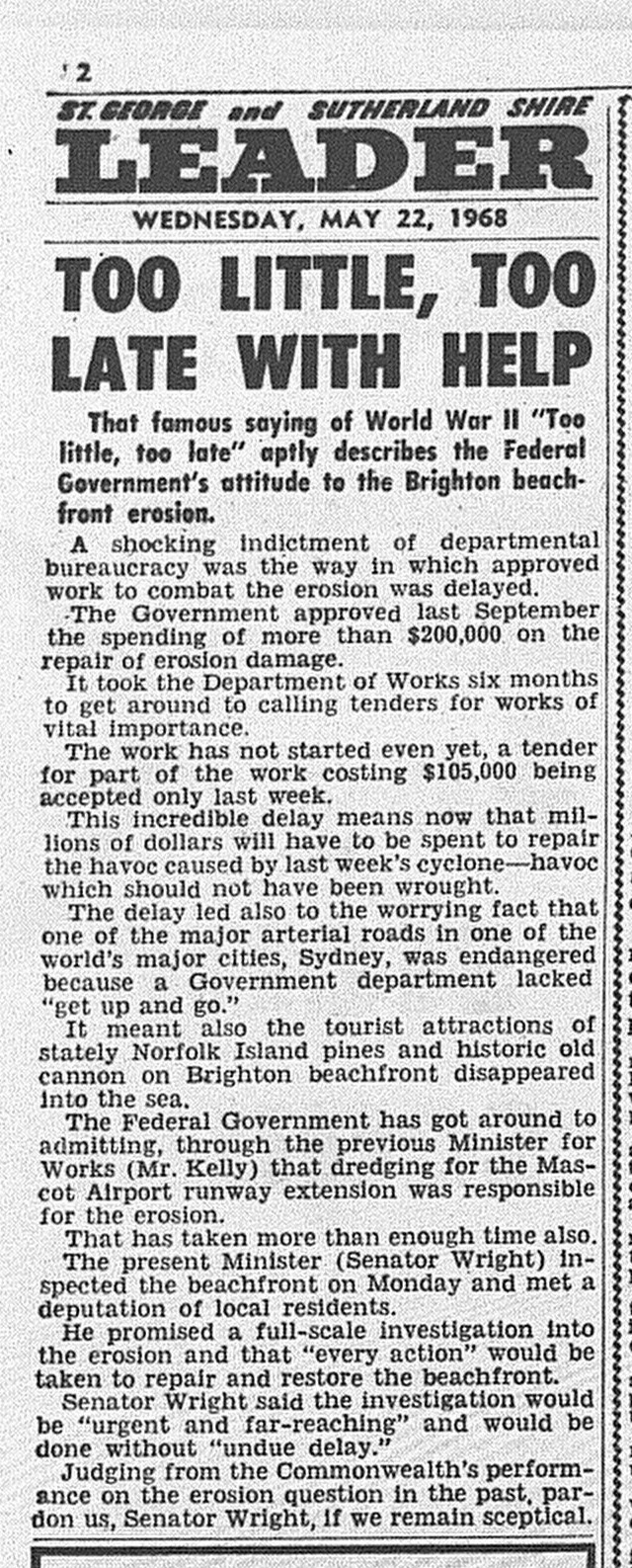
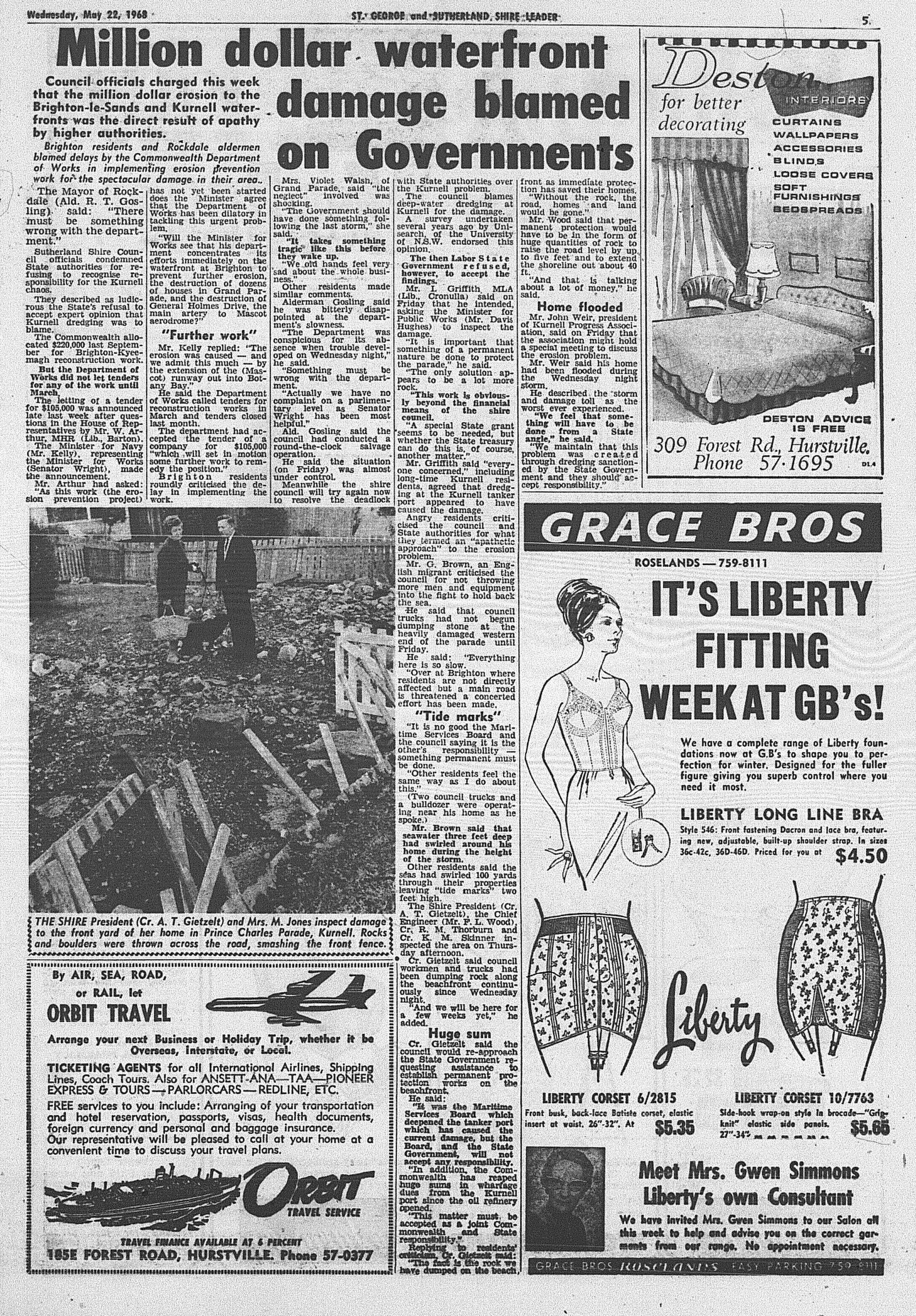
The argument presented was that one storm in May 1968 all but sealed its fate, along with rising maintenance costs and declining patronage (access was via paid entry). The storm was reported to be one of the worst ever to impact on Botany Bay. The storm swells generated massive erosion of the beachfront at Brighton-Le-Sands, including the collapse of a number of Norfolk pine trees and a historic cannon. Homes were flooded at Kurnell, when waves crashed over Prince Charles Drive. Scans from the May 22, 1968, edition of The St George and Sutherland Shire Leader are included below including the editorial from page 2.


I wanted to also consider other sources as well. I consulted the local history collection of the former Rockdale City Council but also some of the scanned material that I have managed to obtain through my ongoing scans.

A search of the image collection through Bayside Council revealed images of significant storm damage to the baths as early as 1962. I found one image that had a concrete staircase overhanging from 1965. In addition, the beachfront at Brighton had been damaged in a number of storms in the lead up to 1968. The walkway on the perimeter of the baths had buckled during storms, forcing the baths to close

I found an article by former Rockdale Mayor and Alderman Ron Rathbone (date unknown) in a vertical file. Rathbone mentioned that council had prior to the 1960s faced difficulties in managing the baths. Patronage had declined as swimmers flocked to free enclosures located in nearby suburbs. Costs of maintenance had increased.

In 1970 the council struck an agreement with the Maritime Services Board and the Department of Lands and Planning to demolish the baths and replace it with a pier and floating net.The Seymour Pavillon was also to be demolished.

The former dressing sheds were converted into the Le Sands restaurant, opening in 1972. In 2017, the restaurant celebrates 45 years of trade.

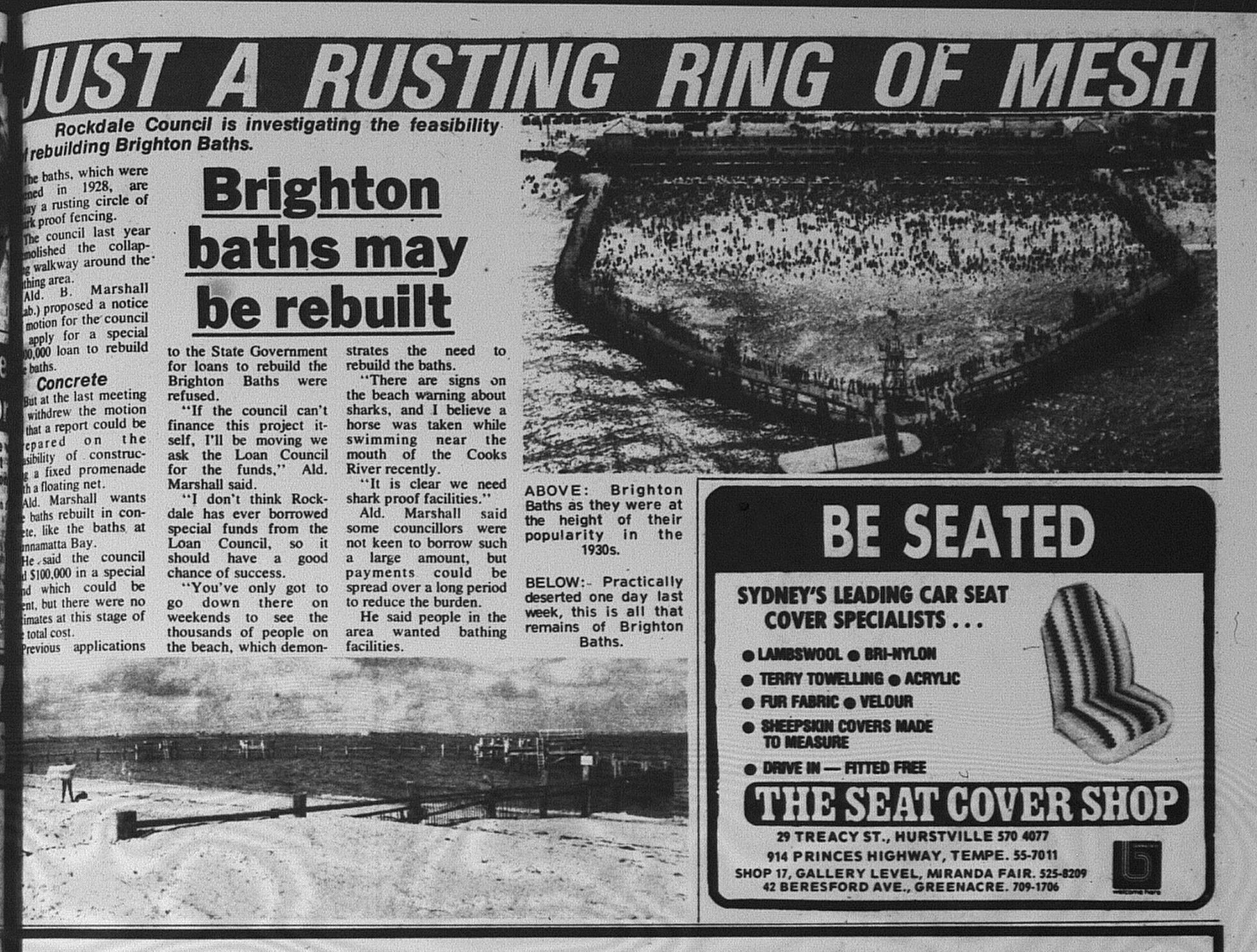
A report in 1978, identified major structural concerns and it was recommended that the baths be demolished immediately. The following year, demolition took place.


Source: Anon. 1979. "Just a Rusting Ring of Mesh: Brighton baths may be rebuilt". The St George and Sutherland Shire Leader, February 14: 19. 

In mid 1980, the tender to construct the new floating net and pier was awarded by Rockdale Council. By the end of 1980, the new baths were completed at an estimated cost of $160 000. It was in fact bigger than the one that it had replaced. In the 2000's the council demolished the pier.


Monday, 4 September 2017

1967: When Collaroy's unit blocks faced collapse


Above: The Sydney Morning Herald published an aerial shot of the storm swells threatening properties at Collaroy on the front page of the September 7, 1967 edition of the paper.


Source: Anon. 1967. "Beaches Ruined: Battle to save esplanade, homes". The Sun, September 5, 3.

For many of us, we remember the devastation at Collaroy Beach last year when 10 homes faced collapse at Collaroy when the beachfront was eroded heavily during a storm.

Fifty years ago, homes and unit blocks along the beachfront were threatened with collapse when similar conditions affected the beach over several weeks in August and September of 1967

The worst affected dwellings were just south of Ramsay Street. This included the Flightdeck and Shipmates apartment buildings. The foundations were exposed leading to the risk of collapse.
One nearby home nearly fell into the sea. Fifty years and many storms later, its still standing.


Source: Anon. 1967. "Fight to Save Homes". The Daily Mirror, September 6, 5.

The battle against nature was won


Source: Anon. 1967. "The Beach Battle Won: Rock Wall Holds". The Sun, September 7, 2.

People were being warned back then about the loss of beachfront properties which could have occurred within a lifetime e.g. fifty years. The beachfront homes are still standing today. However, with natural processes, the Collaroy area will eventually succumb to the sea. 


Source: Harrison, T. 1967. "Professor says... All this Will Go! But don't panic, it may take centuries". The Sun, September 7, 4. 

The properties in the affected area in 1967 eventually saw a rock seawall placed in front of their dwellings. This has prevented further erosion and any loss of property. However, it stopped at Ramsay Street. The worst affected properties in last years super storm were located to the immediate north of the street.

Is it worth spending a fortune on beachfront property? Some are prepared to fork out the money, but they do so knowing that the next storm could see their home washed out to sea.

Fortuantely, we have learnt in Sydney and NSW that building right on the foredune of a beach is not good in protecting a beach, but also the damage it can cause to buildings in the event of erosion. Highrise buildings are no longer permitted in beachfront areas that are vulnerable to beach erosion along with restrictions in housing development?

But what about homes built before the laws? One can still build, but bear the risks that the next major storm can bring.


Monday, 5 September 2016

1974: The battle to save beachfront homes at Bilgola Beach

I was motivated to do this entry after what occurred back along the beachfront at Collaroy in June. Ten homes fronting the beach were threatened with collapse after heavy swells caused by an East Coast Low eroded the beachfront.

The East Coast Low of May 25-26 1974 (known as the Sygna Storm) is regarded as the most ferocious storm to ever strike Sydney.  The city was pounded by heavy rain, strong winds (up to165km/h) and record swells of nine metres along the city's coastline. the worst damage was reported on the city's beaches, which were heavily eroded. The following fortnight saw another two East Coast Lows hit the city, which only worsened erosion.

The worst hit area was at Bilgola Beach, where homes in June 1974 were threatened with collapse which was quite similar to what happened at Collaroy this year. Below is the front page of the  June 5, 1974, edition of The Manly Daily.


A seawall was built (presently under the dunes) to protect the homes. Fortunately, they were saved as this front page clipping from The Manly Daily of June 12, 1974, shows below.


 An almost intact pool fell into the sea, just like at Collaroy earlier this year.


It is inevitable that the homes on the beachfront will be threatened again in the future as natural processes reshape the beachfront and retreat inland. There is no date for when it will happen, but luckily locals have not had to deal with the threat of losing their beachfront homes since that storm.


Monday, 8 June 2015

1989: Sydney's filthy beaches

I was five years old in 1989, but too young to understand the talk about Sydney's dirty beaches at the time. Older readers might remember the weekly beach reports telling you if it was clean to swim or not. I have a number of clippings that talk about the issue.

During 1989, beach pollution had become a major issue with swimmers complaining of various infections that resulted from swimming in the water.


Source: Mealey, E & Craig, O. 1989. "Beachside doctors tell of surf victims". The Sun Herald, March 12: 6-7.

Surfers were also prepared to boycott events at Sydney beaches and even lifesavers were unwilling to rescue swimmers.


Source: Feneley, R. 1989. "Surfies boycott Sydney's oceans of filth". The Daily Telegraph, January 7, page unknown. 

At the time the deep water ocean outfalls were under construction at the Sewage treatment plants at North Head, Bondi & Malabar. Instead of sewage being directly discharged into the sea from the cliff tops, the sewage would be pumped through pipes that extended to four kilometres off the coast. The sewage would be diluted and dispersed further out to sea.

These works had been commissioned by the Water Board in 1984 in response to the rising occurrence of pollution at Sydney beaches. The clifftop pipes meant that the effluent easily washed onto city beaches, making it unsafe for swimming. Currents sent it drifting up and down the coast resulting in pollution at other beaches.

Below is an advertisement educating the public on the ocean outfalls.


Source.: Water Board. 1989. "We are committed to ending pollution of Sydney's beaches (Advertisement)". The Daily Telegraph, January 16, 12. 

A Waterboard Study during that year found that only one beach was safe for swimming. It was Elouera at Cronulla. South Curl Curl Beach was the most polluted.


Source: Olsen, S. 1989. "Pollution report lists just one clean beach". The Daily Telegraph, November 24, 3.

The outfalls at Malabar was completed in September 1990, North Head in December 1990 and Bondi in September 1991.

Since then, water quality at Sydney beaches has improved dramatically as the sewage is less likely to be swept onto the beaches.

It was interesting this past week to have a look at the Beachwatch reports online and noting that the coastal beaches were generally safe for swimming with the exception of Boat Harbour due to the possibility of contamination.

However though when it rains, you are generally advised to avoid swimming for a day at coastal beaches (two days elsewhere) due to stormwater run-off.

I have other clippings, and hopefully in the future can comment further and add to what is here.

Monday, 12 January 2015

1986: Shark Attack warning in Botany Bay

The St George and Sutherland Shire Leader decided to dedicate a front page during the summer of 1986 to warn people of the dangers of swimming in Botany Bay. As a youngster of the (late) 1980s, I recall those simple signs reminding people of the possible dangers. Rockdale Mayor, Ron Rathbone believed that calm waters, plenty of food (fish) along with the dredging of the bay for the development of Port Botany and Sydney Airport had increased the risk of shark attack.

At the beach, were normally told to swim between the flags. Rockdale Council wanted swimmers swimming in between the nets (netted bathing pools) as a means of keeping people safe in the water.

   
Source: Poulus, J. 1986. "Swimmers risk death: Mayors' warning on shark attack threat." The St George and Sutherland Shire Leader, January 16: 1. 

Even in the 1970s, the council was concerned. It even produced signage to alert swimmers in four languages (English, Italian, German and Macedonian). The calmer waters have always been popular with those from immigrant backgrounds, even to this day. In 1986, Rockdale Council believed that 80 % of swimmers at Lady Robinsons Beach were of immigrant background. 


Source: Anonymous. 1972. "Shark Warning In Four Languages." The St George and Sutherland Shire Leader, September 20:11.

For the record, the last fatal shark attack in the Georges River/Botany Bay catchment was in 1946 at Oatley Bay in Oatley when Valma Tegel (14) died after having her left leg ripped off by a shark in water's just one metre deep. The last shark attack in the bay itself was in February 1940 when John William Eke sustained injuries to his arms at North Brighton (Kyeemagh). There have been no fatal deaths from a shark attack in the bay itself.

The risk of shark attack is still there but doesn't seem to be as of much concern as now. These days you are more likely to drown in Botany Bay due to the structure of the beach itself. A five-year boy drowned at Dolls Point in late 2013. The water depth increased sharply not too far offshore and people may not be able to see it. Currents in the bay have also played their part as well.

Updated November 2018 - Clearer image added.