Showing posts with label "red rattlers" (train). Show all posts

Monday, 2 October 2023

1992: Cityrail's controversial timetable

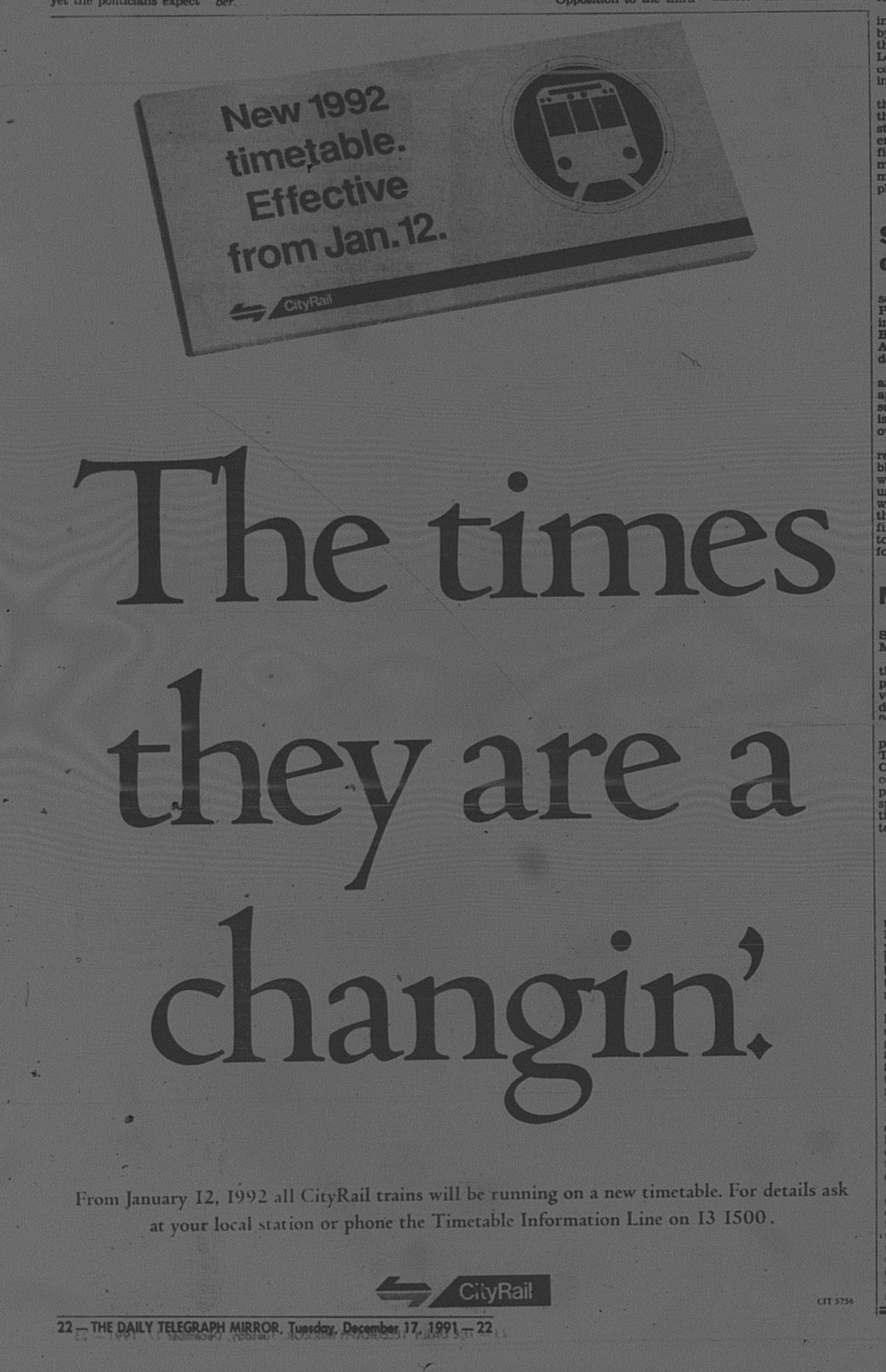
Cityrail 1992 Timetable Ad December 17 1991 daily telegraph 22

Source: Cityrail. 1991. "The times they are a changin'." (Advertisement). The Daily Telegraph Mirror, December 17: 22. 

Rail Timetable January 12 1992 Daily Telegraph 16 

Source: Nance, J. 1992. "Rail commuters rattled". The Sunday Telegraph, January 12: 16.

Any change to public transport timetables in Sydney will always incur at least some criticism or controversy. It may affect one line or route or the entire network.

Given that trains are our more patronised mode of public transport in Sydney, any changes to timetables will impact more commuters than buses and ferries, and hence receive more attention. Changes to train timetables often flow onto bus timetables where bus routes connect with rail services.

You may remember the changes from a particular year, because they may have impacted you directly.

In 1992, I was seven years of age and being a child did not have to rely on trains to get around, but Cityrail made changes to its timetables, which at the time were controversial. This entry provides an overview of why.

Why a new timetable?

In 1991, the NSW Government decided to retire the red rattler trains due to safety concerns associated with open doors in their carriages, which was to be completed in 1993. Most of the remaining carriages were retired in January 1992 and were to be confined to the Bankstown and Inner West lines until their final withdrawal the following year. 

Meanwhile, Tangara carriages (known as T set) were still being rolled out across the network following their introduction in 1988 and continued to be rolled out to suburban lines until 1994, with the outer suburban G set version rolled out in 1994 and 1995.

Also, Cityrail sought to increase services to outer suburban stations. 

What were the changes?

  • Reduced off-peak services
  • Longer wait times for connections with other lines
  • An additional 2500 seats were made available for commuters during peak hours.
  • Reductions in peak-hour services on the Bankstown, North Shore and Western Lines
  • Additional services from Campbelltown to the Sydney CBD.
  • Reductions in services on the Illawarra Line.
Why the controversy?

As mentioned, services were reduced, longer connection times and reduced services on lines impacted workers, especially those who travelled in shoulder or off-peak periods.

For the majority of commuters, they were inconvenienced, whether it meant having to change trains, longer dwell (waiting times) or having to alter their travel times. Delays and cancellations also added to the difficulties experienced.

Despite an additional 2500 seats added to existing peak-hour trains, reduced service frequencies meant that trains were more crowded. Below are clippings from a special feature that was published in The Sydney Morning Herald on February 7, 1992 (page 4).

New Train timetable February 7 1992 SMH 4

Transport advocacy group Action for Public Transport called for the restructuring of some lines to improve efficiency and hence capacity, such as the Bankstown Line and better turnarounds at Berowra.

Cityrail timetable changes January 22 1992 daily telegraph 20

Source: Anon. "Train service 'a mess'". The Daily Telegraph Mirror, January 22: 20.  

The State Government was forced to act, altering timetables. The first round of changes was "small".  Cityrail claimed to have received 26,000 calls, with many supporting the new timetable, especially the replacement of red rattler trains with modern carriages. Shadow Transport Minister Brian Langton (ALP, Kogarah) called for the timetable to be axed while the ALP had received thousands of complaints via a special hotline that they set up. Mr Langton himself was a rail commuter and saw firsthand for himself the impact it was having on his travels and those of his fellow constituents. 

Cityrail Timetable Review February 8 1992 daily telegraph 11

Source: Jones, S. 1992. "New review of Cityrail timetables". The Daily Telegraph Mirror, February 8:11. 

Later that month, a further 100 changes to the timetable were to be implemented over the following months. Some services would receive extra carriages, while some services would be altered to either have more stops or fewer stops.
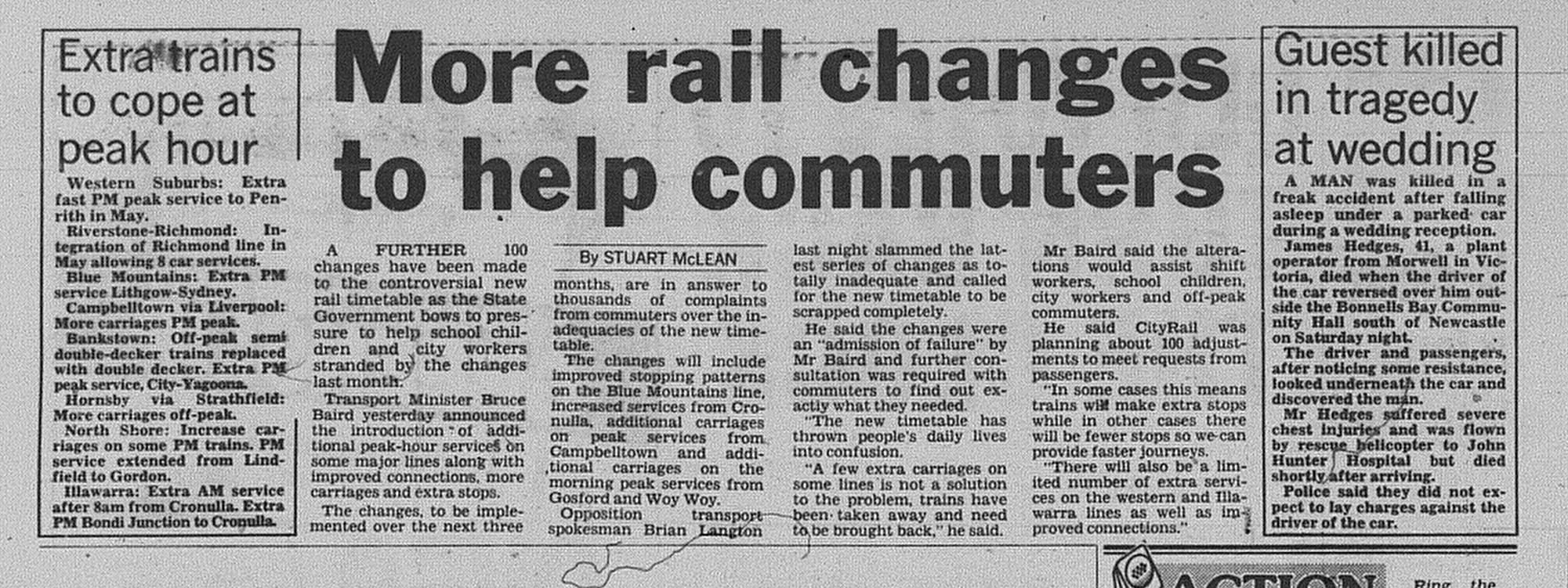
  Rail timetable changes February 24 1992 daily telegraph 18 

Source: McLean, S. "More tail changes to help commuters". The Daily Telegraph Mirror, February 24: 18. 

Additional Reading

Action for Transport (N.S.W.). 1992.  "New Cityrail timetable," Action for Public Transport (N.S.W.) Media Release Newsletter, no 1 (February 1992), https://www.aptnsw.org.au/newsletters/19921.html  

Monday, 28 February 2022

1993: The end of the red rattlers

Between 1926 and 1993,  Sydney's rail network was served by single deck trains known as the "red rattlers" because of their red appearance and for the rattling windows.

At their peak there were apporoximately 1100 carriages in service and had dwindled to around 360 by 1988.

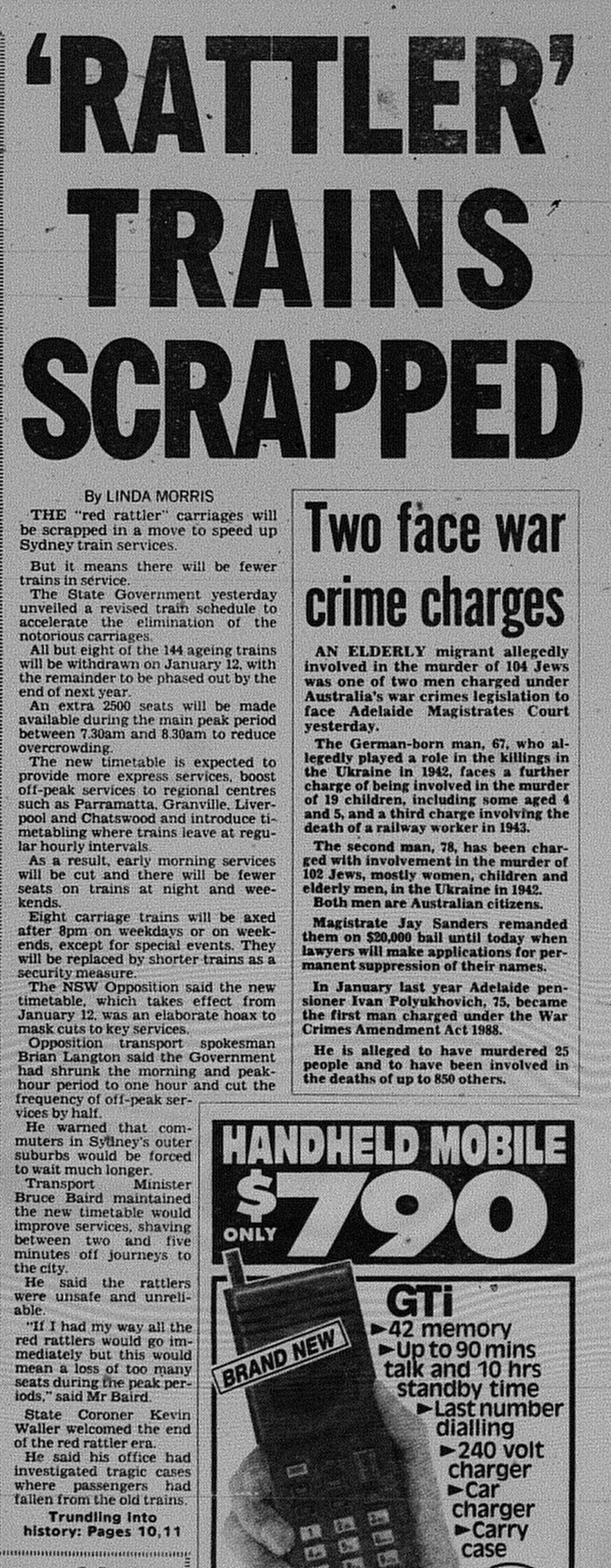
In 1991, the decision was made to formally retire the trains by the end of 1993 due to safety concerns associated with the open doors, along with the introduction of a new timetable from January 12 1992 that was designed to speed up trains across the network. Only eight red rattler trains would be retained with the intent of phasing them out of service within a further year.

Rattler Trains to be removed September 6 1991 daily telegraph 3 
Source: Morris, L. 1991. "'Rattler' Trains Scrapped. The Daily Telegraph Mirror, September 6: 3.

 End of Red Rattlers September 6 1991 daily telegraph 10-11
Source: Skelsey, M. 1991. "Red rattlers trundle off into history:. The Daily Telegraph Mirror, September 6: 10-11

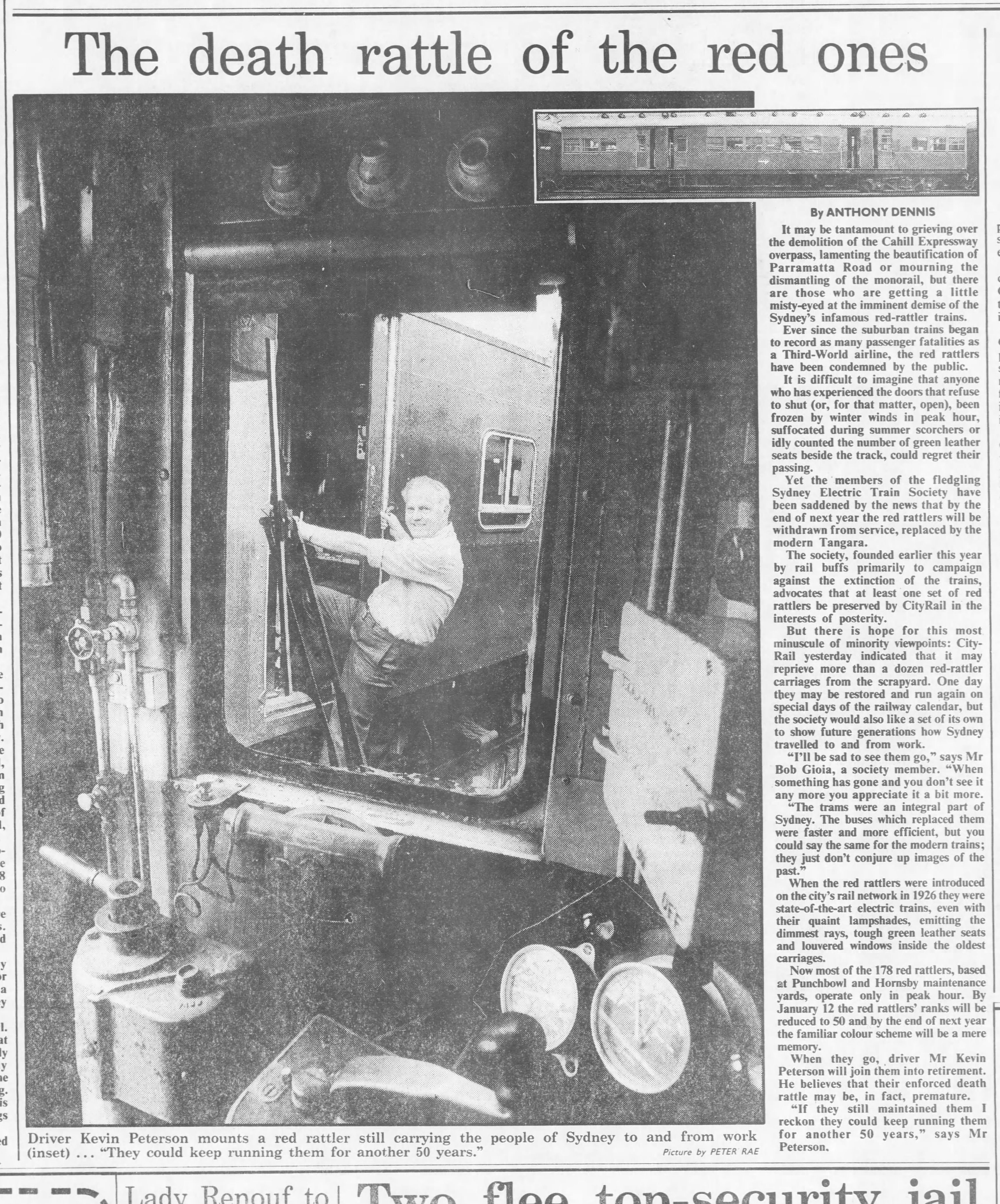
The Sydney Electric Train Society did not receive the news well, especially as they were destined to be scrapped.

  Red Rattlers November 5 1991 SMH 3 

Source: Dennis, A. 1991. "The death rattle of the red ones". The Sydney Morning Herald, November 5: 3.

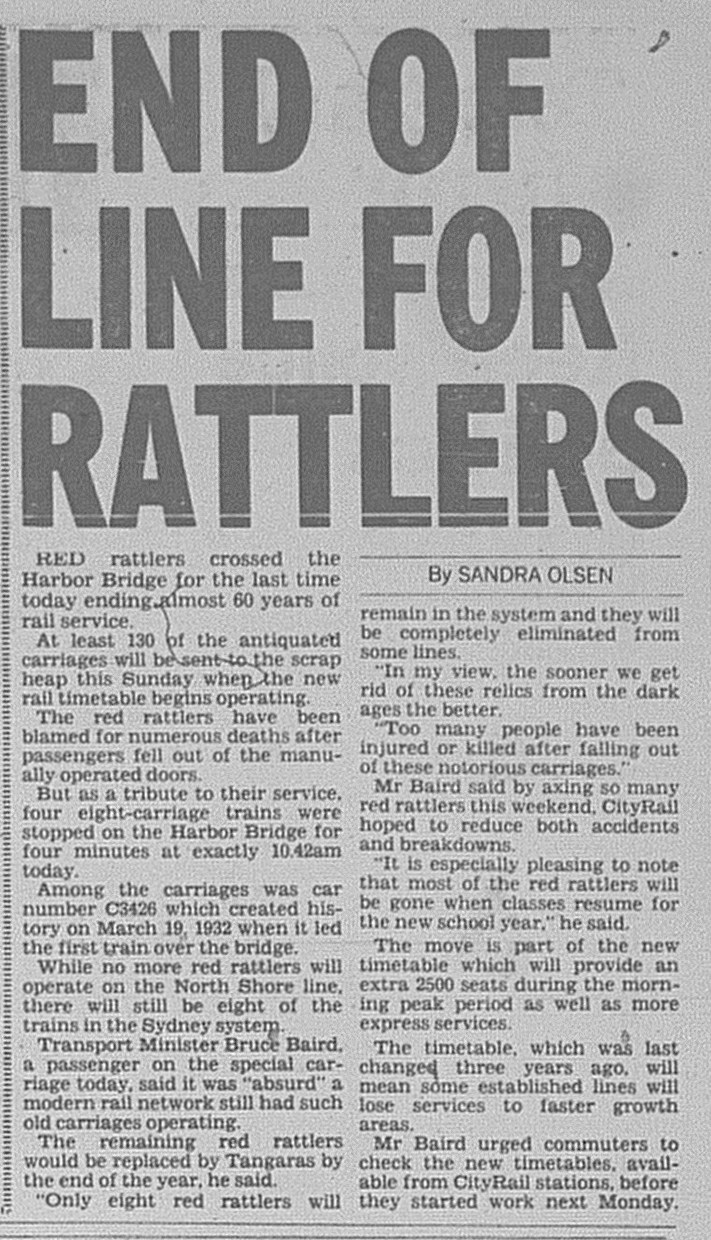
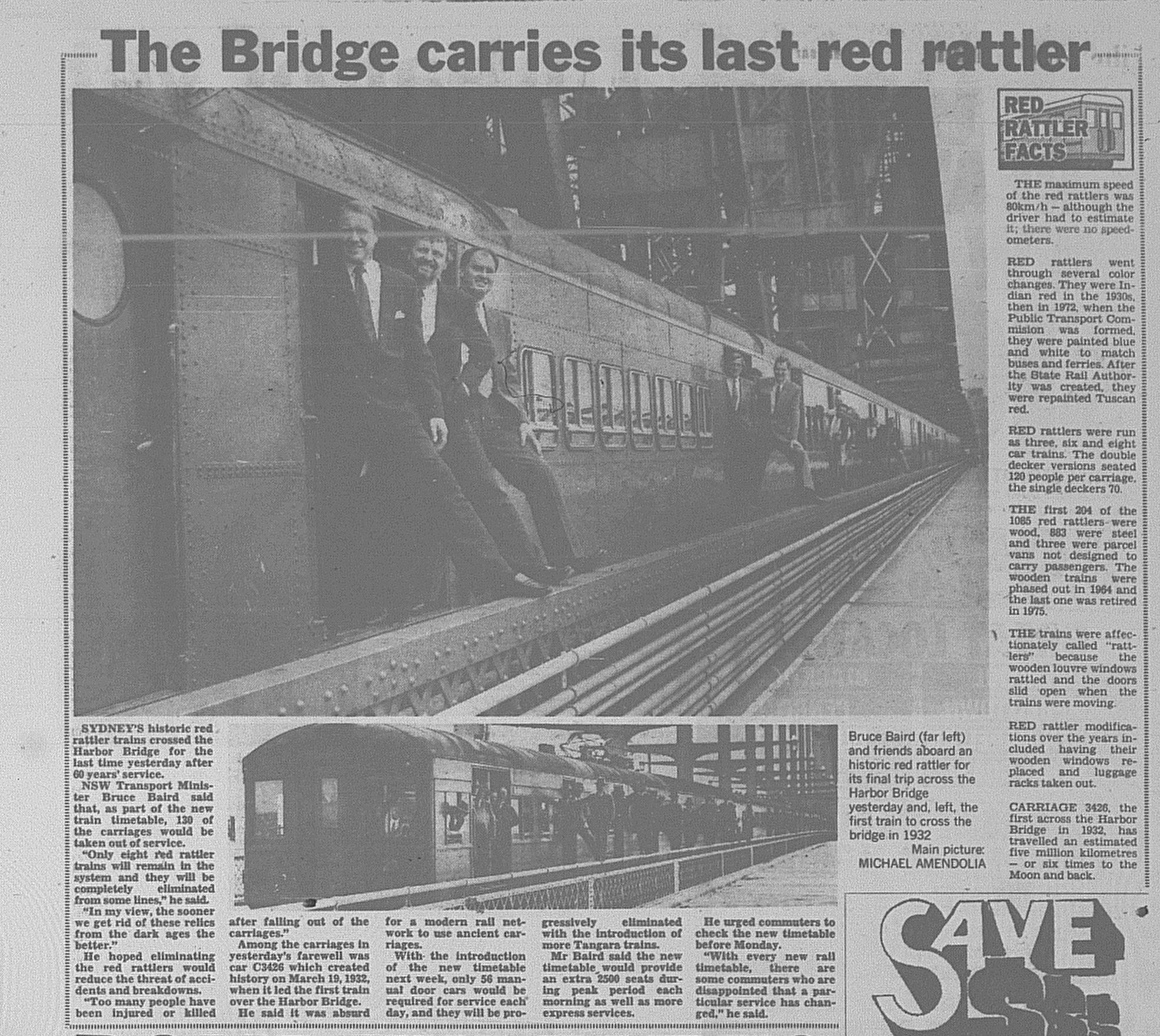
On January 10, 1992 red rattler trains crossed the Sydney Harbour Bridge for the final time ahead of their retirement. For four minutes at 10:40, four eight car trains stopped on the Sydney Harbour Bridge to pay tribute to their service. 

Red Rattlers stop crossing harbour bridge January 10 1992 Daily Telegraph 9 

Source: Olsen, S. 1992. "End of line for rattlers". The Daily Telegraph Mirror, January 10: 9. 

 Final Bridge crossing for red rattlers January 11 1992 daily telegraph 3 

Source: Anon. 1992. "The Bridge carries its last red rattler". The Daily Telegraph Mirror, January 11:3. 

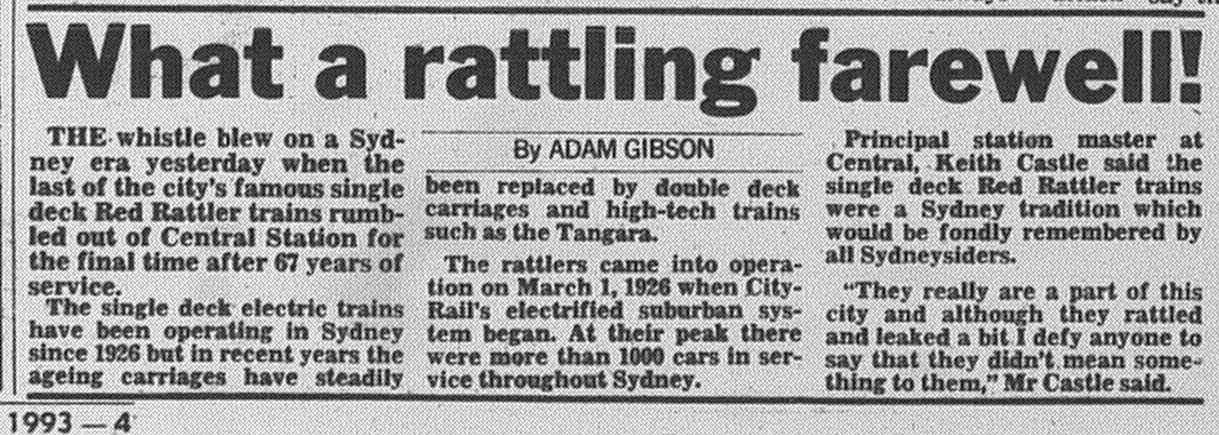
The retirement of the red rattlers led to a decrease in the number of carriages operating on the Sydney rail network, but the delivery of Tangara carriages meant by the end of 1993, the remaining eight trains in operation could be retired. The final services ran on November 20, 1993 after sixty seven years of service. 

  The Final Red Rattler Service november 21 1993 sunday telegraph 4

Source. Gibson, A. 1993. "What a rattling farewell!" The Sunday Telegraph, November 21: 4. 

While the overwhelming majority of red rattlers were scrapped, several carriages have been preserved for historical use which has also been supported by Sydney Trains and the NSW Government. Special trips featuring the trains are organised, allowing people to either relive or experience riding a red rattler for the first time. 

Finally a "bonus" - news reports from January 10 1992 when the red rattlers gathered on the Sydney Harbour for the final time.

ABC News


Seven Nightly News

National Nine News

Ten Eyewitness News