Showing posts with label CityRail. Show all posts

Monday, 16 December 2024

1990: Train Skipping

In 2024, one may find that a timetable service may not stop at your station or you are on the train and then find out that the service will not stop at your destination.

Sometimes on the T4 line, a South Coast Line service that is meant to terminate at either Martin Place or Bondi Junction ends up terminating at the interurban platforms at Central forcing "all out, all change".

Usually, this happens when a train is delayed. It is done to assist in maintaining on-time running or to aid in getting the broader timetable on time following a major delay, e.g., signal failure.

In 1990, The Sunday Telegraph interviewed Rob Schwarzer (CityRail Chief) about the situation after NSW Shadow Transport Minister Brian Langton (ALP, Kogarah) had revealed to Parliament the previous week that drivers had been ordered to skip stations. He cited one example where a train from Sutherland bound for the city skipped 14 stations. The driver was directed to run it express to Redfern. Langton himself was a regular rail commuter.

Trains skipping stations November 29 1990 daily telegraph 1 & 4 (1)

Trains skipping stations November 29 1990 daily telegraph 1 & 4 (1) enlarged

Trains skipping stations November 29 1990 daily telegraph 1 & 4 (2) enlarged

Source: Grimshaw, P. 1990. "Trains told to skip stations". The Daily Telegraph Mirror, November 29: 1 & 4.

The interview gave us answers. Schwarzer was asked whether or not train skipping was acceptable. He responded with "it is a standard operating practice" and that is necessary to do so. Either cancel the train and "get it out of the road" or return it to the regular timetable. Another element considered, according to Schwarzer, was whether there was a suitable alternate service after the now-altered service. Another question arose - What if commuters are already on the train and want to get off if stations were to be skipped? He stated it was "very rare" as stopping patterns were not generally changed once the run began. The second part of the interview focused on reforms to CityRail and even one question about a new North Shore line (likely a reference to what is now the Epping-Chatswood line, originally heavy rail, now a section of the M1 metro line). 

Train skipping december 2 1990 sunday telegraph 16-17  
Source: Quinn, S. 1990. "Train Skipping". The Sunday Telegraph, December 2: 16-17.

What is the reality in 2024?

My introduction to this entry would sum up the reality. It does happen, but the concern is whether this will receive the same coverage in the media as in 1990? The state of the rail network was under scrutiny, particularly with job losses, ageing infrastructure, timetabling and overcrowding. Even today, there is scrutiny; though the challenges that face the network are more complex, some of the issues confronting the rail network in 1990 still linger. The question has to be asked - What do commuters value as most important to them when accessing Sydney Trains? 

As a commuter, it is annoying that trains sometimes skip stations, whether I am left stranded on the platform or forced to change trains to complete my journey.

Hopefully, this entry and article will make commuters aware of the situation, whether from the perspective of those operating our network or from a commuter's perspective.


Monday, 1 July 2024

Remember This? : Daytripper Tickets Ad (2004)

In Sydney, daily transport fares for adults are capped at $17.80, and if the $50 weekly cap is reached, travel is free for the remainder of the week.

Before Opal Cards were introduced and the ability to pay fares directly from a debit or credit card, a person had to purchase a Daytripper ticket to access unlimited travel on the day of travel.

However, there were limitations compared with Opal fares—the ticket was not valid on light rail services and services operated by private bus operators.

Daytripper Ad January 16 2004 daily telegraph 27

Source: Sydney Ferries, Sydney Buses & CityRail. 2004. "Daytripper" (Advertisement). The Daily Telegraph, January 16: 27. 

Is the Opal Travel Daily Cap cheaper than a Daytripper ticket in 2004?
According to the RBA Inflation Calculator, a Daytripper ticket purchased in 2004 for $15 equates to a person spending $24.96 today. Therefore, a commuter can have unlimited travel on public transport at a cheaper price in 2024.


Monday, 2 October 2023

1992: Cityrail's controversial timetable

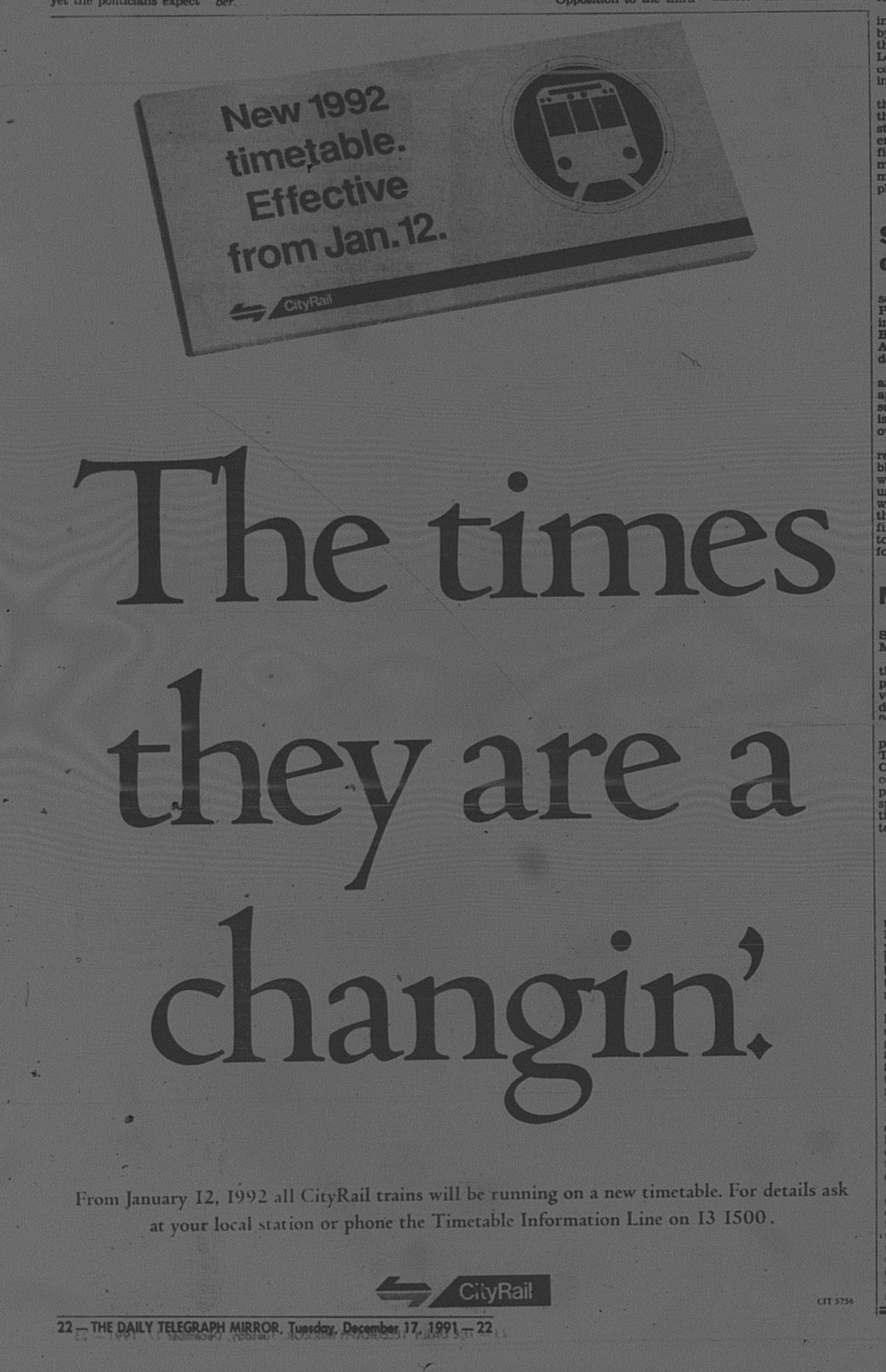
Cityrail 1992 Timetable Ad December 17 1991 daily telegraph 22

Source: Cityrail. 1991. "The times they are a changin'." (Advertisement). The Daily Telegraph Mirror, December 17: 22. 

Rail Timetable January 12 1992 Daily Telegraph 16 

Source: Nance, J. 1992. "Rail commuters rattled". The Sunday Telegraph, January 12: 16.

Any change to public transport timetables in Sydney will always incur at least some criticism or controversy. It may affect one line or route or the entire network.

Given that trains are our more patronised mode of public transport in Sydney, any changes to timetables will impact more commuters than buses and ferries, and hence receive more attention. Changes to train timetables often flow onto bus timetables where bus routes connect with rail services.

You may remember the changes from a particular year, because they may have impacted you directly.

In 1992, I was seven years of age and being a child did not have to rely on trains to get around, but Cityrail made changes to its timetables, which at the time were controversial. This entry provides an overview of why.

Why a new timetable?

In 1991, the NSW Government decided to retire the red rattler trains due to safety concerns associated with open doors in their carriages, which was to be completed in 1993. Most of the remaining carriages were retired in January 1992 and were to be confined to the Bankstown and Inner West lines until their final withdrawal the following year. 

Meanwhile, Tangara carriages (known as T set) were still being rolled out across the network following their introduction in 1988 and continued to be rolled out to suburban lines until 1994, with the outer suburban G set version rolled out in 1994 and 1995.

Also, Cityrail sought to increase services to outer suburban stations. 

What were the changes?

  • Reduced off-peak services
  • Longer wait times for connections with other lines
  • An additional 2500 seats were made available for commuters during peak hours.
  • Reductions in peak-hour services on the Bankstown, North Shore and Western Lines
  • Additional services from Campbelltown to the Sydney CBD.
  • Reductions in services on the Illawarra Line.
Why the controversy?

As mentioned, services were reduced, longer connection times and reduced services on lines impacted workers, especially those who travelled in shoulder or off-peak periods.

For the majority of commuters, they were inconvenienced, whether it meant having to change trains, longer dwell (waiting times) or having to alter their travel times. Delays and cancellations also added to the difficulties experienced.

Despite an additional 2500 seats added to existing peak-hour trains, reduced service frequencies meant that trains were more crowded. Below are clippings from a special feature that was published in The Sydney Morning Herald on February 7, 1992 (page 4).

New Train timetable February 7 1992 SMH 4

Transport advocacy group Action for Public Transport called for the restructuring of some lines to improve efficiency and hence capacity, such as the Bankstown Line and better turnarounds at Berowra.

Cityrail timetable changes January 22 1992 daily telegraph 20

Source: Anon. "Train service 'a mess'". The Daily Telegraph Mirror, January 22: 20.  

The State Government was forced to act, altering timetables. The first round of changes was "small".  Cityrail claimed to have received 26,000 calls, with many supporting the new timetable, especially the replacement of red rattler trains with modern carriages. Shadow Transport Minister Brian Langton (ALP, Kogarah) called for the timetable to be axed while the ALP had received thousands of complaints via a special hotline that they set up. Mr Langton himself was a rail commuter and saw firsthand for himself the impact it was having on his travels and those of his fellow constituents. 

Cityrail Timetable Review February 8 1992 daily telegraph 11

Source: Jones, S. 1992. "New review of Cityrail timetables". The Daily Telegraph Mirror, February 8:11. 

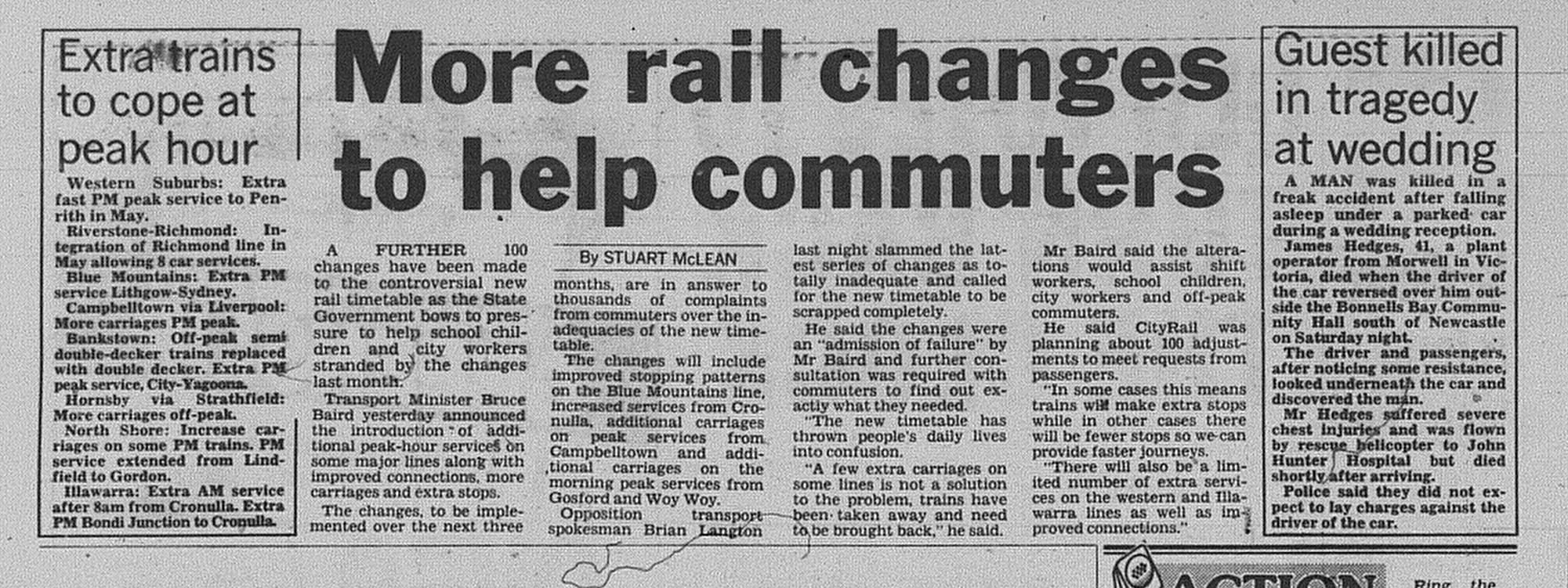
Later that month, a further 100 changes to the timetable were to be implemented over the following months. Some services would receive extra carriages, while some services would be altered to either have more stops or fewer stops.

  Rail timetable changes February 24 1992 daily telegraph 18 

Source: McLean, S. "More tail changes to help commuters". The Daily Telegraph Mirror, February 24: 18. 

Additional Reading

Action for Transport (N.S.W.). 1992.  "New Cityrail timetable," Action for Public Transport (N.S.W.) Media Release Newsletter, no 1 (February 1992), https://www.aptnsw.org.au/newsletters/19921.html  

Monday, 28 February 2022

1993: The end of the red rattlers

Between 1926 and 1993,  Sydney's rail network was served by single deck trains known as the "red rattlers" because of their red appearance and for the rattling windows.

At their peak there were apporoximately 1100 carriages in service and had dwindled to around 360 by 1988.

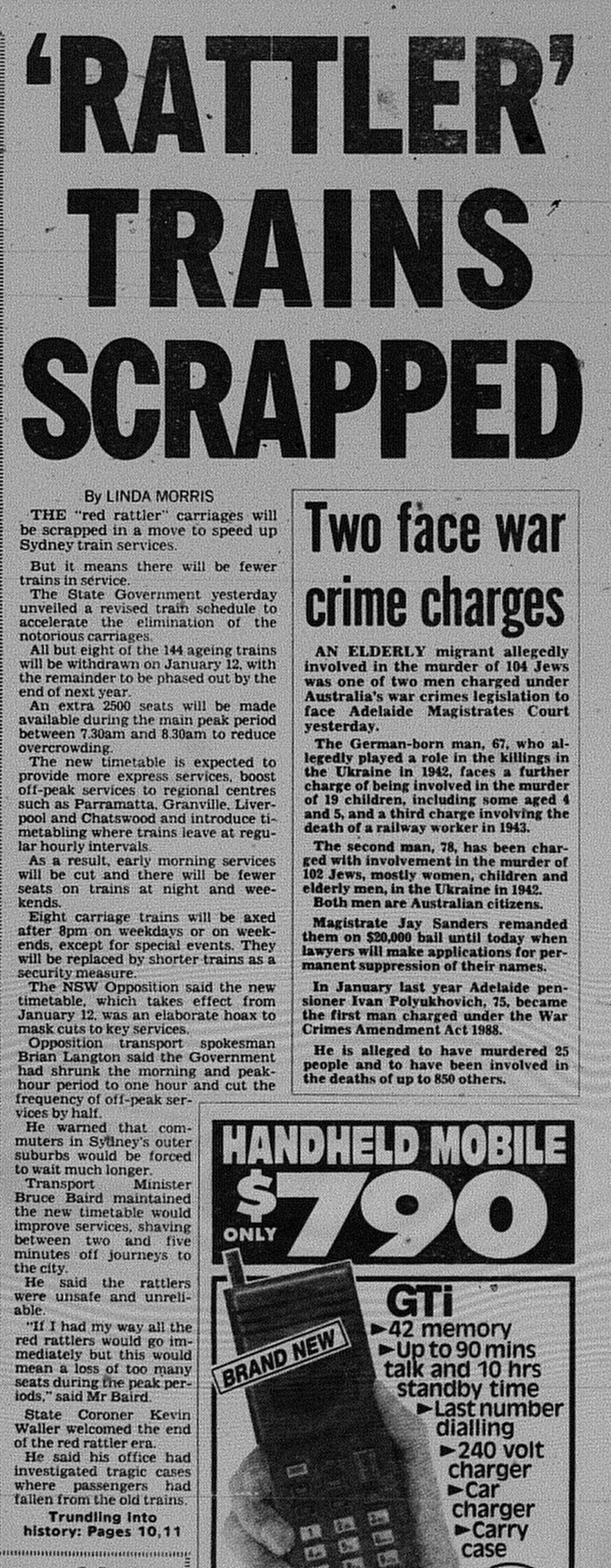
In 1991, the decision was made to formally retire the trains by the end of 1993 due to safety concerns associated with the open doors, along with the introduction of a new timetable from January 12 1992 that was designed to speed up trains across the network. Only eight red rattler trains would be retained with the intent of phasing them out of service within a further year.

Rattler Trains to be removed September 6 1991 daily telegraph 3 
Source: Morris, L. 1991. "'Rattler' Trains Scrapped. The Daily Telegraph Mirror, September 6: 3.

 End of Red Rattlers September 6 1991 daily telegraph 10-11
Source: Skelsey, M. 1991. "Red rattlers trundle off into history:. The Daily Telegraph Mirror, September 6: 10-11

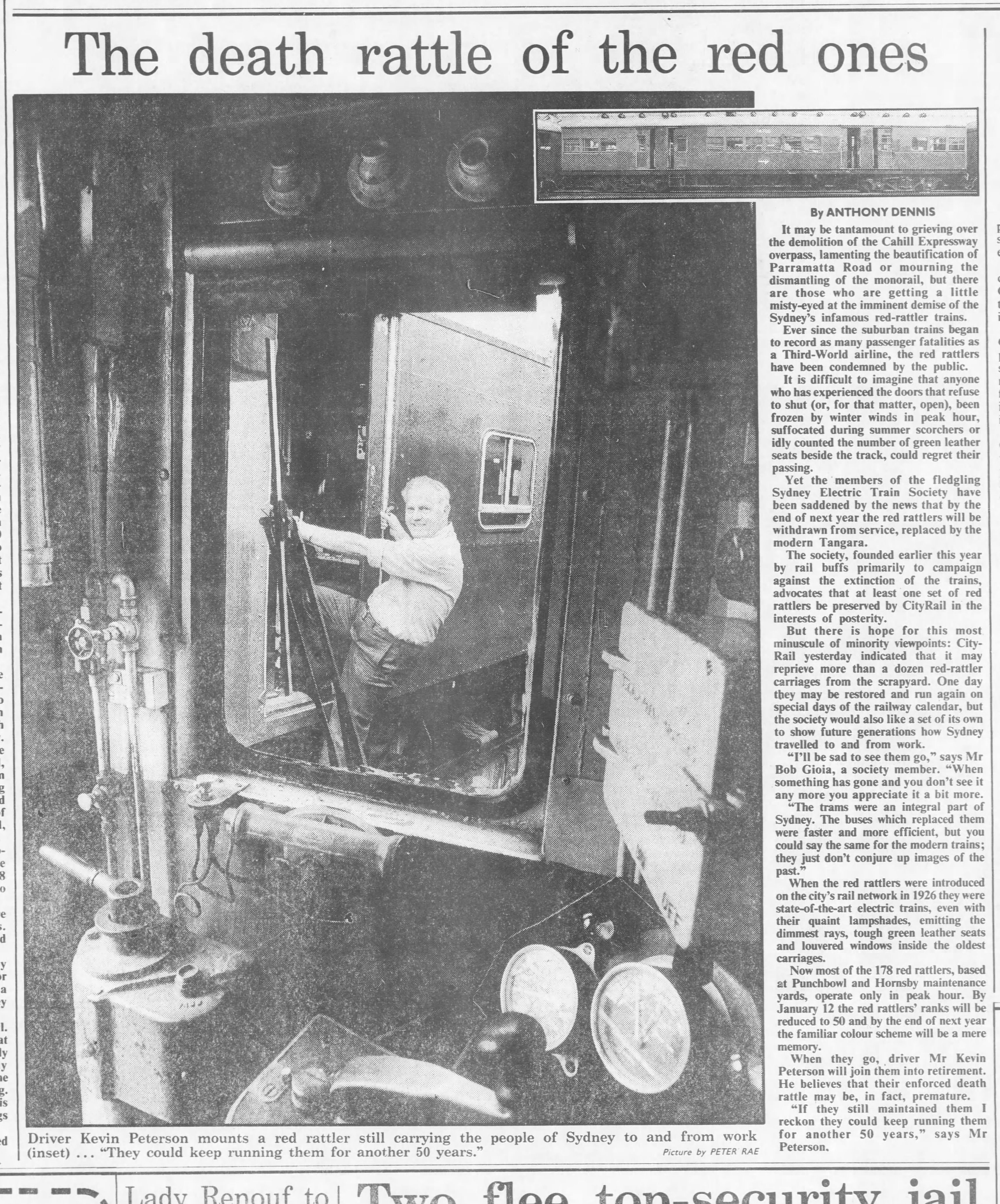
The Sydney Electric Train Society did not receive the news well, especially as they were destined to be scrapped.

  Red Rattlers November 5 1991 SMH 3 

Source: Dennis, A. 1991. "The death rattle of the red ones". The Sydney Morning Herald, November 5: 3.

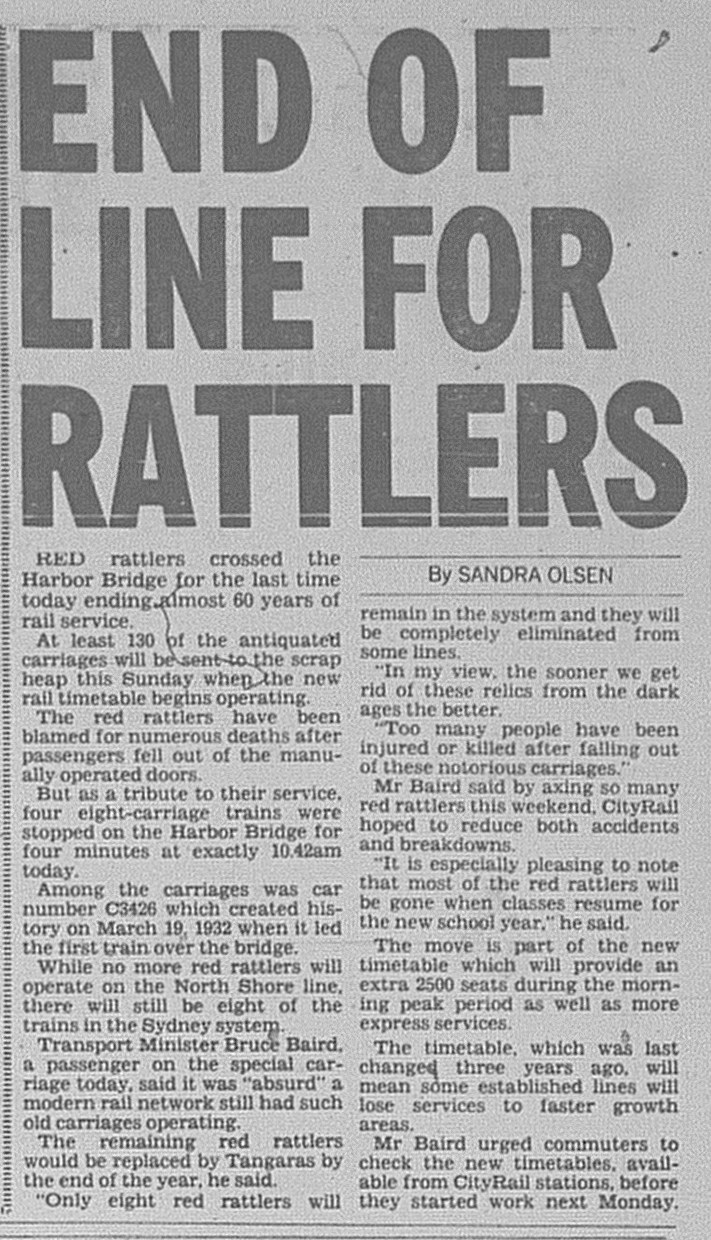
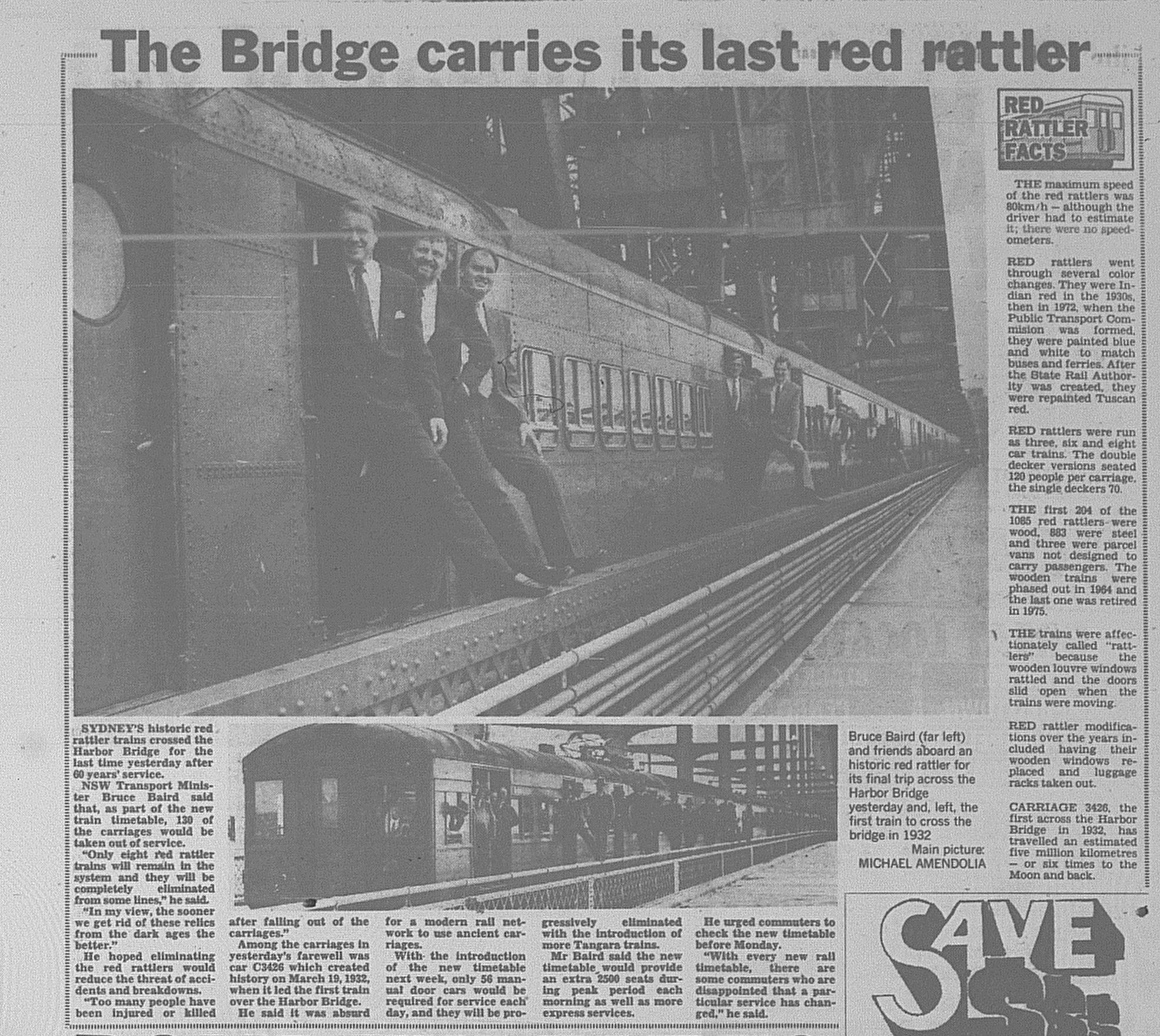
On January 10, 1992 red rattler trains crossed the Sydney Harbour Bridge for the final time ahead of their retirement. For four minutes at 10:40, four eight car trains stopped on the Sydney Harbour Bridge to pay tribute to their service. 

Red Rattlers stop crossing harbour bridge January 10 1992 Daily Telegraph 9 

Source: Olsen, S. 1992. "End of line for rattlers". The Daily Telegraph Mirror, January 10: 9. 

 Final Bridge crossing for red rattlers January 11 1992 daily telegraph 3 

Source: Anon. 1992. "The Bridge carries its last red rattler". The Daily Telegraph Mirror, January 11:3. 

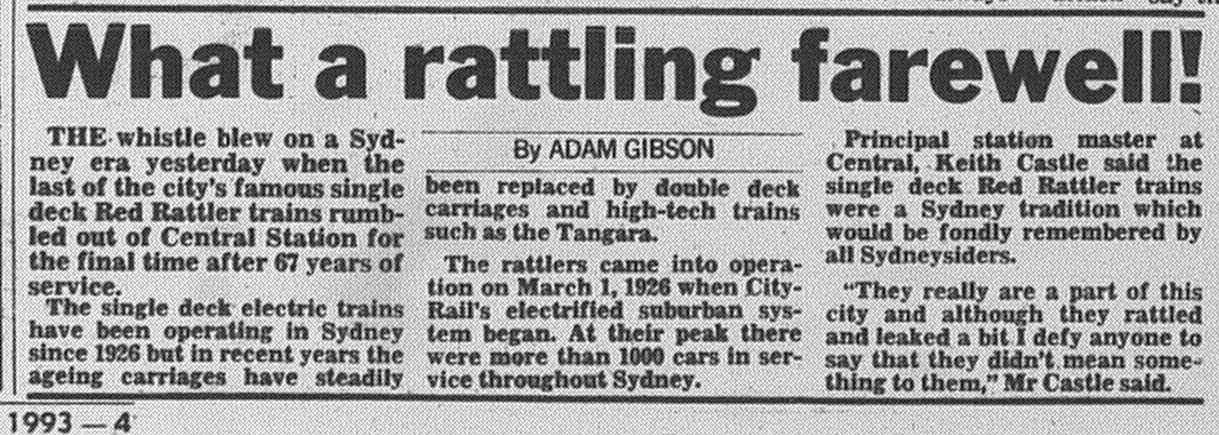
The retirement of the red rattlers led to a decrease in the number of carriages operating on the Sydney rail network, but the delivery of Tangara carriages meant by the end of 1993, the remaining eight trains in operation could be retired. The final services ran on November 20, 1993 after sixty seven years of service. 

  The Final Red Rattler Service november 21 1993 sunday telegraph 4

Source. Gibson, A. 1993. "What a rattling farewell!" The Sunday Telegraph, November 21: 4. 

While the overwhelming majority of red rattlers were scrapped, several carriages have been preserved for historical use which has also been supported by Sydney Trains and the NSW Government. Special trips featuring the trains are organised, allowing people to either relive or experience riding a red rattler for the first time. 

Finally a "bonus" - news reports from January 10 1992 when the red rattlers gathered on the Sydney Harbour for the final time.

ABC News


Seven Nightly News

National Nine News

Ten Eyewitness News


Monday, 4 January 2021

Remember This? CityRail Advertisement (1990)

During January, we take a break from the usual weekly posts and run our Remember This? series.

This week features a 1990 newspaper advertisement by CityRail. In the second half of 1990 petrol prices surged following the invasion of Kuwait by Iraq and the threat of war in the Middle East.

Petrol rose as high as 80.9 cents per litre giving an excuse to ditch the car and take the train. According to the RBA Inflation Calculator, this would equate to $1.62 per litre in todays money.

For CityRail, rising petrol prices provided the perfect opportunity to encourage Sydneysiders to take the train to travel around the city. 


Source: CityRail. 1990. "80.9 Per Litre Or take the train" (Advertisement). The Daily Mirror, October 3: 6. 


Monday, 15 June 2020

NEVER BUILT SYDNEY: Chinatown Railway Station (1990)

In 1990, a developer offered to build a railway station in Haymarket at the corner of George and Campbell Streets as part of a proposed office tower. The site was 720 George Street, which was redeveloped a decade ago into a residential tower.

There were plans to connect the railway station into the redeveloped Capitol Theatre.

However the station would only serve the Eastern Suburbs and Illawarra Railway Lines as the tunnels ran directly underneath the site.

Like the proposed railway station at World Square one block away (1989), it joined the list of "Never Builts".


Source: Morris, L. 1990. "Chinatown station plan". The Daily Telegraph Mirror, November 29: 4. 

The station would have improved accessibility to Paddys Markets, Chinatown and the Sydney Entertainment Centre for visitors and tourists, and have taken pressure off Town Hall Station for Eastern Suburbs and Illawarra line commuters. However, other lines were not to be served by the station. Also, it appears to be located halfway between Central and Town Hall railway stations.

One fault in the proposal is the curve of the station, which would hamper accessibility but also pose safety concerns.

Monday, 4 November 2019

Remember this? Free Rail Travel if you presented your drivers licence (1990)

I will return to my series on the evolution of Westfield Miranda next week. Below is a CityRail (Sydney Trains) advertisement from 1990 that offered free travel on Sydney trains upon presentation of their drivers licence after 9am on February 8, 1990.


Source: CityRail. 1990. "On Thursday After 9am Travel Free Anywhere On This Page Just By Showing Your Drivers Licence. The Daily Telegraph, February 6: 12. 


Monday, 7 October 2019

Remember This? Cityrail periodical tickets Ad (1991)

I am in the process of unearthing some further material on the evolution of Westfield Miranda. This week "Remember This" returns to fill in the gap.

Below is a 1991 advertisement by Cityrail promoting the sale of periodical tickets. The introduction of the Opal Card in recent years and the travel cap (originally $60 per week, now $50) has marked the end of such tickets. Reduced fare journeys are also available to regular commuters on a weekly basis e.g. a person making return trips to and from work five days a week saves 10% along. Opal also $2 discounts for transfers to other modes of public transport in a journey, which was not available with paper tickets for single or return trips.

How about a person who does alot of travel in one day? $15 maximum daily travel cap.

The abolition of periodical tickets did hurt some as they were attracted by the big savings on offer by paying upfront.

Commuters were promised up to 196 free trips if they bought a yearly ticket. The advertisement was published in The Daily Telegraph Mirror on June 3, 1991.


Monday, 10 June 2019

1998: The first plan for a North West Sydney rail line


Enlarged from the following source: Bissett, K. "$5bn transport link to the future".  The Daily Telegraph, November 24: 4.


The Berejiklian Government has delivered the Metro North West Rail Line to the people of Sydney and has quickly been embraced by the people of Sydney and also has given the people of the booming North West its own rail line.

This week, I look back at when the first proposal for a rail line to serve the North West was mooted.

It was in 1998 when Labor was in power, led by Bob "the builder" Carr and Carl Scully was Transport Minister.

In November of that year, Action for Transport 2010 was released, providing a decade long plan for the delivery of transport infrastructure across Sydney covering all modes of transport.

With rail, the ambitious plan included a rail line running from Chatswood to Parramatta (via Epping), another line running from Hurstville to Strathfield, extension of the Eastern Suburbs line to Bondi Beach, a Y link at Casula and upgrades to the intercity lines running between Sydney, Newcastle and Wollongong.

There were also plans for a branch line to run from Epping to Castle Hill with new stations at Castle Hill and West Pennant Hills. Completion was anticipated for 2010. Question to ask - Would trains run via the northern line or would they proceed to Chatswood and then the city (like how the Sydney Metro will evolve into).

That would make the delivery of heavy rail to Castle Hill a decade late under the 1998 plan!!!


Source: Bissett, K. "$5bn transport link to the future".  The Daily Telegraph, November 24: 4.

Monday, 10 December 2018

Remember This? CityRail Fare Evasion advertisement (1991)

Fare evasion on Sydney trains has always been a constant problem. Below is a 1991 advertisement from Cityrail warning commuters if they cannot be bothered buying a ticket, Cityrail will give one out for you (which would be more expensive than the ticket you were meant to buy).

Even with Opal Cards, the message is still relevant in 2018. It is still fairly easy to evade, especially where a station has no ticket barriers. However, it is pleasing to note that ticket inspectors are on the trains more regularly than they were in previous years, which makes evading a fare a little harder.


Source. CityRail. 1991. "If you can't be bothered buying a ticket, we'll give you one" (Advertisement). The Sunday Telegraph, September 13: 131.

Monday, 19 February 2018

MAJOR EVENT: Cityrail Strike (1999)


Above: How The Daily Telegraph reported on the strike in its second afternoon (Final) edition on September 29, 1999.


Sydney dodged a bullet several weeks ago when rail workers decided to pursue industrial action to demand a 6 % pay rise. It didn't occur as the Fair Work Commission ruled that the strike would hinder the ability of essential workers e.g. firefighters and teachers from attending work.

The current offer by the NSW Government is for a 4.6% increase in annual pay, $1000 bonus and free public transport.

Had the strike occurred, it would have been the first since 1999.

Let's look back at what happened, and for younger readers, an idea of what to expect should it collapse or if they simply want to walk off the job. Older readers would remember when strikes were normal during the 1960s, 1970s and 1980s.


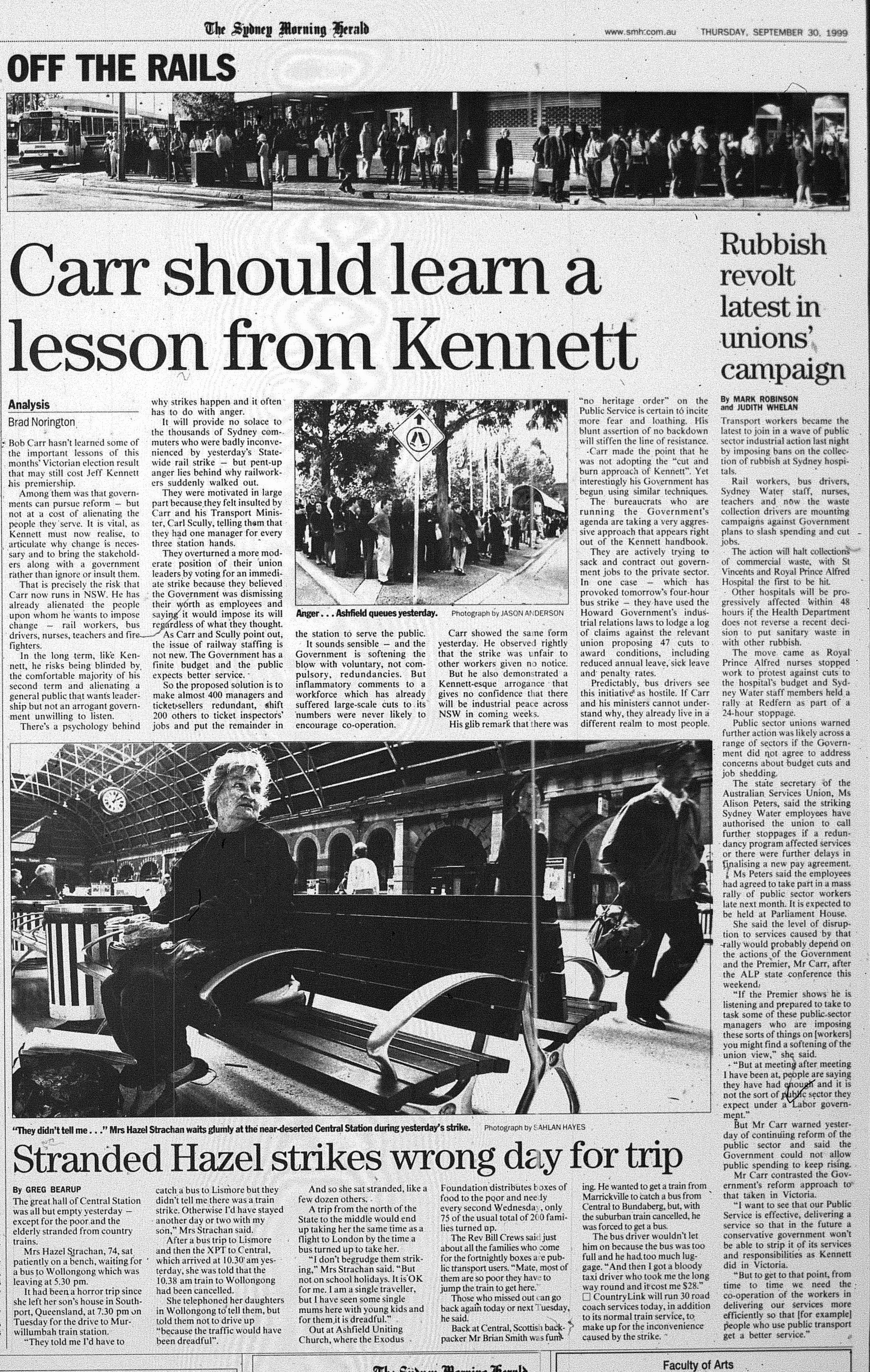
Above: Page 1 of The Sydney Morning Herald on September 30, 1999.


When did it happen

September 29 1999 (Wednesday). This was a wildcat strike that was announced at 5pm, the day before giving people little notice to make alternative arrangements.

Who was in government in 1999?

The Labor party, led by Premier Bob Carr was in government.

Why?

It was in response to plans to cut 300 station staff. There was a partial shutdown on September 24, 1999, which led to reduced or delayed services. Some lines had no services at all. Station staff did not report to work.

What was the impact?


Above: Coverage from the September 30, 1999 edition of The Daily Telegraph.
  • Cost the NSW economy approximately $1.5bn in lost productivity. Media reports for the intended January 2018 strike were $100 million, far below that of 1999. A rail strike today would definitely cost at least $2bn in lost productivity.
  • Retailers and offices were forced to close. Trade in city stores was well below normal.
  • The impact extended to Melbourne, where travelers were left stranded at Spencer Street (Southern Cross) Station.
  • Petrol Prices were reported to have increased.
  • Overcrowding on city buses.
  • Congestion on Sydney roads.

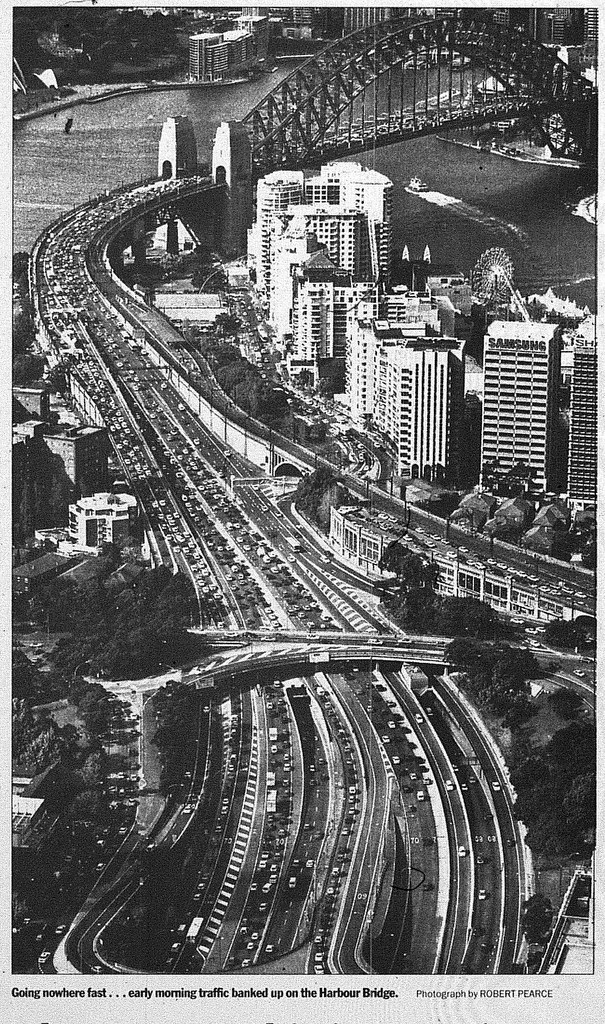

Source: Pearce, R. 1999. "Untitled" (photograph). The Sydney Morning Herald, September 30, 5. 

The Sydney Morning Herald in its editorial of September 30 argued that while the NSW Government needed to justify the job cuts to station staff and supported public concerns over customer service, the strike was "unnecessary" it actually caused harm to the cause. Calling a wildcat strike only generated disruption but also didn't give commuters and businesses time to plan for the strike. How can one muster support if they intend to abruptly withdraw their services? Some will not accept strikes in any form because they feel that they have been punished in order to advance an individuals cause or because it ruins their routine.


Source: Anon. 1999. "Unnecessary rail strike" (editorial). The Sydney Morning Herald, September 30, 14. 

Doesn't punishing the Government through a work ban or fare-free days seem fairer to muster the cause like they have a number of times in recent years. Services continue but the Government loses revenue?


Above: Coverage of the strike from the September 30, 1999 edition of The Sydney Morning Herald (Pages 4 and 5).

Monday, 23 October 2017

1989: The start of Nightride Services

Younger generations like mine (Generation Y) are accustomed to using late night bus services to get home from the city after a night out.

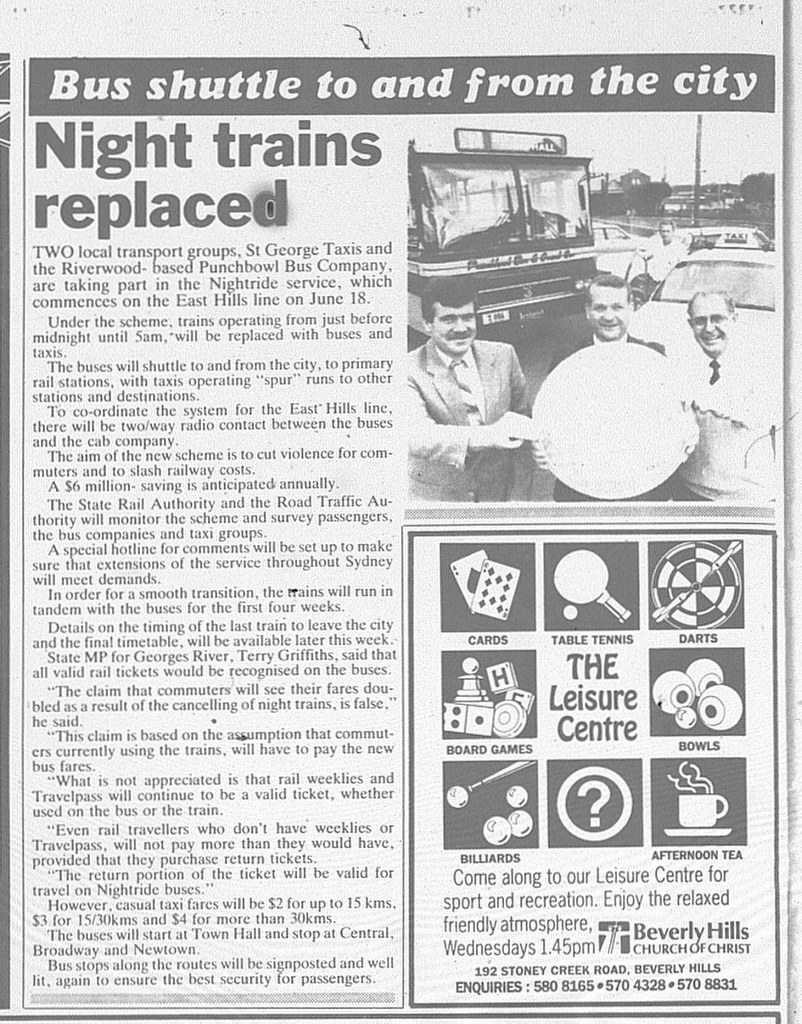
In the 1980s trains services did operate after midnight in Sydney. In 1989, the NSW Government made a controversial decision to replace late night rail services with Nightride Buses. It was in response to concerns over violence on trains at night but also to reduce operating costs.


Source: Nicholson, L. "All stations go for travellers: Buses to run taxi service". The Daily Telegraph, May 26: 5.

It was phased in two stages with a trial implemented on the Illawarra, East Hills and Bankstown Lines during June and July. By July, late night rail services on those lines ceased.


Source: Ministry for Transport (NSW). 1989. "Midnight to Dawn Services: Nightride" (Advertisement). The Daily Telegraph, July 21: 19.

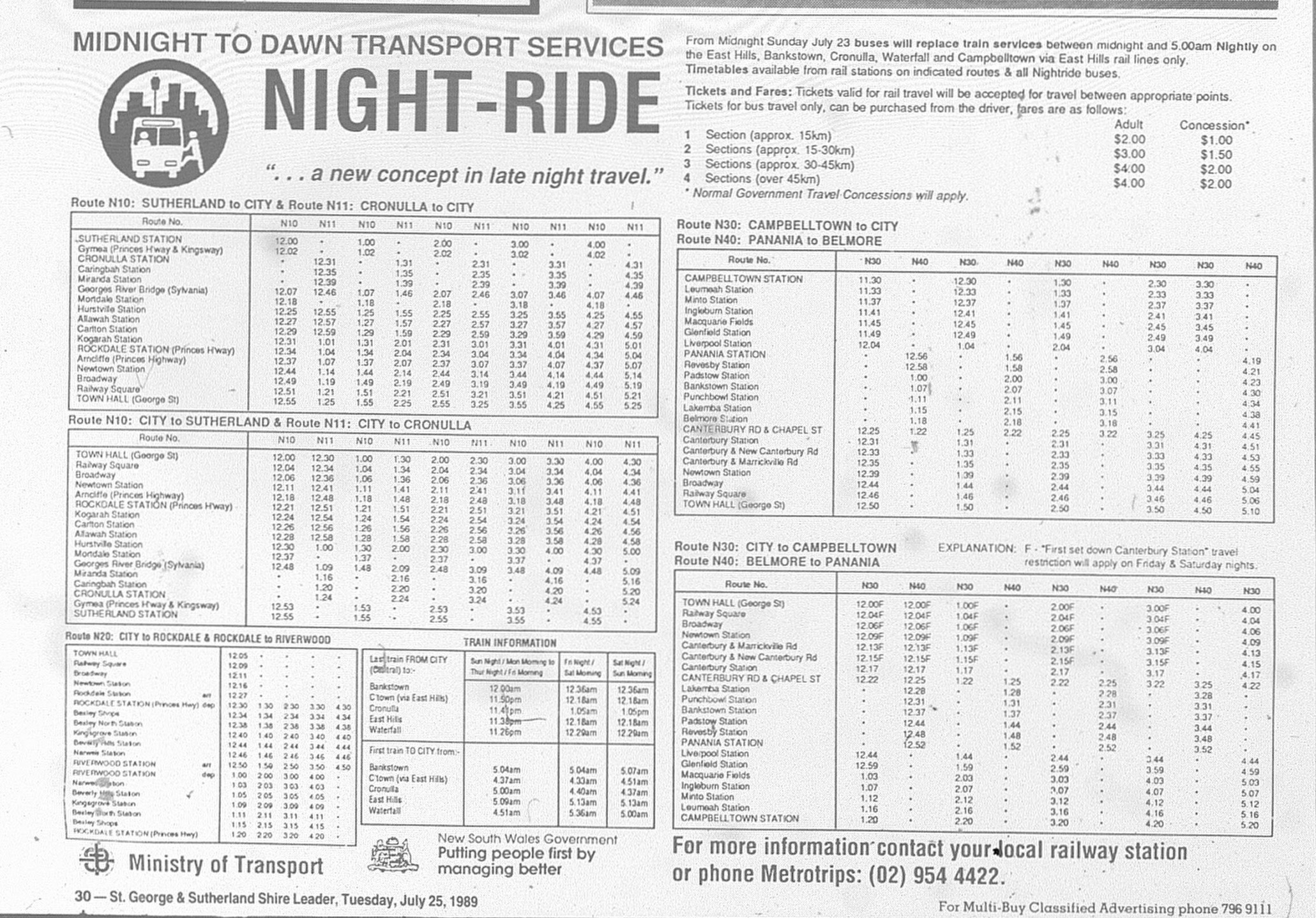
Below is a timetable that was published in The St George and Sutherland Shire Leader.


Source: Ministry for Transport (NSW). 1989. "Midnight to Dawn Transport Services: Night-Ride"(Advertisement). The St George and Sutherland Shire Leader, July 25, 30.


Source: . Anon. 1989. "Night Trains replaced". The St George and Sutherland Shire Leader, June 6: 7.

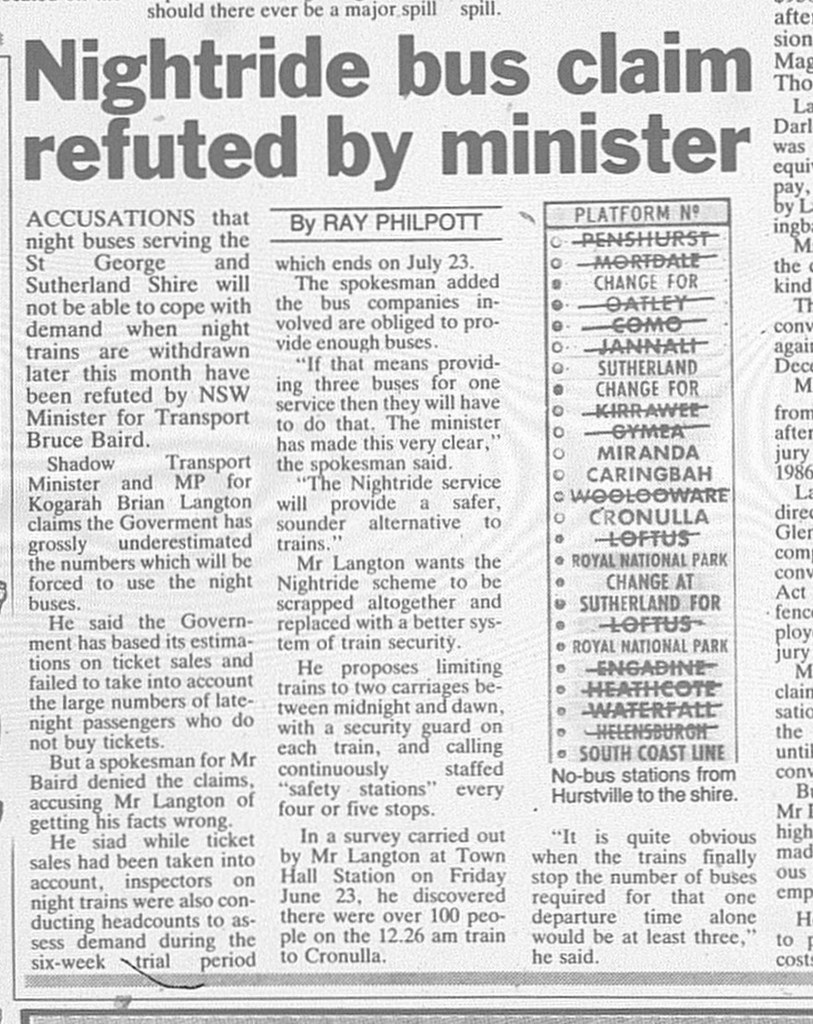
The opposition were not too impressed. Shadow Transport Minister Brian Langton (ALP, Kogarah) raised concerns that buses would not cope with demand


Source: Philpott, P. 1989. "Nightride bus claim refuted by minister". The St George and Sutherland Shire Leader, July 6, 2.

When initially announced, the reaction from late night commuters was not positive citing that buses added extra travel time, safety concerns and would be forced to travel in taxi's for some or all of their journeys. The article above highlighted a weakness in the Nightride System - Many stations missed out on Nighride services altogether. Note that Penshurst, Mortdale and Gymea have since been added to the Nightride Bus Network. 

Those that were happy claimed that they felt safer on buses (research shows that you are less likely to be a victim of crime on a bus than a train). 

By the end of the year, it had been introduced on remaining lines.


Source: Ministry for Transport (NSW). 1989. "Midnight to Dawn Transport Service: Nightride". The Daily Telegraph, October 27: 14.

One advantage of the Nightride Network was the ability for buses to serve suburbs without rail stations including Sylvania and the Parramatta Road corridor. Some suburbs with rail stations ended up having non station stops.

Fast forward three decades later, the Nightride Network has expanded. Services now operate from Town Hall to Richmond (N71) and Carlingford (N61) along with Railway Square to Bondi Junction (N100)

Monday, 22 September 2014

1997: The Millennium Train is born


Source: Bissett, K. 1997. "New train pulls into the future." The Daily Telegraph, November 10: 17. 

In 1997, the push was on to have new trains in time for Sydney Olympics and to begin the replacement of the S-Set Trains. In November that year, Sydneysiders were introduced to what would become the Millennium Trains.

At the time it was one of three options, but what is disappointing about The Daily Telegraph article is that we only really see one option, the option that would ultimately be selected.

Sadly the trains were not ready in time for the Olympics. The delays were compounded by engineering problems during testing. It would be 2002 before the first Millennium trains hit the network. I for one did not get to ride on one until a year later.

A photo I took in June 2003 after riding it for the first time.
Currently, they operate on the T2 and T3 lines serving the Southern, Inner West, Bankstown and East Hills lines. 141 Carriages were built.


Monday, 23 June 2014

SYDNEY TRANSPORT: Eastern Suburbs Railway Line (1979)

Today is the 35th anniversary of the Official Opening of the Eastern Suburbs Railway Line between Central and Bondi Junction. Four new stations joined the CityRail Network: Martin Place Kings Cross, Edgecliff and Bondi Junction. It was the first rail line in Sydney to have all its stations underground. For the first two years of operation, it was a shuttle service between Central and Bondi Junction. It was connected to the Illawarra Line in 1981 and Redfern also got its underground platforms (11 and 12).

On that day in 1979, it was a Saturday and the Premier Neville Wran had the honours of officially declaring the line open.

Below are two advertisements promoting the opening of the line. For the opening weekend, travel was free. After that a single trip cost between 10 and 30 cents.


Source: Public Transport Commission of New South Wales. 1979. "Be our guests, take a free train ride on the new Eastern Suburbs Railway," The Sun, June 21: 27. 


Source: Public Transport Commission of New South Wales. 1979. "Eastern Suburbs Railway Now Open," The Daily Telegraph, June 25, 32. 


The Sydney Morning Herald and The Daily Telegraph reported (above) on June 25 that about 250 000 people took advantage of the opening weekend and free rides. There were long queues at stations and platforms overflowed with people.

Most Sydney newspapers were happy. The Daily Telegraph in its editorial on June 25 praised its completion and its addition to the existing rail network. With the Second Oil Crisis underway, it also highlighted the dependence on the motor car and the need to rely on it when one could not use their car. The Sun was quite similar in its view on June 25. The rail line actually made providing transport to Sydney's east even cheaper to about $1.5 million per year. If the oil crisis continued, the savings could increase. However, The Sydney Morning Herald in its editorial on June 23 was critical, suggesting the Eastern Suburbs did not need it and should have focused on spending on improving public transport in the outer suburbs.

Originally, the line was to extend south from Bondi Junction through to Waverley (Charing Cross), Randwick, the University of NSW and Kingsford. The line was to be built in four stages: Edgecliff (1973), Bondi Junction (1974), Randwick (1976) and Kingsford (1977).


Source: State Political Roundsman. 1967. "$12 million a mile track: Bondi Junction on Rail Route," The Daily Telegraph, March 1: 7.

Rushcutters Bay was originally set to have a station but was axed in 1969. It was deemed unviable due to the construction of the William Street tunnel and "small population". Woollahra was also to get its own railway station but construction stopped in 1976 as part of cost-cutting but locals also objected to having their own station.

The platforms between Edgecliff and Bondi Junction are a reminder of what could have been.


Source: Cohen, S. B. 1994. Untitled. accessed June 17, 2014, http://www.oocities.org/trendy_rechauffe/Woollahra_station_site_3DEC94_tset.JPG 

By completion in 1979, it was five years behind schedule.