Showing posts with label 1992. Show all posts

Saturday, 24 October 2026

Property Advert of the Week: St John's Wood, Gordon (1992)

Below is a 1992 newspaper advertisement promoting "St John's Wood" at Gordon. The development comprised townhouses and apartments. In addition, residents received 24-hour security, and facilities including a swimming pool, tennis courts and a clubhouse.

Australian Housing & Land Ad December 5 1992 SMH 83

Source: Australian Housing & Land. 1992 "St John's Wood" (Advertisement). The Sydney Morning Herald, December 5: 83. 

Saturday, 16 May 2026

Property Advert of the Week: Chelsea Court, Surry Hills (1992)

Below is a 1992 newspaper advertisement for Chelsea Court in Surry Hills. Two bedroom apartments were on offer from $260, 000. 

Chelsea Court Surry Hills Ad December 16 1992 daily telegraph 5

Source: Toga Building Company Pty. Ltd. "Chelsea Court, Surry Hills" (Advertisement). The Daily Telegraph Mirror, December 16: 5. 

Monday, 19 January 2026

Remember This? When The Beach Boys Rocked Narrabeen (1992)

During their 1992 tour of Australia, The Beach Boys did one concert in Sydney. Instead of opting for venues such as the Sydney Entertainment Centre, Sydney Football Stadium and the Sydney Cricket Ground, they performed at North Narrabeen Reserve, North Narrabeen (home to Rat Park and Warringah Rugby Club).

The venue was within walking distance of Narrabeen Beach. Narrabeen is referenced in the Beach Boys’ 1963 hit “Surfin’ U.S.A.” as “Australia’s Narrabeen,” establishing a direct geographic connection between the 1992 concert site and the song’s roll call of surf locations.

20, 000 people attended the concert on Saturday, November 28 1992. Lead singer Brian Wilson did not perform, but John Stamos (Full House) was a guest drummer, as reported by The Sun Herald (November 29 1992), who was a "hit" with the "teenage girls". 

Beach Boys at North Narrabeen November 29 1992 Sun Herald 6

Source: Tubb, R. 1992. "Beach Boys Thrill Fans Again". The Sun Herald, November 29: 6

Monday, 1 December 2025

1992: Vacant Sydney CBD Office Space

City office space for lease March 9 1992 daily telegraph 10-11

Source: McDougall, B. 1992. "Rooms at the top". The Daily Telegraph Mirror, March 9: 10 & 11.

One of the biggest impacts of the 1990-1991 economic recession in Sydney was the increase in vacant space in city office buildings. 

In 1992, the recession had finished but was still making its presence felt. Unemployment in Australia would peak at 11.2 % of the labour force by the end of that year.

Also, building projects that were conceived during the boom years of the Australian economy during the 1980s were still under construction as developers hoped that strong economic times would continue and that businesses would lease space in office buildings in central Sydney and the suburbs. In early 1992, thre were 14 office buildings that were identified by The Daily Telegraph Mirror as under construction including Chifley Tower, Governor Phillip Tower and Governor Macquarie Tower. 

At the time, office vacancy rates in central Sydney ranged around 15%, but Chatswood was recording a vacancy rate of 30%. Around half a million square meters of office space was dormant.

There were some projects that did not go ahead e.g. 2 Park Street, Angel Place, Village Cinema Centre redevelopment. World Square was a major victim. A dispute between the developer, construction workers and unions saw the project grind to a halt in 1990 as it had raised concerns over the economic vialability of the project. Even in the early 1990s there was optimism that construction would recommence but built in stages over an extended period of time

Vacancy rates in central Sydney is currently at 13.7%, reflecting the reduced demand for office space associated with the appeal of work from home arrangements for workers which has seen a reduction in demand for office space. This is up from 5% in the period prior to COVID. 


Saturday, 9 August 2025

Property Advert of the Week: Neeta Homes (1992)

Below is a 1992 newspaper advertisement by Neeta Homes. Not long after this advertisement was published, the company went into liquidation (May 1992). Buyers only needed $1000 for an initial deposit, while the total price of a house and land package ranged from $ 99,500 to $ 149,000. House and land packages were available in Liverpool, Blacktown, Campbelltown, Penrith, and Camden regions, along with Bligh Park and the Central Coast.  

Neeta Homes Ad March 7 1992 daily telegraph 4

Source: Neeta Homes. 1992. "Super Homes Sellout" (Advertisement). The Daily Telegraph Mirror, March 7: 4. 

Monday, 6 May 2024

East Circular Quay Redevelopment (Series): Mirvac Hotel Scheme - 61 Macquarie Street (1992)

East Circular Quay Mirvac Project February 11 1992 SMH HD 26 enlarged

East Circular Quay Mirvac Project February 11 1992 SMH HD 26

Source: Chancellor, J. & Cook, D. 1992. "Mirvac keen to go alone on Quay site". The Sydney Morning Herald, February 11: 26. 

After a two-week recess, I present the tenth entry on the redevelopment of East Circular Quay. A fortnight ago, I posted an entry on the 'Ideas Quest' held by Sydney City Council to determine future planning guidelines for Circular Quay. This followed the rejection of Colonial Mutual Limited's (CML) $700 million proposal to redevelop five blocks and consolidate them into a single commercial development.

Mirvac owned 61 Macquarie Street and had been encouraged to unite with AMP (Owners of the Coca-Cola Amatil Building) and CML to redevelop the entire block in a joint project.

Instead, Mirvac proposed their own development for their site in late 1991, but it was not made public until the following year. This would be their first scheme to redevelop the site, which would eventually become a hotel and apartment complex, home to the Pullman Quay Grand Sydney Harbour Hotel.  

The office building occupying the site was to be demolished, and a 22-level, 254-room hotel would be built. The building would have been similar in height to existing buildings on the block, but there were concerns about increased shadowing at Circular Quay in the early morning. 

So why did this plan not proceed? The answer shall be revealed next week

Entries in this series

Monday, 15 April 2024

East Circular Quay Redevelopment (Series): East Circular Quay 'Ideas Quest' (1992)

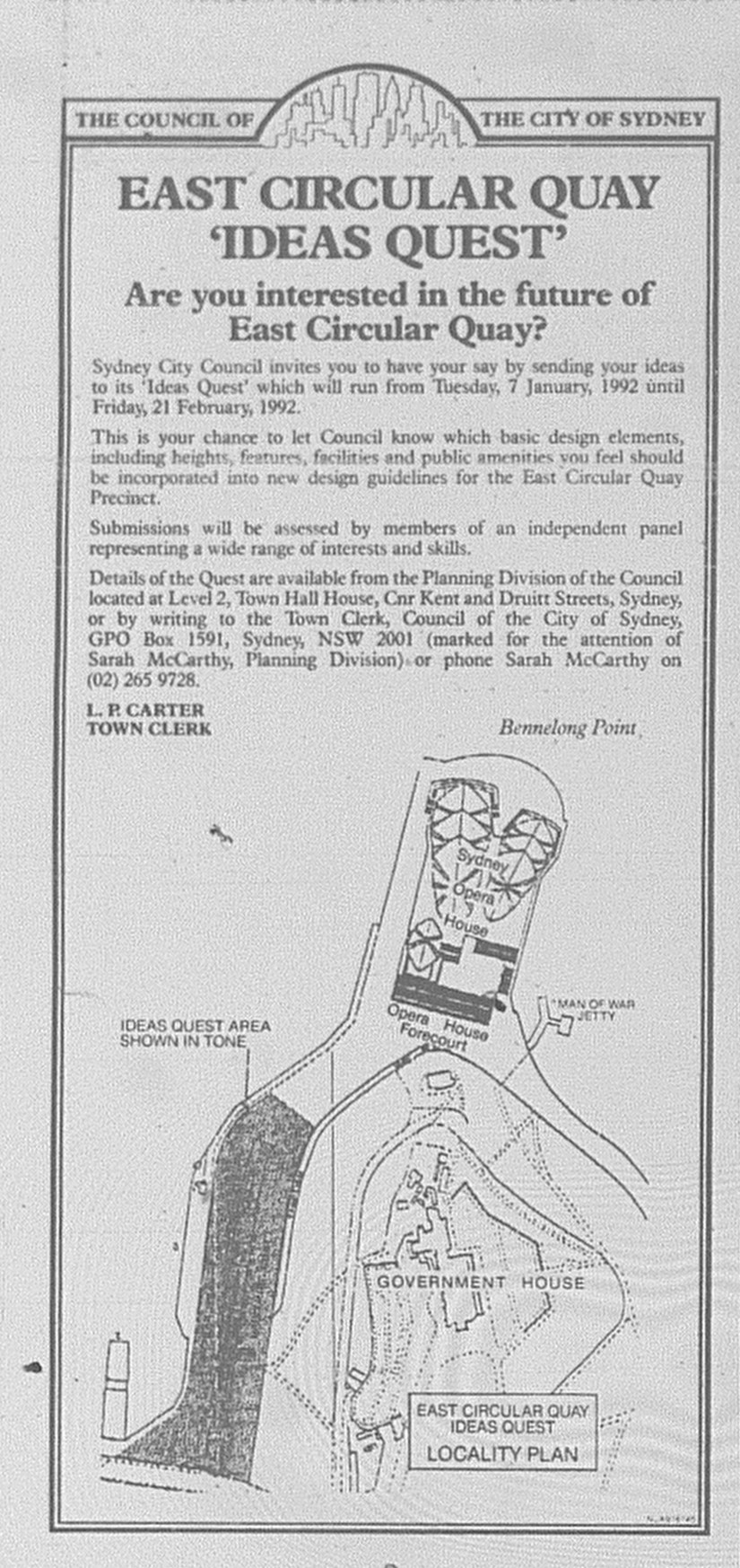
East Circular Quay visions Ad January 6 1992 daily telegraph 12
Source: Sydney City Council. 1992. "East Circular Quay 'Ideas Quest'" (Advertisement). The Daily Telegraph Mirror, January 6: 12.   

A fortnight ago, I posted Colonial Mutual Limited's (CML) proposal to build a $700 million commercial development at East Circular Quay in 1991. Sydney City Council rejected the proposal because it did not comply with the site's planning guidelines.

This led to Sydney City Council reviewing the site's planning guidelines. In January 1992, it invited the public to submit ideas on how the site should be developed. Architect Ken Woolley assessed the submissions. 

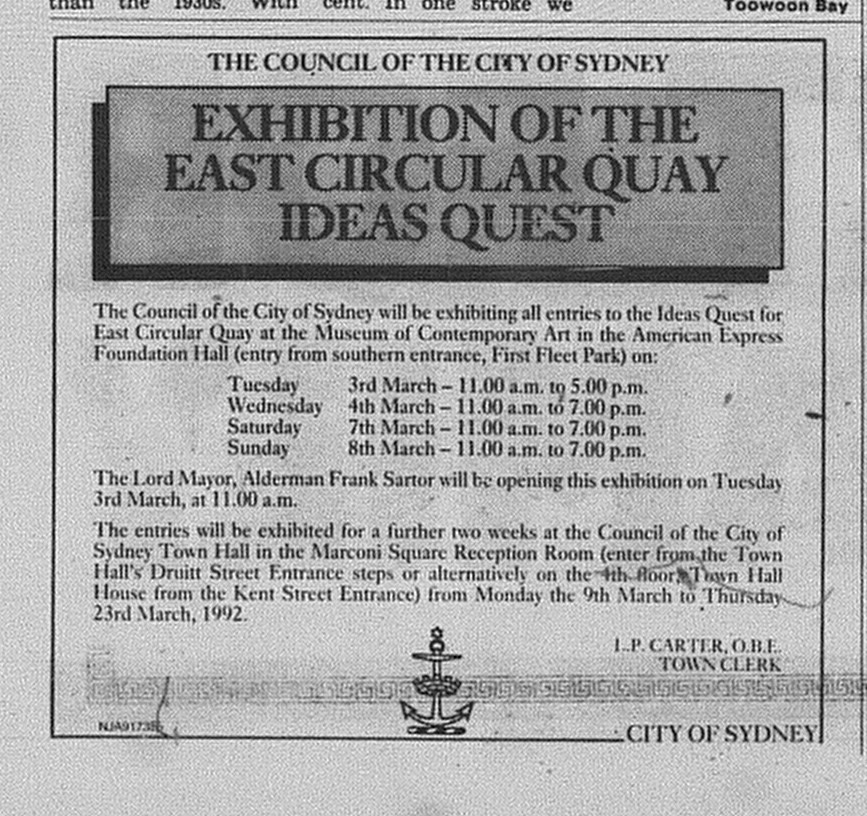
In March 1992, the submissions were placed on public exhibition. 

East Circular Quay Vision Ad February 29 1992 daily telegraph 23
Source: Sydney City Council. 1992. "Exhibition of the East Circular Quay Ideas Quest". The Daily Telegraph Mirror, February 29: 23. 

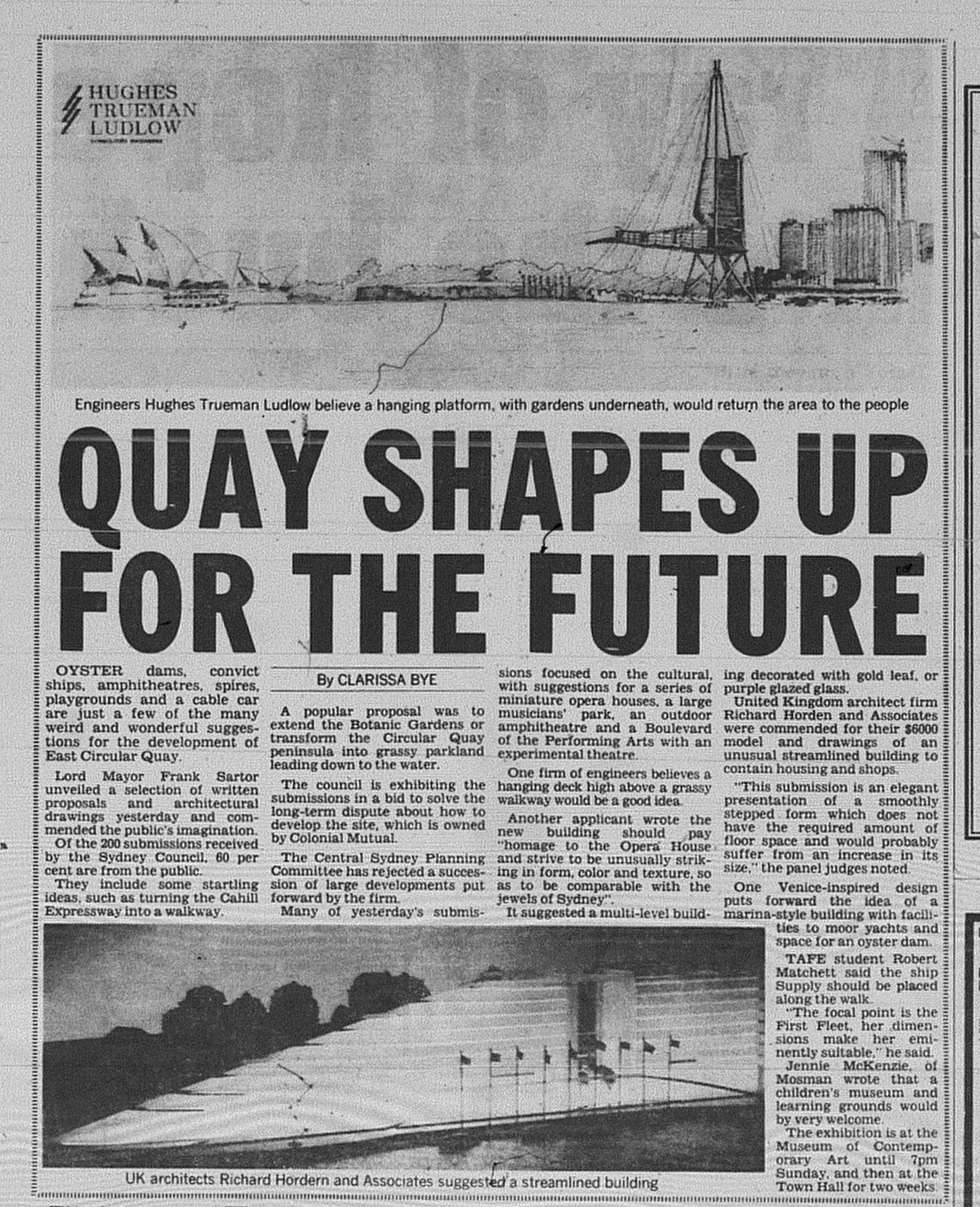
Below is a feature article from The Daily Telegraph Mirror featuring some of the submissions.

East Circular Quay March 4 1992 daily telegraph
Source: Bye, C. 1992. "Quay shapes up for the future". The Daily Telegraph Mirror, March 4: page unknown.

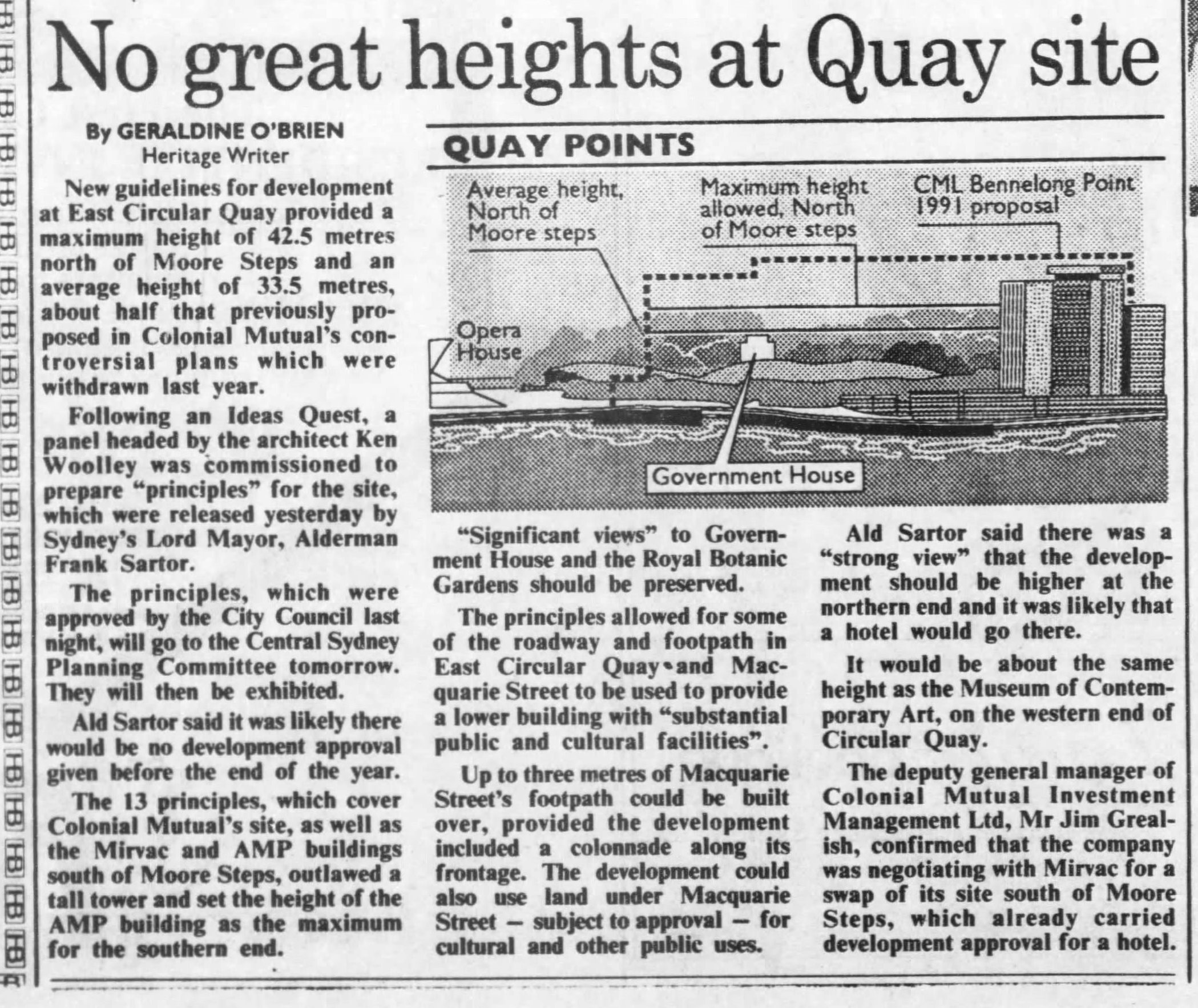
Following the exhibition, new guidelines were drawn by the panel led by Ken Woolley. For the site owned by Colonial Mutual Limited (CML), a maximum height limit of 42.5 metres was set, which was lower than four of the buildings that either occupied the site or had been demolished. South of Moore Steps, future development would be capped at a maximum of 65 metres. 

East Circular Quay June 10 1992 SMH 4 enlarged 2
East Circular Quay June 10 1992 SMH 4 enlarged
Source: O'Brien, G. 1992. "No great heights at Quay site". The Sydney Morning Herald, June 10: 4. 

The guidelines also recommended:
  • Provision of a cultural facility
  • Utilise part of the existing roadway for pedestrian use
  • Ground and lower floors to accommodate restaurants, retail, entertainment and tourist facilites.
  • Possible use of land under Macquarie Street for public use. 
The National Institute of Architects objected to the new guidelines.

East Circular Quay June 11 1992 SMH 8

Source: Anon. 1992. "Architects call for new Quay design". The Sydney Morning Herald, June 11: 8. 

As I will be away during the school holiday period, I will have two Remember This? entries for the next two Mondays and will resume this series on May 6.

Monday, 2 October 2023

1992: Cityrail's controversial timetable

Cityrail 1992 Timetable Ad December 17 1991 daily telegraph 22

Source: Cityrail. 1991. "The times they are a changin'." (Advertisement). The Daily Telegraph Mirror, December 17: 22. 

Rail Timetable January 12 1992 Daily Telegraph 16 

Source: Nance, J. 1992. "Rail commuters rattled". The Sunday Telegraph, January 12: 16.

Any change to public transport timetables in Sydney will always incur at least some criticism or controversy. It may affect one line or route or the entire network.

Given that trains are our more patronised mode of public transport in Sydney, any changes to timetables will impact more commuters than buses and ferries, and hence receive more attention. Changes to train timetables often flow onto bus timetables where bus routes connect with rail services.

You may remember the changes from a particular year, because they may have impacted you directly.

In 1992, I was seven years of age and being a child did not have to rely on trains to get around, but Cityrail made changes to its timetables, which at the time were controversial. This entry provides an overview of why.

Why a new timetable?

In 1991, the NSW Government decided to retire the red rattler trains due to safety concerns associated with open doors in their carriages, which was to be completed in 1993. Most of the remaining carriages were retired in January 1992 and were to be confined to the Bankstown and Inner West lines until their final withdrawal the following year. 

Meanwhile, Tangara carriages (known as T set) were still being rolled out across the network following their introduction in 1988 and continued to be rolled out to suburban lines until 1994, with the outer suburban G set version rolled out in 1994 and 1995.

Also, Cityrail sought to increase services to outer suburban stations. 

What were the changes?

  • Reduced off-peak services
  • Longer wait times for connections with other lines
  • An additional 2500 seats were made available for commuters during peak hours.
  • Reductions in peak-hour services on the Bankstown, North Shore and Western Lines
  • Additional services from Campbelltown to the Sydney CBD.
  • Reductions in services on the Illawarra Line.
Why the controversy?

As mentioned, services were reduced, longer connection times and reduced services on lines impacted workers, especially those who travelled in shoulder or off-peak periods.

For the majority of commuters, they were inconvenienced, whether it meant having to change trains, longer dwell (waiting times) or having to alter their travel times. Delays and cancellations also added to the difficulties experienced.

Despite an additional 2500 seats added to existing peak-hour trains, reduced service frequencies meant that trains were more crowded. Below are clippings from a special feature that was published in The Sydney Morning Herald on February 7, 1992 (page 4).

New Train timetable February 7 1992 SMH 4

Transport advocacy group Action for Public Transport called for the restructuring of some lines to improve efficiency and hence capacity, such as the Bankstown Line and better turnarounds at Berowra.

Cityrail timetable changes January 22 1992 daily telegraph 20

Source: Anon. "Train service 'a mess'". The Daily Telegraph Mirror, January 22: 20.  

The State Government was forced to act, altering timetables. The first round of changes was "small".  Cityrail claimed to have received 26,000 calls, with many supporting the new timetable, especially the replacement of red rattler trains with modern carriages. Shadow Transport Minister Brian Langton (ALP, Kogarah) called for the timetable to be axed while the ALP had received thousands of complaints via a special hotline that they set up. Mr Langton himself was a rail commuter and saw firsthand for himself the impact it was having on his travels and those of his fellow constituents. 

Cityrail Timetable Review February 8 1992 daily telegraph 11

Source: Jones, S. 1992. "New review of Cityrail timetables". The Daily Telegraph Mirror, February 8:11. 

Later that month, a further 100 changes to the timetable were to be implemented over the following months. Some services would receive extra carriages, while some services would be altered to either have more stops or fewer stops.
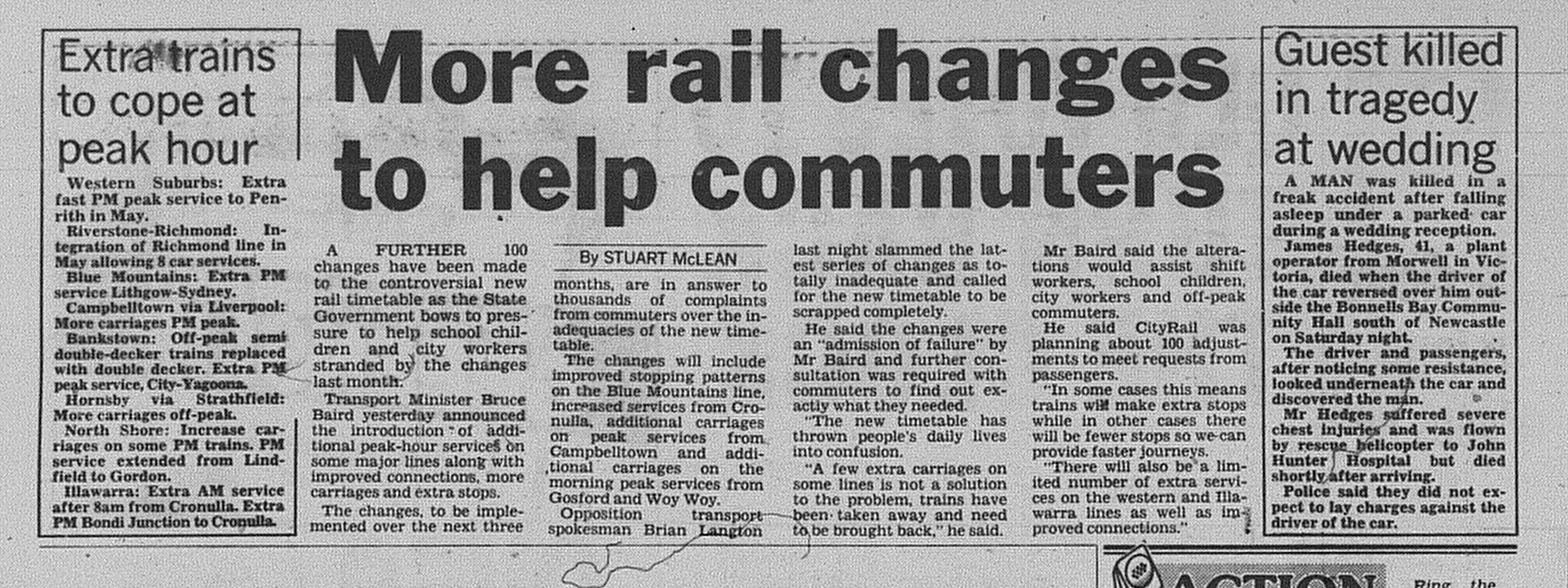
  Rail timetable changes February 24 1992 daily telegraph 18 

Source: McLean, S. "More tail changes to help commuters". The Daily Telegraph Mirror, February 24: 18. 

Additional Reading

Action for Transport (N.S.W.). 1992.  "New Cityrail timetable," Action for Public Transport (N.S.W.) Media Release Newsletter, no 1 (February 1992), https://www.aptnsw.org.au/newsletters/19921.html  

Monday, 6 February 2023

1992: Ultimo's Australian Mercantile Land and Finance Co. Building destroyed by fire

AWL Fire July 6 1992 daily telegraph (1)

Some readers may remember the fire that destroyed the Australian Mercantile Land and Finance Co. building at Ultimo in 1992.

Originally built in 1909, the former Woolstore in Ultimo had been abandoned and was facing redevelopment into an office, retail, apartment and hotel complex while preserving the heritage-listed building.

AWL Fire July 6 1992 daily telegraph (2) 

The fire began at lunchtime on 6 July 1992, but media reports reported that the fire "took hold" around 12:40pm. Being a former woolstore, lanolin, which had been embedded in the floors of the building, acted as an accelerant.

At around 12:51pm, a section of the wall along the western side collapsed, followed minutes later by sections of the eastern wall which lasted until 1:40pm.

Australian Mercantile Building Ultimo Fire July 7 1992 SMH (1)

Australian Mercantile Building Ultimo Fire July 7 1992 SMH (2)
Above: Coverage by The Sydney Morning Herald on 7 July 1992. 

The collapse of the eastern wall led to the destruction as many as 20 cars parked in Bullecourt Lane, catching alight as the heated walls rained down on them. Fortunately, the Monorail Depot escaped the carnage, though was hit by debris.

Firefighters from 15 fire stations fought the blaze, which took two hours to control but was smouldering for many hours afterwards. Four firefighters were injured.

Flames were reported to have risen as high as fifty metres into the air, with smoke visible from the suburbs.

Given the severity of the fire, 800 people were evacuated from nearby homes and businesses while thousands watched the fire burn from nearby vantage points.

The site eventually became the home of the Ian Thorpe Aquatic Centre and the Bullecourt apartment complex. The Aquatic Centre was opened in 2005 and was designed by Harry Seidler. 

IMG_3040 (2)
Above: Ian Thorpe Aquatic Centre. Photo taken by the Author (2009).

IMG_6878
Above: The Bullecourt Apartment Complex. Photo taken by the Author (2015). 

Monday, 26 September 2022

1992: The creation of St George Bank

This year is thirty years since the St George Building Society (established in 1937 as the St.George Co-operative Building Society Ltd) was granted a banking licence and listed on the Australian Stock Exchange as a public company. 

In January 1992, St George went public with its plans as reported in The Daily Telegraph Mirror on 15 January 1992.
St George Bank applies for Banking Licence January 15 1992 daily telegraph 1-2 (1)

St George Bank applies for Banking Licence January 15 1992 daily telegraph 1-2 (2)

Below is a newspaper advertisement that was published on 1 July 1992 when it offically became a bank.

  St George Bank Ad July 1 1992 daily telegraph 25 

Source: St George Bank Limited. 1992. "A bank remembers its promises." (Advertisement). The Daily Telegraph Mirror, July 1: 24-25. 

During the 1990's St George Bank took over Advance Bank and BankSA. In 2008, St George merged with Westpac. Despite the merger, the brand has been retained in NSW. Its branches in Victoria were rebranded as the Bank of Melbourne in 2011.

St George still maintain their headquarters at Kogarah, where it has been based since 1990, still connected to the region in which it was founded. Originally, they were based at Hurstville. 

Below is the advertisement that I believe was the "launch" advertisement. Southern Sydney does feature. Guess the locations.

Saturday, 9 July 2022

Property Advert of the Week: Crestwood, Blacktown (1992)

Below is a newspaper advertisement by Australian Housing & Land promoting the sale of townhouses and villas in the Crestview development in Reservoir Road, Blacktown. Prices started at $125 950. 

  Australian Housing & Land Ad March 28 1992 daily telegraph 9

Source: Australian Housing & Land. 1992. "Crestview" (Advertisement). The Daily Telegraph Mirror,  March 28: 9. 

Saturday, 26 February 2022

Property Advert of the Week: Glenmore Park Land Release (1992)

I have posted a few advertisements for land releases around Glenmore Park from the early 1990's. Below is one from 1992.

  Glenmore Park Ad  January 18 1992 Daily Telegraph 51

Source: Anon. 1992. "Glenmore Park New Land Release" (Advertisement). The Daily Telegraph Mirror, January 18:51.


Saturday, 18 December 2021

Property Advert of the Week: Lakeside, Chipping Norton (1992)

This is the last of our Property Adverts of the Week for 2021 before we take a break for the summer. For this week, below is a newspaper advertisement for units in the Lakeside development at Chipping Norton. Only $118 000 secured you a unit.

Lakeside Chipping Norton Ad November 28 1992 daily telegraph 9 

Source: Mirvac Real Estate Pty. Ltd. 1992. "Lakeside" (Advertisement). The Daily Telegraph, November 28: 9.

Property Advert of the Week will return in February.

Saturday, 20 November 2021

Property Advert of the Week: Homeworld II (1992)

I have previously shared newspaper advertisements for Homeworld II at Prospect from 1991 and 1993 along with a TV advertisement.  This advertisement for Homeward II was published in 1992.

Homeward no longer uses numbers for each new centre, but rather has opened villages in various suburbs across the Sydney metropolitan area, Central Coast and Hunter regions. One has opened recently at Box Hill, but also at Leppington, Marsden Park, Warnervale (Central Coast) and Thornton (Newcastle).

Homeworld II Ad November 28 1992 daily telegraph 8

Source: HomeWorld II. 1992. "Now 88 homes under one roof." (Advertisement). The Daily Telegraph Mirror, November 28: 8.

Saturday, 10 April 2021

Property Advert of the Week: Heritage Hills, Glenmore Park (1992)

Below is a newspaper advertisement for the Heritage Hills estate at Glenmore Park dating from 1992. Blocks of land were available for just $69 000.

Glenmore Park Ad August 15 1992 daily telegraph 7

Source: Anon. 1992. "Heritage Hills" (Advertisement). The Daily Telegraph Mirror, August 15 : 6. 

Monday, 22 June 2020

1992: Boat Harbour is handed to the public

Thomas Holt purchased the land that encompasses Boat Harbour at Kurnell in 1861. Holt was a major landholder in the Sutherland Shire and owned the entire Kurnell Peninsula.

It meant that the beach at Boat Harbour was also privately owned, unlike other Sydney beaches. Access was only via 4WD.

In 1992, his descendants (still under the Holt family name) handed Boat Harbour to the public.

Below is an article from September 1992 announcing the news.


Source: Cramsie, D. 1992. "Beach free for all". The Daily Telegraph Mirror, September 7:4. 

There was mention of a proposed resort (never proceeded). This will be subject to a separate entry in the future.

Boat Harbour is now an Aquatic Reserve and remains pristine. Currently the reserve is managed by the NSW Department of Primary Industries. 4WD's can access the park but are banned from driving on the dunes at a cost of $30 per vehicle.

Monday, 6 April 2020

1992: Coles commences 24 hour trading

The situation with COVID-19 has led to a relaxation of trading laws for supermarkets to allow for shoppers to purchase necessities for the home.

But Supermarkets have had the right to trade 24 hours for nearly three decades. Coles took the initiative in 1992 when their supermarkets at Lindfield and Ramsgate began offering 24 hour trading. It lasted for much of the 1990's. This was part of the deregulation of shopping hours, which benefited supermarkets more than other retailers. They could open early and trade late.

Busier supermarkets usually trade 6am-midnight each day of the week.

Below is an article from The Daily Telegraph Mirror in 1992.


Source: De Vine, B. 1992. "Shop, shop, shop 'til broad daylight". The Daily Telegraph Mirror, June 23: 3.


Monday, 27 January 2020

Remember This? Gerry Harvey returns to Arncliffe (1992)

In 1961, Gerry Harvey and his business partner Ian Norman opened an electrical and furniture store on the Princes Highway at Arncliffe that would evolve into the now defunct Norman Ross Discounts.

Through Norman Ross, Harvey remained connected with the Arncliffe Store until he was sacked in 1982 following its takeover from Bond-Waltons.

His sacking led to him starting a new chain of electrical and furniture stores - Harvey Norman and evolved to become one of the biggest retailers in Australia.

In 1992, Norman Ross collapsed. For Harvey it presented an opportunity to acquire some of the former Norman Ross stores and convert them into Harvey Norman stores including Arncliffe.

For Harvey, it meant that the site that began his career in retailing was back in his hands and could reconnect with the people of the St George region that he had served for decades. It was also where he would experiment with extended trading hours on Saturdays and Sundays. He identified loopholes in legislation and risked prosecution for breaching trading laws.  However, he would set a precedent for the trading hours that shape shopping in 21st Century Sydney.

Harvey Norman would trade at Arncliffe for several years before it was closed (along with their Westfield Miranda store) when a new store at Caringbah opened.

Below is an advertisement for Harvey Norman at Arncliffe as published in the March 26, 1992 edition of The St George and Sutherland Leader.


Monday, 11 November 2019

EVOLUTION OF WESTFIELD MIRANDA: More Expansion (1992)

The 1990's bought another expansion for Westfield Miranda which was its largest expansion to date. This was completed in 1992.

Westfield had spent around two decades purchasing sites in the block bounded by the Kingsway, Kiora Road, Urunga Parade and Jackson Avenue including shops, offices, Miranda Police Station and the Miranda Congregational Church. St Lukes Anglican Church refused offers to sell, though they did sell a small portion of the site.

For expansion to proceed (and gain support of locals and council), Westfield purchased sites within Miranda to relocate the police station (Cnr Wilcock Street and Kiora Road) and Miranda Congregational Church (Cnr Kariumbla and Kiora Street). Westfield also funded the construction of the new buildings for Miranda Congregational Church.


Source: Stark, N. 1991. "Huge Westfield complex set for Miranda". The St George and Sutherland Shire Leader, May 16: 2.

Expansion plans were officially unveiled in 1991. The expanded centre would contain 370 retailers, up from around 160 retailers..

New retailers included David Jones which meant that Miranda would once again have two major department stores on the one site. BigW was now forced to compete with Target and did an upgrade of their store.


Grace Bros did an upgrade of their existing store.


Greater Union would occupy an eight screen entertainment complex and was joined by a new food court and restaurants.

Above: Advertisement to promote the opening of Greater Union at Miranda in 1992.
The expansion was completed in stages with the full expansion officially opened to shoppers on October 1, 1992. The crowds flocked in their hundreds of thousands. Yours truely as a young child does remember going on that first weekend and yes it was full.


Source: Davis, G & Habermann, L. 1992. "Shopping crowds flock to Miranda". The St George and Sutherland Shire Leader, October 8: 2. 

Below are some advertisements to promote the Westfield Expansion as advertised in The St George and Sutherland Shire Leader on various dates in 1992.


Below is an advertisement for Country Road which promoted itself as a Department Store.


Westfield produced its own special advertisement for the opening of David Jones in August 1992.


Finally is an advertisement to promote Tilt, which was a video game and entertainment arcade complex. With the rise of video gaming during the 1990's, it would not see out the decade. It occupied the space now occupied by Aldi and The Reject Shop.