Below is a 2002 newspaper article from The Daily Telegraph reporting on a proposal to build a light rail line along Parramatta Road. Twenty-five years later, it is still being explored as an option to revitalise the road corridor, which has struggled to attract business and development.
The aim was to build the line to take advantage of the construction of the M4 East Expressway (which eventually became WestConnex), which would have removed cars from Parramatta Road.
It didn't mention of any specific stretch of road but forewarned that branch lines could have been included to connect with railway stations on the Inner West line.
Work on the expressway was estimated to have commenced in 2005, but the road itself (WestConnex) did not open until 2019. The M4 East was built as part of the broader project, which also included the construction of the M8 motorway to connect the M4 and the M5. Construction had commenced in 2015, meaning it took an extra decade for it to become a reality.
Source: Skelsey, M. 2002. "Light is right for clogged Parramatta Rd". The Daily Telegraph, October 30: 6.
Momentum for light rail has gained traction in recent times. Inner West mayors have expressed their support for a Light Rail Line, and that could lead to the construction of 50,000 homes along the road. Click here to read a 2025 article from The Daily Telegraph (Subscription Required).
Did you know that 2026 marks 40 years since Sydney Ferries revived the green-and-yellow livery that adorned the ferries in earlier decades of the 20th century?
The reason for its introduction was that the First Fleet Ferries, to replace the older Lady Class Ferries, were funded by the Australian Bicentennial Roads Development (a misnamed fund) as part of transport upgrades for the Bicentennial, which was held in 1988. It was meant to symbolise that the Federal Government funded the ferries, not the State Government.
Source: Coultan, M. 1986. "Ferries let us see colour of their money". The Sydney Morning Herald, February 19: 4.
They would replace the dark blue and off-white livery of existing ferries.
The successor Lady Class Ferries (post-1968), along with the Manly Freshwater Class Ferries, would eventually be repainted green and yellow.
Ferries introduced during the 1990s and 2000s, including the Jetcats, Rivercats, Harbourcats and Supercats, did not adopt the green-and-gold livery during their working lives.
Since the introduction of the Emerald Class Ferries in 2016, every new Sydney ferry entering service has adopted the green and yellow livery along with the Minicat, River and Parramatta River class ferries. In 2026, 100% of Sydney's ferry fleet will be adorned in green and yellow.
The Sydney Monorail ran between 1988 and 2013. In 1987, a year before its opening, the first monorail train, which ran on a 3.6-kilometre loop, was unveiled to the world at the Transpublic 87 Exhibition in Geneva.
While the Monorail was causing controversy in Sydney, it was receiving praise for its innovation at an international level. Transpublic 87 Managing Director Rodolphe Huser praised it and hoped that other cities would follow Sydney's lead in adopting the monorail.
Source: Anon. 1987. "Monorail steals limelight at show". The Daily Telegraph, April 28: 4.
Did you know that in the 1970s, the Otis Elevator Company proposed a personal rapid transport system to transport people in central Sydney?
Below is a newspaper feature from The Sydney Morning Herald in 1974.
Along the four-mile proposed route (Approximately 6.5 kilometres) from the Sydney Opera House to Central Station, vehicles seating up to 24 people would operate either at ground level or on elevated rails. This was seen as a solution to traffic congestion and air pollution in central Sydney. It was even suggested that it could be used to serve the Northern Beaches, which at the time (and still is) not served by heavy rail.
Source: Anon. 1974. "Air cushion travel proposed". The Sydney Morning Herald, January 30: 3.
Source: Grimshaw, P. 1987. "Plan to put commuters on right track". The Daily Telegraph, July 20: 5.
In 1987, an independent engineering team unveiled plans for a "Suburban Circle Line", a light rail loop that would have served the inner city, eastern suburbs and inner west. The argument was that the infrastructure was already there or followed former tram corridors e.g. middle of ANZAC Parade. It was claimed that 14% of the route would need to be built from scratch.
This would have encompassed two of the light rail routes that operate today - L1 line (Central Station - Dulwich Hill via Pyrmont and Lilyfield) and L2 (From Central Station to Randwick),along with the line looping down to La Perouse using the former tram corridor along ANZAC Parade before turning towards Botany and would have included a stop at Sydney Airport. It would then head towards Dulwich Hill.
It has to be asked - Is it still possible for this vision to become reality? Yes. The L1 and L2 routes already encompass a large share of the route. The former tram corridor along ANZAC Parade is still there - It can be reverted for Tram use. The La Perouse to Dulwich Hill component though isn't clearly shown in the map that featured in the newspaper clipping, though I think they would have considered using the Port Botany-Sydenham Freight Line as part of any route, however considering that the line is used for freight purposes may render that as unfeasible along with the final section from Marrickville to Dulwich Hill.
Our readers or followers of public transport might have their own ideas or may know more. Feel free to leave a comment or two.
Source: State Transit. 1989. "Cleaner, more comfortable bus travel, will require curbing a few appetites" (Advertisement). The Sydney Morning Herald, May 1: 14.
On public transport in Sydney, it is acceptable for commuters to eat or drink on Trains, Light Rail and ferries, but not on buses.
How did it come to be?
In 1989, the State Transit Authority (STA) decided to ban the consumption of food and drink on Government Buses in Sydney and Newcastle. Eating or drinking on a bus carried a fine of $200. The primary reason for the ban was cleanliness, but it was also in response to complaints from commuters.
\
Source: Timmins, M. 1989. "Eating Ban on Buses". The Daily Mirror, May 1: 2.
The Daily Mirror asked commuters for their thoughts on the ban, and had mixed reactions.
Source: Cramsie, D. 1989. "Passengers divided on food bus ban". The Daily Mirror, May 1: 12.
The following year, the NSW Government passed the Passenger Transport Act (1990), which gave the State Government authority to determine whether commuters were permitted to consume food or drink on any mode of transport and regulate behaviour on public transport.
It also allowed the Government to set fines for non-compliance. Under current legislation, a person who eats or drinks on a bus can be fined $550, up from $200 in 1989. The directive not to eat or drink must be displayed on a sign inside the buses. However, commuters can consume water, and those who need to eat or drink for medical reasons can.
As a bus commuter, I have found that it is generally not enforced, particularly where alcohol is consumed, but 99% of commuters exercise common sense and refrain altogether.
Source: Ryan, R. 1999. "Quay to the city". The Daily Telegraph, February 15:16.
In 1999, Alfred Street at Circular Quay was closed to all vehicles between Young Street and Loftus Street. This enabled Customs House Square to be extended and therefore connect the square directly to Circular Quay Station.
The closure commenced on the evening of 14 February 1999. This meant that vehicles could no longer use Alfred Street, particularly buses, taxis, and coaches, to cross the city in either an easterly or westerly direction. It meant that they had to use Bridge Street.
Alfred Street between Loftus and George Street became one way for westbound traffic only, while two-way traffic remained in the section between Young Street and Phillip Street.
Sourced from: Ryan, R. 1999. "Quay to the city". The Daily Telegraph, February 15:16.
A consequence meant that bus services commencing or terminating in Alfred Street had to be shifted to new bus stops.
In 2015, Alfred Street was closed to all vehicles between Loftus and George Streets to enable the construction of the terminus for light rail services operating in the Sydney CBD, which opened in December 2019. In effect, it extended the square further.
Below are some photos I recently took. It was interesting to note that the kerbs on Alfred Street at Customs House Square were retained.
This photo shows how the kerbs for Alfred Street were retained despite being integrated in Customs House Square.
Below is a 1986 newspaper advertisement from State Rail promoting off-peak rail fares across the suburban and outer suburban (intercity) network. Clever marketing was applied. They used the platypus featured on the 20-cent coin to promote the savings by claiming that one would "save a platypus". With off-peak fares in 1986, commuters were promised at least a 20-cent saving on their fares, increasing based on distance travelled, and one could save even more animals by taking advantage of fares, referring to other animals featured on our coins.
Source: State Rail. 1986. "Save a platypus with State Rail". The Daily Telegraph, August 5: 18.
In 2024, one may find that a timetable service may not stop at your station or you are on the train and then find out that the service will not stop at your destination.
Sometimes on the T4 line, a South Coast Line service that is meant to terminate at either Martin Place or Bondi Junction ends up terminating at the interurban platforms at Central forcing "all out, all change".
Usually, this happens when a train is delayed. It is done to assist in maintaining on-time running or to aid in getting the broader timetable on time following a major delay, e.g., signal failure.
In 1990, The Sunday Telegraph interviewed Rob Schwarzer (CityRail Chief) about the situation after NSW Shadow Transport Minister Brian Langton (ALP, Kogarah) had revealed to Parliament the previous week that drivers had been ordered to skip stations. He cited one example where a train from Sutherland bound for the city skipped 14 stations. The driver was directed to run it express to Redfern. Langton himself was a regular rail commuter.
Source: Grimshaw, P. 1990. "Trains told to skip stations". The Daily Telegraph Mirror, November 29: 1 & 4.
The interview gave us answers. Schwarzer was asked whether or not train skipping was acceptable. He responded with "it is a standard operating practice" and that is necessary to do so. Either cancel the train and "get it out of the road" or return it to the regular timetable. Another element considered, according to Schwarzer, was whether there was a suitable alternate service after the now-altered service. Another question arose - What if commuters are already on the train and want to get off if stations were to be skipped? He stated it was "very rare" as stopping patterns were not generally changed once the run began. The second part of the interview focused on reforms to CityRail and even one question about a new North Shore line (likely a reference to what is now the Epping-Chatswood line, originally heavy rail, now a section of the M1 metro line).
Source: Quinn, S. 1990. "Train Skipping". The Sunday Telegraph, December 2: 16-17.
What is the reality in 2024?
My introduction to this entry would sum up the reality. It does happen, but the concern is whether this will receive the same coverage in the media as in 1990? The state of the rail network was under scrutiny, particularly with job losses, ageing infrastructure, timetabling and overcrowding. Even today, there is scrutiny; though the challenges that face the network are more complex, some of the issues confronting the rail network in 1990 still linger. The question has to be asked - What do commuters value as most important to them when accessing Sydney Trains?
As a commuter, it is annoying that trains sometimes skip stations, whether I am left stranded on the platform or forced to change trains to complete my journey.
Hopefully, this entry and article will make commuters aware of the situation, whether from the perspective of those operating our network or from a commuter's perspective.
Rivercat Nicole Livingstone in action on the Parramatta River. Taken by the Author (2022)
Last year saw the commencement of the retirement of the Rivercat ferry fleet on Sydney Harbour. It commenced with Betty Cuthbert, followed by Evonne Goolagong and Nicole Livingstone. Only four Rivercat ferries remain, with the new Parramatta Class ferries being introduced into service.
In 1991, Transport Minister Bruce Baird announced that seven Rivercats would be built, providing seating for 150 people. This would also enable the extension of ferry services to Parramatta, which commenced in 1993.
Source: Anon. 1991. "Higher". The Daily Telegraph Mirror., May 11: 4.
At the time, ferry services on the Parramatta River were operated by First Fleet class ferries. The new Rivercats promised commuters faster trips along the Parramatta River. Express ferries from Parramatta to Circular Quay, stopping only at Rydalmere, would only take fifty minutes to complete the journey.
The NSW Government followed through, with seven Rivercats entering service between 1992 and 1995, ultimately having a capacity of 230 people.
In Sydney, daily transport fares for adults are capped at $17.80, and if the $50 weekly cap is reached, travel is free for the remainder of the week.
Before Opal Cards were introduced and the ability to pay fares directly from a debit or credit card, a person had to purchase a Daytripper ticket to access unlimited travel on the day of travel.
However, there were limitations compared with Opal fares—the ticket was not valid on light rail services and services operated by private bus operators.
Source: Sydney Ferries, Sydney Buses & CityRail. 2004. "Daytripper" (Advertisement). The Daily Telegraph, January 16: 27.
Is the Opal Travel Daily Cap cheaper than a Daytripper ticket in 2004?
According to the RBA Inflation Calculator, a Daytripper ticket purchased in 2004 for $15 equates to a person spending $24.96 today. Therefore, a commuter can have unlimited travel on public transport at a cheaper price in 2024.
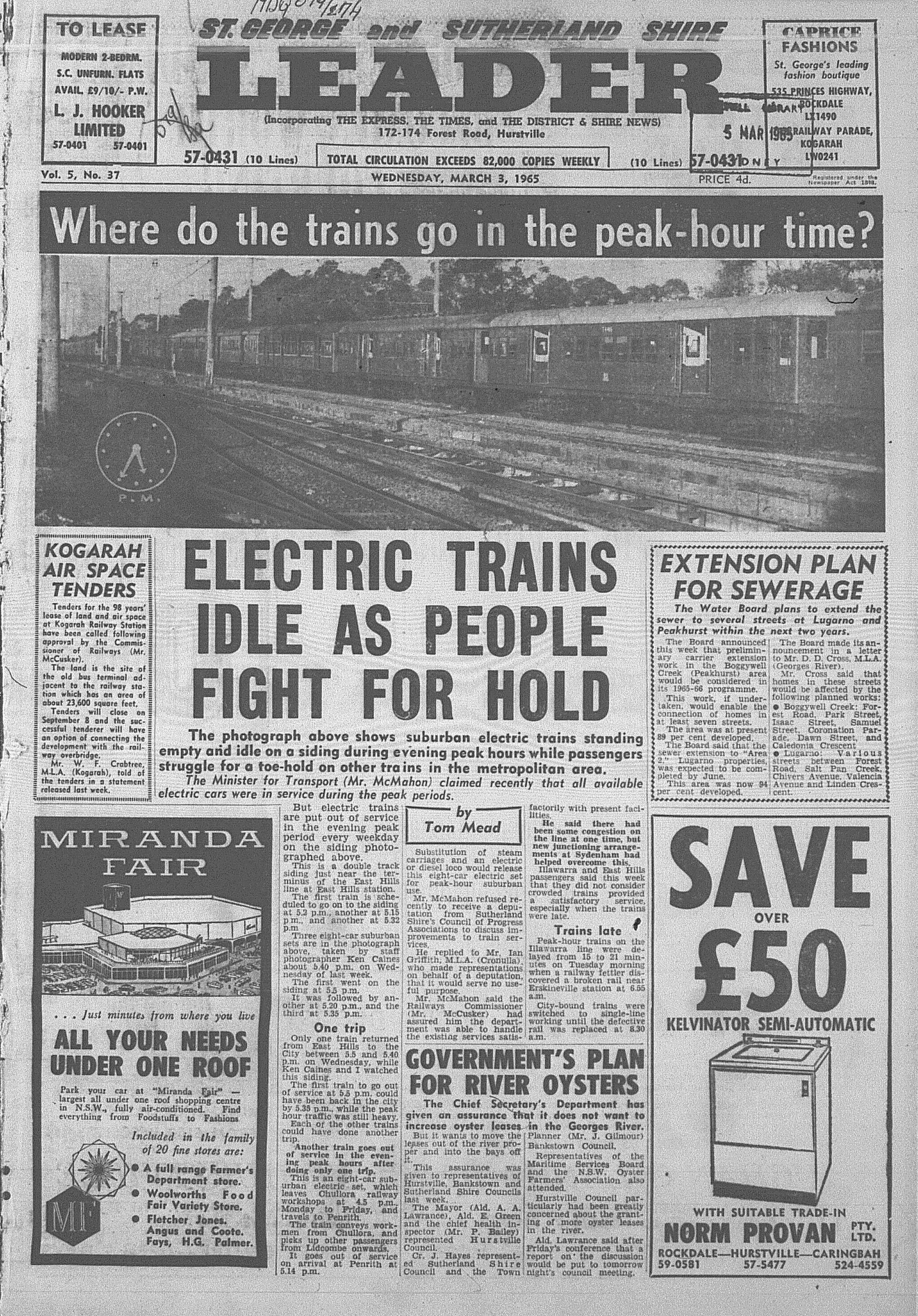
In 1965, The St George and Sutherland Shire Leader published a feature by Tom Mead rebutting claims by NSW Transport Minister John McMahon (ALP) that all available electric carriages were in service during peak hours. As evidence, a photograph of trains stationed on sidings at East Hills during the evening peak period.
It is typical in Sydney to argue that trains are overcrowded, whether it was in the 1960s or now. The question the article raised was why couldn't additional services be provided to reduce the overcrowding. The East Hills Line was the focus, arguing that the idle trains could have made one return trip each from East Hills to the City.
Mead would be elected as a State MP for Hurstville two months later, holding onto the seat until 1976.
Source: Mead, T. 1965. "Electric trains idle as people fight for hold". The St George and Sutherland Shire Leader, March 3: 1.
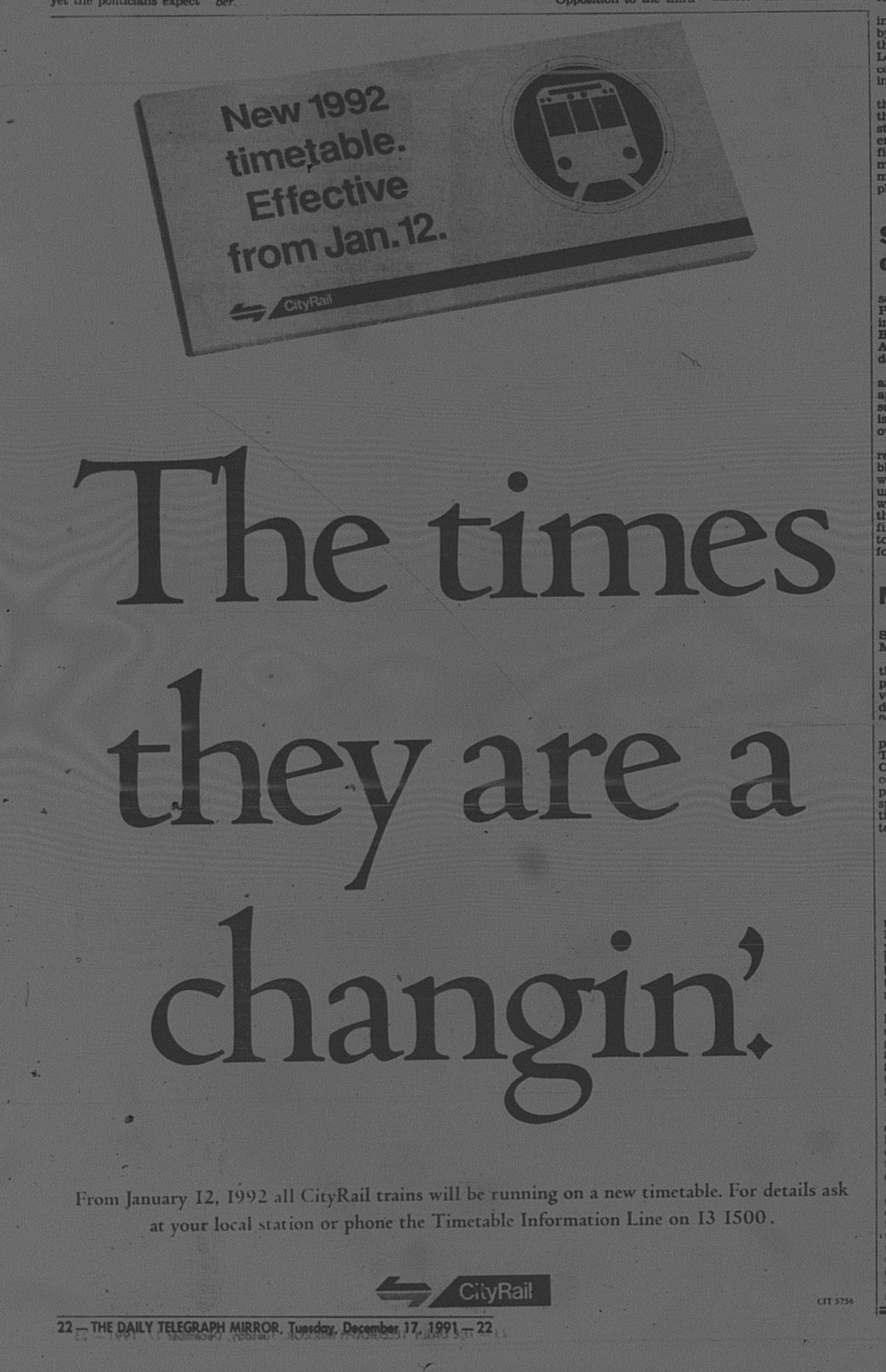
Source: Cityrail. 1991. "The times they are a changin'." (Advertisement). The Daily Telegraph Mirror, December 17: 22.
Source: Nance, J. 1992. "Rail commuters rattled". The Sunday Telegraph, January 12: 16.
Any change to public transport timetables in Sydney will always incur at least some criticism or controversy. It may affect one line or route or the entire network.
Given that trains are our more patronised mode of public transport in Sydney, any changes to timetables will impact more commuters than buses and ferries, and hence receive more attention. Changes to train timetables often flow onto bus timetables where bus routes connect with rail services.
You may remember the changes from a particular year, because they may have impacted you directly.
In 1992, I was seven years of age and being a child did not have to rely on trains to get around, but Cityrail made changes to its timetables, which at the time were controversial. This entry provides an overview of why.
Why a new timetable?
In 1991, the NSW Government decided to retire the red rattler trains due to safety concerns associated with open doors in their carriages, which was to be completed in 1993. Most of the remaining carriages were retired in January 1992 and were to be confined to the Bankstown and Inner West lines until their final withdrawal the following year.
Meanwhile, Tangara carriages (known as T set) were still being rolled out across the network following their introduction in 1988 and continued to be rolled out to suburban lines until 1994, with the outer suburban G set version rolled out in 1994 and 1995.
Also, Cityrail sought to increase services to outer suburban stations.
What were the changes?
Reduced off-peak services
Longer wait times for connections with other lines
An additional 2500 seats were made available for commuters during peak hours.
Reductions in peak-hour services on the Bankstown, North Shore and Western Lines
Additional services from Campbelltown to the Sydney CBD.
Reductions in services on the Illawarra Line.
Why the controversy?
As mentioned, services were reduced, longer connection times and reduced services on lines impacted workers, especially those who travelled in shoulder or off-peak periods.
For the majority of commuters, they were inconvenienced, whether it meant having to change trains, longer dwell (waiting times) or having to alter their travel times. Delays and cancellations also added to the difficulties experienced.
Despite an additional 2500 seats added to existing peak-hour trains, reduced service frequencies meant that trains were more crowded. Below are clippings from a special feature that was published in The Sydney Morning Herald on February 7, 1992 (page 4).
Transport advocacy group Action for Public Transport called for the restructuring of some lines to improve efficiency and hence capacity, such as the Bankstown Line and better turnarounds at Berowra.
Source: Anon. "Train service 'a mess'". The Daily Telegraph Mirror, January 22: 20.
The State Government was forced to act, altering timetables. The first round of changes was "small". Cityrail claimed to have received 26,000 calls, with many supporting the new timetable, especially the replacement of red rattler trains with modern carriages. Shadow Transport Minister Brian Langton (ALP, Kogarah) called for the timetable to be axed while the ALP had received thousands of complaints via a special hotline that they set up. Mr Langton himself was a rail commuter and saw firsthand for himself the impact it was having on his travels and those of his fellow constituents.
Source: Jones, S. 1992. "New review of Cityrail timetables". The Daily Telegraph Mirror, February 8:11.
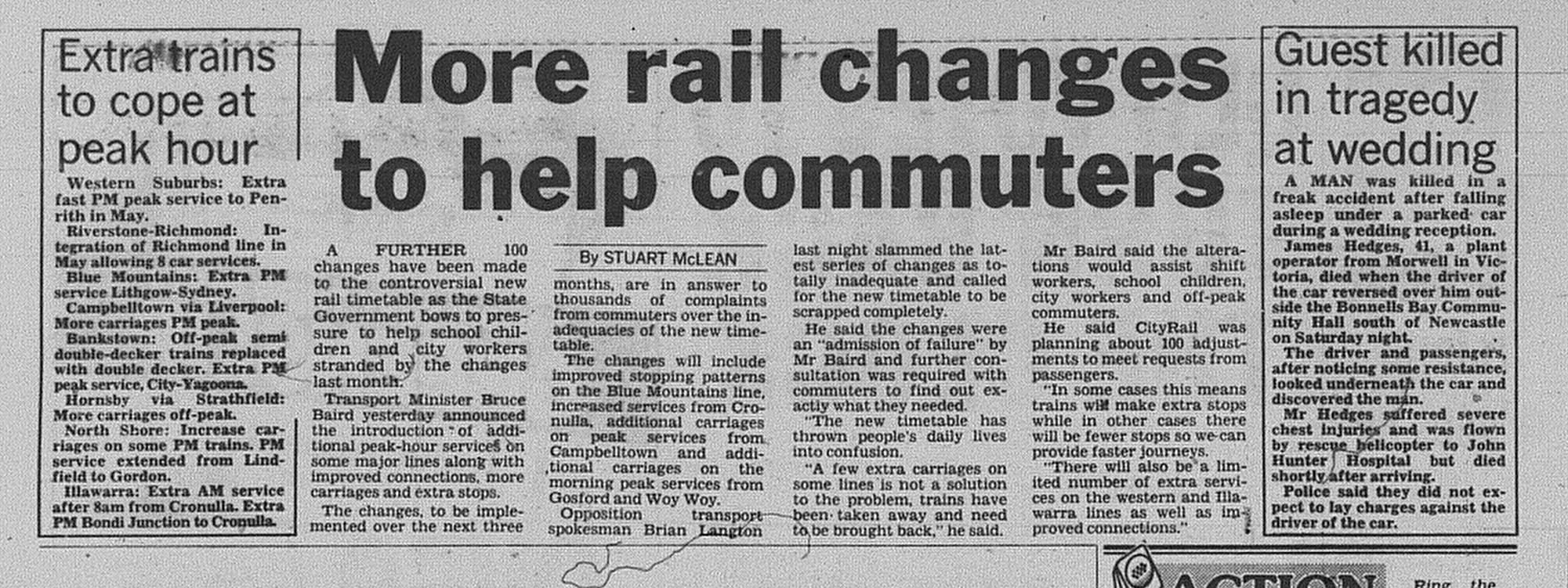
Later that month, a further 100 changes to the timetable were to be implemented over the following months. Some services would receive extra carriages, while some services would be altered to either have more stops or fewer stops.
Source: McLean, S. "More tail changes to help commuters". The Daily Telegraph Mirror, February 24: 18.
Additional Reading
Action for Transport (N.S.W.). 1992. "New Cityrail timetable," Action for Public Transport (N.S.W.) Media Release Newsletter, no 1 (February 1992), https://www.aptnsw.org.au/newsletters/19921.html
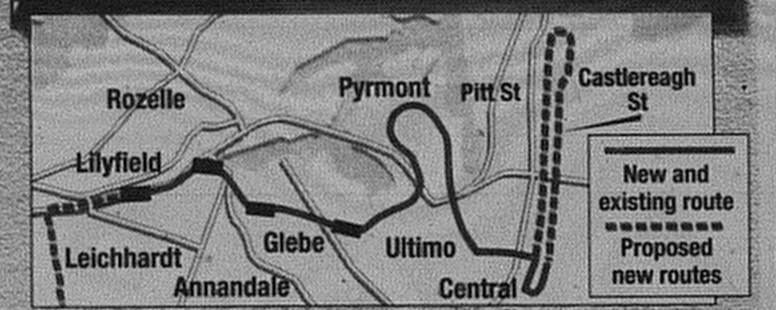
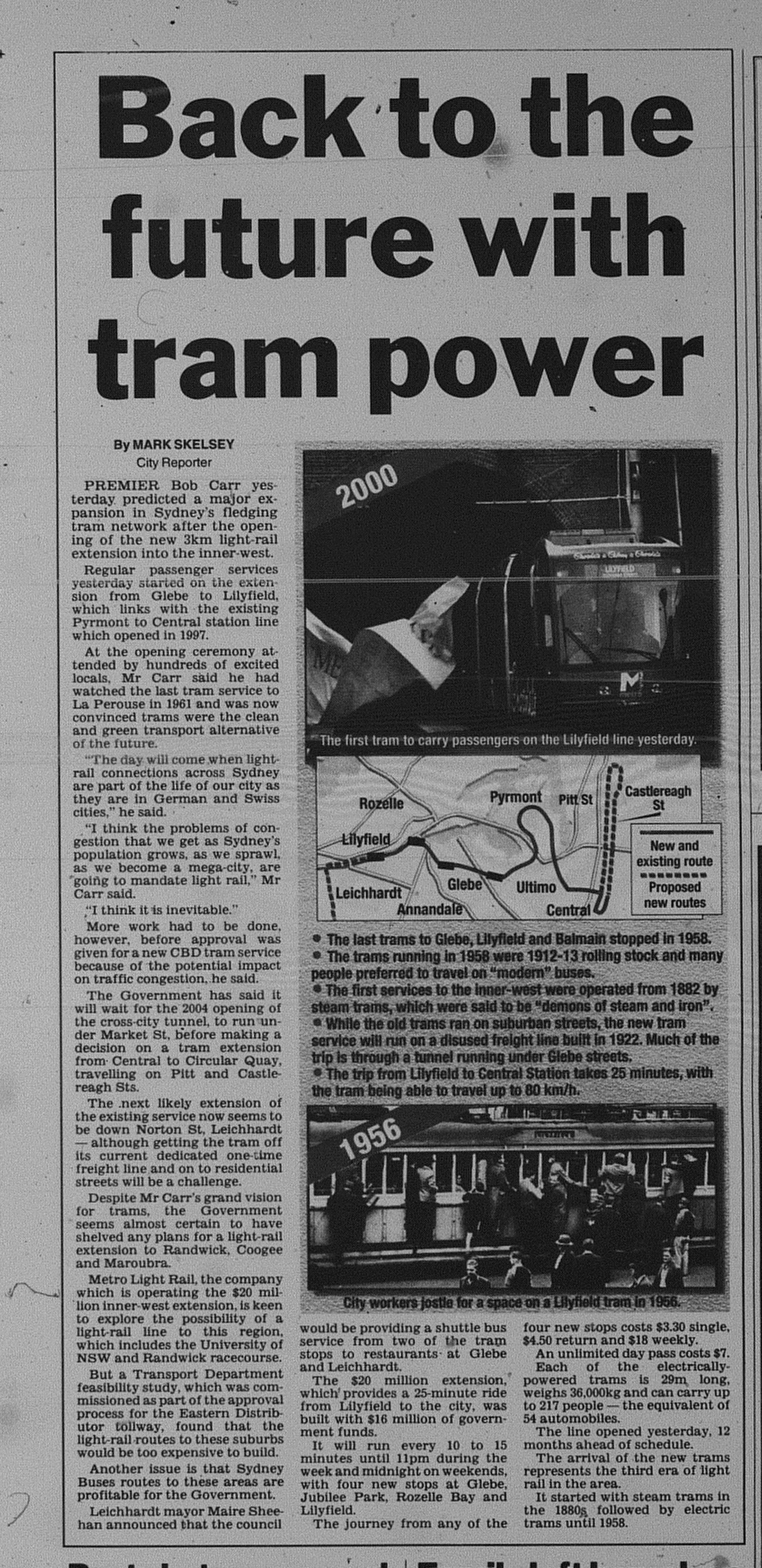
Above: The proposed Sydney CBD Light Rail Loop. Full Citation Below.
Back in 2000, Bob Carr predicted a major expansion of the Inner West Light Rail Line, which ran at the time from Central Station to Lilyfield. To coincide with the opening of the extension from Glebe to Lilyfield, the NSW government considered an expansion of the light rail network to include a Sydney CBD Loop running up Pitt and Castlereagh Streets from Central Station to Circular Quay. In the inner west, the light rail line would have been extended into Norton Street Leichhardt.
Any expansion would wait until the opening of the Cross City Tunnel (proposed to open in 2004 at the time).
Source: Skelsey, M. 2000. "Back to the future with tram power". The Daily Telegraph, August 14: 15.
The vision had its merits, especially the concept of a CBD loop which would have opened up for better integration of eastern suburbs services with inner west services, unlike the current network where eastern suburbs and inner west services operate independently of each other with no integration.
Below is a 1990 newspaper advertisement by the State Transit Authority to promote the savings associated with taking public transport on the weekends.
Source: State Transit Authority. 1990. "Catch the huge savings on buses and ferries this weekend". The Daily Mirror: 39.
In August 1990, Iraq invaded Kuwait, which led to an increase in petrol prices to around 75 cents per litre which was high at the time. The Sydney Harbour Bridge toll has doubled to $3.00 on weekends, but at the time, the $1.50 toll was charged irrespective of the time travelled.
A ferry trip from Manly to Circular Quay in 1990 cost $3.20 for adults, compared with $8.04 on an opal card or contactless payment in 2023. Note that there is a weekend daily cap of $8.40 for an opal meaning a return trip would cost 36 cents.
In 1990, it cost $3.80 to travel by bus from Newport to the city and $2.40 from Coogee to the city. In 2023, the same trip from Newport to the city decreased by 27 cents to $3.53 as bus fares were previously subject to a flat fare with no off-peak discounts. However, the trip from Coogee to the city has increased just 35 cents to $2.75, but when adjusted for inflation, the same trip in real terms is cheaper than in 1990.
A few weeks after the advertisement was published, Cityrail also used high petrol prices to attract commuters to commute by train. A link is listed below.
Source: Anon. 1972. $17 m New Carriages". The Daily Telegraph, July 14: 3.
1972 saw the delivery of the first carriages of the famous S set trains that would operate for 47 years on Sydney's rail network.
The new carriages were built to boost capacity on the rail network and allow more passengers to be accomodated on each service.
509 carriages were built by Comeng and later Goninan with the last carriages entering operation in 1980. Some carriages were built with an amended design.
Source: Anon. 1973. "New Carriages for City". The Sydney Morning Herald, November 20: 3.
Initially, driver cars were built with trailer cars added in future orders.
Trains promised to "increase capacity and comfort", yet they were not air-conditioned which caused discomfort either on cold winter days or hot summer days.
Tulloch trailer cars (carriages) were also used to form either four, six or eight car sets until 2004, when they were phased out ensuring that S-set trains comrpised of S set carriages only.
The introduction of trains that were entirely double-decker marked the beginning of the end of single deck trains on the Sydney rail network as they gradually replaced the red rattler trains. By the end of 1993, the entire Sydney rail network comprised of double-decker carriages. The opening of the Sydney Metro (independent of the main rail network) marked the return of single decker trains.
During the 1990's the carriages were renovated as part of the Citydecker program with new windows and the installation of electronic destination boards on the driver cars.
The S Set trains were phased out from service between 2012 and 2019 as the Waratah Trains were introduced across the network (Excluding the T4 line). The last line that operated the S Sets was the T7 Olympic Park line.
Sydney's Number One icon - The Sydney Harbour Bridge has even had own visions placed on it. I am not referring to the alternate designs or early proposals, but rather the existing structure itself.
Since opening in 1932, it has had to shoulder the burden of carrying vehicles from north to south and vice versa. For sixty years, it was the only direct crossing for vehicles across Sydney Harbour. The Sydney Harbour Tunnel in 1992 provided Sydney motorists with a second crossing. It did for a few years take the pressure off the bridge itself.
It is anticipated by 2027, a third road crossing, the Western Harbour Tunnel will provide another bypass road for Sydney's CBD. The tunnel will connect the WestConnex with the Warringah Expressway, running under the Balmain Peninsula and North Sydney.
Building a harbour crossing is not cheap. The Western Harbour Tunnel will cost at least $7 billion to build (likely to be higher) and the Sydney Harbour Tunnel cost $560 million to build.
Proposals or visions for additional crossings has lasted for decades.
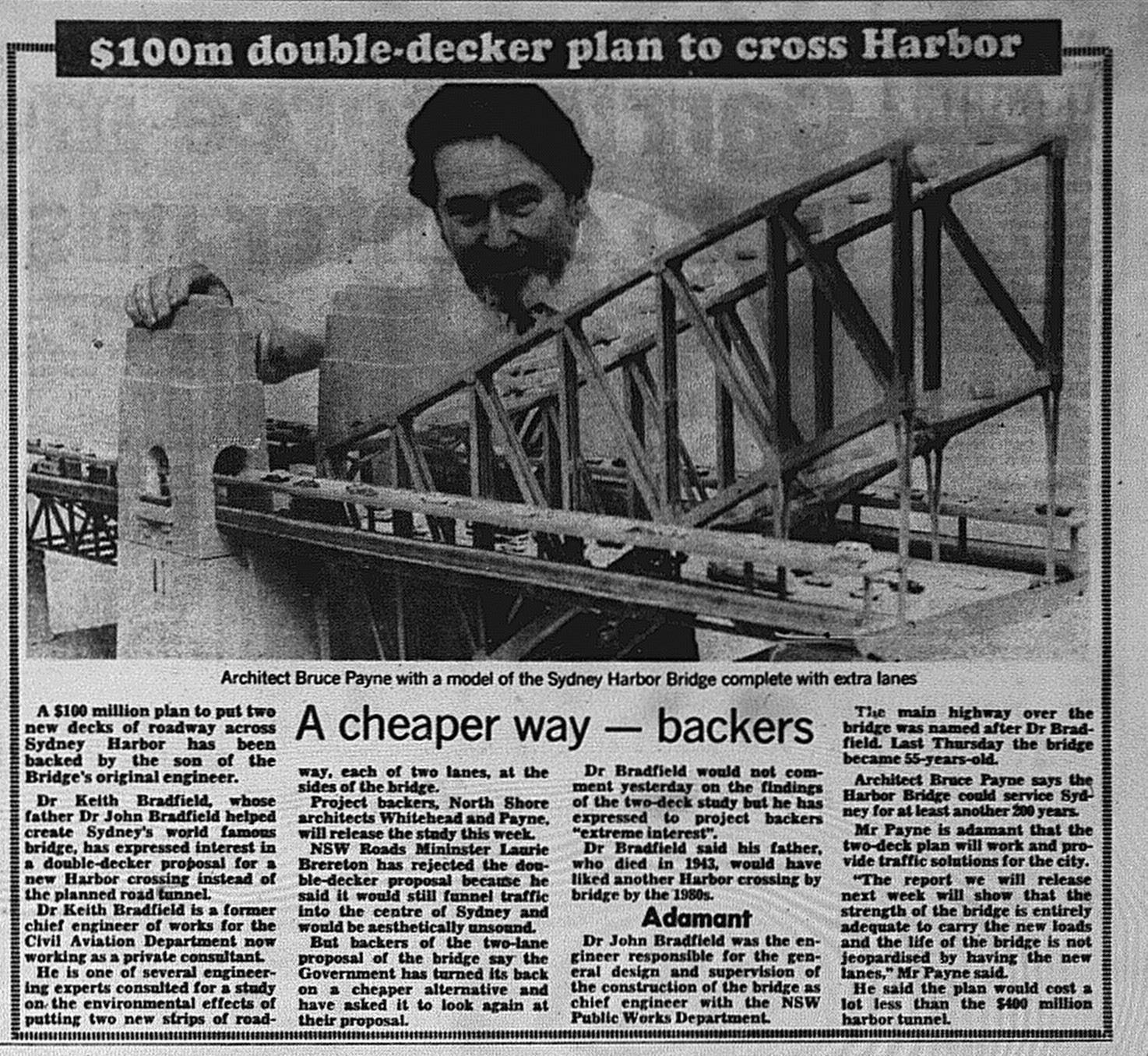
To avoid construction of new crossings, some have proposed boosting the capacity of the briudge itself through construction of additional road decks, either above or below the existing road deck.
In 1987, Architect Bruce Payne of Whitehead and Payne along with the support of Dr Keith Bradfield (son of Dr. John Bradfield), unveiled a proposal to build two additional strips of lanes above the existing lanes instead of building the Sydney Harbour Tunnel.
The two strips would carry an additional four lanes of traffic (combined) with two lanes in each direction.
Source: Anon. 1987. "$100m double-decker plan to cross Harbor". The Daily Telegraph, March 32:13.
It was the not the first proposal. In 2005, "Project Star" proposed that a second deck would be built in the undercarriage of the bridge allowing the bridge to carry an additional four lanes of traffic plus an additional two rail tracks.
In 2010, The Sun Herald, reported on a proposal by transport experts to build a second rail deck underneath the existing road deck to accomodate a new heavy rail line running from St Leonards to the city, following largely what is now the Sydney CBD Metro with new platforms at Wynyard instead of a new station at Barangaroo.
In 1998, Lend Lease proposed to build a fast train line that would have enabled commuters to travel from the Sydney CBD to Parramatta in only 12 minutes. This would be nearly 50 % faster than the proposed Western Sydney metro connecting the two centres or would shave at least fifteen minutes off a standard rail trip. It also proposed that the line would also go through to Penrith. For those commuting from Penrith to Sydney, travel time would be reduced by two thirds to just 22 minutes.
In addition, it was planned that either a light rail line or monorail line would link Parramatta with Castle Hill in just ten minutes.
Source: Humphries, D. & Doherty, L. "City to Parramatta in 10 minutes: transport for a fast track future". The Sydney Morning Herald, March 5: 4.
While it did not eventuate, the issue of fast rail has lasted through to the present day. Note that there is a possible option of connecting the Western Sydney Airport with Parramatta and the Sydney CBD. It is not off the table altogether.
Between 1926 and 1993, Sydney's rail network was served by single deck trains known as the "red rattlers" because of their red appearance and for the rattling windows.
At their peak there were apporoximately 1100 carriages in service and had dwindled to around 360 by 1988.
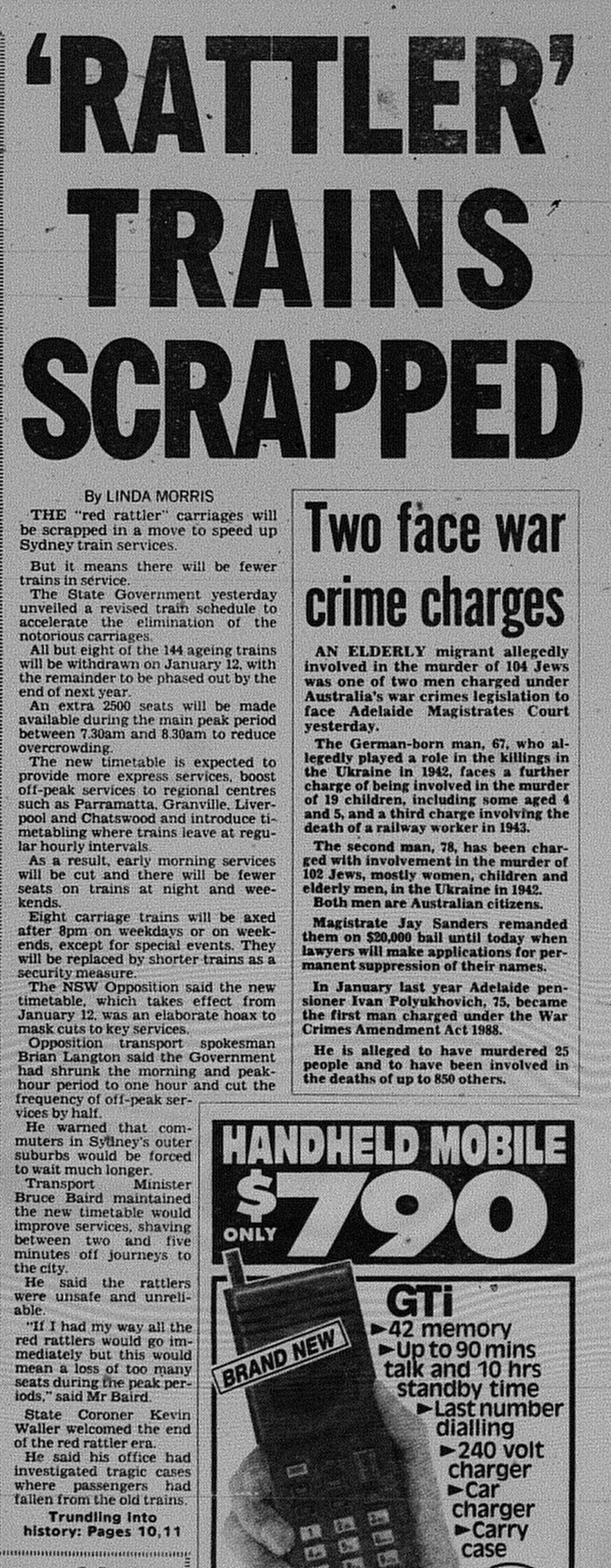
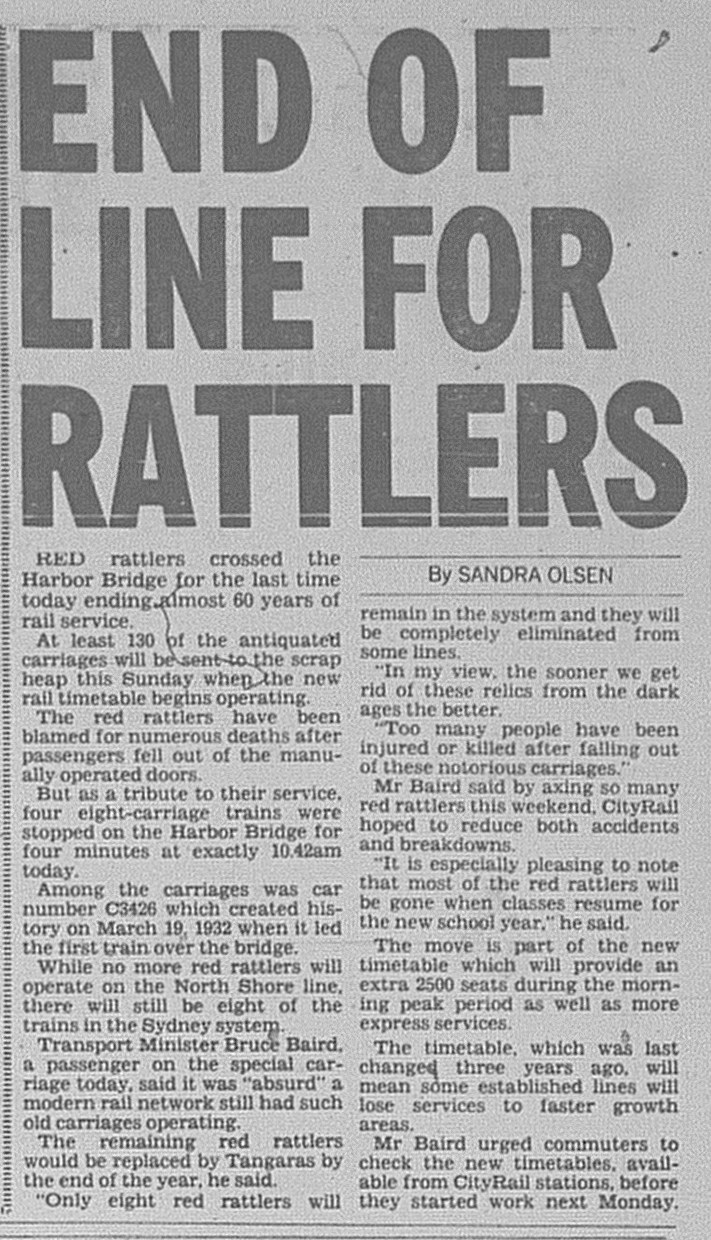
In 1991, the decision was made to formally retire the trains by the end of 1993 due to safety concerns associated with the open doors, along with the introduction of a new timetable from January 12 1992 that was designed to speed up trains across the network. Only eight red rattler trains would be retained with the intent of phasing them out of service within a further year.
Source: Morris, L. 1991. "'Rattler' Trains Scrapped. The Daily Telegraph Mirror, September 6: 3.
Source: Skelsey, M. 1991. "Red rattlers trundle off into history:. The Daily Telegraph Mirror, September 6: 10-11
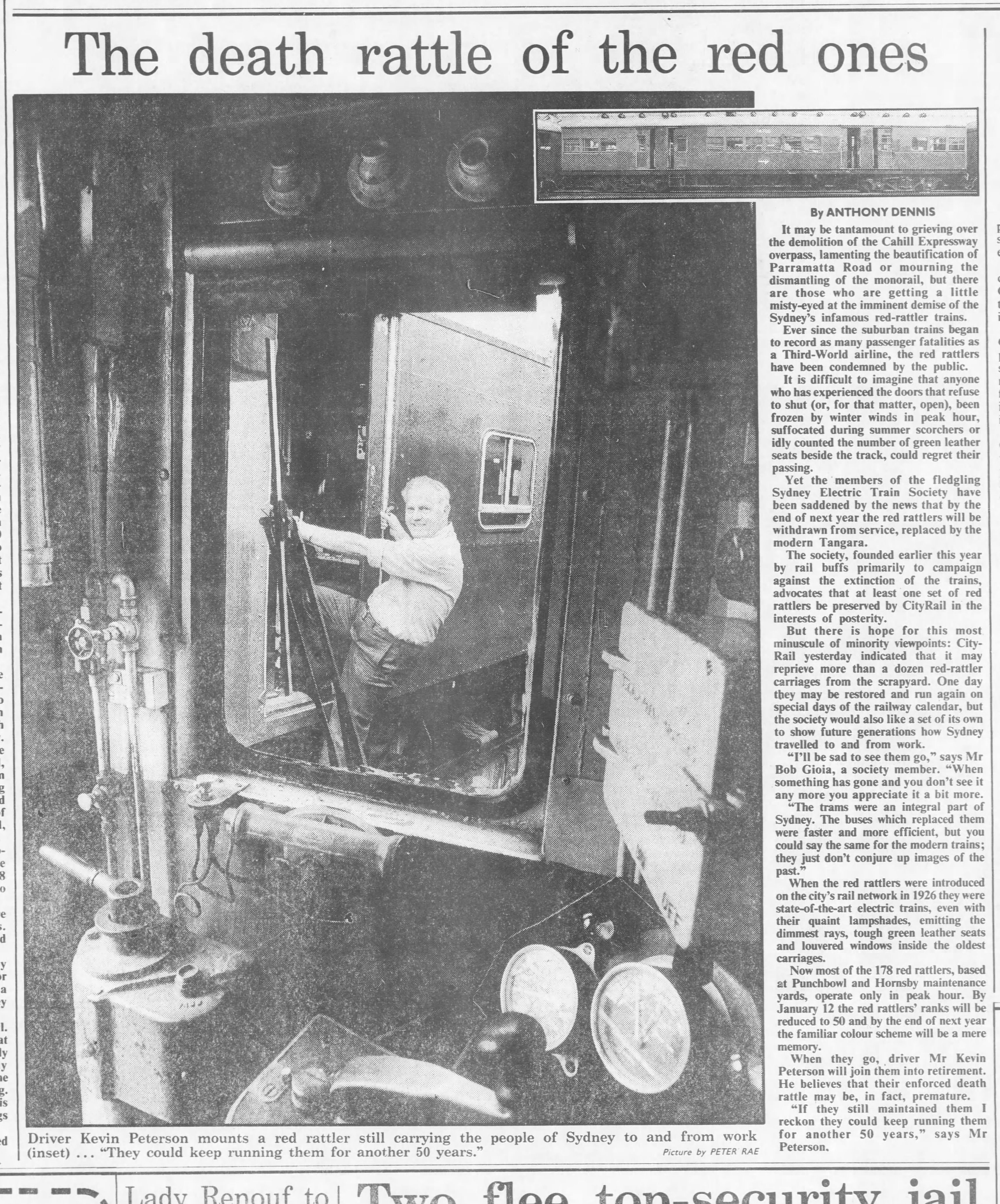
The Sydney Electric Train Society did not receive the news well, especially as they were destined to be scrapped.
Source: Dennis, A. 1991. "The death rattle of the red ones". The Sydney Morning Herald, November 5: 3.
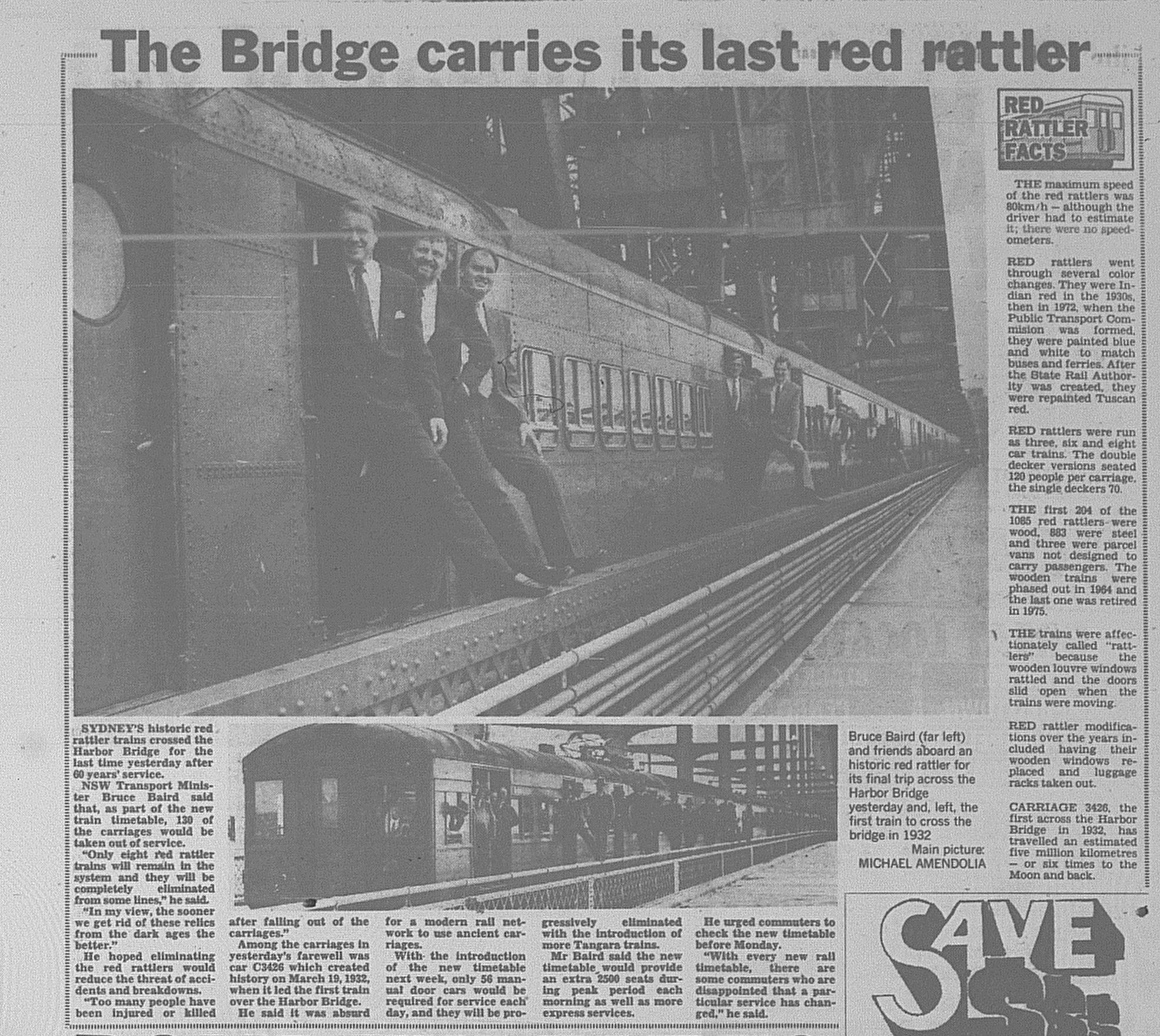
On January 10, 1992 red rattler trains crossed the Sydney Harbour Bridge for the final time ahead of their retirement. For four minutes at 10:40, four eight car trains stopped on the Sydney Harbour Bridge to pay tribute to their service.
Source: Olsen, S. 1992. "End of line for rattlers". The Daily Telegraph Mirror, January 10: 9.
Source: Anon. 1992. "The Bridge carries its last red rattler". The Daily Telegraph Mirror, January 11:3.
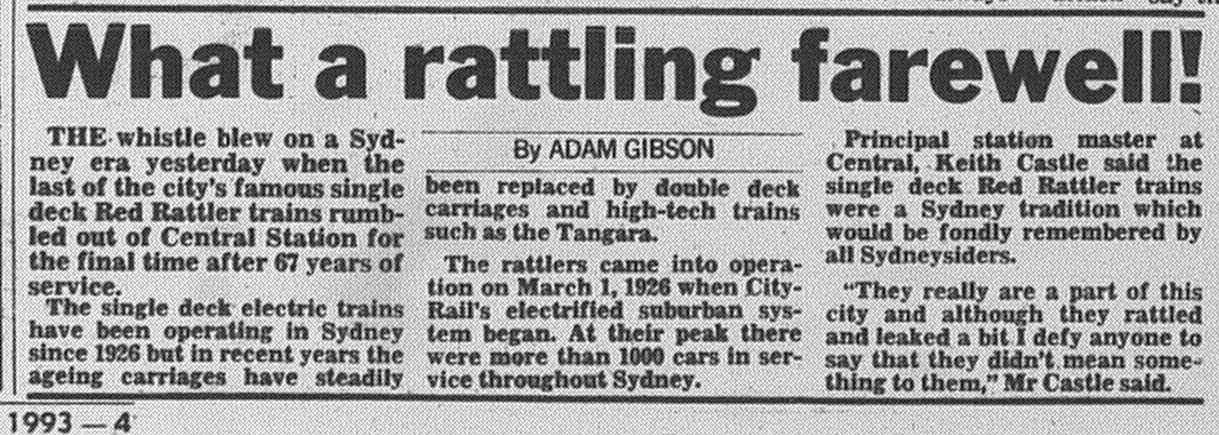
The retirement of the red rattlers led to a decrease in the number of carriages operating on the Sydney rail network, but the delivery of Tangara carriages meant by the end of 1993, the remaining eight trains in operation could be retired. The final services ran on November 20, 1993 after sixty seven years of service.
Source. Gibson, A. 1993. "What a rattling farewell!" The Sunday Telegraph, November 21: 4.
While the overwhelming majority of red rattlers were scrapped, several carriages have been preserved for historical use which has also been supported by Sydney Trains and the NSW Government. Special trips featuring the trains are organised, allowing people to either relive or experience riding a red rattler for the first time.
Finally a "bonus" - news reports from January 10 1992 when the red rattlers gathered on the Sydney Harbour for the final time.
Sydney's Monorail network which connected central Sydney with Darling Harbour operated between 1988 and 2013. It was controversial from its conception, construction and while in operation.
The Monorail was supposed to have commenced service in January 1988 as part of Bicentennial Celebrations with Prince Charles and Princess Diana to be the first passengers, but delays saw the monorail commence service in July, 1988.
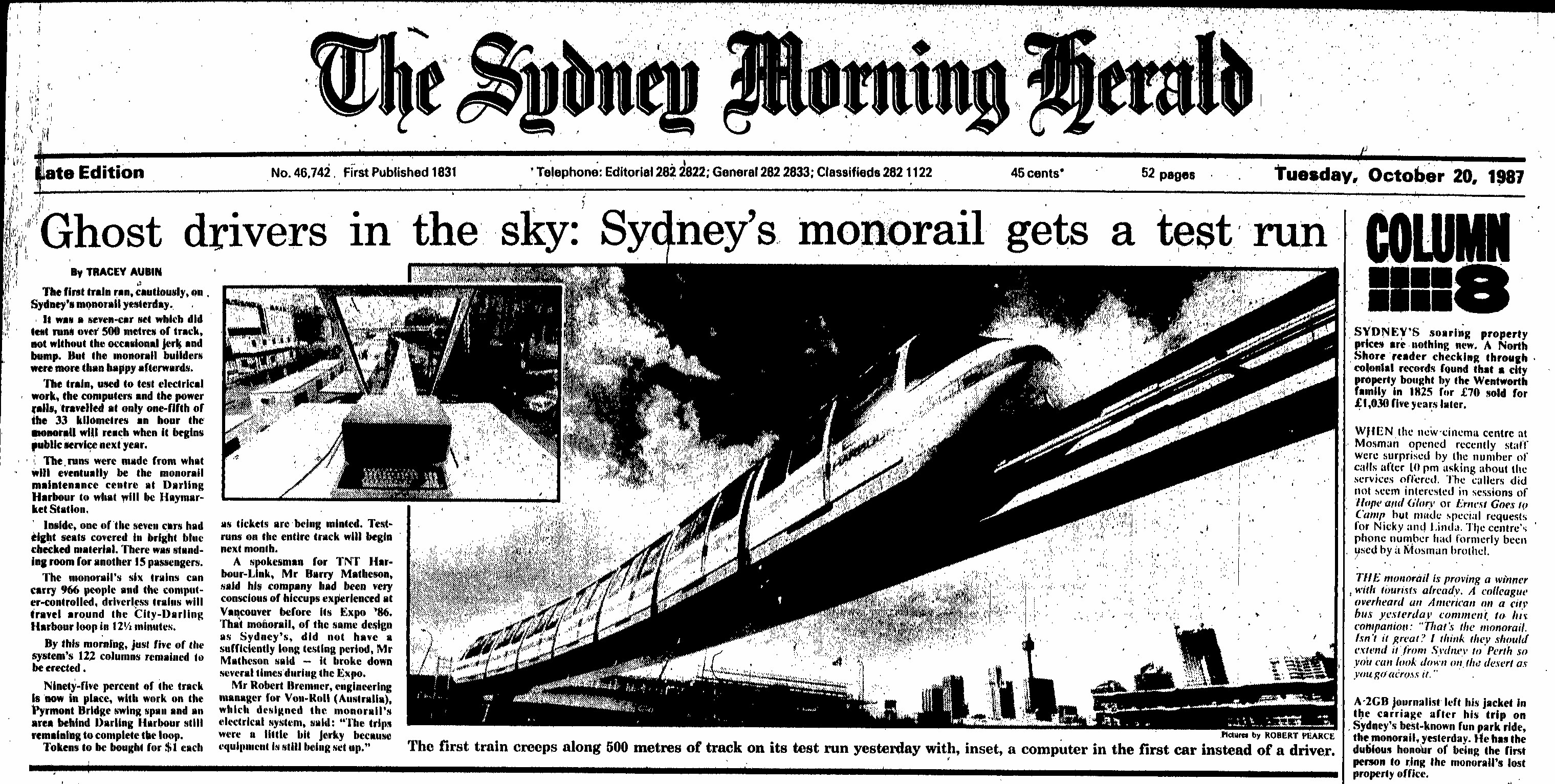
Source: Aubin, T. "Ghost drivers in the sky: Sydney's monorail gets a test run". The Sydney Morning Herald, October 20: 1.
In October 1987, the Monorail trains began the first of their test runs, using the tracks at their Maintenance Centre at Ultimo and travelling to the Haymarket Station.
Test runs were meant to have been run on the route from November 1987, but did not occur until February 1988. The first test run was on February 13 1988 in Liverpool Street and featured on the front page of The Sun Herald on February 14, 1988 (below). At the time it was anticipated that passengers could use the line from April, three months behind schedule. This did not eventuate.
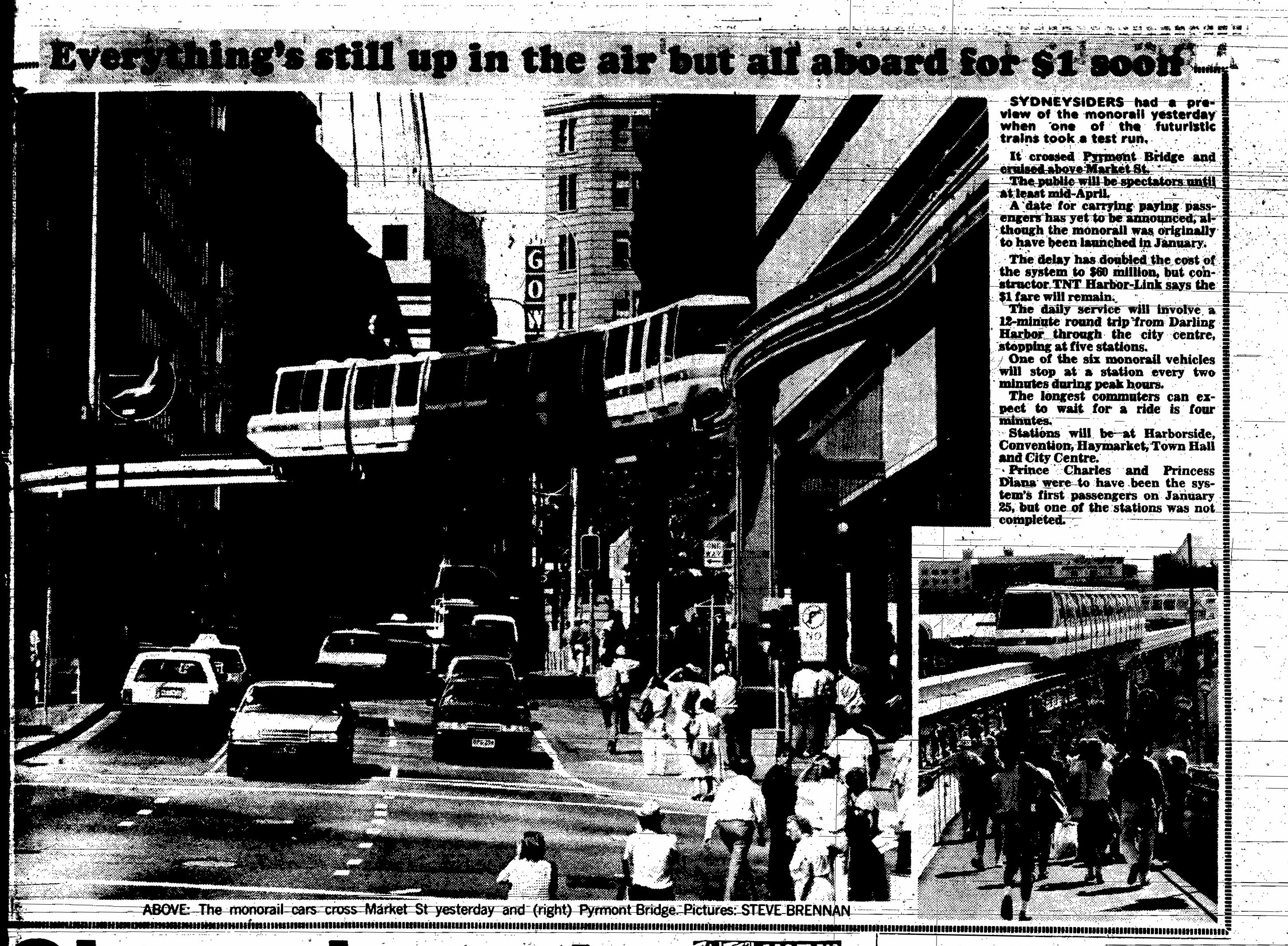
Below are another two newspaper clippings relating to test runs conducted soon after.
Source: Anon. 1988. "Everything's still up in the air but all aboard for $1 soon". The Daily Telegraph, February 27: 3.
Source: Stevens, R. 1988. Untitled (Photograph). The Sydney Morning Herald, February 24: 1.
In May, 6000 people were provided with an opportunity to ride the circuit ahead of its opening.
Source: Hewett, T. 1988. "A hum of satisfaction from above". The Sydney Morning Herald, May 16: page unknown.
James Oram was one of the first journalists to ride the monorail and shared his insights.
Source: Oram, J. 1988. "Magic Carpet Ride at 33km/h". The Sunday Telegraph, March 30:17.
Finally, I published an entry in 2018 that looked at the opening of the monorail in 1988. Click here to view the entry.


.jpg)
.JPG)
.CR3)


.CR2)