Showing posts with label 1959. Show all posts

Monday, 14 August 2023

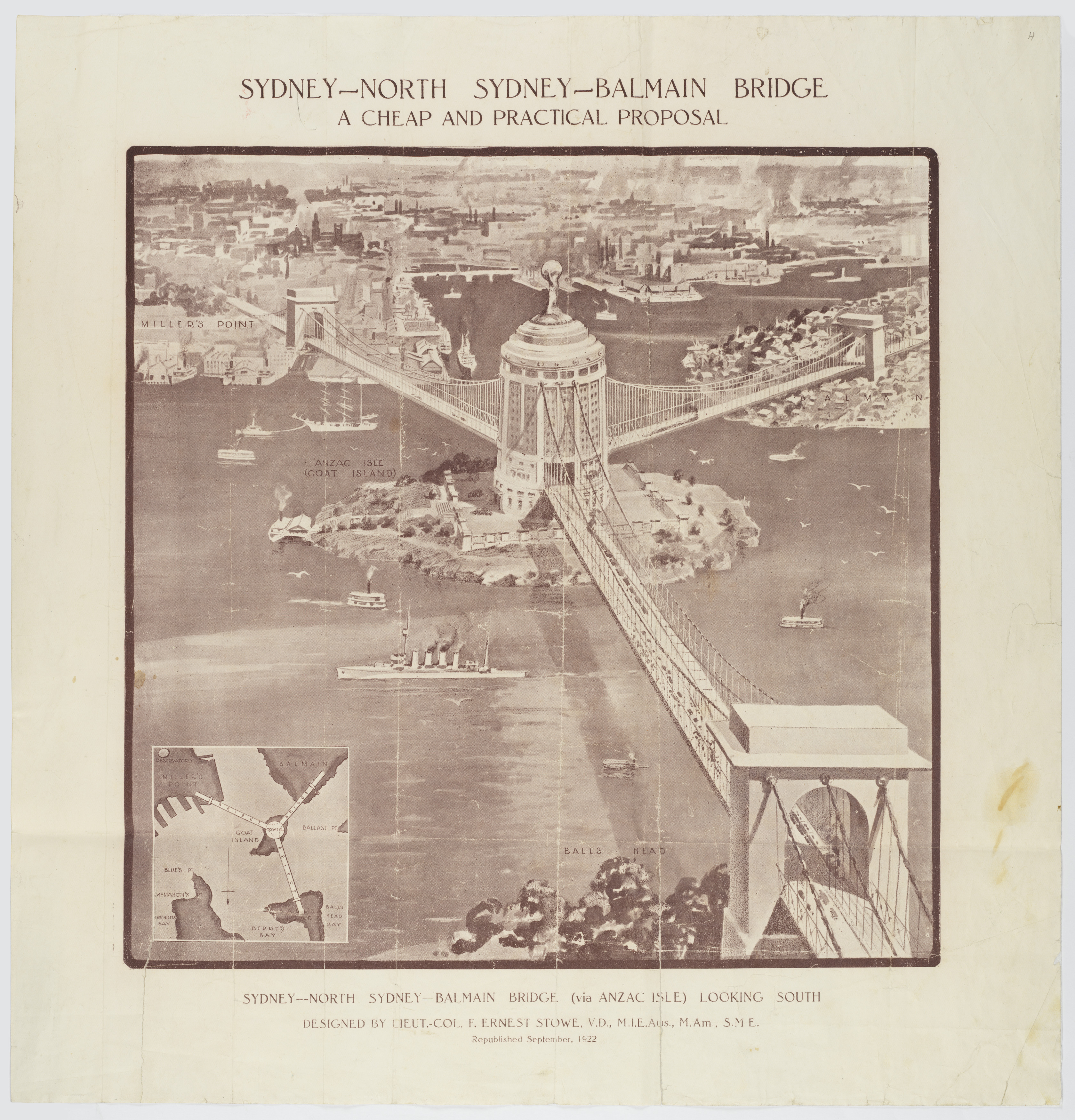
VISIONS OF SYDNEY: Triple-Bridge Plan to Span Harbour (1922)

Series 02: Item 15, Cuttings mainly regarding suggestions for a second harbour bridge in Sydney, 1922

Source: Item 15: Cuttings Mainly regarding Suggestions for a Second Harbour Bridge in Sydney, 1922, 1922. Accessed July 28, 2023, https://digital.sl.nsw.gov.au/delivery/DeliveryManagerServlet?embedded=true&toolbar=false&dps_pid=IE6258874&_ga=2.23513913.2006621465.1690502948-563559362.1682639266&_gl=1*1f7f6uc*_ga*NTYzNTU5MzYyLjE2ODI2MzkyNjY.*_ga_CYHFMM592Q*MTY5MDUxMzU1NS42LjEuMTY5MDUxMzg2OC41NC4wLjA. 

In 1922, engineer Ernest Stowe proposed a three-way bridge to cross Sydney Harbour as "cheap" solution to building a harbour crossing. The three bridges would have linked the Sydney CBD with the North Shore and Balmain. It was envisioned that the bridges converge in a central tower on Goat Island. It was floated as a proposal alongside what became the Sydney Harbour Bridge.

The proposal was floated in 1959 as a second harbour crossing by a Longueville resident who suggested that the bridge design be based on the Gladesville Bridge, which was proposed at the time. Below is an article from The Sydney Morning Herald in 1959.

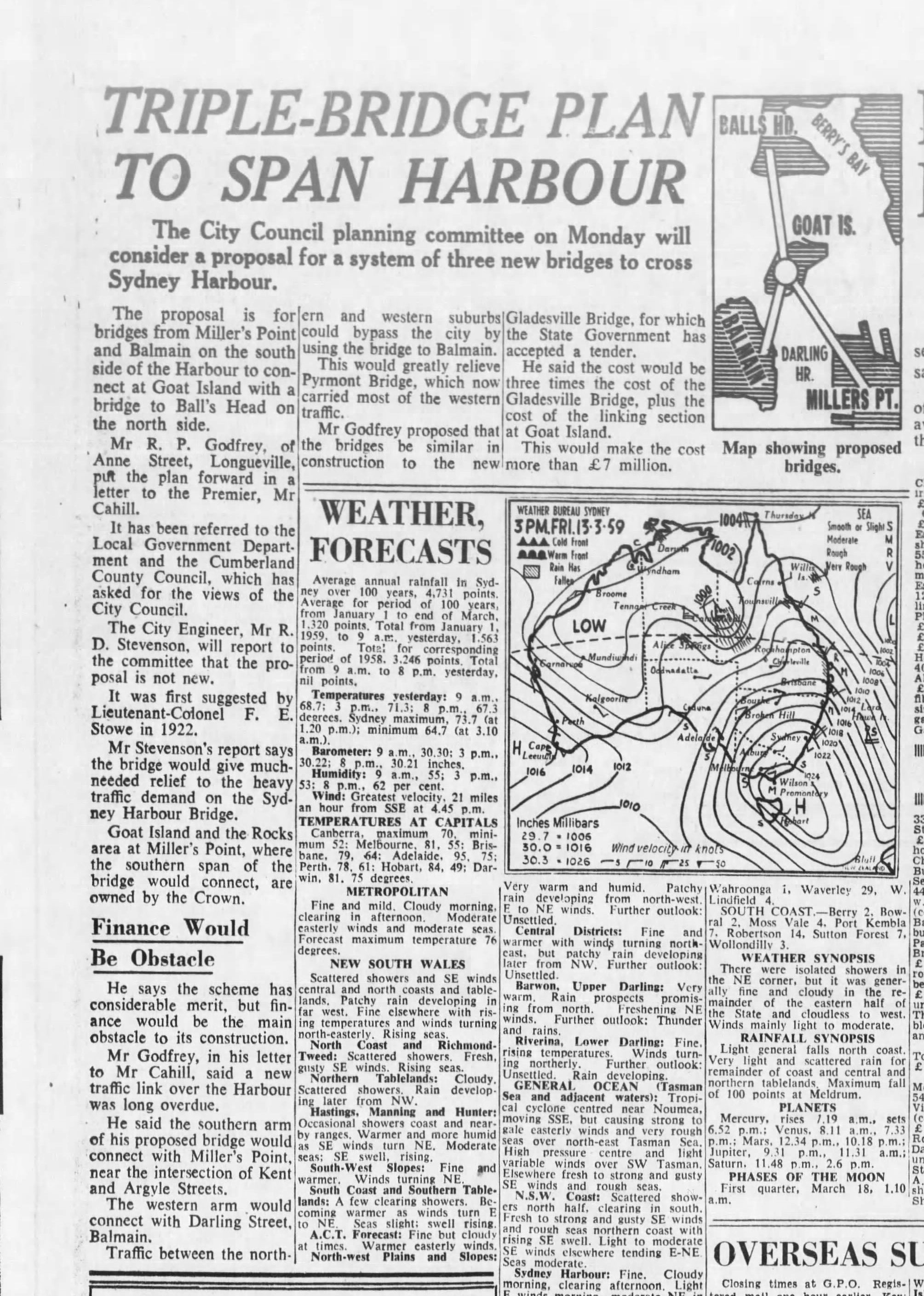
Triple Bridge Span Plan March 14 1959 SMH 9 enlarged

Triple Bridge Span Plan March 14 1959 SMH 9 

Source: Anon. 1959. "Triple-Bridge Plan to Span Harbour". The Sydney Morning Herald, March 14: 9.

In 1981, a scaled-down proposal was proposed. The bridge scheme was one of several schemes which included tunnels under Sydney Harbour running predominantly through the eastern half of the Balmain Peninsula.

Second harbour crossing December 7 1981 SMH 3 
Source: Malley, J. "Under or over the Harbour: a choice". The Sydney Morning Herald, December 7: 1. 

Locals on both sides of the harbour mobilised, citing concerns over the loss of homes and safety risks associated with tunnels. This eventually led to the proposal being dropped, which ultimately led to the construction of the Sydney Harbour Tunnel.

  Balmain Harbour Crossing June 30 1982 SMH 1 enlarged
Source: Glasscott, J. 1982. "Balmain mobilised against the second crossing". The Sydney Morning Herald, June 30: 1.

Four decades later, the Western Harbour Tunnel fulfils the vision to allow those driving from the west to cross Sydney Harbour without driving through the Sydney CBD and need not use the Sydney Harbour Bridge.

Instead of heading in a northerly or northwest direction as envisioned by Stowe in 1922, the tunnel will send motorists in a north-easterly direction under Balmain and Birchgrove to Sydney Harbour, underneath the harbour and under Balls Head and North Sydney before connecting with the Warringah Expressway. 

Monday, 26 June 2017

NEVER BUILT SYDNEY: Sydney City Council Proposal to turn the Queen Victoria Building into a public square (1959)

Some might remember in the early 1970s when architect Harry Seidler called for the demolition of the Queen Victoria Building in George Street and that a multi-storey carpark replace the building.

Demolishing the QVB was an idea for more than a decade. In the late 1950's Sydney City Council wanted the building demolished for a public square with an underground carpark modeled on public squares in San Francisco and Los Angeles.

One proposal called for York Street to be tunneled.


Source: Anon. 1959. "Lord Mayors Idea For A New Square". The Sun Herald, May 10: 12. 

They felt that the building was just half the value of the site itself and not earning revenue for the council, who were the landholders.  They felt the public square and carpark would earn more revenue.

The question will be asked - What if it became reality?
  • The proposed square for the eastern side of George Street would never be in the works.
  • Stricter building codes for York, Market and George Streets. Some of the tall buildings we see today might not have been allowed, especially those in more recent years. The impact would go even to King Street and beyond.
  • The focal point for events around Town Hall would have shifted to its north instead of the east. The public rallies and civil gatherings along George Street would not happen in the way we see today.
We should be grateful that one of finest buildings in Sydney from the Victorian era is still with us today. The decision to convert the building into a shopping centre has paid off massive dividends for Sydney. It is a much-loved destination for shopping in central Sydney and the most famous retail complex of all. It is a meeting place for people too. One can dine at a cafe and restaurant and watch the world go by. 

Related Entries
Added October 2022