Sydney Tower is just weeks away from celebrating its 45th Birthday, but this 1981 newspaper feature focused on delays in its opening.
It was not meant to open in September 1981, but plans had it opening early that year, except that it was too windy and rainy to warrant an opening. July was also considered as an opening date.
For retailers in Centrepoint, it was frustrating that they wanted the tower to open as soon as possible to lure tourists to their shops, but they were still optimistic. Sydney Tower would open, and the hordes would come.
Fast forward 45 years, ownership has changed hands. AMP sold the centre and tower to Westfield in 2001, and it was rebranded as Westfield Centrepoint. In 2009, a major redevelopment project merged Westfield Centrepoint, Imperial Arcade and Skygarden into one retail complex. Westfield also acquired Sydney Central Plaza in 2003 and, in recent years, under the Scentre Group, purchased the former David Jones Market Street store, which is now a mixed-use retail, commercial, and residential complex, to expand its footprint in central Sydney.
Westfield Sydney is regarded as a flagship retail complex within the Scentre Group and has been highly successful in attracting major labels and luxury brands into the centre. A total of 269 retailers trade in the complex
And, as in 1981, the overwhelming majority still have to reach the entrance to Sydney Tower through the centre and navigate the escalators and shops en route.
Source: Lawson, L 1981. "A long wait for the call from the AMP's minaret". The Sydney Morning Herald, February 28:42.
Source: Coles. 1981. "Pie & Chips" (Advertisement). The Daily Telegraph, August 31: 27.
In 1981, Coles Restaurants were offering for $1.25 a Superpie and hot chips
According to the RBA Inflation Calculator, the offer would be equivalent to a person spending about $6.17 today. Fantastic offer.
For soft drinks, there was a special offer during the school holiday period: refills cost just 30 cents. It would be equivalent to spending $1.48 today, which, depending on your view, may be a good value for money or not worth it. Typically, if you want another drink at a fast food outlet or a fast casual restaurant, you would pay full price, e.g. a large drink at McDonald's costs $6.00.
Sydney Tower opened to the public on September 25 1981. Below is an advertisement was published in The Sun Herald on September 6 1981.
Source: Sydney Tower. 1981. "Tickets to the Top Available Now" (Advertisement). The Sun Herald, September 6: 6.
General admission was just $3.50, with pensioners and children paying just $1.50. Tickets to visit Sydney Tower can be purchased in advance at participating outlets, including Mitchell Bass and Grace Bros stores in the Sydney metropolitan area.
Below is an advertisement from The Sun Herald, published on September 27 1981, just two days after opening. By this point, visitors and tourists could purchase directly at the door.
Source: Sydney Tower. 1981. "Sydney Tower is now open...Come on up!" (Advertisement). The Sun Herald, September 27: 40.
Also, this is the first television commercial for Sydney Tower, which was screened in the 1980s. Video uploaded to YouTube by "Shadow Archive".
In 1981, as part of the 150th Anniversary of the founding of The Sydney Morning Herald (originally known as The Sydney Herald ), the publishers of the newspaper (John Fairfax & Sons Limited) gifted the city with a new public square in Alfred Street between George Street and Alfred Street.
Source: Glascott, J. 1981. "Five pools in a fountain ... and all yours". The Sydney Morning Herald, April 17: 3.
On April 16 1981, the square was officially opened by Lord Mayor Doug Sutherland.
The Tank Stream Fountain is the focal point of the square. It was designed by sculptor Stephen Walker and was inspired by the Tank Stream, which once ran through central Sydney but is now a stormwater pipe.
Below are a few photos of the square I took in 2025.
Below is a 1981 newspaper advertisement for "The Savoy" apartment tower at the corner of King and Kent Street in central Sydney. It was among a number of apartment towers built in central Sydney during the 1980s
One-bedroom apartments were on offer from $126 000 which is equivalent to spending $606 000 today (RBA Inflation Calculator)
Source: City Living. 1981. "The Savoy" (Advertisement). The Sydney Morning Herald, August 1: 13.
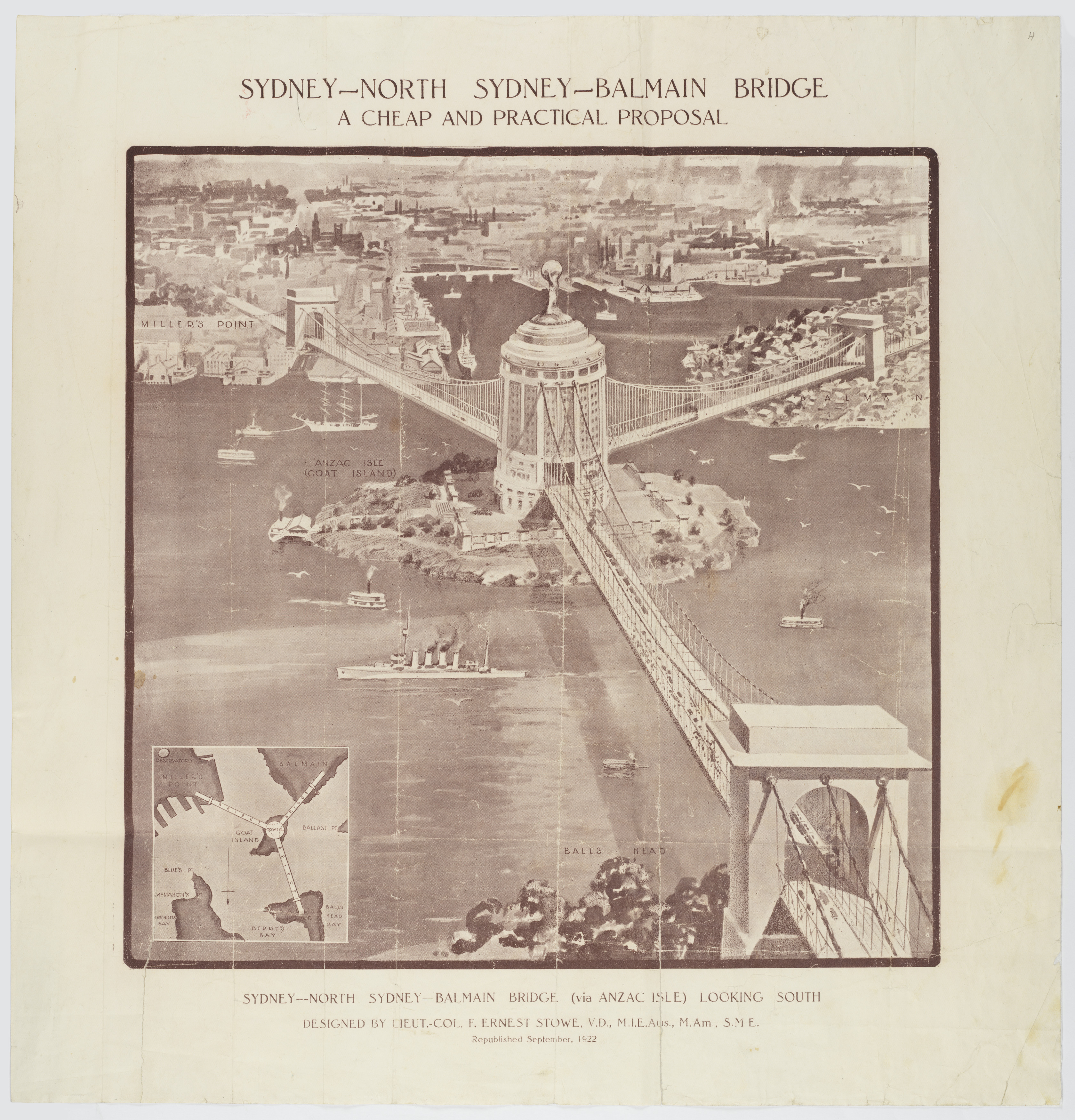
Source: Item 15: Cuttings Mainly regarding Suggestions for a Second Harbour Bridge in Sydney, 1922, 1922. Accessed July 28, 2023, https://digital.sl.nsw.gov.au/delivery/DeliveryManagerServlet?embedded=true&toolbar=false&dps_pid=IE6258874&_ga=2.23513913.2006621465.1690502948-563559362.1682639266&_gl=1*1f7f6uc*_ga*NTYzNTU5MzYyLjE2ODI2MzkyNjY.*_ga_CYHFMM592Q*MTY5MDUxMzU1NS42LjEuMTY5MDUxMzg2OC41NC4wLjA.
In 1922, engineer Ernest Stowe proposed a three-way bridge to cross Sydney Harbour as "cheap" solution to building a harbour crossing. The three bridges would have linked the Sydney CBD with the North Shore and Balmain. It was envisioned that the bridges converge in a central tower on Goat Island. It was floated as a proposal alongside what became the Sydney Harbour Bridge.
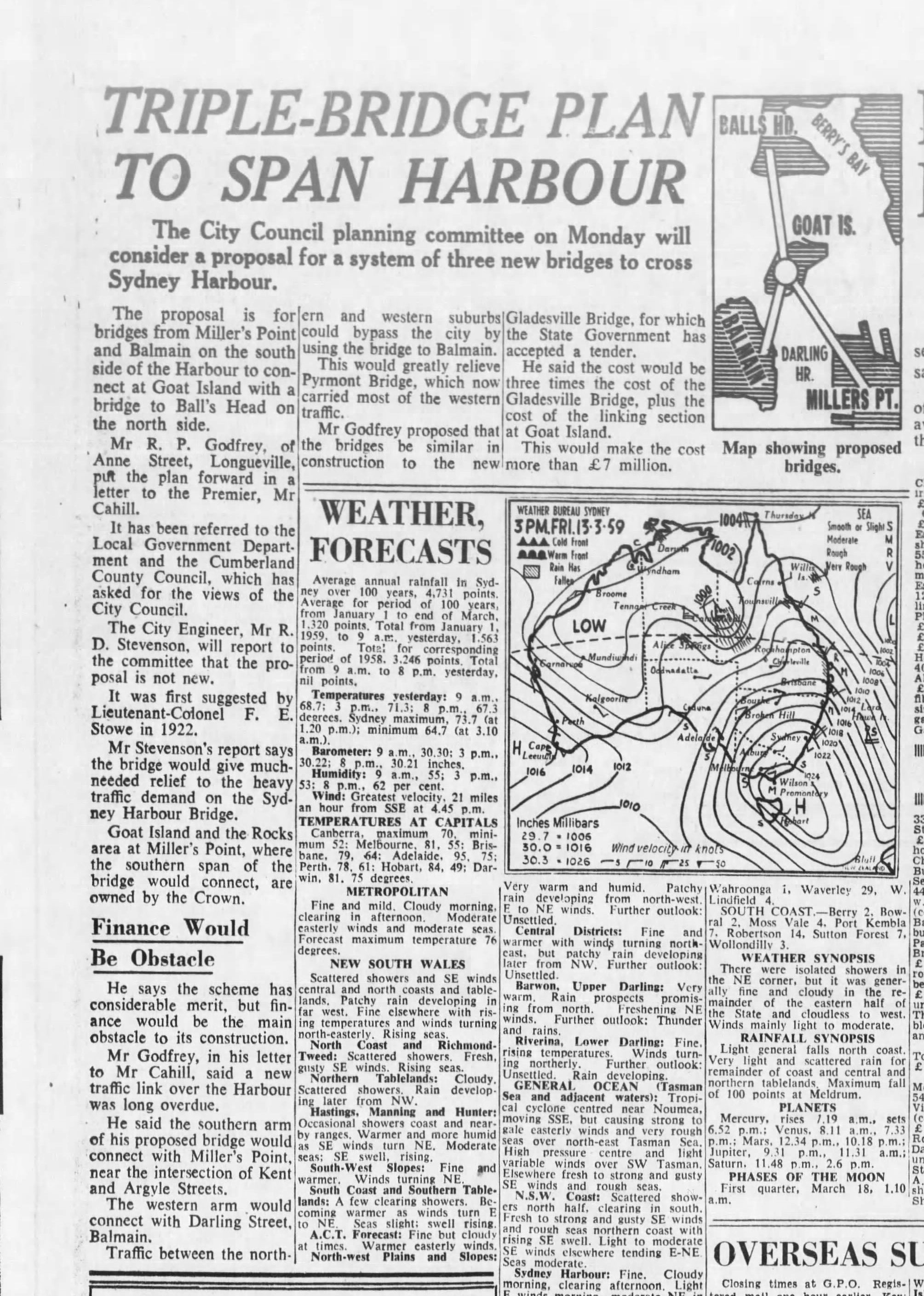
The proposal was floated in 1959 as a second harbour crossing by a Longueville resident who suggested that the bridge design be based on the Gladesville Bridge, which was proposed at the time. Below is an article from The Sydney Morning Herald in 1959.
Source: Anon. 1959. "Triple-Bridge Plan to Span Harbour". The Sydney Morning Herald, March 14: 9.
In 1981, a scaled-down proposal was proposed. The bridge scheme was one of several schemes which included tunnels under Sydney Harbour running predominantly through the eastern half of the Balmain Peninsula.
Source: Malley, J. "Under or over the Harbour: a choice". The Sydney Morning Herald, December 7: 1.
Locals on both sides of the harbour mobilised, citing concerns over the loss of homes and safety risks associated with tunnels. This eventually led to the proposal being dropped, which ultimately led to the construction of the Sydney Harbour Tunnel.
Source: Glasscott, J. 1982. "Balmain mobilised against the second crossing". The Sydney Morning Herald, June 30: 1.
Four decades later, the Western Harbour Tunnel fulfils the vision to allow those driving from the west to cross Sydney Harbour without driving through the Sydney CBD and need not use the Sydney Harbour Bridge.
Instead of heading in a northerly or northwest direction as envisioned by Stowe in 1922, the tunnel will send motorists in a north-easterly direction under Balmain and Birchgrove to Sydney Harbour, underneath the harbour and under Balls Head and North Sydney before connecting with the Warringah Expressway.
Source: Macquarie Centre. 1981. "Macquarie Centre Now Open" (Advertisement). The Sydney Morning Herald, November 17: 15.
On Wednesday (17 November), Macquarie Centre will celebrate forty years of trading. After a decade of planning and two years of construction, the centre was opened by NSW Premier Neville Wran on 17 November 1981.
Last week, I focused on Grace Bros' plans for the centre and its attempt to seek approval to build their centre. This week, as promised, I would share promotional content from various newspapers.
Key Facts at opening
Approximately 145 retailers
3750 car parking spaces
Grace Bros, Woolworths and BigW were the major tenants
The first ice-rink to operate in a shopping centre in Australia and can be covered to accommodate other uses such as tennis and ballet.
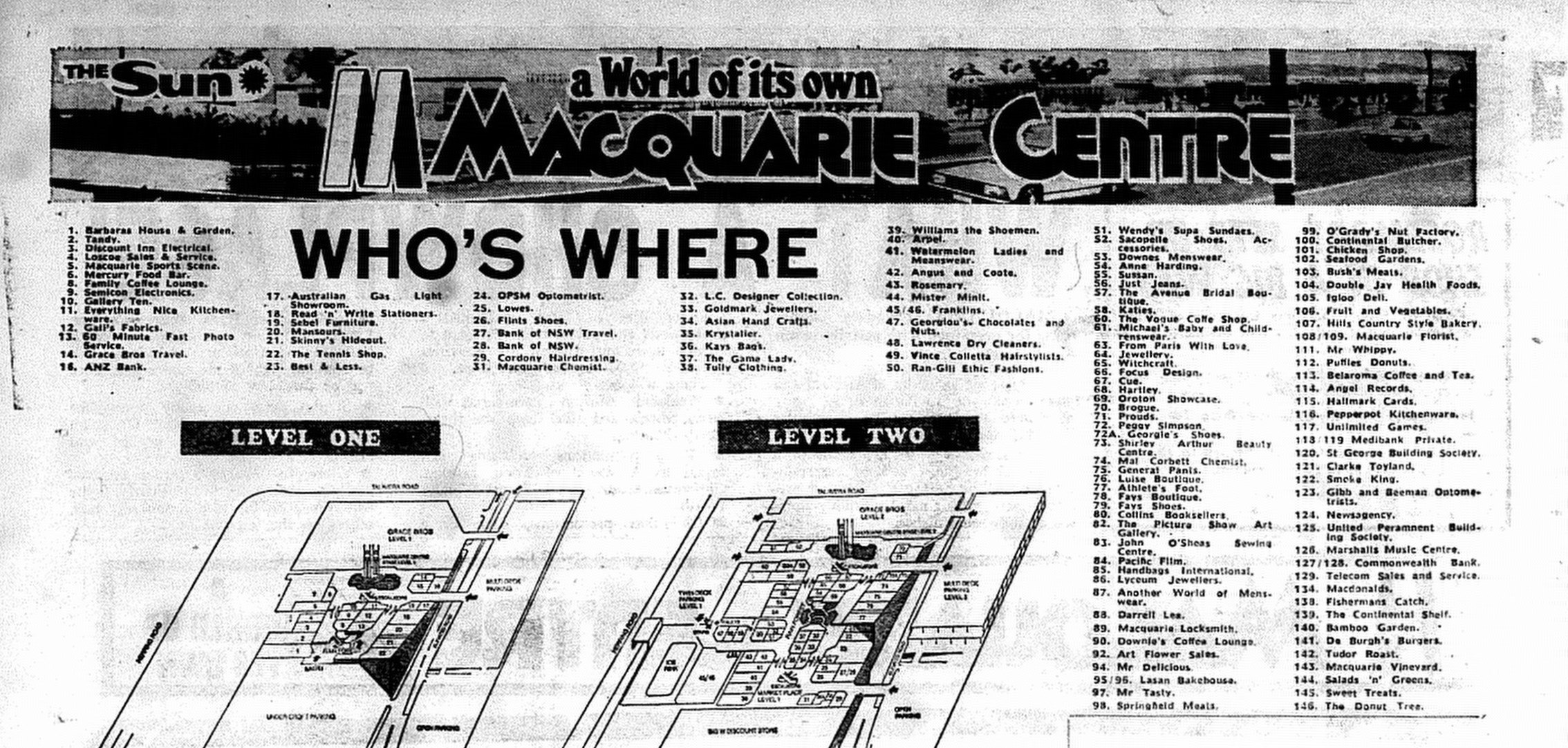
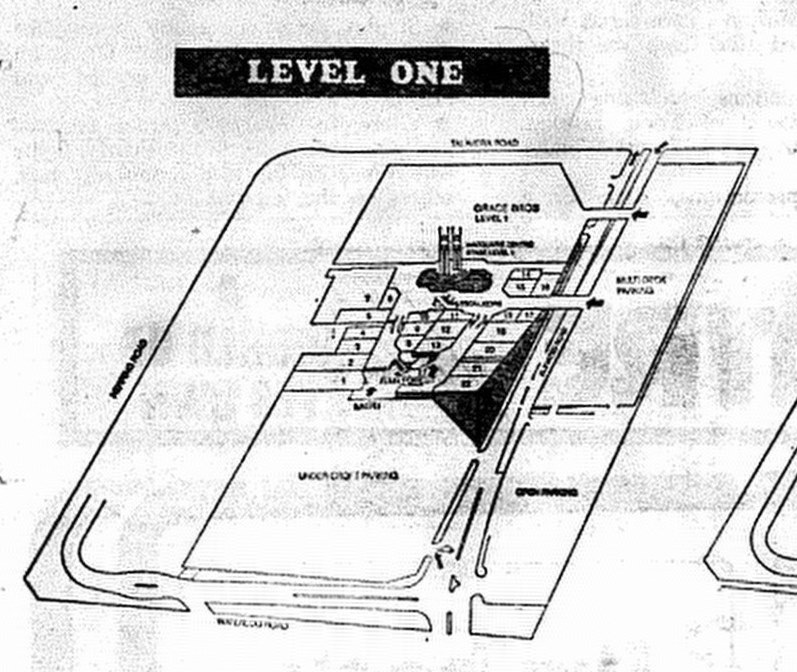
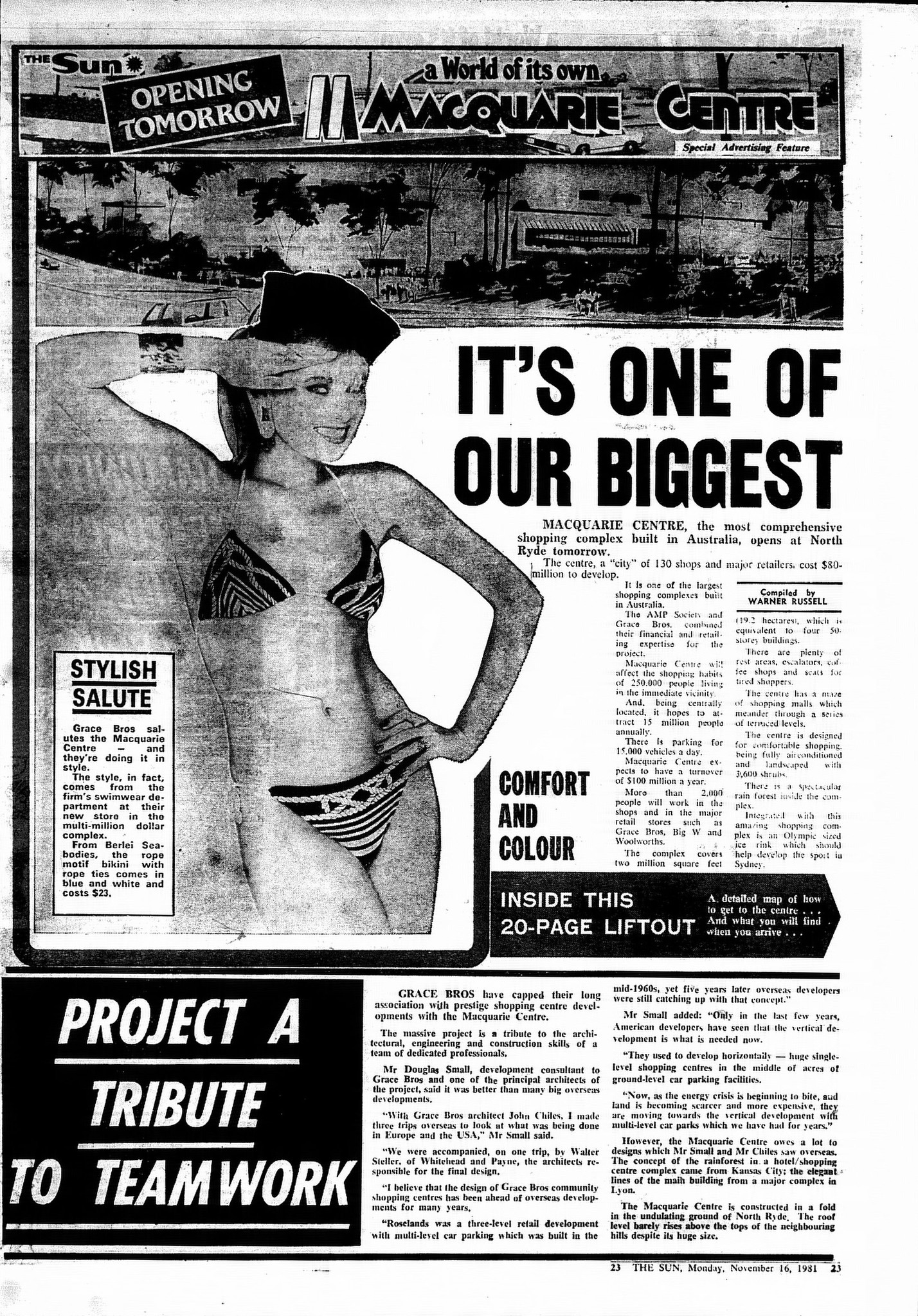
The Sun featured a centre directory including maps to aid shoppers navigating the complex.
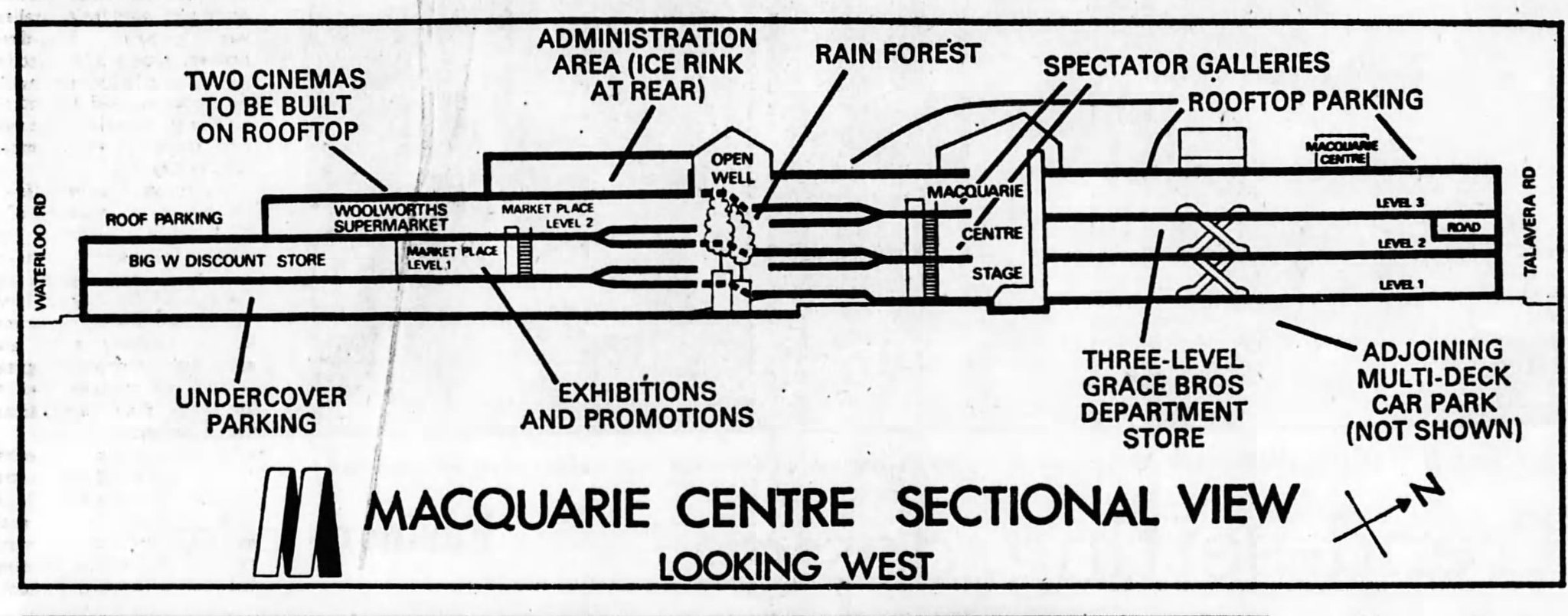
The Sydney Morning Herald (November 17, 1981) published this sectional view to show how it stepped up.
Source. Anon. 1981. “Macquarie Centre Sectional View: Looking West. Image. The Sydney Morning Herald, November 17: 13.
Below is a Grace Bros advertisement to promote their new store.
Source: Grace Bros. 1981. “Grace Bros at Macquarie: Opens Today - Styled For The Year “2001”” (Advertisement). The Sydney Morning Herald, November 17: 16-17.
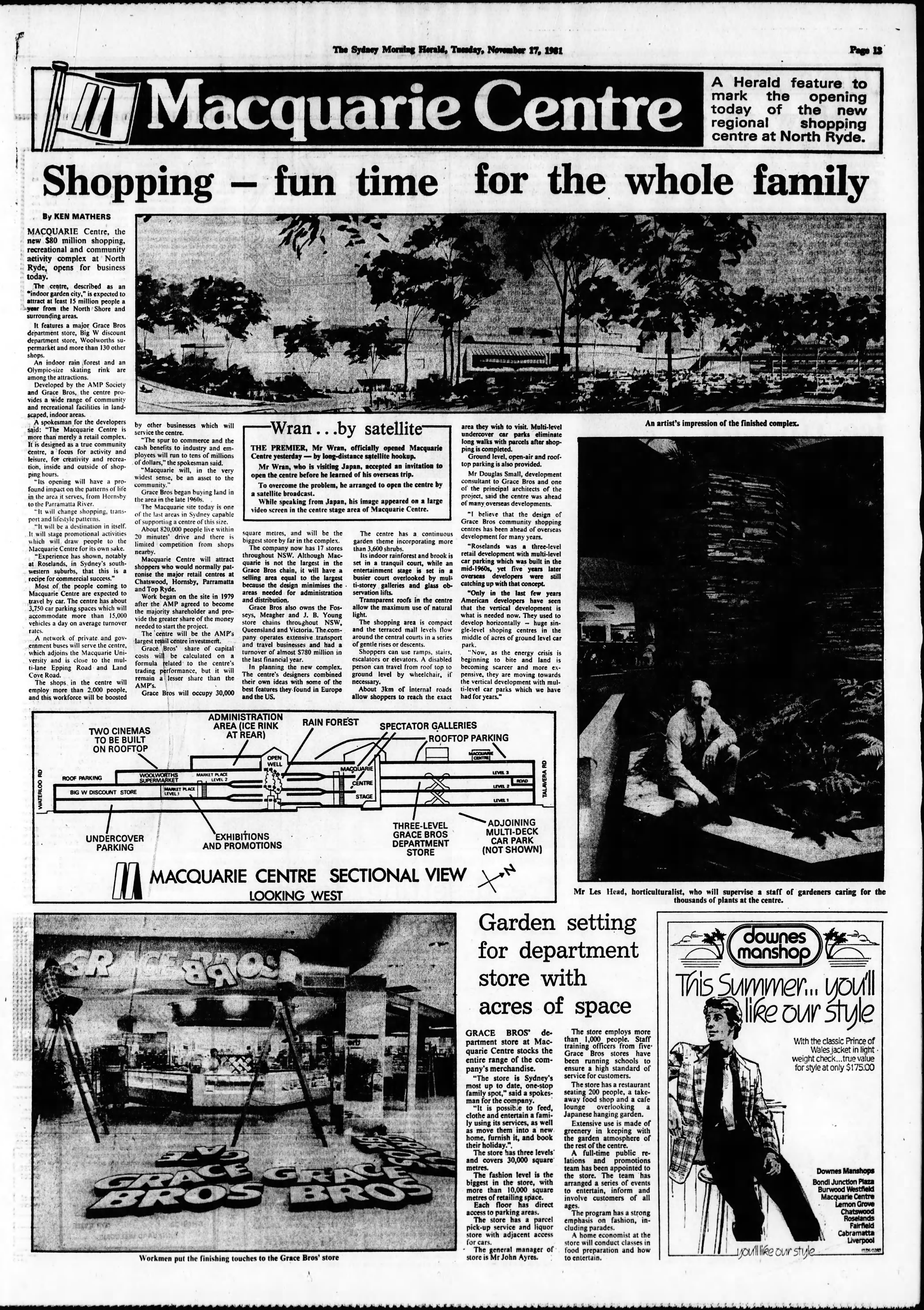
Below are some selected features from the newspaper supplements.
The Daily Mirror (16 November 1981)
The Sun (16 November 1981)
The Sydney Morning Herald (17 November 1981)
The centre forty years later
COVID-19 restrictions in recent months have made it difficult for any Sydneysider to travel around our great city and hopefully in 2022, can do a follow up post on the centre today by visiting the centre in person. I have not visited the centre since 2017 when I went there for lunch. Photography of the centre will pose a challenge, especially internal shots.
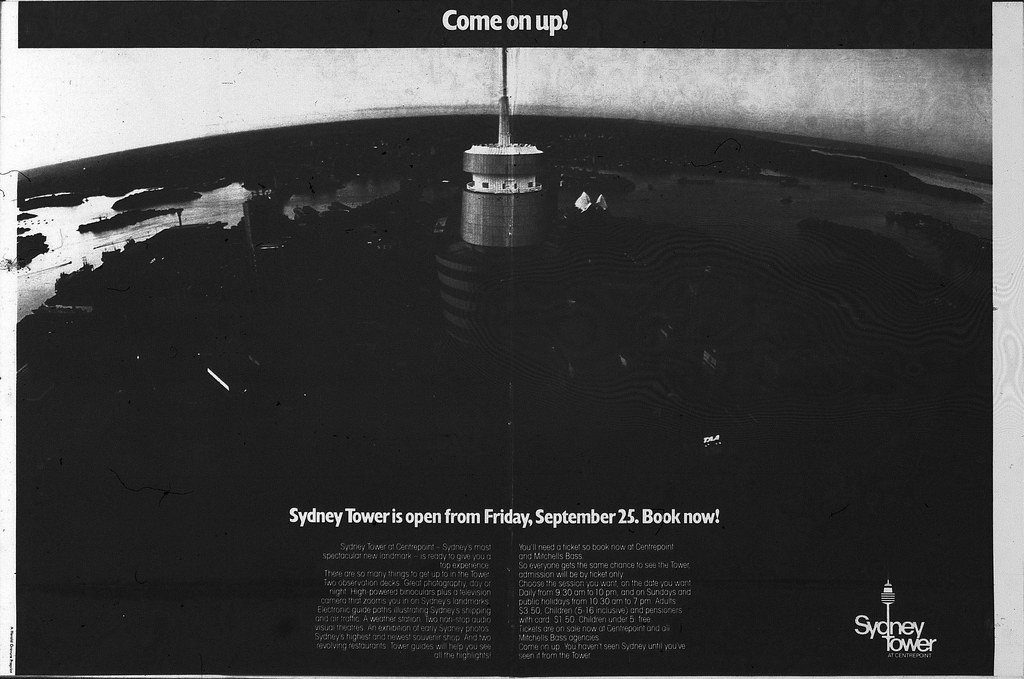
An advertisement published in The Daily Telegraph in September 1981 to promote the opening of Sydney Tower. I recall it was published on September 24.
It took thirteen years for the vision of Donald Crone and the AMP to become a reality. Construction of the tower began in 1974 and took 7 years to complete.
Source: Warnock, S. 1981. "Some guys can afford to be smiling...when they're at the top". The Daily Telegraph, September 24: 2-3.
In September 1981, the public was finally allowed inside Sydney's tallest structure. The official opening was on September 23, 1981, by NSW Premier Neville Wran. He received a gold token that gave him free access for life. The public gained access two days later to the observation deck and two revolving restaurants.
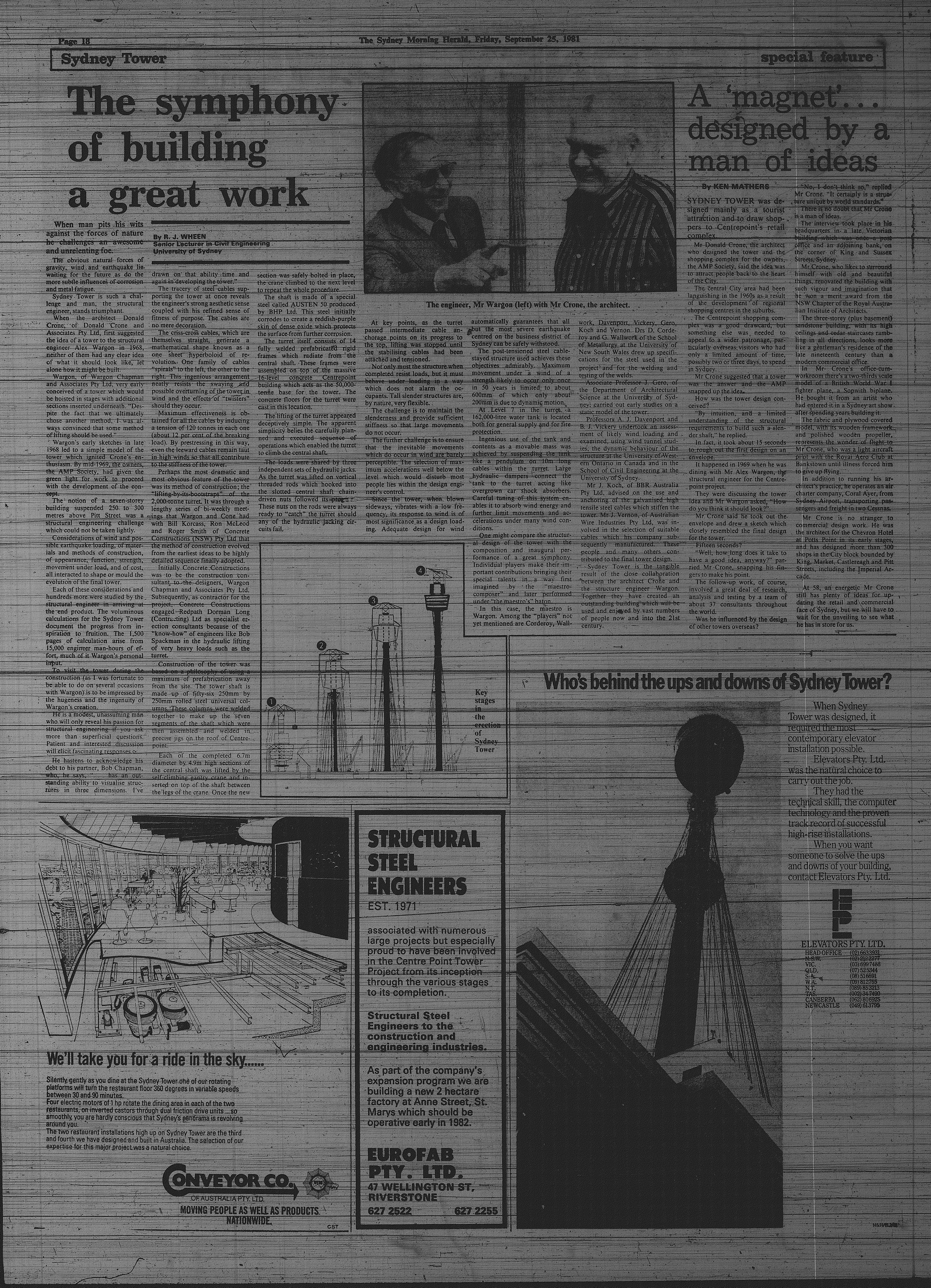
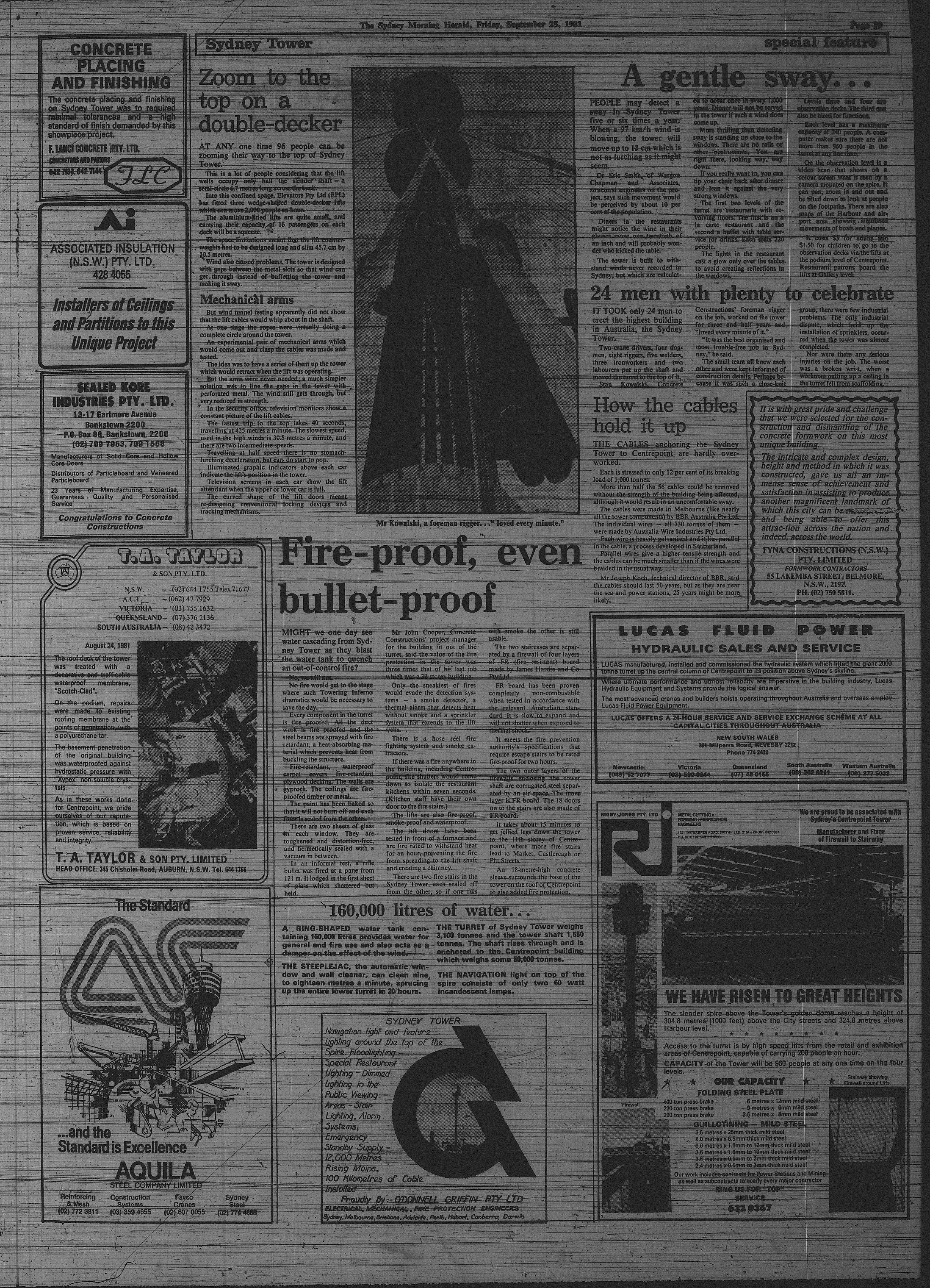
The Sydney Morning Herald published a special supplement on September 25, 1981, focusing mainly on the construction of the structure.
This is believed to be one of the first commercials to promote Sydney Tower.
Since 1981, it has been the main observation deck in the Sydney CBD. The observation deck at Australia Square closed immediately after the completion of Sydney Tower. However, the observation deck (and museum) on the southern pylon of the Harbour Bridge continues to be open decades after opening.
Crown Sydney will offer an observation deck at a similar height to Sydney Tower when it is completed in 2021, but I think Sydney Tower will continue to attract the hordes.
The construction of Sydney Tower has profoundly impacted on the evolution of the city skyline. It's central location in the "midtown" precinct has meant that Sydney Tower appears to be in the middle when viewing the skyline from any vantage point in the metropolitan area. Sydney Tower hence appears as the "summit" on the city skyline. The photos below illustrate the arc as seen from various locations around the city.
Until recent times, it has also been a yardstick for city development. While planning guidelines control building heights to preserve streetscapes and protect city parks, streets and public spaces from overshadowing, it has also been used to protect the views from Sydney Tower.
As for the tower itself, visitors have been provided with additional experiences including the Skywalk (introduced in 2006) to provide an outdoor viewing experience, 4D cinema feature at ground level.
Currently, Sydney Tower is managed by Merlin Entertainment and is currently branded as the Sydney Tower Eye. Merlin Entertainment is also responsible for several tourist attractions in Sydney including Sydney Aquarium, Sydney Wildlife Park and Madame Tussauds. Tourists can buy integrated passes that allow access to those venues on one pass.
Sydney Tower and Centrepoint has been owned by Westfield since 2001 after it was sold by AMP. In 2011, Westfield relocated their headquarters into the office building after a major renovation. This included the redevelopment of the retail complex which also encompassed the former Imperial Arcade and Skygarden shopping centres to create one large city shopping centre - Westfield Sydney.
Westfield Sydney also includes the former Sydney Central Plaza directly opposite in the Pitt Street Mall.


.JPG)
.JPG)
.JPG)
.JPG)