Showing posts with label Sunday Trading. Show all posts

Monday, 25 September 2023

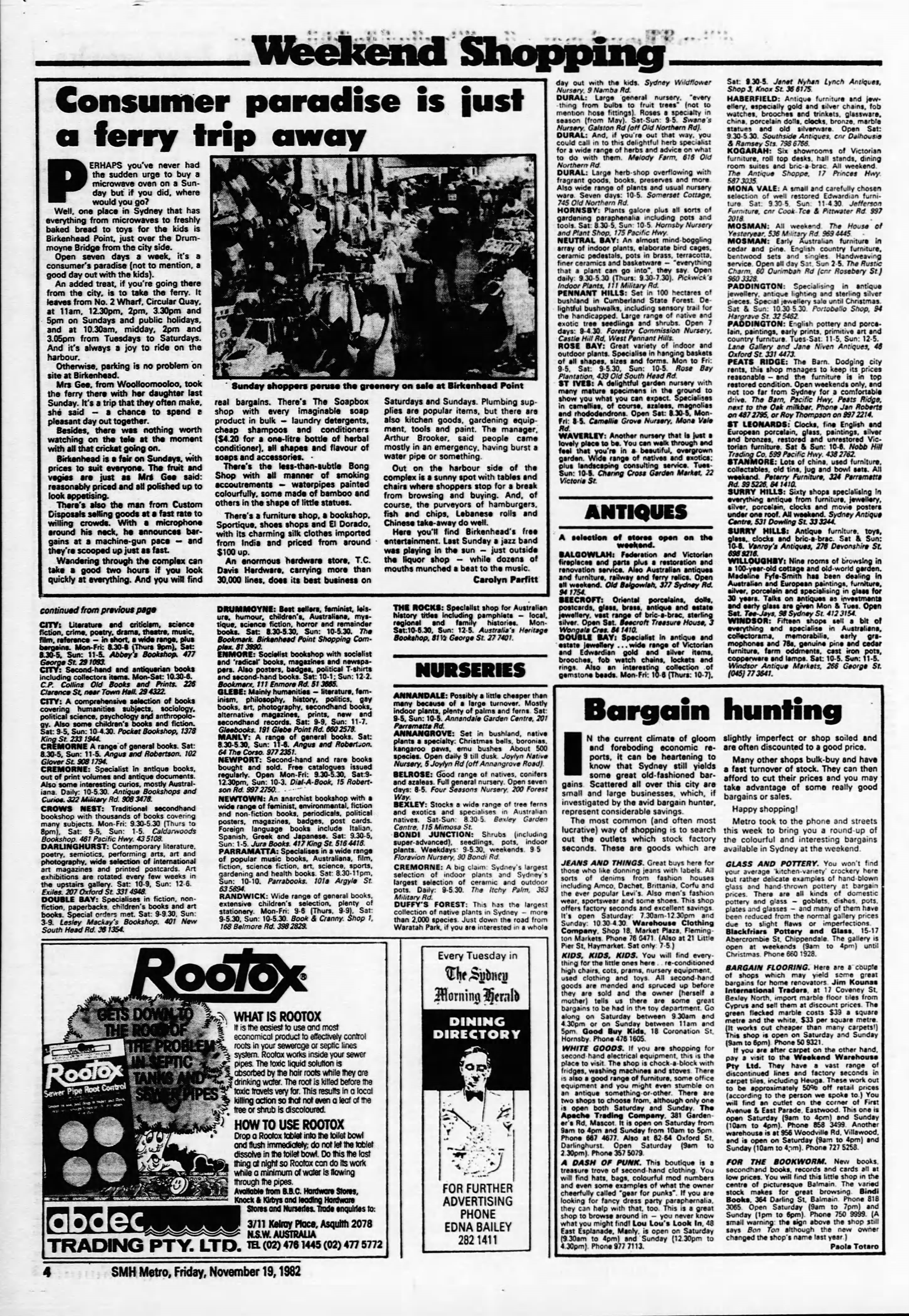
1982: Weekend Shopping - SMH Feature

Forty years ago, retail trading hours for shops were heavily restricted on weekends. Shops were required to close at noon on a Saturday and were not permitted to trade on a Sunday. By the 1980s, major retailers such as Harvey Norman, Norman Ross and Waltons were challenging the laws by identifying loopholes with either success or failure.

Extending retail hours on weekends was opposed by the unions, citing the right of workers to have Sunday off and continued throughout the decade, though by the end of the decade, Sunday trading would be phased in, though gradually into the 1990s. 

Meanwhile, a court ruling in 1982 by Jim Macken in the NSW Industrial Commission raised concerns about big businesses i.e. Harvey Norman and Norman Ross extending their trading hours at the expense of small businesses, which relied on the weekend trade for their survival.

The Sydney Morning Herald's weekly Metro liftout published a feature in 1982 that provided Sydneysiders with a guide to shopping on weekends once the shutters went down at noon on Saturdays.

Reporter Mary Lord spent one weekend exploring the metropolitan area to see what was open on weekends and this is what she unearthed:

  • Birkenhead Point offered "everything" on a Sunday.
  • Manly offered options for "After-hours shopping" including clothing stores, bookstores and chemists.
  • Kings Cross - most of the usual shops were open but 'very little" could actually be bought on Sundays
  • Harvey Norman, Auburn - "mecca" on Parramatta Road, which attracted "more buyers at weekends".
  • Norman Ross & Waltons conducted "warehouse sales" at Homebush, Homebush Bay or Granville as they would not be subject to general shop laws.
  • Hardware stores - smaller stores were open on weekends.
  • Hudson's in Miranda was "open at back and staffed by management only"
I have included the feature below with a full citation.

Source: Lord, M. 1982. "The Weekend Shopper". The Sydney Morning Herald, November 19: 2-4 (Metro Liftout).

Weekend Shopping Feature November 19 1982 SMH Metro Liftout Weekend Shopping November 19 1982 SMH Metro 3 Weekend Shopping November 19 1982 SMH Metro 4

Monday, 29 May 2017

1992: Introduction of Sunday Trading

Last week, we explored the introduction of Saturday afternoon trading in NSW in 1984. As the decade rolled on, pressure was being applied by some retailers to allow shops to trade on a Sunday. A number of major retailers had been flouting a loop hole in trading laws to allow them to trade.

This was led by Electrical and Whitegoods chains like Harvey Norman and Norman Ross. the argument was simple - Sunday provided time for people to buy goods that they needed for their homes.

Meanwhile, illegal Sunday trading continued as The Sydney Morning Herald highlighted in 1985. Hardware chains were trading on Sundays in order to compete with smaller operators, who were allowed under legislation to trade.


Source: Howlett, S. 1985. "Sunday Trade is Booming". The Sun Herald, April 2: 28. 

By late 1987, Premier Barrie Unsworth announced that he would explore allowing Sunday trading in parts of Sydney. The Greiner Government was elected the following year and took it a step further. It deregulated retail trading hours from Monday to Saturday. Furniture, Electrical and Hardware Stores were permitted to trade from 10am to 4pm on Sundays.


Source: Taylor, T. 1988. "The shop counter revolution". The Sunday Telegraph, October 23: 4. 

Other retailers could exemptions from Sunday trading laws. In 1988, Grace Bros was allowed to open their CBD store on a Sunday. It had become the first department store in Australia to trade on a Sunday. 


Source: Coles Myer Ltd. 1988. "Our City Store is open Today and Every Sunday 10am-4pm (Advertisement). The Sunday Telegraph, December 11: 30 & 31. 

However they were unsuccessful in gaining approval for another six of their stores to open.


Knowles, C & Bowditch, D. 1988. "Grace Bros bid to open Sundays". The Daily Telegraph, November 16: 8. 

The Sydney Morning Herald did foresee that Sunday trading for all retailers was inevitable as shown in this editorial from late 1988.

In December 1989, retailers were given permission to trade on the two Sundays leading up to Christmas, after successfully persuading the NSW Government to change its decision on keeping shops closed. I posted them in a Christmas feature several years back if you wish to browse through them. The public voted with their feet (and wallets).

This was repeated through 1990 and 1991.

During 1992, Sunday Trading was introduced throughout Sydney. It began with major shopping centres or retail precincts like the Sydney CBD, Parramatta, and Chatswood and expanded through regions across the metropolitan area. By the end of the year, Sunday trading was available in all suburbs. The argument by big retailers was that it was shoppers, not the law that should determine when a shop should be open. The State Government also passed legislation that finally led to deregulation of standard retail hours.

For your interest, I have also included another editorial relating to Sunday trading as The Sydney Morning Herald saw it in 1992.

For the first time too, Post Christmas sales could also commence on a Sunday as December 27 was the first day that trade could be allowed after Christmas. It happened that December 27 fell on a Sunday that year.

When you look at Sunday trading 25 years later, shoppers have voted with their feet. How hard is it to find a place to park your car on a Sunday if you are at a major shopping centre? There are some that would prefer that the shops still stay close on a Sunday on either religious or social grounds i.e. give time for people to be with loved ones, but its each of us that has the choice.

Sunday Trading was generally between 10am and 4pm, though it has now been extended to 5pm. Supermarkets and other major retailers initially had to stick to those hours, but gradually were relaxed.


Monday, 21 December 2015

Christmas Snapshot: 1990

Christmas is on this Friday, and this week we focus on how Sydney marked Christmas in 1990.

1990 wasn't as a dramatic as the year before, but Australia was entering the recession "that we had to have". In November, Paul Keating delivered the news that the nation was going to dread.

So Christmas 1990 was going to be tough for some and the fear of losing one's job or income would see some keep their cash in their wallets.

It was up to the retailers to persuade you to put your fears aside as these advertisements show.
Grace Bros were happy to save the best deals until the last moment, a bit of a forerunner to some of the deals you see in the lead up to December 25.


Source: Grace Bros. 1990. "We've Left The Best 'Til Last (Advertisement). The Sunday Telegraph, December 23: 18.


Source: Brashs. 1990. "Brashs 4 Day Christmas Sellout (Advertisement)".  The Daily Telegraph Mirror, December 21: 22. 

And Woolworths promised lots of specials.


Source: Woolworths. 1990. "Christmas brings you Lower Prices (Advertisement)". The Daily Telegraph Mirror, December 19: 56-57. 

As with 1989, retailers were permitted to trade on the two Sundays in the lead up to Christmas Day (December 16 and 23) which actually required legislation by the NSW Government to be passed before it was approved. Sunday trading was generally still not allowed in NSW.

The Christmas Season in Sydney had begun over a month before. On November 11, Grace Bros put on their second annual Christmas Pageant which began the Christmas season as an estimated 200 000 lined city streets to welcome Santa Claus to Sydney on November 11. The parade was held under sunny skies as celebrities and Santa himself was paraded down Macquarie, Market and George Streets through to Darling Harbour.


Source: O'Rourke, J. 1990. "200 000 join parade". The Daily Telegraph Mirror, November 12, 4-5. 

Carols in the Domain was held on December 22. It had an earlier starting time than today (7:30pm) and the Electricity Commission replaced Esso as the main sponsor.


Source: Anonymous. 1990. "Carols in the Domain". The Sunday Telegraph, December 23: 4. 

Western Sydney had their major carols event to compete with those in the east. On December 16, 40 000 packed Parramatta Stadium for the St George Carols by Candlelight.

Christmas 1990 didn't produce the dramatic news events that shaped the following Christmas, but bushfires on the northern beaches tried to put a dampener on celebrations. Fires swept through suburbs including Wahroonga, North Turramurra, Forestville, Killarney Heights, Terry Hills & Allambie Heights on December 23. Around 20 homes on the Central Coast were destroyed by fires. Cyclone Joy was also menacing Far North Queensland but was downgraded to a tropical low by the time it crossed the coast near Townsville.

The front page of The Sydney Morning Herald on December 24, 1990, with some amazing pictures of bushfires on Sydney's Northern Beaches. 

On Friday, I was taking some Christmas themed photos in the city, and one of my stops was the Queen Victoria Building, where their Christmas tree just becomes more and more ornate each year.


Photos taken by the Author. 

Compare that with 1990, which was quite modest in my view.


Source: Bishop. K. 1990. "Artificial Christmas trees - a growth industry". The Sydney Morning Herald, December 22: 3. 

Next week, New Year's Eve 1990 is our focus and then we will scale back to one entry for the month of January. Given the huge interest in old property advertisements, I'll keep them going and that also gives me time to research.

I wish you all a very Merry Christmas.


Monday, 22 December 2014

Christmas Snapshot: 1989


Source: Anonymous. 1989. "Santa swaps sled for sailboard." The Daily Telegraph, December 26: 9.

For a Christmas Flashback, I've decided to go back a quarter of a century ago to 1989 to give a small snapshot of how the city marked Christmas.

1989 was a big year. Communism was falling apart in Eastern Europe and here at home, sharp increases in Interest Rates were beginning to hit with families and businesses on the nose.

As we know, the arrival of Santa to our department stores and shopping centres marks the start of the Christmas season in November. Grace Bros made sure it was grand with an estimated 200 000 people gathering on city streets on a very wet November morning (November 11) to welcome him to the city for their first ever Christmas Parade.  There were plenty of stars involved including Grace Bros Ambassador Deborah Hutton, Kay Cottee (Sailor), entertainer Normie Rowe and pop star Colette.


Source: Anonymous. 1989. "Ah, music to pour over." The Daily Telegraph, November 13: 3. 

Advertisement for the parade.


Source: Coles-Myer Limited. 1989. "Grace Bros Christmas Parade (Advertisement)." The Sunday Telegraph, November 5: 26. 

The official program.


Source: Coles-Myer Limited. 1989. "Grace Bros Christmas Parade (Advertisement)." The Daily Telegraph, November 11: 20-21. 

1989 was the first time that all retailers were given permission to trade on Sunday's, but only on the two Sundays before Christmas (December 17 and 24). The previous year, Grace Bros had experimented successfully with Sunday Trading at its city store. This was not welcomed by the Allied Shops and Trades Union nor the Churches, but despite that many workers elected to work on both Sunday's attracted by double pay for the hours worked. People enjoyed the convenience that came with it knowing they had extra time to shop. Westfield claimed that 50% of its shoppers wanted Sunday trading. NSW was now another step closer to seven days a week trading. With Christmas Eve (December 24), it was generally the larger shopping centres that stayed open. Stores like BigW which had shops in smaller shopping centres. For instance, Bonnyrigg did not open while their Westfield Miranda store traded.

Below are several reports on Sunday trading from December 17 as covered by The Daily Telegraph, in its edition of December 18.


But even during the week you had plenty of time to shop with extended shopping hours. Westfield's trading hours for the week before Christmas gives us a good idea how late they traded. Compared to today it has changed little, except with weekends with an extra hour or two to trade.


Source: Westfield. 1989. "Open Today and Every Day until Christmas (Advertisement)." The Sunday Telegraph, December 17: 149. 

And an example of how the major retailer's restricted trade to larger centres. This one is from Coles New World Supermarkets.


Source: Coles Myer Limited. 1989. "We've extended our Christmas shopping hours... (Advertisement). " The Daily Mirror, December 22:13.

Peter Fitzsimons of The Sydney Morning Herald spent the Thursday evening before Christmas (December 21) at Grace Bros in the city. It was chaotic, and for some, it was their best chance to get their shopping done. Notice the time on the clock below.


Source: Fitzsimons, P. "To some, night is the time for shopping. " The Sydney Morning Herald, December 23: 2. 

And below a few of the Christmas specials provided by the department stores and supermarkets.

Target


Sources: 

Coles-Myer Limited. 1989. "Great fashion gift ideas at Target (Advertisement). " The Sunday Telegraph, December 17: 144-145.

Coles-Myer Limited. 1989. "Gift ideas for all the family at Target (Advertisement). " The Sunday Telegraph, December 17: 146-147.

Grace Bros


Source: Coles-Myer Limited. 1989. "Extended Hours for Shopping...Last Minute Gift Ideas (Advertisement). " The Sunday Telegraph, December 17: 26-27.

Coles/Fosseys


Source: Coles-Myer Limited. 1989. "Million dollar Summer Price Clearance (Advertisement). " The Daily Mirror, December 20: 52-53. 

Norman Ross


Source: Norman Ross Discounts. 1989. "Appliance and Toy Clearance (Advertisement). " The Daily Mirror, December 20: 16-17. 

Woolworths


Source: Woolworths. 1989. "Lower Prices For Christmas (Advertisement)." The Daily Mirror, December 20: 44-45.

In a report in The Sunday Telegraph, on December 24, retailers were reporting that business was "steady" and earnings would be slightly ahead on the year before, despite the tough economic times settling in.

Carols in the Domain had grown through the 1980s into a major community event and was held on December 16. The Sunday Telegraph reported on December 17 that 90 000 had attended the carols, hosted by Barry Crocker. For the record, it was sponsored by ESSO.


Source: Anonymous. 1989. "Sea of candlelight." The Daily Telegraph, December 24, 2. 

Over the past week, we have been treated to a terribly tragic event, right on the eve of Christmas with the siege at the Lindt Cafe in Martin Place.17 people were held hostage for up to 17 hours by gunman Man Haron Monia, a self-styled Iranian Cleric on Monday. The siege ended when police raided the cafe at approximately 2:15 am on Tuesday. Lawyer Katrina Dawson and store manager Tori Johnson were killed. At this stage, we know that Johnson was executed by the gunman Haron Monia, and hence led to the raid

The reaction by Sydneysiders has been of great shock and sadness which I have seen during the week, with thousands lining up to remember Dawson and Johnson at a floral memorial two blocks away from the cafe. Martin Place may be the scene of the crime but it also is the place where Sydney gathers. It has bought the city together, particularly given that Christmas is a time that we come together. We are good at doing that. We have also come together to grieve collectively for the dead. It also demonstrates true resilience. The fact the city is continuing on as normal is a sign of this. People are still working. People are shopping and making use of what the city has to offer. At the same time, we are taking time to reflect on it.

By the end of the week, we had learnt that a mother had killed her seven children and one nephew at her home in Cairns, which has given the nation yet another Christmas tragedy.

1989 also bought on its own tragedy during the Christmas season, which bought sadness upon the nation, though it would not measure to what saw last week. However, the loss of life was far greater than what we saw at the Lindt. 36 people were killed when two buses collided on the Pacific Highway near Clybucca Heads on the NSW North Coast. The incident occurred in the early hours of December 22. This is the worst ever loss of life on Australian roads. The collision had occurred two months after a coach collided with a semi-trailer, near Grafton, killing 21 people.


I found a video on Youtube of assorted reports relating to the crash as screened on Seven Nightly News in Brisbane on the night of December 22.


The 1980's was a bad decade for those who enjoyed speeding or having a few drinks and driving home under the influence. They got an even worse Christmas present to end the decade off, with bigger penalties for drink driving.


Source: Roads and Traffic Authority (NSW). 1989. "From Now On, Don't Even Think About Breaking The New NSW Drink-Driving And Speeding Laws (Advertisement)." The Daily Telegraph, December 20: 6

Those who used the Illawarra and South Coast Rail Lines had to deal with trackwork forcing them onto buses or their cars.


Source: CityRail. 1989. "The good news. The bad news (Advertisement)." The Daily Mirror, December 22: 18. 

The pilot's strike which had caused chaos for air travellers was also at an end, just in time for Christmas meaning one could fly to see their loved ones or take a break from normal life.

On the day itself, thousands of backpackers led by the British converged on Bondi Beach for their Christmas celebrations, a tradition that continues decades later.


Source: Fulson, A. 1989. "Streakers, trees and Englishmen out in the Bondi sun." The Sydney Morning Herald, December 26: 4. 

Newspapers were not published on Christmas Day, but the big news continued. On Boxing Day, we were hearing that Romanian Dictator Nicolae Ceausescu and his wife had been executed by the Romanian Army following a Kangaroo Court trial. Just days earlier, he had been overthrown by the people of Romania.


The video itself of the execution.


Warning: The images may be confronting to some people. 

Just days before Christmas, US President George Bush sent in the US Army to overthrow General Manuel Noreiga. He surrendered on January 3 1990 while seeking refuge in the Vatican's Diplomatic Mission in Panama City.


Later that week, an Earthquake struck Newcastle, claiming 13 lives on December 28. Most deaths were in the Newcastle Workers Club and several died in Beaumont Street, Hamilton. The tremor was felt in Sydney. A tragic end to the 1980s.


If you want to see a bigger copy of any of the images, hover your mouse above the image and click them. From me, I wish you all a very safe and wonderful Christmas. May God be with you and watch over you.