Showing posts with label 1982. Show all posts

Saturday, 1 August 2026

Property Advert of the Week: Orchard Hills Estate, Kingswood (1982)

Below is a 1982 newspaper advertisement promoting land for sale in the Orchard Hills Estate at Kingswood. 

Blocks were on sale from $22,500, which is equivalent to spending around $100 000 today (RBA Inflation Calculator).

Orchard Hills Land Release Ad September 17 1982 daily telegraph 26
Source: Landcom. 1982. "Orchard Hills Estate." (Advertisement). The Daily Telegraph, September 17: 26.

Saturday, 6 December 2025

Property Advert of the Week: Chipping Norton Land Sale (1982)

Below is a newspaper advertisement from 1982, promoting the sale of 17 homesites on Epsom Road at Chipping Norton. The blocks were on sale from $37, 950. This is equivalent to paying around $164,000 in today's money (RBA Inflation Calculator)

Chipping Norton Land Sale Ad September 17 1982 daily telegraph 26

Source: Crighton Properties Pty. Pltd's. 1982. "Land Sale Chipping Norton" (Advertisement). The Daily Telegraph, September 17: 26. 


Monday, 12 May 2025

NEVER BUILT SYDNEY: Governor Phillip Tower 1982 Scheme (1982)

GPT Tower Proposal November 24 1982 daily telegraph 9 enlarged
Full Citation Below

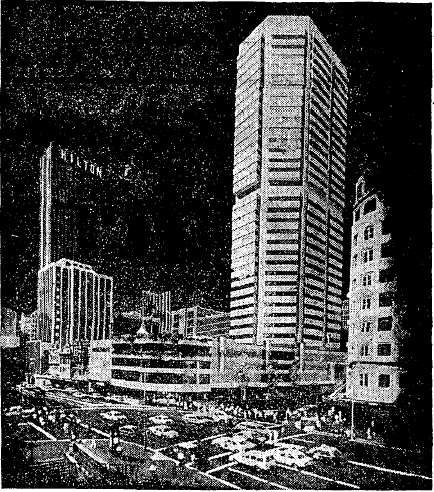
Developing the site of the First Government House in Sydney was a saga in itself. It was an empty site in central Sydney surrounded by sandstone buildings and modern high-rise buildings. By the early 1980s, the NSW Government decided to build an office tower on the site.

In 1982, plans were approved for a 38-storey office tower to be built on the site. The tower was to be located directly fronting Bridge Street, where the Museum of Sydney now stands.

GPT Tower Proposal November 24 1982 daily telegraph 9
Source: Ringrose, R. 1982. "Tower to rise on city site". The Daily Telegraph, November 24:9. 

The following year (1983), an archeological dig unearthed the foundations of the First Government House (1789-1846), sealing its fate. The Foundations would be preserved, and the public could view their remains. With a skyscraper boom occurring in the 1980s, Planning and Environment Minister Bob Carr sought to preserve the historical buildings and streetscape along Bridge Street, which also had implications for future development. 

Comreality (owned by Sid Londish) bought the site in 1986. Over two years, it purchased neighbouring sites, including the Legal and General Buildings, to create a super site covering an entire block bounded by Bridge, Loftus, Bent and Young Streets. It would lead to what we see today, a public square facing Bridge Street with the Museum of Sydney behind it. Governor Phillip Tower (1993 - 37 stories/227 metres - Note that there is a 40 metre high foyer, with fewer floors in the tower) and Governor Macquarie Tower (1994 - 36 levels/145 metres) would rise towards the middle of the block. Terrace houses in Young and Phillip Streets were preserved.


Saturday, 26 April 2025

Property Advert of the Week: South Windsor Homesites (1982)

Below is a 1982 newspaper advertisement from the Crown Lands Office promoting the sale of homesites at South Windsor. The homesites ranged in price from $16,000 to $24,500.

According to the RBA Inflation Calculator, this was the equivalent of spending approximately $69,000 to $106,000 in today's money.

South Windsor Land Release Ad December 3 1982 daily telegraph 25 

Source: Crown Lands Office. 1982. "Fully serviced homesites South Windsor". The Daily Telegraph, December 3: 25. 

Monday, 9 December 2024

1982: Introduction of Random Breath Testing (RBT)


In 1978, 1384 people died on New South Wales (NSW) roads and it was the deadliest year on record for road fatalities in the state. At the end of the 1970s and into the early 1980s, around 1300 people were dying on average in road accidents across New South Wales.

Drink-Driving was identified as a significant factor contributing to the death toll, with around 40% of road fatalities resulting from a driver driving under the influence of alcohol. Such deaths were identified as preventable.

In September 1982, the State Government Safety Road Committee recommended the introduction of Random Breath Testing (RBT). It was to be trialled for three years and became permanent in 1985.

RBT September 30 1982 daily telegraph

Source: Grimshaw, P. 1982. "Tough new blitz on roads". The Daily Telegraph, September 30: 1.

RBT commenced on Friday, December 17 1982, and drivers were warned of police presence on the roads.

RBT December 17 1982 daily telegraph 2

Source: Stanley, A. 1982. "Breath test blitz all weekend". The Daily Telegraph, December 17: 2. 

The first tests were undertaken on Parramatta Road at Granville after 7 pm.

RBT December 18 1982 daily telegraph 2
Source: Crosthwaite, R.  1982. "First drivers all under limit". The Daily Telegraph, December 18: 2. 

It was reported that road deaths had started decreasing in the lead-up to the introduction of RBT because it triggered, for drivers, a fear of being caught drink driving. RBT led to the introduction of the booze buses where further testing could occur.

RBT December 16 1982 daily telegraph 5

Source: Stanley, A. 1982. "Publicity on tests hammers fear in drivers". The Daily Telegraph, December 16: 5. 

Below is a newspaper advertisement explaining how RBT would work. It was "quite simple".

RBT Ad December 14 1982 daily telegraph 12

The legacy of RBT

The introduction of RBT has contributed to the overall decrease in the road toll in NSW. By 1985, the annual road toll had dropped to less than 1100. By 2021, the road toll had dropped to 270, the lowest figure since 1923 (COVID restrictions, especially in the second half of 2021, meant fewer vehicle movements), before settling at 349 in 2023.

Other key figures that show the success of RBT include:
  • The share of deaths resulting from drink driving annually has halved from around 40% to as little as 17%.
  • The overall number of deaths as a result of drink driving has decreased by nearly 90% in the past four decades.
RBT has also changed the way that people drink when they are out. One could no longer stop at the pub for a drink on the way home if they were driving or restricted their drinking. On the positive side, it encouraged responsible drinking, and for those who wished to have a drink, consider other options for transport, such as using public transport, having a friend or family member drive who would not drink, or using taxis (and ride-sharing in more recent years).


Monday, 25 September 2023

1982: Weekend Shopping - SMH Feature

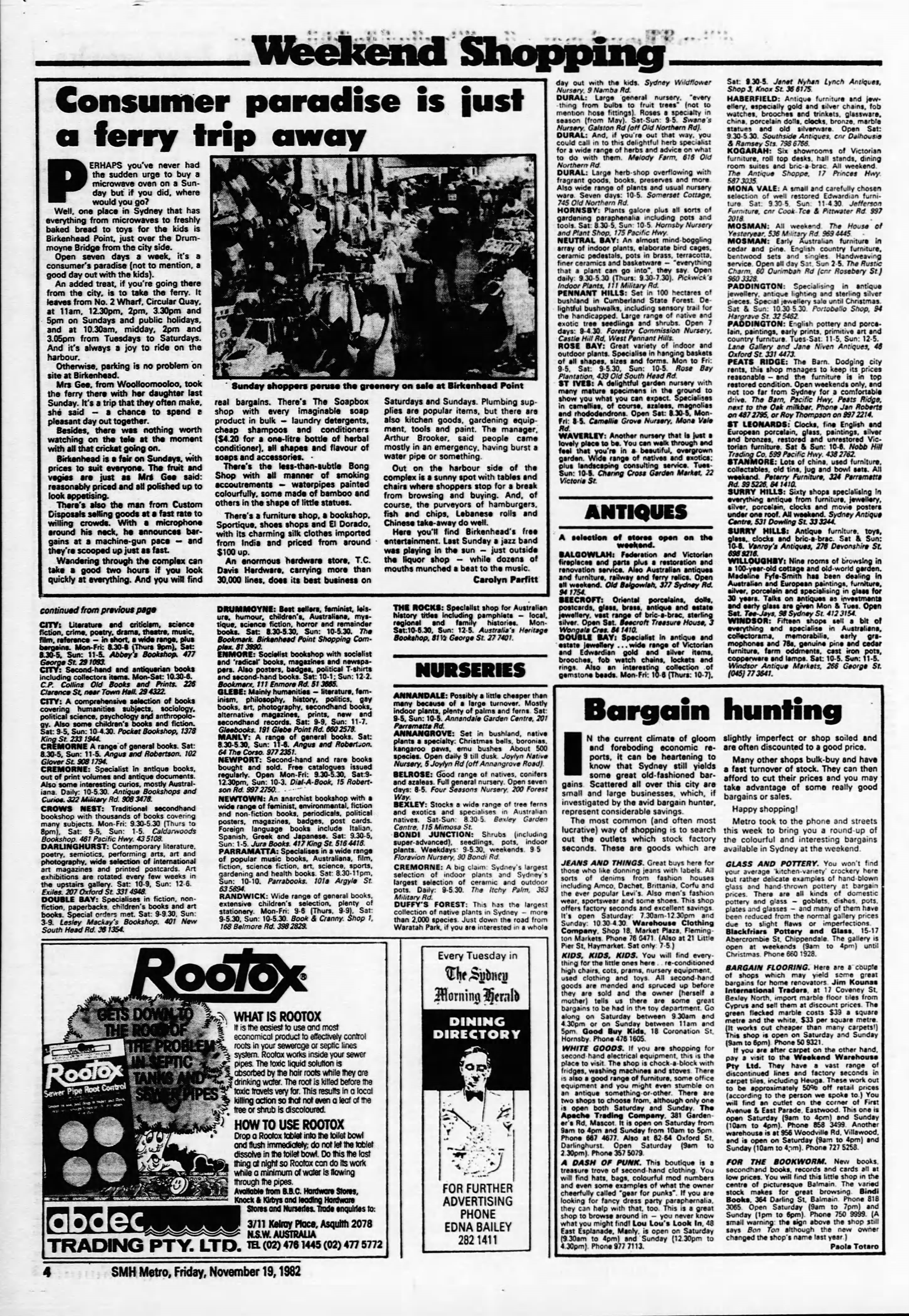
Forty years ago, retail trading hours for shops were heavily restricted on weekends. Shops were required to close at noon on a Saturday and were not permitted to trade on a Sunday. By the 1980s, major retailers such as Harvey Norman, Norman Ross and Waltons were challenging the laws by identifying loopholes with either success or failure.

Extending retail hours on weekends was opposed by the unions, citing the right of workers to have Sunday off and continued throughout the decade, though by the end of the decade, Sunday trading would be phased in, though gradually into the 1990s. 

Meanwhile, a court ruling in 1982 by Jim Macken in the NSW Industrial Commission raised concerns about big businesses i.e. Harvey Norman and Norman Ross extending their trading hours at the expense of small businesses, which relied on the weekend trade for their survival.

The Sydney Morning Herald's weekly Metro liftout published a feature in 1982 that provided Sydneysiders with a guide to shopping on weekends once the shutters went down at noon on Saturdays.

Reporter Mary Lord spent one weekend exploring the metropolitan area to see what was open on weekends and this is what she unearthed:

  • Birkenhead Point offered "everything" on a Sunday.
  • Manly offered options for "After-hours shopping" including clothing stores, bookstores and chemists.
  • Kings Cross - most of the usual shops were open but 'very little" could actually be bought on Sundays
  • Harvey Norman, Auburn - "mecca" on Parramatta Road, which attracted "more buyers at weekends".
  • Norman Ross & Waltons conducted "warehouse sales" at Homebush, Homebush Bay or Granville as they would not be subject to general shop laws.
  • Hardware stores - smaller stores were open on weekends.
  • Hudson's in Miranda was "open at back and staffed by management only"
I have included the feature below with a full citation.

Source: Lord, M. 1982. "The Weekend Shopper". The Sydney Morning Herald, November 19: 2-4 (Metro Liftout).

Weekend Shopping Feature November 19 1982 SMH Metro Liftout Weekend Shopping November 19 1982 SMH Metro 3 Weekend Shopping November 19 1982 SMH Metro 4

Monday, 10 July 2023

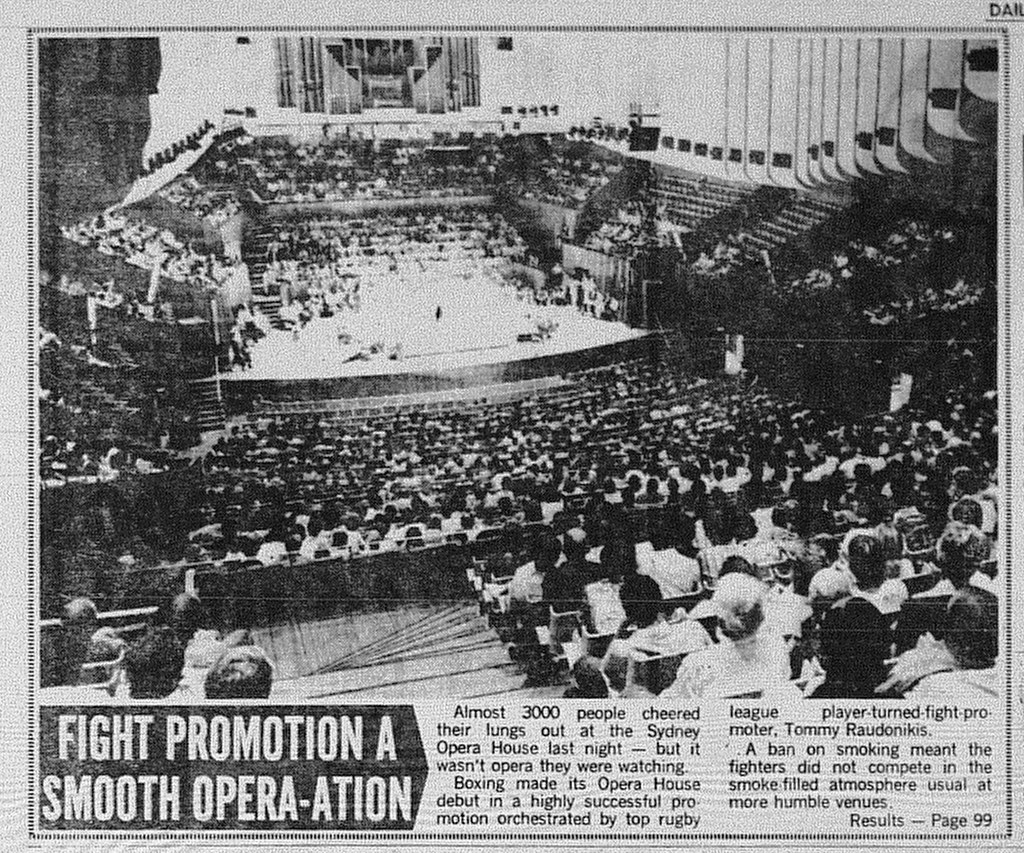
Remember This? Boxing at the Sydney Opera House (1982)

Sydney Opera House hosts boxing fight April 3 1982 daily telegraph 9 
Source: Anon. 1982. "Fight Promotion A Smooth Opera-ation". The Daily Telegraph, April 3: 9. 

Did you know that the Sydney Opera House once hosted Boxing? 

It happened on 4 April 1982 when the Performance Hall was converted into a temporary boxing arena with the boxing ring placed on the stage.

3000 people turned up to the event, promoted by Rugby League player Tommy Raudonikis. 

The evening's main bout was between Paul Ferreri and John Feeney for the Commonwealth bantamweight title, which was won by Ferreri in the 13th round after the fight was stopped. 

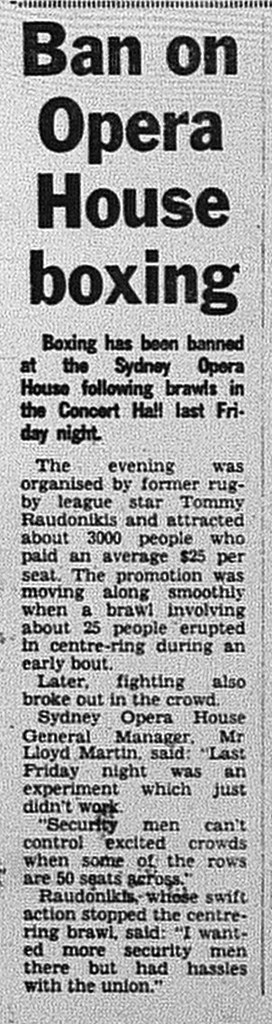
Newspaper reports reported that brawls broke out amongst the crowd during the event, which security struggled to contain, and police were not to be seen until after the fight subsided. 

After the violence that evening, Boxing bouts were banned and have remained so to this day.

Sydney Opera House bans Boxing April 6 1982 daily telegraph 3

Source: Anon. 1982. "Ban on Opera House boxing". The Daily Telegraph, April 6: 3. 

Monday, 29 May 2023

NEVER BUILT SYDNEY: 580 George Street (1982)

580 George Street is one of my favourite skyscrapers in the vicinity of Town Hall Station. Completed in 1988, the 37-storey office building rises 162 metres above street level. The tower was designed by architect Kevin James Rice and was influenced by 1930's Art-Deco style.

We may not have had this building built in this style. In 1982, plans were for a simpler box-style design for the tower, which was to be occupied by State Government Departments - Government Insurance Office (GIO) and the Water Board. The tower was slated to be taller - 45 stories.

580 George Street April 21 1982 SMH 14

Source: Rich, J. 1982. "Lost appeal clears way for $80m City office tower". The Sydney Morning Herald, April 21: 14.

Below is a photo of 580 George Street taken in 2012 by yours truly at almost the exact location of the artist's impression, which shows the eventual tower appearing slightly shorter, though the architectural feature (spire) atop the building may suggest what the possible height could have been.

The eventual design of the tower was lodged as a development application to Sydney City Council in 1984 after developer John Denoon bought the site for $13.5 million in July of that year.


Monday, 26 October 2020

1982: Life in the Park Regis

In 1982, the Park Regis was 14 years old and The Sydney Morning Herald interviewed some of its residents, all of whom were original buyers in the tower.

It would be interesting to compare the residents of 1982 with that of 2020. I am curious if any of the original residents still reside in the tower or even their descendants. 

Four decades ago, living in central Sydney was still a novelty.


Source: Wyndham, S. 1982. "Charles Weil says he'll take the Park Regis". The Sydney Morning Herald, September 18: 27.

Saturday, 23 February 2019

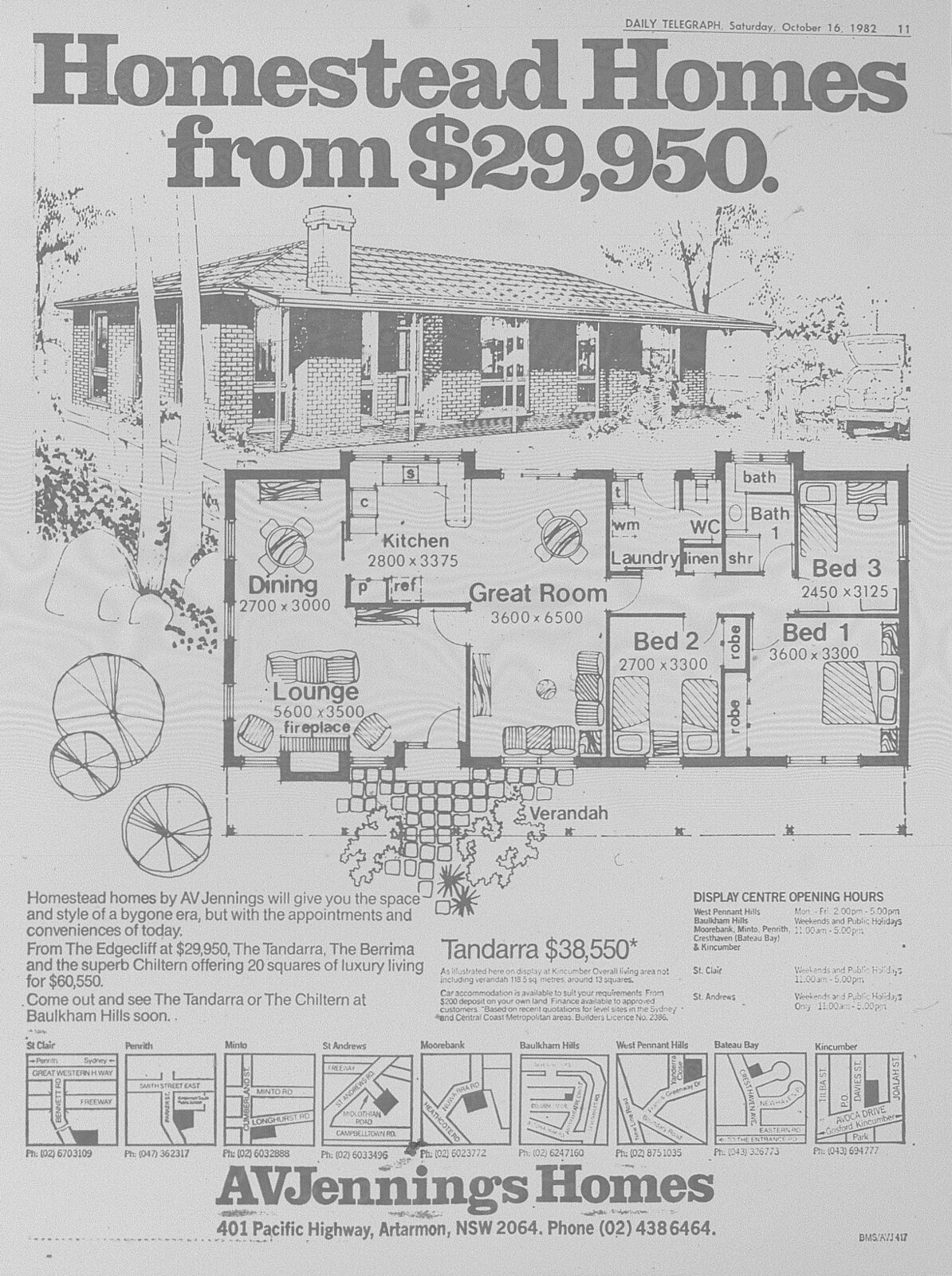
Property Advert of the Week: AVJennings "Homestead" homes (1982)

Below is a 1982 advertisement from AVJennings featuring the "Homestead" which could be built on your block of land from $29 950.


Source: AVJennings Homes. 1982. "Homestead Homes from $29 950" (Advertisement). The Daily Telegraph, October 18, 11.

Monday, 24 September 2018

SERIES: The Evolution of the Citigroup Centre - Plans unveiled for Waltons Site redevelopment (1982)

Apart from World Square, there is one other city site where redevelopment proved to be a very long saga.

2 Park Street is home to the Citigroup Centre a 48 level tower that rises over the former Waltons Department store site.

Today, the building and the site are very well ingrained on our city streetscape. One can walk past yet forget the drama faced just to get a building on this site.

Growing up in the 1990s, I was used to one sight - hoardings, which hid one of the biggest "holes in the ground" in the city.

But how did we end up with the building that we see today along with the Galeries Victoria?

The story begins in 1982. Alan Bond had purchased the Waltons Department Store Chain and Norman Ross.

The flagship store on Park Street at Town Hall comprised of seven buildings including the Town Hall Hotel. Bond wanted the store in simply one building.


Source: Robertson, R. 1982. "New department store will boost jobs: The City's first for 50 years". The Sydney Morning Herald, September 1: 2. 

Donald Crone was commissioned to design a new store to replace the previous store, but also provide a retail complex and office tower. Plans were unveiled in August 1982 for the site. Apart from a new Waltons Store, there would be 90 shops, restaurant, tavern and 28 storey office building to house the headquarters of Bond Waltons (Waltons and Norman Ross). The estimated cost was $100 million and would be completed by 1985.

A clearer copy of the Artists Impression as featured in The Sydney Morning Herald article (above) from September 1, 1982.
The tower was to be placed on the Southeastern corner of the site at the intersection of Park and Pitt Street.

Approval was granted in January 1983.


Source: Coultan, C. 1983. "Council gets $2m...Waltons gets shopping centre". The Sydney Morning Herald, January 28: 2. 

As time wore on, Alan Bond had bigger plans brewing. The proposed building heights increased to 35 and then 43 levels.

Next Week, we will look at his most ambitious proposal - Skytower.


Monday, 13 August 2018

1982: The changing face of Circular Quay

Only two decades after the completion of the AMP Building and the first wave of development around Circular Quay, the area was to undergo a significant change as this feature report published in The Sydney Morning Herald in July 1982 shows.


Altmann, C. 1982. "Untitled" (Artists Impression). The Sydney Morning Herald, July 3: 1. 

From left to right, what was the outcome?

  • The proposed building at East Circular Quay - The site remained vacant throughout the decade and into the 1990s as owners sought to redevelop the precinct. It became part of the Bennelong Apartments completed in 1998.
  • Approved Unit Block - Completed in 1984 as the Quay Apartments at 27 stories/94 metres tall.
  • Proposed Commercial Development (Gateway Site). Concerns about the blocking of vistas as the render shows, led to a taller, slimmer tower (Gateway Tower). Gateway Tower was built as a 46 level/164 metre tower in 1989.  
  • Regent Hotel (Completed that year)
  • Grosvenor Place ("Proposed office tower" completed in 1988). 
  • The Proposed Apartment tower opposite Grosvenor Place (far right) was the Quay West Apartments, which is part hotel, part apartment complex. It was completed in 1991. 
The construction of the above developments would not be completed for a decade (or at East Circular Quay, a decade and a half). This wave of development would shape Circular Quay for over a generation. 

The demolition of Goldfields House (2017-18) and the AMP Quay Quarter redevelopment is ushering in a new era for Circular Quay. There are also towers either under construction or proposed for the block bounded by Alfred, George, Bridge and Pitt Street's which will transform that section of the city. 


Monday, 30 July 2018

1982: The arrival of Sydney's Freshwater Class Ferries

The Manly Ferry Freshwater moored at Manly Wharf in 2011. Photo taken by the Author. 

The Freshwater Class Ferries at present are the pride of Sydney's ferry fleet as they operate on the Circular Quay to Manly run.

They have served us proudly since 1982, and acted as the replacements for the aging steamers which had served the run for nearly 70 years.

But how did we end up with them?

It began in 1971. The Manly run was privately run by the Port Jackson & Manly Steamship Company and not part of the Sydney Ferries Network. The company was bought by Brambles Industries. Brambles increased fares, reduced services and retired the Bellubera. It was intended that the Baragoola would also be retired during this time. For regular commuters, it was feared that Ferry services from the city to Manly may be scrapped altogether.

At the time, patronage on the Manly run was decreasing due to increased car ownership, completion of new Spit Bridge in 1958 and the introduction of direct bus services from the Manly-Warringah region to the city.

Two years later (1974), the NSW Government assumed control of the Manly run.

However the Government wanted only two of the three steamers to operate - Baragoola, North Head and South Steyne. When the South Steyne was destroyed by a fire in August 1974, only two steamers were left.

During the decade, the cost of servicing the steamers had become a concern. With two steamers, no ferries were available in the event of a breakdown or if withdrawn for maintainence. Two Lady Class Ferries - Lady Wakehurst & Lady Northcott (both now retired) were reconfigured for the Manly run during their construction.

In 1975, it was announced by NSW Transport Minister Wal Fife that two new Manly Ferries would be in operation within three years.

The election of the Wran Government in 1976 led to the ideas that would shape the Freshwater Class Ferries, though construction did not begin until 1980:

  • Twin hulls to allow for an easy turnaround and to accommodate the swells as they cross the Harbour Heads.
  • Capacity for 1200 (slightly lower than the steamers).
  • Mechnical Gangways (Required upgrades to wharves at Circular Quay and Manly to accomodate them. It meant that they could be configured according to tide levels.

The Freshwater was the first ferry to enter service in December 1982. This was followed by the Queenscliff (1983) , Narrabeen (1984) and Collaroy (1988). The remaining steamers were withdrawn with the Baragoola in 1983 and North Head in 1985. 

The Collaroy was unique in that was configured to operate ocean cruises, which it did between 1988 and 1991. It has since been reconfigured for harbour services only. The Collaroy also managed to have open air decks on its second level, which were eventually phased onto the remaining member's of the fleet in the early 2000's.

The anticipated growth in patronage did happen and has established itself as it as "must do" for any tourist to Sydney, providing a cheap way to explore Sydney Harbour. On board, one will receive a comfortable experience. Recent renovations have resulted in contemporary furniture, free Wifi and even TV screens to catch up on your favourite show.

Upgrades to the Freshwater Class have improved commuter comfort. Photo taken by the Author (2011) onboard the Freshwater
As for when they will retire? Thats unknown. Will we see a 5th member join or will they ultimately be taken over by a new class. The old steamers lasted up to 70 years before they sailed into history.