Showing posts with label Public Transport Commission of New South Wales. Show all posts

Monday, 17 August 2026

1974: The Manly Daily & Ferry Overcrowding

Last week, I posted newspaper clippings related to the 1974 fire that damaged the Manly Ferry South Steyne and consequently led to cuts to Manly Ferry services, as only two ferries were available to transport commuters.

The Manly Daily, concerned by the cuts to ferry services as a result, decided to report on overcrowding after claims by the Minister for Transport, Milton Morris, denied any claims of overcrowding.

One reporter and two photographers travelled on the ferries. As the pictures show from The Manly Daily (September 5, 1974) , it was standing room only and even commuters were sitting on the stairs, scenes normally reserved for our rail network. 

Manly Ferry Overcrowding September 5 1974 Manly Daily 1

The Manly Daily also raised concerns that patronage figures were being underreported as season ticket holders were not required to access turnstiles, as reported on page 1 on September 7, 1974 

Manly Ferry Overcrowding September 7 1974 Manly Daily 1

The Minister Responds.

  manly ferry crisis sept 11 1974 manly daily 

On September 11 1974, the Transport Minister wrote to The Manly Daily to rebut the newspaper's claims. This included the claim that weekly and season tickets were not available and that those people identified had discounted daily tickets (bought in bulk in advance)

The following day (September 12, 1974), The Manly Daily published a second set of images and provided the service run and dates. In the minister's view, the initial photos were "isolated incidents".

Manly Ferry Overcrowding September 12 1974 Manly Daily 1
 
The outcome 

To address overcrowding, two Lady Class Ferries - Lady Northcott and Lady Wakehurst were modified for the Manly run with their bows built up to manage the swells as they navigated the heads and gangways were built on their upper deck. 

Lady Wakehurst enters service October 5 1974 Manly Daily 1

The Lady Wakehurst commenced operations on the Manly Run in October, followed by Lady Northcott in January 1975. However, they were smaller than the 1200 that could fit on the Baragoola and North Head, with room for only 800. However, it meant that four ferries could operate on the run. Also, Baragoola and North Head were taken off the run (one at a time), meaning only a two-ferry service operated in the short term, keeping services limited. Express buses supplemented ferries.

This would act as a short-term solution until new ferries (Freshwater Class) commenced operation in 1982, when the Freshwater entered service, followed by Queenscliff (1983), Narrabeen (1984) and Collaroy (1988). Except for Collaroy, the Freshwater ferries continue in service, alongside three specially built Emerald Class ferries - Balmoral, Clontarf, and Fairlight. The Emerald Class ferries are significantly smaller than their predecessors - they can carry 400 commuters. One benefit of the Emerald Class ferries is that they complete the run in 20 minutes, allowing them to operate more services.

The NSW Government proposed retiring the Freshwater Class ferries several years ago, and the public backlash that followed ensured they continue to operate today. The same spirit shown by commuters, Manly locals and the media in 1974 when services were under threat (to the point wre Manly ferry services could have been abolished completely), ensured the survival of the Freshwater Class. The NSW Government (now under Labor) are working towards building a new fleet that will replace the Freshwater Class and retain the experience and vibe associated with a ferry commute to and from Manly.


Monday, 13 February 2023

1977: Sydney Advertising Buses Feature

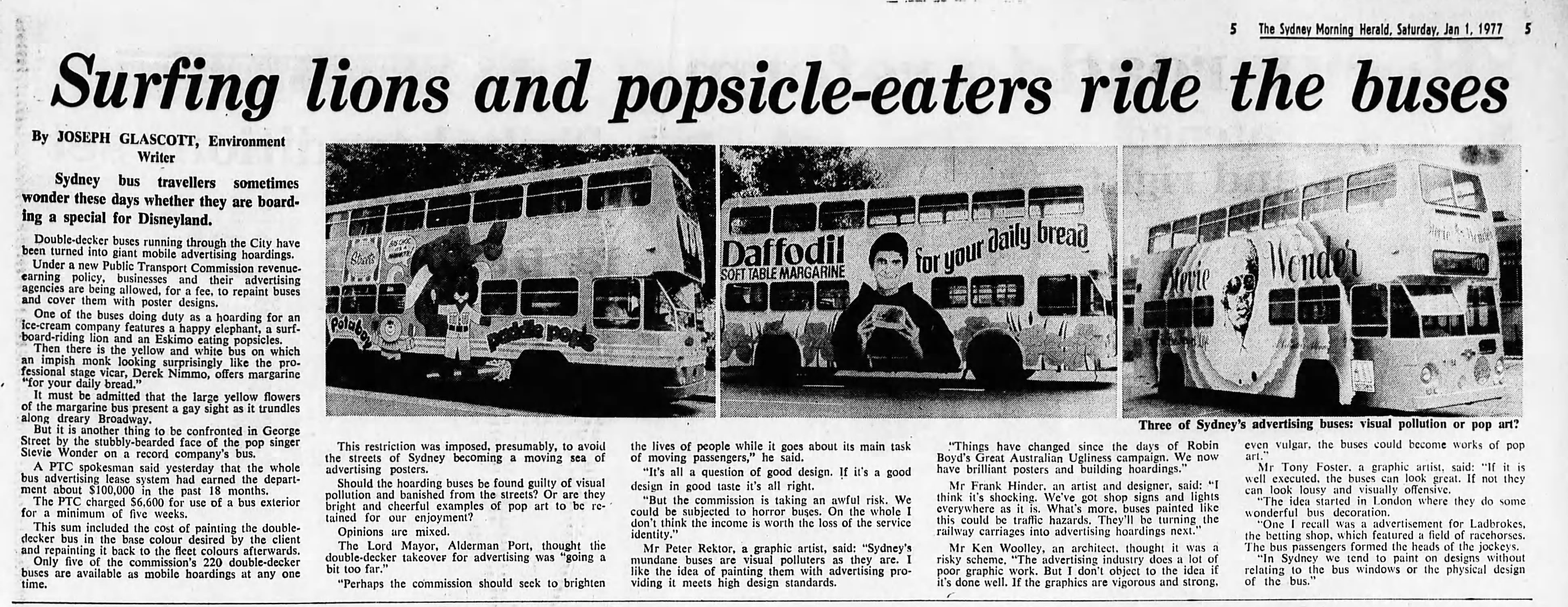
Today, Sydney buses are generally regarded as moving billboards, to the point that window views are generally obstrucutred. 

"Advertising Buses" in Sydney have been around for nealy fifty years, and began with five government buses in the 1970s. At least the windows were not covered. 

  Bus advertising January 1 1977 SMH 5

Source: Glascott, G. 1977. "Surfing lions and popsicle-eaters ride the buses". The Sydney Morning Herald, January 1: 5. 

Joseph Glascott wrote a feature article for The Sydney Morning Herald in 1977 on the buses. Views were mixed. 

"oldtapecaptures" uploaded a clip to Youtube of a Stevie Wonder Segment featuring the Stevie Wonder themed bus above. The bus itself played Stevie Wonder music. 


Monday, 5 December 2022

1972: The Arrival of Sydney's S Set trains

Sydney Trains July 18 1972 daily telegraph 3

Source: Anon. 1972. $17 m New Carriages". The Daily Telegraph, July 14: 3. 

1972 saw the delivery of the first carriages of the famous S set trains that would operate for 47 years on Sydney's rail network.

The new carriages were built to boost capacity on the rail network and allow more passengers to be accomodated on each service.

509 carriages were built by Comeng and later Goninan with the last carriages entering operation in 1980. Some carriages were built with an amended design.

Double Decker Carriages November 20 1973 SMH 3

Source: Anon. 1973. "New Carriages for City". The Sydney Morning Herald, November 20: 3.

Initially, driver cars were built with trailer cars added in future orders.

Trains promised to "increase capacity and comfort", yet they were not air-conditioned which caused discomfort either on cold winter days or hot summer days.

Tulloch trailer cars (carriages) were also used to form either four, six or eight car sets until 2004, when they were phased out ensuring that S-set trains comrpised of S set carriages only. 

The introduction of trains that were entirely double-decker marked the beginning of the end of single deck trains on the Sydney rail network as they gradually replaced the red rattler trains. By the end of 1993, the entire Sydney rail network comprised of double-decker carriages. The opening of the Sydney Metro (independent of the main rail network) marked the return of single decker trains.

During the 1990's the carriages were renovated as part of the Citydecker program with new windows and the installation of electronic destination boards on the driver cars.

The S Set trains were phased out from service between 2012 and 2019 as the Waratah Trains were introduced across the network (Excluding the T4 line). The last line that operated the S Sets was the T7 Olympic Park line. 

Monday, 23 June 2014

SYDNEY TRANSPORT: Eastern Suburbs Railway Line (1979)

Today is the 35th anniversary of the Official Opening of the Eastern Suburbs Railway Line between Central and Bondi Junction. Four new stations joined the CityRail Network: Martin Place Kings Cross, Edgecliff and Bondi Junction. It was the first rail line in Sydney to have all its stations underground. For the first two years of operation, it was a shuttle service between Central and Bondi Junction. It was connected to the Illawarra Line in 1981 and Redfern also got its underground platforms (11 and 12).

On that day in 1979, it was a Saturday and the Premier Neville Wran had the honours of officially declaring the line open.

Below are two advertisements promoting the opening of the line. For the opening weekend, travel was free. After that a single trip cost between 10 and 30 cents.


Source: Public Transport Commission of New South Wales. 1979. "Be our guests, take a free train ride on the new Eastern Suburbs Railway," The Sun, June 21: 27. 


Source: Public Transport Commission of New South Wales. 1979. "Eastern Suburbs Railway Now Open," The Daily Telegraph, June 25, 32. 


The Sydney Morning Herald and The Daily Telegraph reported (above) on June 25 that about 250 000 people took advantage of the opening weekend and free rides. There were long queues at stations and platforms overflowed with people.

Most Sydney newspapers were happy. The Daily Telegraph in its editorial on June 25 praised its completion and its addition to the existing rail network. With the Second Oil Crisis underway, it also highlighted the dependence on the motor car and the need to rely on it when one could not use their car. The Sun was quite similar in its view on June 25. The rail line actually made providing transport to Sydney's east even cheaper to about $1.5 million per year. If the oil crisis continued, the savings could increase. However, The Sydney Morning Herald in its editorial on June 23 was critical, suggesting the Eastern Suburbs did not need it and should have focused on spending on improving public transport in the outer suburbs.

Originally, the line was to extend south from Bondi Junction through to Waverley (Charing Cross), Randwick, the University of NSW and Kingsford. The line was to be built in four stages: Edgecliff (1973), Bondi Junction (1974), Randwick (1976) and Kingsford (1977).


Source: State Political Roundsman. 1967. "$12 million a mile track: Bondi Junction on Rail Route," The Daily Telegraph, March 1: 7.

Rushcutters Bay was originally set to have a station but was axed in 1969. It was deemed unviable due to the construction of the William Street tunnel and "small population". Woollahra was also to get its own railway station but construction stopped in 1976 as part of cost-cutting but locals also objected to having their own station.

The platforms between Edgecliff and Bondi Junction are a reminder of what could have been.


Source: Cohen, S. B. 1994. Untitled. accessed June 17, 2014, http://www.oocities.org/trendy_rechauffe/Woollahra_station_site_3DEC94_tset.JPG 

By completion in 1979, it was five years behind schedule.