Showing posts with label Sydney Ferries. Show all posts

Monday, 17 August 2026

1974: The Manly Daily & Ferry Overcrowding

Last week, I posted newspaper clippings related to the 1974 fire that damaged the Manly Ferry South Steyne and consequently led to cuts to Manly Ferry services, as only two ferries were available to transport commuters.

The Manly Daily, concerned by the cuts to ferry services as a result, decided to report on overcrowding after claims by the Minister for Transport, Milton Morris, denied any claims of overcrowding.

One reporter and two photographers travelled on the ferries. As the pictures show from The Manly Daily (September 5, 1974) , it was standing room only and even commuters were sitting on the stairs, scenes normally reserved for our rail network. 

Manly Ferry Overcrowding September 5 1974 Manly Daily 1

The Manly Daily also raised concerns that patronage figures were being underreported as season ticket holders were not required to access turnstiles, as reported on page 1 on September 7, 1974 

Manly Ferry Overcrowding September 7 1974 Manly Daily 1

The Minister Responds.

  manly ferry crisis sept 11 1974 manly daily 

On September 11 1974, the Transport Minister wrote to The Manly Daily to rebut the newspaper's claims. This included the claim that weekly and season tickets were not available and that those people identified had discounted daily tickets (bought in bulk in advance)

The following day (September 12, 1974), The Manly Daily published a second set of images and provided the service run and dates. In the minister's view, the initial photos were "isolated incidents".

Manly Ferry Overcrowding September 12 1974 Manly Daily 1
 
The outcome 

To address overcrowding, two Lady Class Ferries - Lady Northcott and Lady Wakehurst were modified for the Manly run with their bows built up to manage the swells as they navigated the heads and gangways were built on their upper deck. 

Lady Wakehurst enters service October 5 1974 Manly Daily 1

The Lady Wakehurst commenced operations on the Manly Run in October, followed by Lady Northcott in January 1975. However, they were smaller than the 1200 that could fit on the Baragoola and North Head, with room for only 800. However, it meant that four ferries could operate on the run. Also, Baragoola and North Head were taken off the run (one at a time), meaning only a two-ferry service operated in the short term, keeping services limited. Express buses supplemented ferries.

This would act as a short-term solution until new ferries (Freshwater Class) commenced operation in 1982, when the Freshwater entered service, followed by Queenscliff (1983), Narrabeen (1984) and Collaroy (1988). Except for Collaroy, the Freshwater ferries continue in service, alongside three specially built Emerald Class ferries - Balmoral, Clontarf, and Fairlight. The Emerald Class ferries are significantly smaller than their predecessors - they can carry 400 commuters. One benefit of the Emerald Class ferries is that they complete the run in 20 minutes, allowing them to operate more services.

The NSW Government proposed retiring the Freshwater Class ferries several years ago, and the public backlash that followed ensured they continue to operate today. The same spirit shown by commuters, Manly locals and the media in 1974 when services were under threat (to the point wre Manly ferry services could have been abolished completely), ensured the survival of the Freshwater Class. The NSW Government (now under Labor) are working towards building a new fleet that will replace the Freshwater Class and retain the experience and vibe associated with a ferry commute to and from Manly.


Monday, 10 August 2026

1974: South Steyne Ferry Fire

For decades, the Manly Ferry South Steyne was regarded as the flagship of the Manly Fleet. It was the largest ferry itself, with a capacity for 1700 and had entered service in 1938

On Sunday, August 25, 1974, while berthed at Mort Bay in Balmain, it caught fire. It is believed the fire started in a boiler room before 5pm, and firefighters were called to fight the fire.

South Steyne Ferry Fire August 26 1974 SMH 1 enlarged

Source: "Biggest ferry burns, solving Govt selection problem". The Sydney Morning Herald, August 26: 1. 

The ferry was extensively damaged. 

At the time of the fire, the Manly Ferry route was operated by the Port Jackson and Manly Steamship Company and was to be taken over by the NSW Government in December 1974. Given the cost of repairs (estimated at $1 million at the time), the NSW Government decided to focus on operating a two-ferry service upon handover.

Given the damage sustained, it was anticipated that the ferry would be scrapped. It never returned to service as a commuter ferry. It was restored n the 1980s and was recommissioned in 1988. 

During the 1990's it spent part of the decade as a floating restaurant before moving to Darling Harbour, where it served as the Olympic Information Centre and, post-Olympics (2000), as a function centre.

In 2016, it was moved to Berry's Bay as it could no longer be accommodated at Darling Harbour and has remained there since.

Impact on Commuters

Commuters were severely impacted by the fire and withdrawal of South Steyne with services reduced. Frequencies were reduced from 30 minutes to 45 minutes. It had added to service cuts due to the retirement of another two ferries - Dee Why (1968) and Bellubera (1974).  

South Steyne fire August 27 1974 Manly Daily 1

Source: Anonymous. 1974. "Ferry Chaos! Hundreds stranded as new timetable starts". The Manly Daily, August 27: 1. 

Next week, I'll look at the overcrowding concerns that stemmed from it as The Manly Daily saw it and mentioned in the book Manly Ferries of Sydney Harbour.  

Monday, 13 April 2026

1986: The return of the Green & Yellow on Sydney Ferries

Did you know that 2026 marks 40 years since Sydney Ferries revived the green-and-yellow livery that adorned the ferries in earlier decades of the 20th century?

The reason for its introduction was that the First Fleet Ferries, to replace the older Lady Class Ferries, were funded by the Australian Bicentennial Roads Development (a misnamed fund) as part of transport upgrades for the Bicentennial, which was held in 1988. It was meant to symbolise that the Federal Government funded the ferries, not the State Government.

First Fleet Ferries February 19 1986 SMH 4

Source: Coultan, M. 1986. "Ferries let us see colour of their money". The Sydney Morning Herald, February 19: 4. 

They would replace the dark blue and off-white livery of existing ferries.

The successor Lady Class Ferries (post-1968), along with the Manly Freshwater Class Ferries, would eventually be repainted green and yellow.

Ferries introduced during the 1990s and 2000s, including the Jetcats, Rivercats, Harbourcats and Supercats, did not adopt the green-and-gold livery during their working lives.

Since the introduction of the Emerald Class Ferries in 2016, every new Sydney ferry entering service has adopted the green and yellow livery along with the Minicat, River and Parramatta River class ferries. In 2026, 100% of Sydney's ferry fleet will be adorned in green and yellow.


Monday, 2 December 2024

1991: Conception of the Rivercats

Rivercat Nicole Livingstone in action on the Parramatta River. Taken by the Author (2022)

Last year saw the commencement of the retirement of the Rivercat ferry fleet on Sydney Harbour. It commenced with Betty Cuthbert, followed by Evonne Goolagong and Nicole Livingstone. Only four Rivercat ferries remain, with the new Parramatta Class ferries being introduced into service.

In 1991, Transport Minister Bruce Baird announced that seven Rivercats would be built, providing seating for 150 people. This would also enable the extension of ferry services to Parramatta, which commenced in 1993.

  Rivercat Announcement May 11 1991 daily telegraph 4

Source: Anon. 1991. "Higher". The Daily Telegraph Mirror., May 11: 4. 

At the time, ferry services on the Parramatta River were operated by First Fleet class ferries. The new Rivercats promised commuters faster trips along the Parramatta River. Express ferries from Parramatta to Circular Quay, stopping only at Rydalmere, would only take fifty minutes to complete the journey.

The NSW Government followed through, with seven Rivercats entering service between 1992 and 1995, ultimately having a capacity of 230 people.

Related Entry


Monday, 1 July 2024

Remember This? : Daytripper Tickets Ad (2004)

In Sydney, daily transport fares for adults are capped at $17.80, and if the $50 weekly cap is reached, travel is free for the remainder of the week.

Before Opal Cards were introduced and the ability to pay fares directly from a debit or credit card, a person had to purchase a Daytripper ticket to access unlimited travel on the day of travel.

However, there were limitations compared with Opal fares—the ticket was not valid on light rail services and services operated by private bus operators.

Daytripper Ad January 16 2004 daily telegraph 27

Source: Sydney Ferries, Sydney Buses & CityRail. 2004. "Daytripper" (Advertisement). The Daily Telegraph, January 16: 27. 

Is the Opal Travel Daily Cap cheaper than a Daytripper ticket in 2004?
According to the RBA Inflation Calculator, a Daytripper ticket purchased in 2004 for $15 equates to a person spending $24.96 today. Therefore, a commuter can have unlimited travel on public transport at a cheaper price in 2024.


Monday, 9 January 2023

Remember This? State Transit Authority Ad (1990)

Below is a 1990 newspaper advertisement by the State Transit Authority to promote the savings associated with taking public transport on the weekends.

STA Ad September 20 1990 daily mirror 39

Source: State Transit Authority. 1990. "Catch the huge savings on buses and ferries this weekend". The Daily Mirror: 39.

In August 1990, Iraq invaded Kuwait, which led to an increase in petrol prices to around 75 cents per litre which was high at the time. The Sydney Harbour Bridge toll has doubled to $3.00 on weekends, but at the time, the $1.50 toll was charged irrespective of the time travelled. 

A ferry trip from Manly to Circular Quay in 1990 cost $3.20 for adults, compared with $8.04 on an opal card or contactless payment in 2023. Note that there is a weekend daily cap of $8.40 for an opal meaning a return trip would cost 36 cents. 

In 1990, it cost $3.80 to travel by bus from Newport to the city and $2.40 from Coogee to the city. In 2023, the same trip from Newport to the city decreased by 27 cents to $3.53 as bus fares were previously subject to a flat fare with no off-peak discounts. However, the trip from Coogee to the city has increased just 35 cents to $2.75, but when adjusted for inflation, the same trip in real terms is cheaper than in 1990.

A few weeks after the advertisement was published, Cityrail also used high petrol prices to attract commuters to commute by train. A link is listed below.

Opal Fares are correct as of  9 January 2023. 

Related Entry

Remember This? CityRail Advertisement (1990)


Monday, 17 January 2022

Remember This? SS South Steyne in big swells (1971)

I would regard this photo as one of the best weather themed photos taken in Sydney, but also on our ferry network as well.

Below is a photo that was published.in The Daily Telegraph on February 1971.  The photographer's identity is unknown. Sydney storm february 5 1971 daily telegraph 7 

The photo was taken on the lower deck of the Manly Ferry South Steyne as it navigated its way through Sydney's heads in high seas. Apart from the photographer, there is a deckhand on the outside deck, presumably trying to keep his balance. At right is the sea and has the appearance its about to go right over. I think the ferry was heaving down amongst the swell as the image was taken. It would have been a very rough and stomach churning ride for commuters. 

The old steamers had a very good reputation for being very good at managing the swells, even with more than a thousand onboard. The Freshwater Class could not manage that same reputation, though the Freshwater Ferries in rough seas could keep everyone inside dry. 

Monday, 23 August 2021

1989: Sydney Ferries introduce automatic ticketing

Sydney Ferries Automatic Ticketing Ad July 4 1989 Daily Mirror 37

Source: Sydney Ferries. 1989. "Announcing the Launch of a Great new Ferry Service. Automatic Ticketing" (Advertisement). The Daily Mirror, July 4: 37. 

In 1989, Sydney's Ferry Network became the first mode of public transport in Sydney to offer automatic ticketing across its entire network. Prior to 1989, automatic ticketing was only available for rail commuters on the Eastern Suburbs Railway Line, which had been available since its opening in 1979.

All tickets for services operated by Sydney Ferries featured a magnetic stripe which contained ticketing data. This would reduce fare evasion and assist government authorities in collecting data relating to public transport usage and inform planning for future provision of services. 

Automatic Ticketing led to the introduction of a new ticket option - Ferry Ten Tickets for regular commuters. This would be offered for more than twenty five years. They were withdrawn from sale at end of 2015 as part of the implementation of the Opal Card across Sydney's public transport network.  

Self-service ticket machines were introduced which meant that commuters no longer had to queue at the ticket office to buy a ticket. 

Monday, 2 August 2021

1989: The return of ferry ocean cruises

In 1988, the NSW Government delivered the last ferry in the Freshwater Class of Sydney Ferries -  Collaroy. 

collaroy ocean cruises august 2 1988 daily telegraph 9 

Source: Anon. 1988. "'Family' cruises for new ferry". The Daily Telegraph, August 2: 9.

Unlike the other three ferries in the fleet - Freshwater, Queenscliff and Narrabeen, the upper deck was open at each end. Post 2000, the other three ferries would also provide open decks at each end.

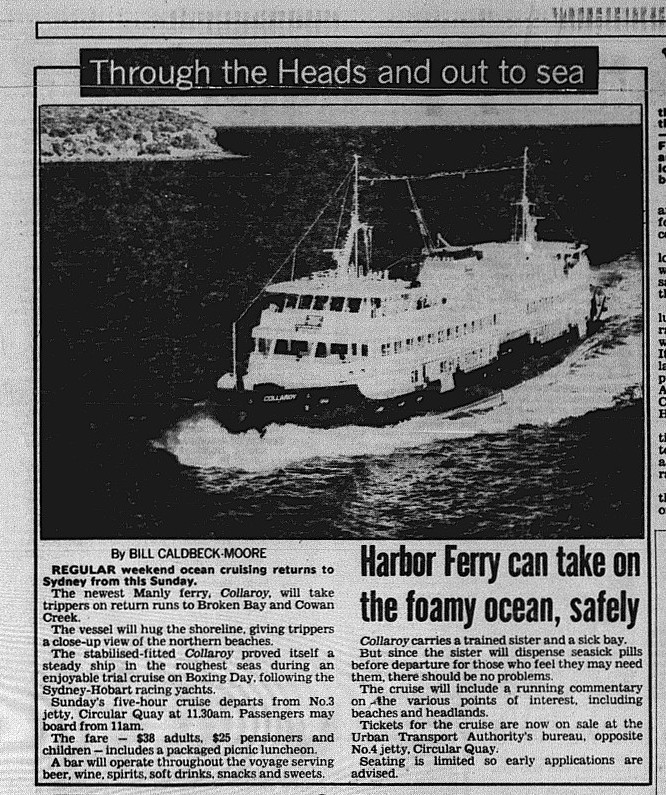
Collaroy had been fitted with stablisers to manage the ocean swells along with catering facilities. More than a canteen could be offered to commuters on the Manly run or on a harbour or ocean cruise. 

Collaroy Cruise January 6 1989 daily telegraph 

Source: Caldbeck-Moore, B. 1989. "Harbor Ferry can take on the foamy ocean, safely". The Daily Telegraph, January 6: page unknown. 

In 1989, Sydneysiders were able to experience ocean cruises on the Collaroy, reviving the cruises provided by the South Steyne between 1953 and 1973, when it was under the ownership of the Port Jackson and Manly Steamship company. 

Below is one newspaper advertisement from February 1989.  Cruises ran between Circular Quay and Cottage Point. Tickets were $38 for adults and $25 for children and pensioners and included a picnic lunch. 

  Ocean cruises Sydney Ferries Ad February 28 1989 daily telegraph 43

Source: Sydney Ferries. 1989. "Run away to sea for a day on a Sunday Coastal Cruise" (Advertisement). The Daily Telegraph, February 28: 43.

The cruises ran until the following year. It was written in Ferries of Sydney by Graeme Andrews that the services were terminated after ferry officers demanded the payment of a "spew allowance" that was being received by deckhands working on the services. The "spew allowance" referred to a payment to cover cleaning up the mess left behind by seasick passengers. 

With new Emerald Class ferries about to commence full time service on the Manly run, Collaroy will step back into a part time role, operating on weekends alongside the Freshwater (oldest of the Freshwater Class ferries). This only occurred after a backlash from Sydneysiders over plans to retire the entire fleet citing:

  • The iconic nature of the ferries 
  • Cultural Importance
  • Ability to transport large numbers of commuters - 1100 people compared to 400 on Emerald Class Ferries.
  • Heritage value
  • Ability to manage the swells at the heads.
The Narrabeen and Queenscliff are expected to be retired from service by the end of 2021. 


Monday, 20 January 2020

Remember This? Sydney Ferries Ocean Cruises (1989)

In 1988, the Collaroy was added to the Manly Ferry Fleet. Unlike the other three ferries in the fleet, it was designed to operate ocean cruises. Also, it had outdoor decks on the upper level at each end (they were eventually added to the other Manly Ferries).

Ocean Cruises were provided for decades on Sundays by the old steamers, but had stopped. By the end of the 1980's, an attempt was made to revive the cruises.

The cruises were provided between 1988 and 1991. They were discounted as crew demanded a "spew allowance" to deal with cleaning up after those who were seasick.

The coastal cruises would commence at Circular Quay and proceed north along the Northern Beaches to the Hawkesbury River, exploring its lower reaches before returning back to Circular Quay by the same route.

For our readers, should the cruises be revived?

Below is an advertisement from 1989.


Source: Sydney Ferries. 1989. "Run away to sea for a day on a Sunday Coastal Cruise" (Advertisement). The Daily Telegraph, February 28: 43. 


Monday, 18 February 2019

1993: Rivercat Services to Parramatta Commence

One of the most popular ferry routes in Sydney doesn't operate east of the Sydney Harbour Bridge. It is the Parramatta Rivercat run.

The first service from Circular Quay to Parramatta was on December 9, 1993. It was intended that the Rivercat service would be a major mode of transport from Sydney to Homebush Bay.

Today the service generally operates during off-peak periods and at weekends. Services used to run express to Rydalmere, resulting in a 50-minute trip either way, but today takes nearly a 90 minutes as it generally operates as an all stops service.

It is a great way to see the western harbour and the Parramatta River on a budget.

Below is a special feature from the December 9, 1993, edition of The Daily Telegraph Mirror. 


Monday, 30 July 2018

1982: The arrival of Sydney's Freshwater Class Ferries

The Manly Ferry Freshwater moored at Manly Wharf in 2011. Photo taken by the Author. 

The Freshwater Class Ferries at present are the pride of Sydney's ferry fleet as they operate on the Circular Quay to Manly run.

They have served us proudly since 1982, and acted as the replacements for the aging steamers which had served the run for nearly 70 years.

But how did we end up with them?

It began in 1971. The Manly run was privately run by the Port Jackson & Manly Steamship Company and not part of the Sydney Ferries Network. The company was bought by Brambles Industries. Brambles increased fares, reduced services and retired the Bellubera. It was intended that the Baragoola would also be retired during this time. For regular commuters, it was feared that Ferry services from the city to Manly may be scrapped altogether.

At the time, patronage on the Manly run was decreasing due to increased car ownership, completion of new Spit Bridge in 1958 and the introduction of direct bus services from the Manly-Warringah region to the city.

Two years later (1974), the NSW Government assumed control of the Manly run.

However the Government wanted only two of the three steamers to operate - Baragoola, North Head and South Steyne. When the South Steyne was destroyed by a fire in August 1974, only two steamers were left.

During the decade, the cost of servicing the steamers had become a concern. With two steamers, no ferries were available in the event of a breakdown or if withdrawn for maintainence. Two Lady Class Ferries - Lady Wakehurst & Lady Northcott (both now retired) were reconfigured for the Manly run during their construction.

In 1975, it was announced by NSW Transport Minister Wal Fife that two new Manly Ferries would be in operation within three years.

The election of the Wran Government in 1976 led to the ideas that would shape the Freshwater Class Ferries, though construction did not begin until 1980:

  • Twin hulls to allow for an easy turnaround and to accommodate the swells as they cross the Harbour Heads.
  • Capacity for 1200 (slightly lower than the steamers).
  • Mechnical Gangways (Required upgrades to wharves at Circular Quay and Manly to accomodate them. It meant that they could be configured according to tide levels.

The Freshwater was the first ferry to enter service in December 1982. This was followed by the Queenscliff (1983) , Narrabeen (1984) and Collaroy (1988). The remaining steamers were withdrawn with the Baragoola in 1983 and North Head in 1985. 

The Collaroy was unique in that was configured to operate ocean cruises, which it did between 1988 and 1991. It has since been reconfigured for harbour services only. The Collaroy also managed to have open air decks on its second level, which were eventually phased onto the remaining member's of the fleet in the early 2000's.

The anticipated growth in patronage did happen and has established itself as it as "must do" for any tourist to Sydney, providing a cheap way to explore Sydney Harbour. On board, one will receive a comfortable experience. Recent renovations have resulted in contemporary furniture, free Wifi and even TV screens to catch up on your favourite show.

Upgrades to the Freshwater Class have improved commuter comfort. Photo taken by the Author (2011) onboard the Freshwater. 
As for when they will retire? Thats unknown. Will we see a 5th member join or will they ultimately be taken over by a new class. The old steamers lasted up to 70 years before they sailed into history.

Monday, 8 May 2017

1990: The Jetcats enter service

In 1990, the Greiner Government introduced the Jetcat ferries into operation on Sydney Harbour. This stemmed from the decision of NSW Transport Minister Bruce Baird in 1988 to replace the aging
hydrofoils.


Source: Nicholson, L. 1988. "Costly hydrofoils will be scrapped". The Daily Telegraph, August 22: 9.

The Jetcats promised a modern and more reliable service for Ferry Commuters. For the government, the costs of servicing the Jetcats would be lower. In addition, there was the promise of more comfort for commuters. There were plans to eventually expand the service to Gladesville but also operate as far as Port Kembla and Newcastle.


Source: Morris, L. 1990. "Jetcat to oust the hydrofoils". The Daily Telegraph, April 30: 15. 

The first Jetcat to enter service was The Blue Fin. It ended up with its name after the public was asked to name the new ferry.


Source: Anon. 1990. "Blue Fin slices time to Manly". The Sunday Telegraph, April 29: page unknown.


Source: State Transit. 1990. "Name Your Own $5m. Catamaran" (Advertisement). The Daily Telegraph, March 21: page unknown. 

The Blue Fin commenced operation on July 16, 1990, after three months of trials. Below is a preview article from The Daily Telegraph.


Source: Riddell, A. 1990. "Anchors away for new Jetcat". The Daily Telegraph, July 16: 12. 

 The hydrofoils after 26 years of service ran their last service in March 1991 after another two Jetcats - Sir David Martin and Sea Eagle were bought into service. During their first decade of service, The Jetcats were actively used. In fact, they were seen as a fifth ferry on the Manly run, replacing the regular ferries late at night and early in the morning. It was argued that with fewer crew required (and commuter demand), operating late night services would keep costs of operating the broader Manly Ferry service down. If existing ferries broke down, the Jetcat fleet would act as a substitute (as a trio), like in 2004 when two Manly Ferries - Collaroy and Queenscliff were out of service for maintenance. In the final years of service, Jetcats were restricted to peak hour operations only.

Sadly, The Jetcat fleet had a shorter life than their predecessors. Jetcats were withdrawn from service on December 31, 2008. It was argued that costs had increased along with declines in revenue. They were lucky not to have been pulled out of service earlier, when the Carr Government (1995-2005) introduced Supercats to the Sydney Ferries Fleet but had struggled to cope with the swells at the Heads of Sydney Harbour. Manly Fast Ferries (2009) currently operate High-speed services between Manly and Circular Quay, but have expanded to provide services from Manly to North Sydney, Darling Harbour, Pyrmont Bay, and the Eastern Suburbs. Sydney Fast Ferries also operated services between 2010 and 2015, when they were the tender to operate the high-speed service.

Monday, 1 May 2017

1968: The Lady Class Ferries debut on Sydney Harbour

Back in 2015, I shared a 1966 newspaper clipping on the Lady Class Ferries that were due to enter into service by the end of 1967.

On September 19, 1968, the first of six Lady Class Ferries - Lady Cutler, entered service. It was named after the wife of the current NSW Governor, Sir Roden Cutler who was there in person to see her namesake. Another five ferries would enter service over the next decade. Lady Northcott and Lady Herron still operate today.


Source: Anon. 1968. "New Lady Takes Harbour". The Daily Telegraph, September 20: 3. 

The ferry operated until 1991. In 1998, it sailed down to Melbourne. After refurbishment works, it returned to service in 2007 as the Lady Cutler Melbourne Showboat and does chartered cruises along the Yarra River and Port Phillip Bay.

Monday, 24 August 2015

1966: The Lady Class Ferries are conceived

Sydney's Lady Class Ferries have been serving Sydney Harbour since 1968. Here is an article from The Daily Telegraph from 1966, when they announced tenders for the new ferries which were to serve on the North Shore routes. It did promise that the first ferry would be in operation by the following year. However, it was not until 1968 that the Lady Cutler went into service. Five ferries would join her over the next decade: Lady Woodward, Lady McKell, Lady Wakehurst, Lady Northcott and Lady Herron.


Source: Anonymous. (1966). "Airy, Spacious & Commodious". The Daily Telegraph, October 26: 12.

The Lady Northcott and Lady Wakehurst were modified (with higher bows) to operate on Manly Services when introduced in the mid-1970s.

The Lady Cutler no longer operates but is based in Melbourne's Docklands along with Lady McKell. Lady Northcott and Lady Herron are the only two ladies from this era still in operation.

The Lady Cutler and Lady McKell at Melbourne's Docklands in 2011. The photo was taken by the Author.