The Sydney Monorail ran between 1988 and 2013. In 1987, a year before its opening, the first monorail train, which ran on a 3.6-kilometre loop, was unveiled to the world at the Transpublic 87 Exhibition in Geneva.
While the Monorail was causing controversy in Sydney, it was receiving praise for its innovation at an international level. Transpublic 87 Managing Director Rodolphe Huser praised it and hoped that other cities would follow Sydney's lead in adopting the monorail.
Source: Anon. 1987. "Monorail steals limelight at show". The Daily Telegraph, April 28: 4.
Sydney's Monorail network which connected central Sydney with Darling Harbour operated between 1988 and 2013. It was controversial from its conception, construction and while in operation.
The Monorail was supposed to have commenced service in January 1988 as part of Bicentennial Celebrations with Prince Charles and Princess Diana to be the first passengers, but delays saw the monorail commence service in July, 1988.
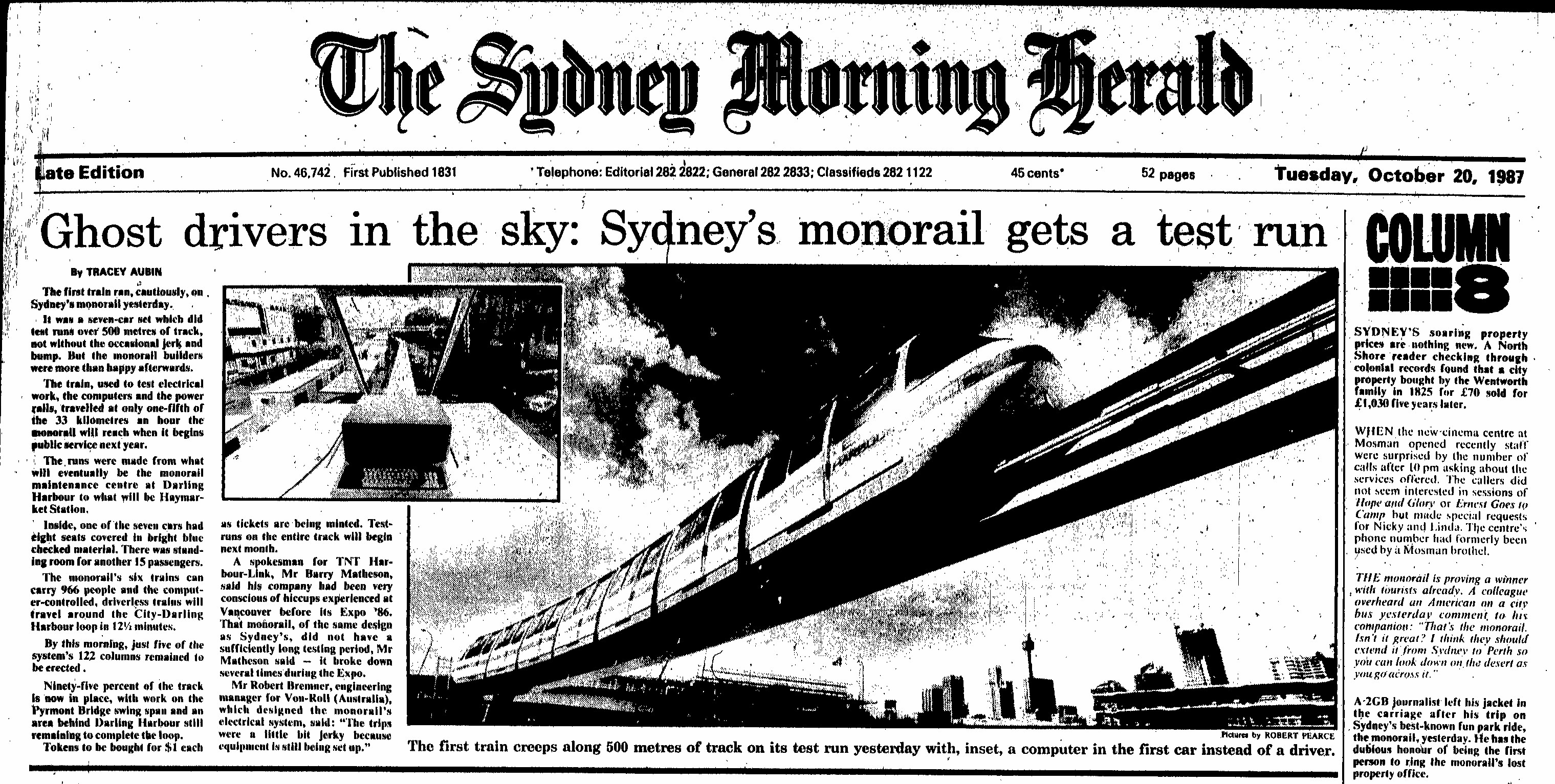
Source: Aubin, T. "Ghost drivers in the sky: Sydney's monorail gets a test run". The Sydney Morning Herald, October 20: 1.
In October 1987, the Monorail trains began the first of their test runs, using the tracks at their Maintenance Centre at Ultimo and travelling to the Haymarket Station.
Test runs were meant to have been run on the route from November 1987, but did not occur until February 1988. The first test run was on February 13 1988 in Liverpool Street and featured on the front page of The Sun Herald on February 14, 1988 (below). At the time it was anticipated that passengers could use the line from April, three months behind schedule. This did not eventuate.
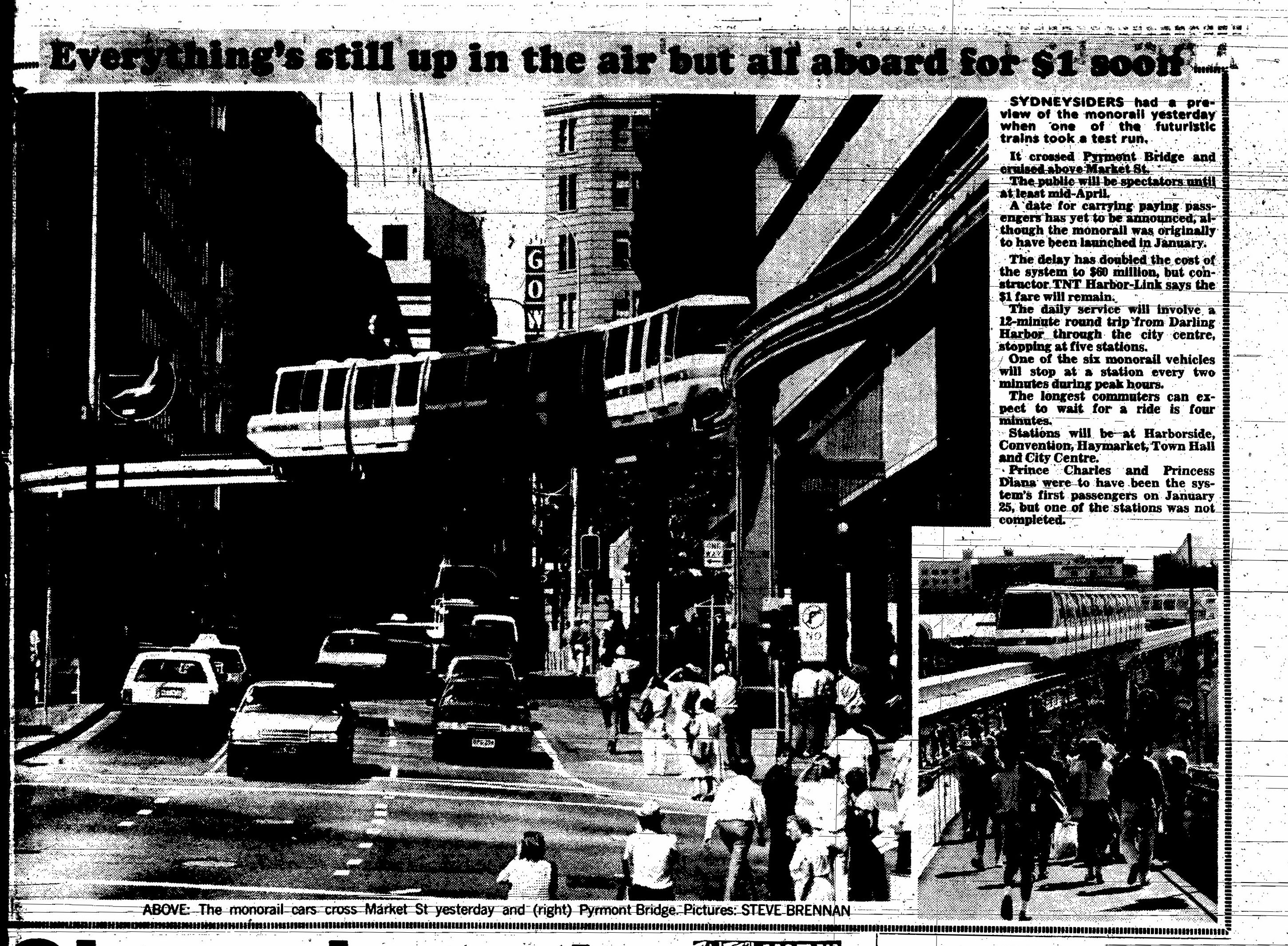
Below are another two newspaper clippings relating to test runs conducted soon after.
Source: Anon. 1988. "Everything's still up in the air but all aboard for $1 soon". The Daily Telegraph, February 27: 3.
Source: Stevens, R. 1988. Untitled (Photograph). The Sydney Morning Herald, February 24: 1.
In May, 6000 people were provided with an opportunity to ride the circuit ahead of its opening.
Source: Hewett, T. 1988. "A hum of satisfaction from above". The Sydney Morning Herald, May 16: page unknown.
James Oram was one of the first journalists to ride the monorail and shared his insights.
Source: Oram, J. 1988. "Magic Carpet Ride at 33km/h". The Sunday Telegraph, March 30:17.
Finally, I published an entry in 2018 that looked at the opening of the monorail in 1988. Click here to view the entry.
When talking about the Monorail in Sydney, we must have an obligatory reference to The Simpsons .
Last week, I shared content on the opening of the Monorail in 1988, but the question needs to be asked:
What was the impact of the monorail on Sydney?
The impact of the monorail will depend on whether you supported it or opposed it.
This is my summary of the positives and benefits that the monorail bought to Sydney.
Positives:
It initially was the main public transport option to travel from the city to Darling Harbour, though ferry, bus and light rail connections followed.
A mode of transport free from congestion. It didn't require road space that a bus or tram would need.
Big appeal for visitors to Sydney and families. Many travellers were tourists.
Negatives
Fares when compared to travel on other modes was higher.
It was just as easy and quick to walk to Darling Harbour.
Impact on the streetscape - it blocked views from the street of city buildings.
Only connected Darling Harbour with "midtown". It didn't serve other areas of the Sydney CBD. An expansion was mooted but did not eventuate further than a drawing board.
Cost of maintenance was an ongoing concern.
Didn't cater for day to day commuters.
Some of the monorail stations are still with us five years after closure with virtually no plans to remove them or adapt them to new uses. The most notable one is at Darling Park, where it appears suspended in mid-air.
While I liked the monorail for giving a futuristic touch to Sydney streets and made the street appear active, it seems that the monorail bought more negatives to Sydney than benefits.
I believe it was in the planning of the monorail that caused its demise. It needed to connect Darling Harbour to the entire city centre, not just "midtown" or even sent it through Pyrmont. A bigger network might mean that we still have the monorail.
Non Sydneysiders and fans may lament its departure, Sydneysiders, in general, have moved on as there are greater transport needs to focus on, than maintaining a monorail that served a limited area of the city.
In the end, it contributed little to transport in Sydney, apart from shuttling tourists from the city to and from Darling Harbour.
What if Nick Greiner's plan to reroute the line through Kent Street had proceeded?
Apart from a cost blowout on top of the existing blowout, it would have hastened its demise. The Kent Street option would have had poorer connections with rail and bus services at Town Hall. The advantage of Pitt Street also improved access for those connecting with buses on Elizabeth and Castlereagh Streets.
In addition, there would be no station near the Pitt Street Mall, which was evolving into a popular city destination.
Why did it get pulled down?
Above: Ten News Report from March 23, 2012, announcing the plans by the NSW Government to close the monorail.
The O'Farrell Government decided in 2012 to remove the monorail within "five years" for the following reasons:
Increasing maintenance costs and upgrades were financially unviable.
Decreasing patronage
Seen as hindering the expansion of public transport in central Sydney.
Hindering plans to redevelop the Sydney Exhibition & Convention Centre.
It only cost $20 million for the state to purchase the entire network from operator Metro Transport Sydney (MTS), but also landed the entire light rail network as part of the package.
Above: ABC News Report from June 30, 2013, on the Monorail's final day of operation.
Between 1988 and 2013, visitors to Darling Harbour were able to travel to the precinct from the city by monorail.
Built as a Bicentenary gift by TNT to the people of Sydney at a cost of up to $150 million, it was opened with controversy on July 21, 1988; more than six months behind schedule. Only four stations along the route were ready for opening day.
NSW Premier Nick Greiner was a vocal critic of the monorail. He did not attend, nor did any members of the State Government.
You were either for or against the monorail and even until its closure on June 30, 2013, it divided the city. On opening day, protestors opposing the monorail continued their protests, assembling at the Queen Victoria Building for what was a now a lost cause.
Many more were interested in testing out the Monorail, forming long lines at Monorail Stations for free rides. TNT was ordered by Premier Greiner to do so for two weeks before introducing a $1 fare.
Believe it or not, the network was designed to last just 20 years and outlived it by five years.
Below is coverage by each TV network from opening day 1988 (except SBS).
Channel Ten provided the best report covered by political reporter Bob Mullins. The famous footage of Clover Moore (State MP for Bligh) speaking at the protest outside the QVB is featured - "The monorail is the most offensive structure...". Channel Seven even featured the clip in a 2012 report when the O'Farrell Government decided to buy the monorail and pull it down for upgrades to Darling Harbour.
National Nine News gave us an insight into the views of passengers.
Seven Nightly News gave us a balanced perspective from passengers and protesters.
ABC got an exclusive with Sir Peter Abeles in its report, and follow the debate between a protester and bystander at the QVB.
Newspaper coverage was a bit restrained, despite constant coverage of its hurdles in getting to opening day.
Source: Bayvel, B. 1988. "Monorail Lays it on the Line: Off and running six months late". The Daily Mirror, July 21: 5.
Source: Bowditch, S. 1988. "Monorail, is up, up and away". The Daily Telegraph, July 22: page unknown.
The Sydney Morning Herald listed a one paragraph summary of opening day on Page 6 under "In Brief" in its edition on July 22. 12 000 were reported as riding the monorail on its first day of operation.
Next week, I shall answer the question of the impact of the monorail on the city of Sydney.