Showing posts with label transport. Show all posts

Monday, 20 September 2021

1988: Monorail Test Runs

Sydney's Monorail network which connected central Sydney with Darling Harbour operated between 1988 and 2013. It was controversial from its conception, construction and while in operation.

The Monorail was supposed to have commenced service in January 1988 as part of Bicentennial Celebrations with Prince Charles and Princess Diana to be the first passengers, but delays saw the monorail commence service in July, 1988.
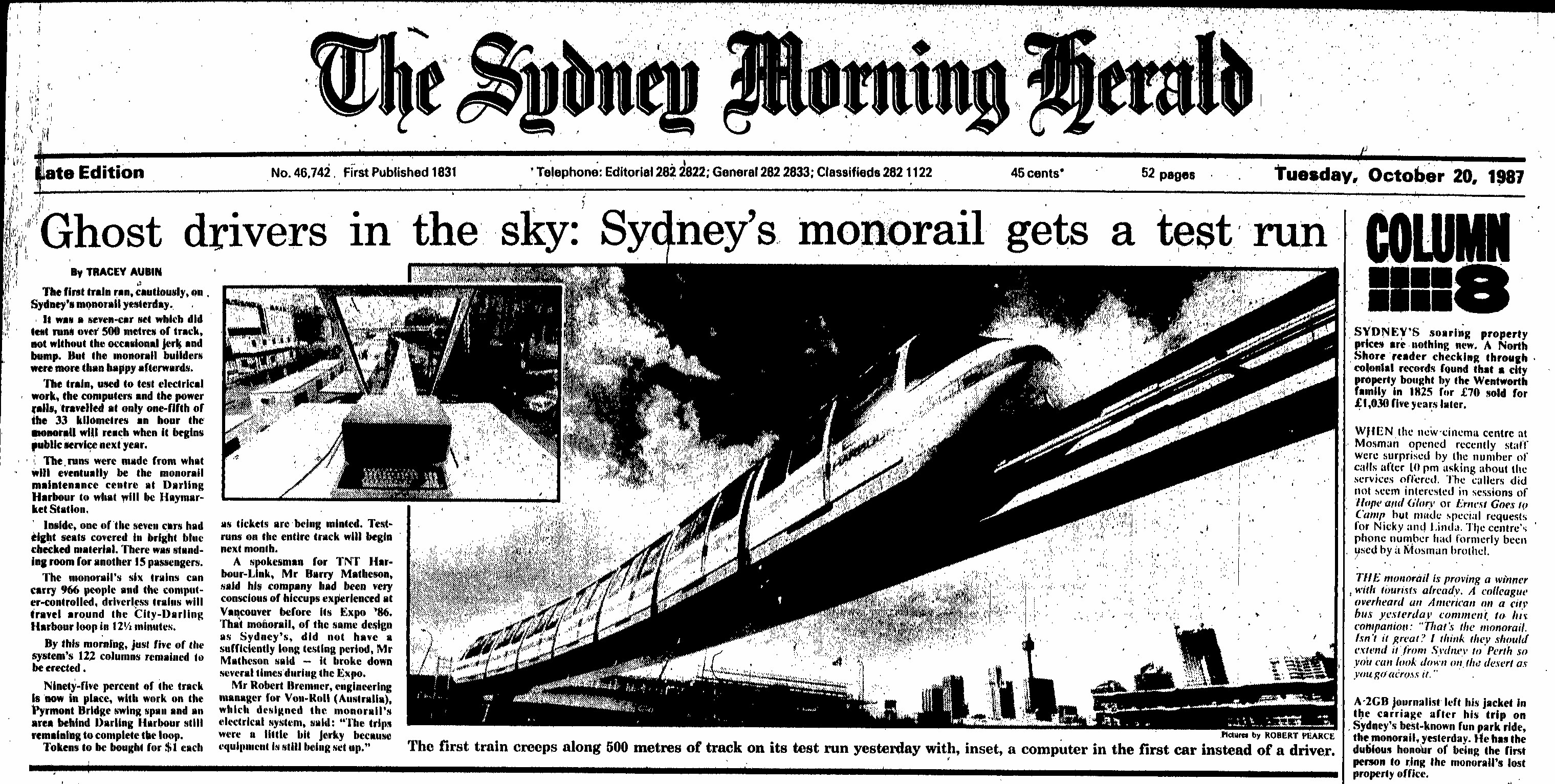
Monorail test run october 20 1987 SMH 1 closeup 

Source: Aubin, T. "Ghost drivers in the sky: Sydney's monorail gets a test run". The Sydney Morning Herald, October 20: 1. 

In October 1987, the Monorail trains began the first of their test runs, using the tracks at their Maintenance Centre at Ultimo and travelling to the Haymarket Station.

Test runs were meant to have been run on the route from November 1987, but did not occur until February 1988. The first test run was on February 13 1988 in Liverpool Street and featured on the front page of The Sun Herald on February 14, 1988 (below). At the time it was anticipated that passengers could use the line from April, three months behind schedule. This did not eventuate. 

 Monorail Test Run February 14 1988 Sun Herald 1 enlarged

Below are another two newspaper clippings relating to test runs conducted soon after.
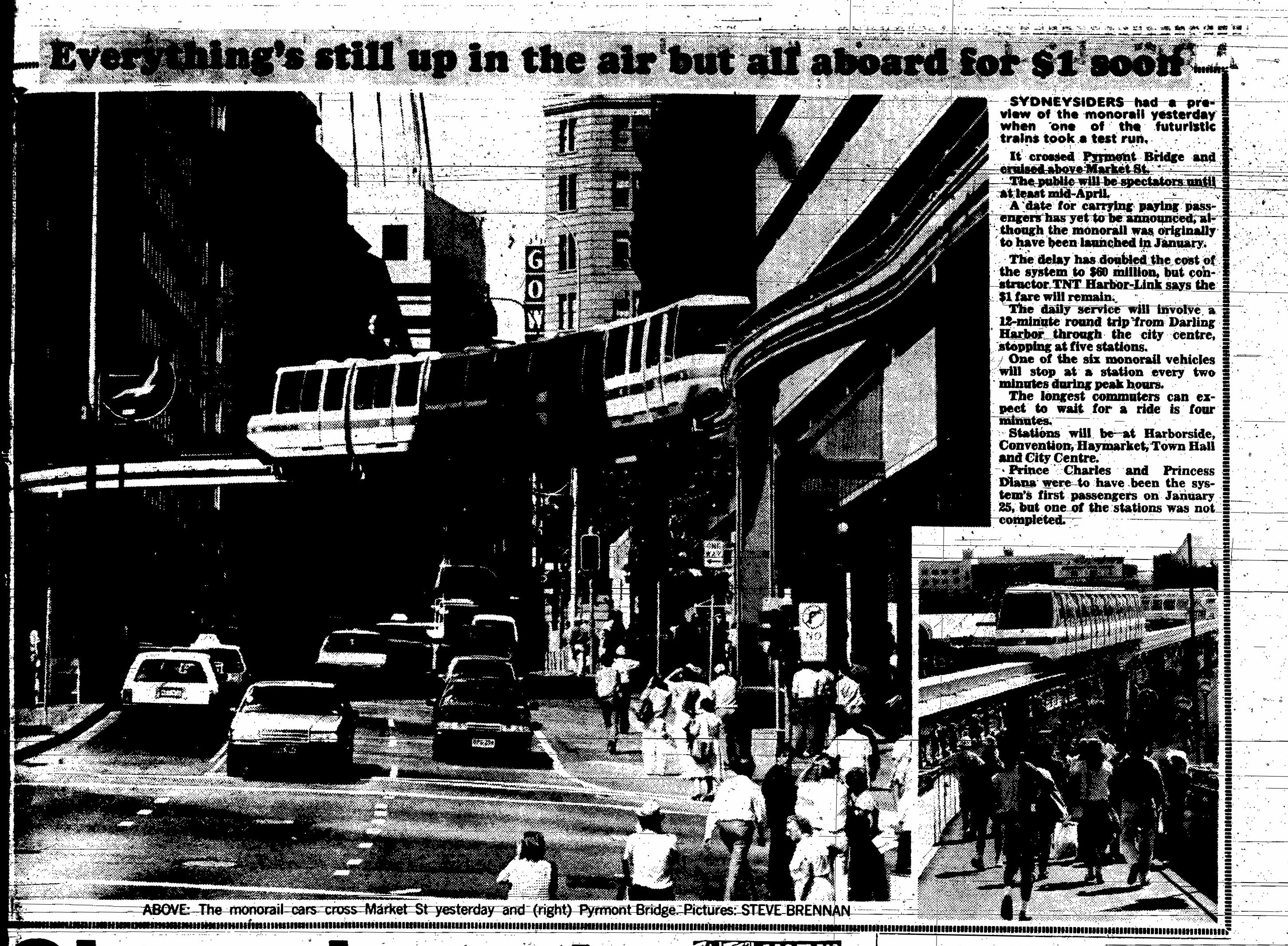
Monorail test february 27 1988 daily telegraph 3

Source: Anon. 1988. "Everything's still up in the air but all aboard for $1 soon". The Daily Telegraph, February 27: 3. 

Monorail Test Run February 24 1988 SMH 1 enlarged

Source: Stevens, R. 1988. Untitled (Photograph). The Sydney Morning Herald, February 24: 1. 

In May, 6000 people were provided with an opportunity to ride the circuit ahead of its opening. 

monorail test run May 16 1988 SMH page unknown


Source: Hewett, T. 1988. "A hum of satisfaction from above". The Sydney Morning Herald, May 16: page unknown. 

James Oram was one of the first journalists to ride the monorail and shared his insights.

monorail march 20 1988 sunday telegraph 17

Source: Oram, J. 1988. "Magic Carpet Ride at 33km/h". The Sunday Telegraph, March 30:17. 

Finally, I published an entry in 2018 that looked at the opening of the monorail in 1988. Click here to view the entry.

Monday, 2 August 2021

1989: The return of ferry ocean cruises

In 1988, the NSW Government delivered the last ferry in the Freshwater Class of Sydney Ferries -  Collaroy. 

collaroy ocean cruises august 2 1988 daily telegraph 9 

Source: Anon. 1988. "'Family' cruises for new ferry". The Daily Telegraph, August 2: 9.

Unlike the other three ferries in the fleet - Freshwater, Queenscliff and Narrabeen, the upper deck was open at each end. Post 2000, the other three ferries would also provide open decks at each end.

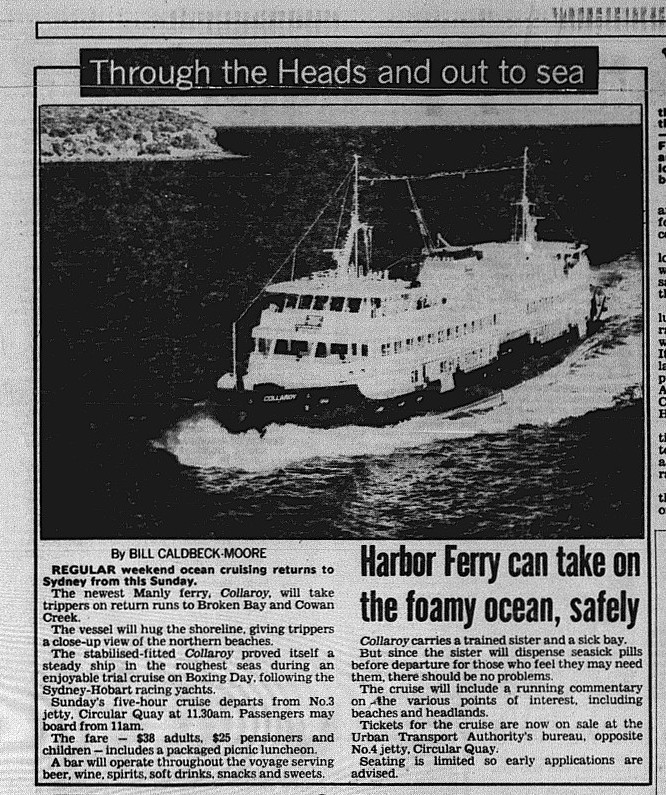
Collaroy had been fitted with stablisers to manage the ocean swells along with catering facilities. More than a canteen could be offered to commuters on the Manly run or on a harbour or ocean cruise. 

Collaroy Cruise January 6 1989 daily telegraph 

Source: Caldbeck-Moore, B. 1989. "Harbor Ferry can take on the foamy ocean, safely". The Daily Telegraph, January 6: page unknown

In 1989, Sydneysiders were able to experience ocean cruises on the Collaroy, reviving the cruises provided by the South Steyne between 1953 and 1973, when it was under the ownership of the Port Jackson and Manly Steamship company. 

Below is one newspaper advertisement from February 1989.  Cruises ran between Circular Quay and Cottage Point. Tickets were $38 for adults and $25 for children and pensioners and included a picnic lunch. 

  Ocean cruises Sydney Ferries Ad February 28 1989 daily telegraph 43

Source: Sydney Ferries. 1989. "Run away to sea for a day on a Sunday Coastal Cruise" (Advertisement). The Daily Telegraph, February 28: 43.

The cruises ran until the following year. It was written in Ferries of Sydney by Graeme Andrews that the services were terminated after ferry officers demanded the payment of a "spew allowance" that was being received by deckhands working on the services. The "spew allowance" referred to a payment to cover cleaning up the mess left behind by seasick passengers. 

With new Emerald Class ferries about to commence full time service on the Manly run, Collaroy will step back into a part time role, operating on weekends alongside the Freshwater (oldest of the Freshwater Class ferries). This only occurred after a backlash from Sydneysiders over plans to retire the entire fleet citing:

  • The iconic nature of the ferries 
  • Cultural Importance
  • Ability to transport large numbers of commuters - 1100 people compared to 400 on Emerald Class Ferries.
  • Heritage value
  • Ability to manage the swells at the heads.
The Narrabeen and Queenscliff are expected to be retired from service by the end of 2021. 


Monday, 8 February 2021

MILESTONE: Opening of the Woronora Bridge (2001) - Part 2

This week is my second and concluding entry on the opening of the Woronora Bridge in 2001. Thursday (February 11), will mark twenty years since the bridge opened to the public.

Last week's entry focused on planning and construction of the bridge. As promised, this entry will focus on opening day.

The St George and Sutherland Shire Leader reported on February 6, 2001 that the Roads and Traffic Authority (RTA) had yet to announce who would officially open the bridge.  


The bridge was officially opened by NSW Premier Bob Carr. Before the road was opened to traffic, the public were invited to walk across the bridge for the cost of a gold coin donation. Activities and entertainment were provided on both sides of the bridge at Akuna Oval, Bangor and Sutherland Oval. 

Motorists were allowed to access the bridge the following day (February 12, 2001).

Below are newspaper reports associated with the opening.

The St George and Sutherland Shire Leader

February 13 2001


This article (below) was published on Page 2. 


The Daily Telegraph
February 12, 2001, Page 9


The Sydney Morning Herald
February 12, 2001, Page 3. 


Below are assorted news clippings relating to the opening uploaded to Youtube by "TheTVGuru3". 


Finally, while the bridge provided improved road connections to Menai, Menai Road continued to remain congested. This led to the construction of the Bangor Bypass from the bridge to Old Illawarra Road in 2005. The North-South section connecting the bypass Old Illawarra Road Menai to Alfords Point Road was completed in 2011. 


Monday, 25 May 2020

MILESTONE: The Airport Line turns 20 (2000) - Additional material

Last week, I focused on the opening of the Airport Line in 2000. This week, I will share additional media clippings that were not featured.

Below is another newspaper advertisement.


Source: Airport Link. 2000. "Catch a train to your plane" (Advertisement). The Sunday Telegraph, May 28: 38.

The Sydney Morning Herald published a special feature article on May 18 2000. I have enlarged the visual diagram.


For those living along the route, it meant one thing - higher home values.


Source: Hilferty, T. 2000. "Ready for takeoff: Airport Link to life home values". The Daily Telegraph, May 13: 7.

One teething problem identified prior to its opening was that ticket machines across the network had not been updated to feature the new stations.


Source: Bissett, K. 2000. "No tickets to ride on airport link". The Daily Telegraph, May 17: 5. 

As a bonus, ever wondered why the stations along the line were designed the way they are?


Source: Bissett, K. 2000. "Track to the future: New stations resemble airports". The Sunday Telegraph, April 1: page unknown. 

Monday, 18 May 2020

MILESTONE: The Airport Line turns 20 (2000)


Source: Airport Link. 2000. "Fly by Train" (Advertisement). The Sunday Telegraph, May 14: 51. 

On Thursday (May 21), Sydney's Airport Railway Line will celebrate twenty years of service. The $900 million line was built as part of extensions to Sydney's rail network in the lead up to the 2000 Olympic Games.

The line was significant as:

  • Sydney became the first city in Australia to have a railway line to serve its airport.
  • It was the first (and only) railway line to be built in Sydney under a public private partnership. 
  • Excluding the Olympic Park Loop (1998), this was the first new railway line constructed in Sydney since the Eastern Suburbs Railway Line (1979).
  • Commuters had to pay a station access fee in addition to their rail fare to cover the cost of construction. This was abolished in 2011 for those accessing Green Square and Mascot Stations.
Five new stations were built - Green Square, Mascot, Domestic Terminal, International Terminal and Wolli Creek. 

Wolli Creek also acted as an interchange station for commuters on the Illawarra and South Coast Railway Lines wishing to access Sydney Airport.

What was it like on day one back in 2000?

The public were invited to inspect the new stations and experience the line before normal operations commenced at 7pm.


Source: Airport Link. 2000. "The New Airport Line Grand Opening Sunday" (Advertisement). The Sydney Morning Herald. May 19: 3. 

The first full day of operation was May 22. The Daily Telegraph (Final or 2nd Afternoon Edition) reported that while activity was quiet along the new line, there were no problems with services. Feedback from commuters was positive.


The Sydney Morning Herald reported on May 23 (Page 8) that while services ran smoothly, overcrowding of trains was a concern with airport travellers struggling to fit their luggage. NSW Premier Bob Carr even advised luggage laden travellers to travel to central Sydney by bus or train. Taxi Drivers also believed that the line would ruin their business. Two decades later, it is ride-share services e.g. Uber that have impacted on their business and not the train.


The need for luggage racks on the trains servicing the airport was considered but was dismissed. Two decades later - no change.


Source: Bissett, K. 2000. "Need for baggage carriages rejected". The Daily Telegraph, May 23: 11. 

A Courier Service was explored as well with no success.


Source. Wainwright, R. 2000. "Airport Link takes the bag at $8 a pop". The Sydney Morning Herald, May 24: 2. 

A new rail line also resulted in changes to timetables across the rail network, especially the East Hills and Illawarra/Eastern Suburbs Lines. Some stations on the East Hills line saw a reduction in services while stations between Glenfield and Campbelltown experienced increase services. However Travel times for East Hills Line commuters increased as services were now rerouted via the Airport Line, and those wishing to travel between Wolli Creek and Redfern had to change at Wolli Creek. Many Illawarra line services also stopped at Wolli Creek.


Source: Bissett, K. 2000. "Airport line changes all timetables". The Daily Telegraph, May 18: 9.

Next week, I will share some additional material relating to the Airport Line

Monday, 2 March 2020

1965: Possible Combined Terminal at Sydney Airport

I recently located a newspaper report relating to a proposal for a combined International-Domestic Terminal at Sydney Airport along those seen today at Tullamarine Airport in Melbourne and Adelaide Airport.

It appears that the northwestern section of the airport had been selected as the site for the new terminal, where the new International Terminal would be built and opened in 1970.

Below is the article from The Daily Telegraph dated June 8 1965.


On the same page, there were also concerns over the development of the modern facilities at Sydney Airport and that Melbourne's new Tullarmarine Airport would be completed before Sydney Airport. Sydney Airport did open ahead of Tullarmarine airport in 1970.

It would have been interesting had the Federal Government gone for the combined terminal option, especially if extensions had to occur in the years ahead. The space where the International Terminal is located is tight as it is today. Imagine sharing it with the Domestic Terminal.

We could have ended up even with separate terminals for separate airlines as seen in numerous airports. Sydney Airport's layout would have made this challenging.

Interesting to note in the article of a possible rail link to where the Domestic Terminals are located today, which was to be linked to a future eastern suburbs railway line. The Airport Line (2000) would eventually see a station built there along with the international terminal. It linked the city, but instead of serving the eastern suburbs, it serves the western suburbs through a direct connection to the East Hills Railway Line.

And a need for two parallel runways. Only one of them became reality as reflected in the third runway (1994).

Monday, 2 January 2017

Remember this: Airport Express Advertisement (1991)

For January, our weekly entries will focus quite simply on classic advertisements or moments in time.

Many like myself have left town for the summer, and some are about to head off. I will admit this was written well before I went away.

In fact today, I'll be in the air and contending with the challenges of flying including the fight to get to the airport.

This one does relate to holidays and travel. Here is a 1991 advertisement promoting the now-defunct Airport Express Bus service. Buses used to shuttle passengers between the Airport, City and Kings Cross.

The service was provided by the State Transit Authority/Sydney Buses. Following the opening of the Airport Rail Line in 2000, the service was discounted in 2001 with private operators providing door to door shuttles.

Compared to today, it would cost the equivalent of $10 single or $16 return which is pretty cheap. There is a push to operate more bus services to Sydney Airport to reduce congestion on the roads in the area.


Source: State Transit Authority. 1991. "Take off for Your Holiday on our Runway" (Advertisement). The Sunday Telegraph, December 22: 11.

Monday, 15 February 2016

1969: Sydney's double decker test train


Source: Anonymous. 1968. "The Train Made to Hold 2096". The Daily Telegraph, December 31: 7. 

Sydney might not have the world's best rail network but visitors to Sydney do like it for its double-decker trains. It is the only Australian city that has them in operation. Ever wondered when they began operation? It was on January 1, 1969. Some might say 1964 when the Tulloch carriages were incorporated into trains carrying single level cars.

However, this train in 1969 was entirely double deck (or bi-level). It set the precedent for the modern fleets that would operate on the Sydney rail network through to this very day. The following year, the first of the famous V set double-decker trains began operation on interurban services. In 1972, the first mass order for double-decker trains for suburban services was undertaken. These trains are what as known as the 'S' Sets and would carry up to 1600 people, about 25 % below what they thought a few years earlier.

These trains are still part of the Sydney Trains fleet, mostly used as surplus trains for major event services, though there are a few timetabled services where the trains still run. Updated versions (the C & K sets) came into service during the 1980s. One notable feature is that they were airconditioned trains. In 1988, the Tangara came into operation.

Since the turn of the Millennium, there have been two major rollouts - Millennium Trains (2002) and the Waratah Trains (2011). The Waratah trains were bought in to replace the remaining S set trains. The final eight car set in the Waratah fleet was delivered in 2014. The double-deckers would see the demise of the single deck trains on metropolitan services with the "red rattlers" phased out by 1993.

However single deck trains will return in 2019 when the North West Rail Link opens between Chatswood and Rouse Hill. Some people question the decision because the single deck trains will lack the capacity that double deckers have. It tells us one thing - Sydneysiders take their double-decker trains for granted. It is a way of life.

Monday, 1 February 2016

1970: The Indian-Pacific Begins Service

On February 23, 1970, the Indian Pacific Train went into operation and for the first time allowed for uninterrupted rail travel between Sydney, Adelaide, and Perth. Before 1970, one had to take five trains just to cross the country (and via Melbourne) on various gauges. The line completed a century-long vision to construct a rail line to link the eastern and western coasts of the continent. A lavish ceremony was held to mark the commencement of services at Central Station.


Source: Anon.1970. "On the first train to Perth: Indian-Pacific's big send off". The Daily Telegraph: February 24: 3. 

Four days later, the train arrived to a big welcome in Perth with 10000 gathering at Perth Station for its arrival.

It has survived the jet age due to the experience that it is offered to travelers. While one can fly from Sydney to Perth in four and a half hours, a journey by rail allows one to see the many landscapes that shape our nation. The hospitality on board makes the journey a holiday in itself and has become regarded as one of the world's great rail journeys.


Monday, 15 December 2014

1995: Sydney's Olympic Road (M4 East)

With the WestConnex now planning to snake its way under Sydney, lets look at one dead scheme that was proposed for the inner west from 1995 as a solution to the traffic gridlock on Parramatta Road.

However it was not going to be a motorway and the road would run above ground through a section of Concord and Five Dock before connecting with the City West Link at Wattle Street, Haberfield. A wise idea to not proceed with it because I think it wouldn't have had any major impact on traffic on Parramatta Road. The bottlenecks would have shifted east along the road into Haberfield and Ashfield. This appears that controlling traffic there would be so challenging as you'd not just manage traffic coming out of the new road but also the City-West Link, Parramatta Road and Frederick Street, Ashfield.


Two alternative routes were considered. One would have included a tunnel under Parramatta Road like the WestConnex Motorway but would have required closure of parts of Parramatta Road or the construction of a viaduct along Parramatta Road.

Source: Larkin, J. 1995. "RTA in push for Olympic road link," The Sunday Telegraph, August 20: 5.

Monday, 8 December 2014

1972: Inside the Sydney Airport Control Tower

This week, I share a feature from The Daily Telegraph in late 1972 that took readers inside the old control tower at Sydney Airport. In those days it had recently opened as part of the expansions to the airport during the late 1960's at a cost of $19 million. To build it today would equate to $200 000 000 according to the RBA Inflation Calculator. The control tower operated until 1996 when the current control tower opened on the opposite side of the North-South Runway.

The old control tower could handle up to 45 flights per hour (about half of today's maximum of eighty flights) while boasting that the radar covered the entire state of New South Wales.

The building has been remained idle, but there is the possibility it may be heritage listed in the future.


Source: Behr, J. 1972. "$19m nerve centre." The Daily Telegraph. December 1: 30-31.

Monday, 18 August 2014

1972: Wynyard's Double Decker Walkways

As Sydneysiders know, Wynyard is one of Sydney's busiest railway stations and has been getting busier by the year. In the early 1970's, the footpaths in streets around the station were getting congested and it was proposed that double-decker walkways could be the answer.


Source: Anonymous. 1972. "Threat to Million Dollar Plan For Wynyard". The Daily Telegraph, August 19: 17. 

There were also plans to provide underground retail complexes that would link the station. The Hunter Connection when completed about a decade later, would include a link along with the Metcentre. The render above shows an artists impression of the retail complex that would be above the concourse of the station. That did not eventuate for two decades.

Also, it is mentioned that the scheme could be "wrecked" due to plans for a Telephone Exchange in the block bounded by Erskine, Kent, Margaret & Clarence Streets. The Exchange did get built, closer to Erskine Street and a walkway was built through to Kent Street, minus the retail (apart from one shopfront at the Kent Street end, and one small space under Clarence Street.

That is now forming the new Wynyard Walk which will link the station with Barangaroo.


Monday, 9 June 2014

1987: Freeway free-for-all

To coincide with the opening of the Georges River Bridge (southbound bridge for the Princes Highway at Tom Uglys Point) in October 1987, The Daily Telegraph ran a special photo spread showing the construction of freeways across the city including the Western Distributor, Southern Cross Drive and the F3 (Sydney-Newcastle Freeway). The road building at the time was deemed by journalists to be the most "ambitious" in years.


Source: Reid, C. 1987. "Freeway free-for-all," The Daily Telegraph, October 13: 26-27.  

Thursday, 5 June 2014

2004: Spirit of Tasmania unloads its cargo

A photo I took at Sydney Tower of the Spirit of Tasmania unloading cars and buses in October 2004 at East Darling Harbour (Barangaroo).