Showing posts with label Darling Harbour. Show all posts

Monday, 28 September 2026

1995: Challenging times at Darling Harbour

Darling Harbour December 6 1995 daily telegraph

Source: Skelsey, M. 1995. "Yesterday's darling". The Daily Telegraph Mirror, December 6: 11. 

For over a decade, Darling Harbour has undergone a redevelopment phase. Precinct by Precinct, dating as far back as 1983, have been demolished and rebuilt.

Some precincts, such as Tumbalong Park, have had their own upgrades to reflect the changes occurring around them. 

Renovations, redevelopments and construction can take their toll on any precinct, while the work has occurred. I have had to adjust to the fact that at present there is one precinct undergoing work on any visit. This may keep visitors away and lead to a downturn in business trade, but Darling Harbour has shown resilience. Many still trek there on a weekend. 

In 2026, the focus is on the site of the former Harbourside Shopping Centre. It closed early in 2023 to make way for a new retail complex and, rising above it, a luxury apartment tower. It is due to be completed next year.

In 1995, The Daily Telegraph Mirror reported that Darling Harbour was undergoing a slump and the Harbourside Shopping Centre was struggling most. 

It is not surprising that the centre had struggled throughout its first incarnation. Apart from the restaurants that lined the space facing the waterfront, the general retail space did not offer anything that could make it stand out. There were tacky souvenir stores selling overpriced items, some chain fashion stores, and even lolly shops selling overpriced lollies that could be found cheaper elsewhere.

Just before its closure in 2023, it even had a convenience store selling overpriced USA candies, drinks, and snacks. 

Harbourside was also fortunate to be the only retail centre that could trade every night until late, and that was still not enough to pull them in.

The broader precinct at the time was also under scrutiny, though the IMAX theatre opened the following year. Cockle Bay Wharf on the opposite side of Cockle Bay was opened in 1998. Sega World opened in 1997, but closed in 2000, with the space remaining dormant until demolished in 2008 for the Darling Quarter complex. 

At the time of the article (1995), Ron Finlay, who was a former member of the Darling Harbour Authority Board, felt that Darling Harbour needed to evolve to continue attracting visitors.

Fast forward three decades, and those redevelopment works, renovation and construction work. That represents evolution and fulfils Finlay's concerns. 

There has been controversy, especially the demolition of the Sydney Entertainment Centre and the Sydney Exhibition and Convention Centre. Both were combined to form the International Convention Centre on the Exhibition and Convention Centre site.

The redevelopment of the Exhibition and Convention Centre Site was necessary because it had become a victim of its own success. Over the years, Sydney had gained a reputation globally for hosting exhibitions and conventions, and they were popular in themselves for hosting major events. The NSW Coalition Government (2011-2023) wanted to maintain the competitive edge and ensure that Sydney's Exhibition and Convention Centre could continue hosting major global events. Architecturally, they were fine examples of 1980s architecture in Sydney, but consider that in the 1980s, no one foresaw the success that they would experience. 

Darling Square, which was built on the former Sydney Entertainment Centre site, has been a success, notably for its dining and public spaces, while also acting as a residential neighbourhood within central Sydney. It enabled Darling Harbour to become a place that could call home, and not merely be a place to just visit. Pre-development, it was seen that the area surrounding the Entertainment Centre was an underutilised area, except when concerts and events were on, and that mixed-use development (residential and commercial) and then mixed with dining, public spaces and even a public library could allow the area to have activity at all hours of the day. This was used to justify the redevelopment.

The redevelopment of the Harbourside Shopping Centre is part of the evolution. It was overdue for redevelopment at any scale. The restaurants lining the waterfront will return, and hopefully a retail offering that caters to locals and visitors. It will also need to cater for the office workers who will work above the complex and those who will reside in the apartment tower rising above it. 

Its challenge, though, is how to stand out from other city retail complexes. Do extended trading hours provide that answer, as with the original centre? Should it be more neighbourhood based? Does focusing on dining (its strong point in the original centre) and specialising in it make it the focus? Do the tacky souvenir stores and fast food chains have their place or belong elsewhere?


Monday, 6 October 2025

1987: Launch of Sydney's Monorail Train

The Sydney Monorail ran between 1988 and 2013. In 1987, a year before its opening, the first monorail train, which ran on a 3.6-kilometre loop, was unveiled to the world at the Transpublic 87 Exhibition in Geneva. 

While the Monorail was causing controversy in Sydney, it was receiving praise for its innovation at an international level. Transpublic 87 Managing Director Rodolphe Huser praised it and hoped that other cities would follow Sydney's lead in adopting the monorail. 

Sydney Monorail unveiled April 28 1987 Daily Telegraph 4

Source: Anon. 1987. "Monorail steals limelight at show". The Daily Telegraph, April 28: 4. 

Monday, 28 April 2025

NEVER BUILT SYDNEY: Harrah's Sydney Casino Proposal (1986)

Darling Harbour Casino July 2 1986 SMH 1 enlarged

Sourced from: Dale, D. & Shanahan, D. 1986. "Sydney Casino: FBI checks US partner". The Sydney Morning Herald, July 2: 1. 

For the first time in two years, Never Built Sydney is back for another series, as I look at more of the "never builts" that were proposed for Sydney.

As part of the redevelopment of Darling Harbour in the 1980s, the Wran and Unsworth Governments sought to develop the eastern side of Cockle Bay into a Casino and Hotel complex. This was also a solution to rid the city of illegal gambling houses.

The site in question is currently the site of the Darling Park complex, comprising three office towers and the Cockle Bay Wharf dining precinct. 

Darling Harbour Casino August 12 1986 daily telegraph 1-2 (1) enlarged render

Sourced from: Holland, M. & Ringrose, D. 1986. "Casino deal 'cannot be scrapped'". The Daily Telegraph, August 12: 1 & 2. 

In 1985, the Wran Government put the site up for tender.  American casino operator Harrah's (owned by hotel chain Holiday Inn) in conjunction with Hooker Corporation was awarded the contract on June 24, 1986. Their proposal for the Casino Resort would comprise two buildings: one rising atop the Western Distributor and fronting Cockle Bay to around 11/12 storeys tall, which would feature the casino, while a 45-level hotel tower would be built towards the corner of Druitt and Sussex Street. 

Darling Harbour Casino August 13 1986 daily telegraph 1-2 (2) enlarged 2

Sourced from: Ringrose, D. 1986. "Hooker vows: We'll fight for casino". The Daily Telegraph, August 13: 1 & 2. 

Details about the towers and facilities were not published at the time and were based on observations in the photos of the model published in the media.

Why did it not proceed?

Darling Harbour Casino July 2 1986 SMH 1 enlarged 2

Source: Dale, D. & Shanahan, D. 1986. "Sydney Casino: FBI checks US partner". The Sydney Morning Herald, July 2: 1. 

The process required tenders (and individuals involved) to pass an "integrity check, " equivalent to a police check on an individual who may be considered for employment within a company. The Sydney Morning Herald in July 1986 revealed that Harrah's was under investigation by the FBI in the United States and the New Jersey Division of Gaming Enforcement over a claim that "it used organised crime figures to arrange deals with a union". This had not been uncovered during the initial integrity checks.

Darling Harbour Casino July 2 1986 SMH 1 enlarged 3

Darling Harbour Casino July 2 1986 SMH 4 enlarged

Source: Dale, D. 1986. "Questions Atlantic City wasn't asked". The Sydney Morning Herald, July 2: 1 & 4. 

The New Jersey Division of Gaming Enforcement responded that the NSW Government had not approached them.

Darling Harbour Casino August 12 1986 daily telegraph 1-2 (1)

Darling Harbour Casino August 12 1986 daily telegraph 1-2 (2) enlarged

Source: Holland, M. & Ringrose, D. 1986. "Casino deal 'cannot be scrapped'". The Daily Telegraph, August 12: 1 & 2. 

The revelation led to the State Government cancelling the contract on August 12 1986. Harrah's and Hooker took the government to the NSW Supreme Court claiming that the government were obligated to comply with the agreement. It would be settled out of court in 1989 with the NSW Government paying the consortium $33 million in compensation plus $5 million in court costs, a fraction of the $700 million initially demanded.

Darling Harbour Casino August 13 1986 daily telegraph 1-2 (1)

Darling Harbour Casino August 13 1986 daily telegraph 1-2 (2) enlarged

Source: Ringrose, D. 1986. "Hooker vows: We'll fight for casino". The Daily Telegraph, August 13: 1 & 2. 

New tenders were sought later that year and continued into 1987, but integrity checks saw all tenders rejected. Harrah's and Hooker tried again, but were unsuccessful. By the end of 1987, the Unsworth Government attempted a third round of tenders.

In 1988, the Unsworth Government was replaced by a Coalition Government under Nick Greiner. With $500 million still owing on the cost of the Darling Harbour Redevelopment, the NSW Government shifted in 1989 towards a mixed-use development of the site with a hotel, offices, and retail buildings to be built. In 1991, Darling Park was conceived, with towers built in three stages—1992, 1999, and 2005—with Cockle Bay Wharf constructed in 1998. The proposed hotel tower did not proceed. 

Saturday, 2 March 2024

Property Advert of the Week: The Goldsbrough Pyrmont - Apartment Release (1997)

Below is a 1997 newspaper advertisement promoting a new release of units in The Goldsbrough complex in Pyrmont, including studio, one and two-bedroom apartments. Studio apartments were on sale from $190 000, one-bedroom apartments from $255 000 and two-bedroom apartments with terraces from $485 000. 

Goldsbrough Ad April 5 1997 SMH 11RE 

Source: Colliers Jardine & Charles & Stuart. 1997. "Now showing for the first time" (Advertisement). The Sydney Morning Herald, April 5: 11RE (Real Estate Liftout).

Below are links to two other advertisements relating to The Goldsbrough.


Saturday, 1 July 2023

Property Advert of the Week: Harbour Tower Gardens (1999)

Below is a 1999 newspaper advertisement for the Harbour Garden Towers in Harbour Street in the city.

Apartments started from $242 000 for a one bedroom unit with penthouses on offer from just under $2.2 million

The monorail was literally on the doorstep with a monorail station located in the podium of the building to transport residents to Town Hall.

Harbour Gardens Ad June 5 1999 SMH 18 RE

Source: Accord Pacific & Jones Lang La Salle. 1999. "Harbour Garden Towers" (Advertisement). The Sydney Morning Herald, June 5: 18. 

Monday, 5 September 2022

1971: When Pyrmont Bridge faced demolition

The Pyrmont Bridge has evolved as Sydney has grown and changed. For decades it served as a major arterial connecting western Sydney with the Sydney CBD. The Western Distributor may have made the bridge redundant, but was reborn into a pedestrian walkway with the redevelopment of Darling Harbour.

But half a century ago, Sydney was facing the possiblity of losing it forever, and the lost opportunities that went with it.

In 1971, the first stage of Western Distributor from the Harbour Bridge Tollgates to Day Street was under construction while plans to extend the freeway from Darling Harbour to Glebe were underway. 

The freeway would render the Pyrmont Bridge redundant and would be demolished, when the expressway was in full operation by 1978.

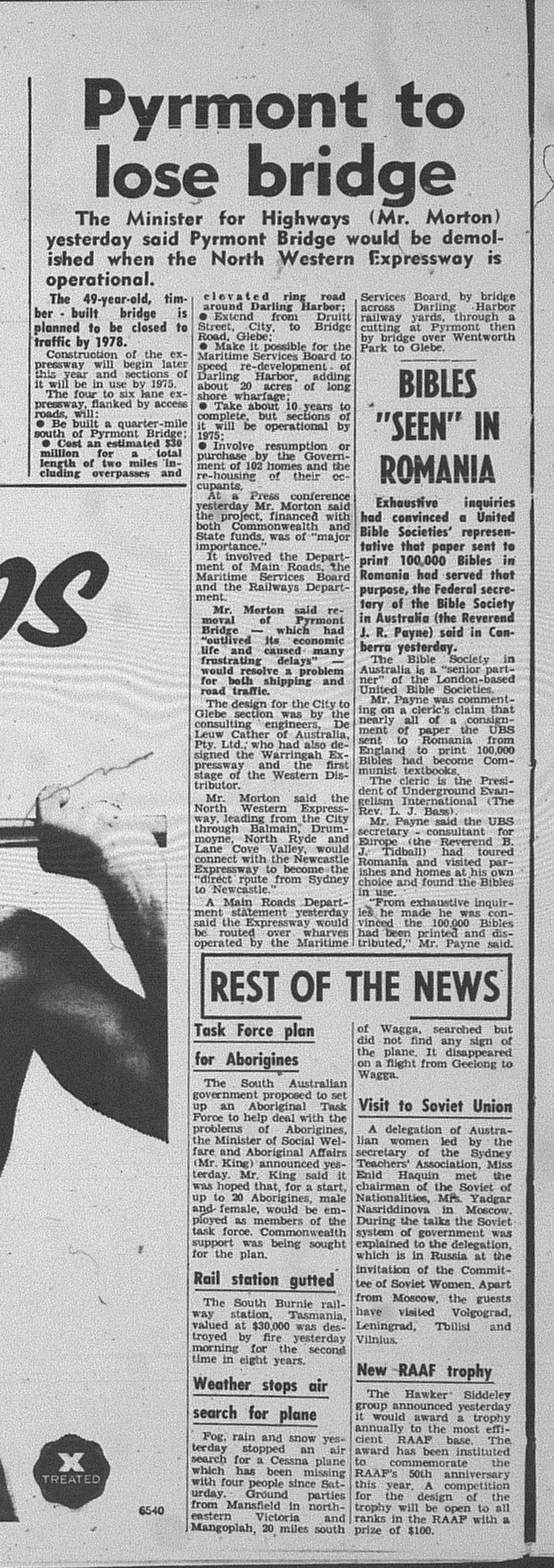
Pyrmont Bridge June 3 1971 daily telegraph 22

Source: Anon. 1971. "Pyrmont to lose bridge". The Daily Telegraph, June 3: 22. 

In 1980, the westbound viaduct from Day Street to Harris Street was completed. The Pyrmont Bridge was reconfigured to permit eastbound traffic. When the eastbound viaduct from Pyrmont Street to Day Street was opened the following year, the bridge was closed to all traffic.

  Pyrmont Bridge July 24 1981 SMH 9

Source: Name obsecured. 1981. "Pyrmont Bridge closing, but future open to suggestions. The Sydney Morning Herald, July 24: 9. 

With Darling Harbour set to be redeveloped, the bridge was still threatened with demolition. It was reported that the bridge was hindering redevelopment opportunites, while the argument to retain the bridge gained momentum.

Sydneysiders protested against plans to demolish the bridge and the NSW Government investigated alternative schemes. In 1983, it was suggested that the bridge be converted into a pedestrian walkway connecting Pyrmont with Market Street with shops and restaurants. The previous year, there was a proposal just to retain the ends and relocate the swinging span.

Pyrmont Bridge May 9 1983 SMH 3

Source: Coultan, M. 1983. "Bridge may get the Florence touch". The Sydney Morning Herald, May 9: 3. 

Some pushed for what became what it is now a pedestrian and cycleway only. 

When redevelopment plans for Darling Harbour were released in 1984, it's future would be secured. It became the pedestrian and cycleway that the public longed for. From 1988 until 2013, it carried the monorail.


Monday, 15 August 2022

VISIONS OF SYDNEY: Redeveloping the City Markets Precinct (1968)

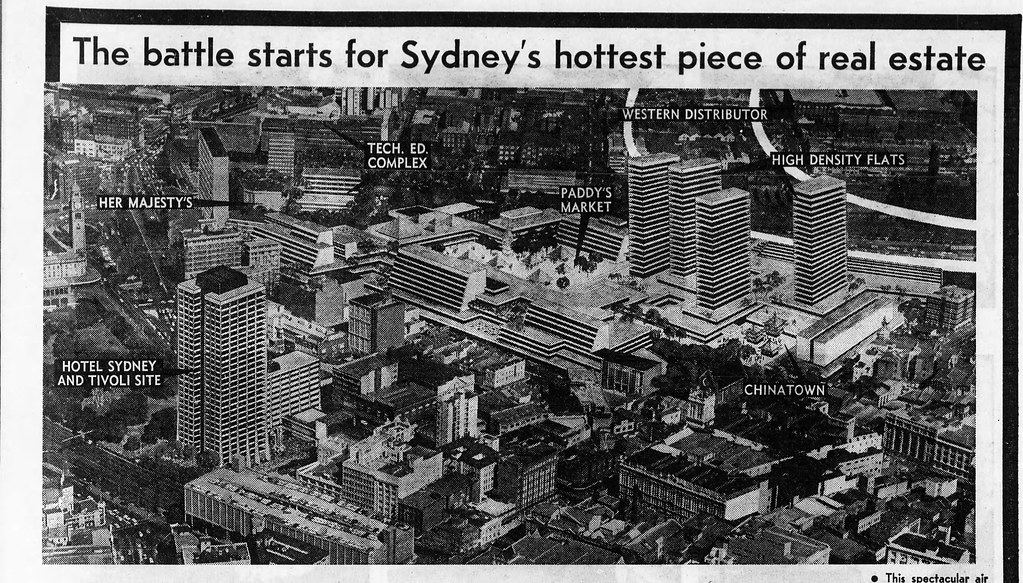
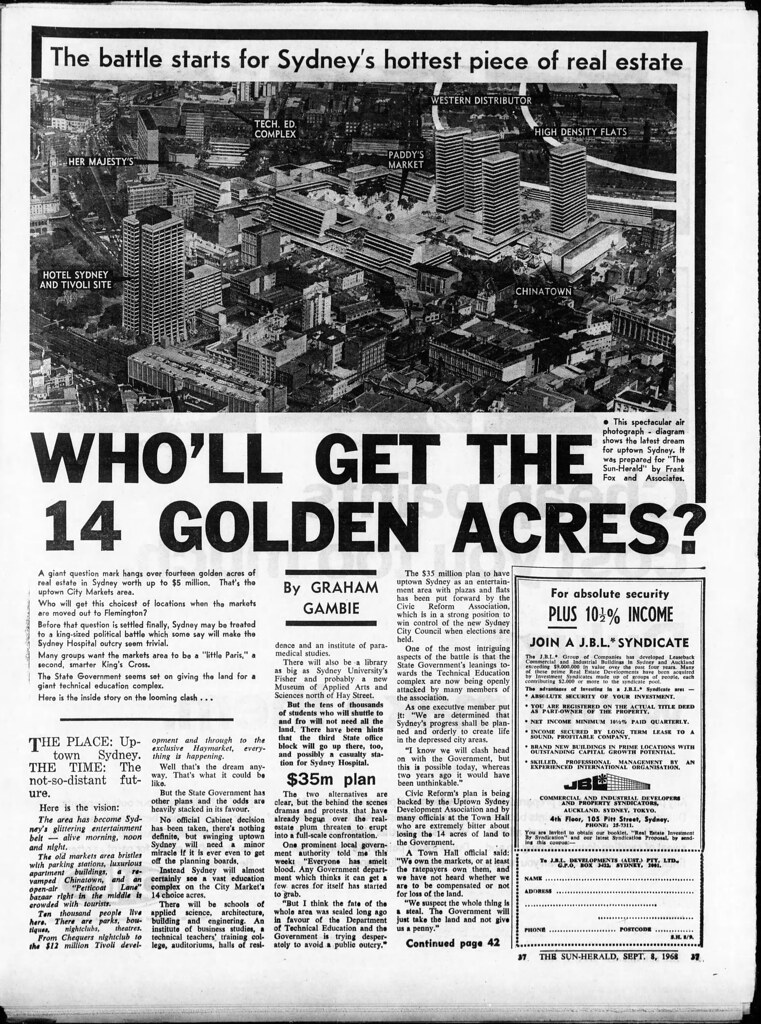
Haymarket Redevelopment September 8 1968 sun herald (1) enlargement 37Haymarket Redevelopment September 8 1968 sun herald (1)

Source: Gambie, G. 1968. "Who'll get the 14 golden acres?". The Sun Herald, September 8: 37 & 42. 

This is the last of my first set of entries in the Visions of Sydney series. In 1968, The Sun Herald asked Frank Fox & Associates to prepare a possible vision for the future of the City Markets site at Haymarket, which was relocated to Flemington. This was in response to State Government Proposals for an educational precinct to be created in the area, which was being opposed by the Civic Reform Association.

The fourteen acre area encompassed the current site of Paddys Markets, Darling Square (former site of the Sydney Entertainment Centre), Chinatown and areas encompassing Ultimo Road, Quay and Thomas Street's down to Railway Square.

The Civic Reform development plan encompassed the following:

  • Highrise apartment towers and carparks to be built alongside the Western Distributor (planned at the time to go through Glebe and the route is shown at the top right of image). The estimated population living in the area would be 10 000 people.
  • Opening up part of George Street to improve pedestrian access.
  • Retention of Paddys Markets.
Was this vision fufilled?
Not everything in a concept plan or vision will be fufilled. As the development at Barangaroo shows, it can be changed easily to accomadate changing needs or uses, which means there is a shift away from original plans or intentions.

The NSW State Government proceeded with its plans to develop an education precinct, which has evolved into the University of Technology, Sydney (attaining university status in 1988). Buildings encompassing the university have been built as far as Quay Street (Where the library is based). 44 000 students are currently enrolled. 

Paddy's Markets still trades at Haymarket, and is a "must-do" for visitors to Sydney. 

The High Density Flats would not appear until mid 2010's, after the closure of the Sydney Entertainment Centre (1983-2015) and the decision to incorporate it into a redeveloped Sydney Exhibition and Convention Centre Complex. The precinct is known as Darling Quarter.

Above: Darling Quarter fufilled a 1960's vision to turn Haymarket into a residential precinct. Photo taken by the Author (2021). 

One element not completed was the improved pedestrian access to George Street, though the underpass under Railway Square and the conversion of the former goods line into a walkway could be regarded as fufilling at least part of the vision.

The residential population of Haymarket according to the 2021 Census was approximately 8500., just short of the estimated 10 000.

As for the idea of the area becoming a centre of entertainment. Except for the Sydney Entertainment Centre (1983-2015), little was provided in terms of entertainment for Sydneysiders and visitors. Her Majestys Theatre was eventually demolished for an apartment block in the 2000's.


Monday, 30 May 2022

NEVER BUILT SYDNEY: Shangri-La Hotel, Haymarket (1983)

In 1982, plans were unveiled to build a 26 level hotel and convention centre atop what is presently Paddys Markets at Haymarket. It would be managed by the Shangri-La Hotel Group. Sydney City Council were keen to have it cut to twelve storeys. 

It was planned with the impending redevelopment of Darling Harbour but also to take advantage of being at the door of the newly completed Sydney Entertainment Centre. 

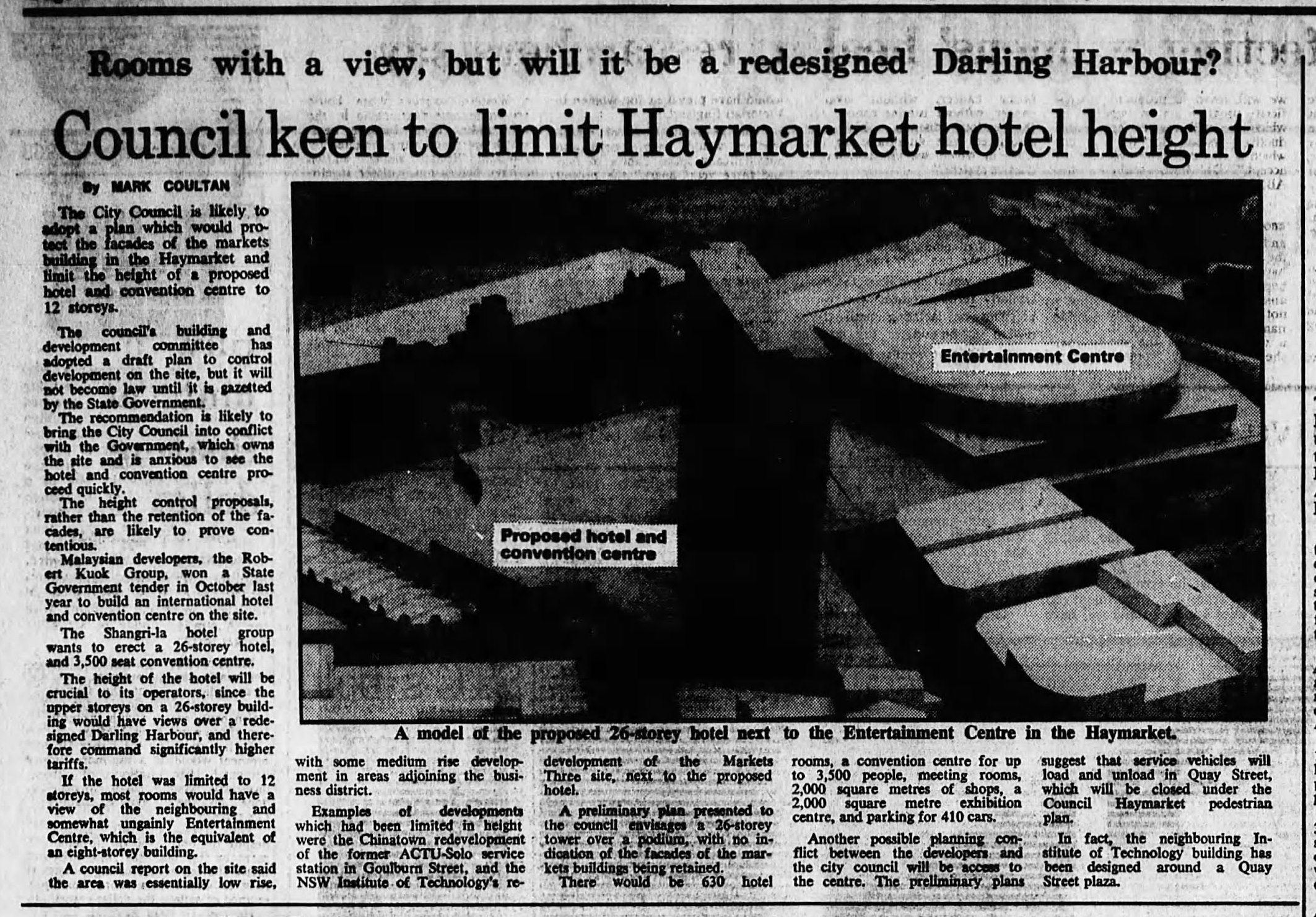
Haymarket Hotel Proposal December 5 1983 SMH 2

Source: Coultan, M. 1983. "Council keen to limit Haymarket hotel height". The Sydney Morning Herald, December 5: 2. 


Monday, 24 January 2022

Remember This? The photo that caused industrial action (1987)

The Darling Harbour Redevelopment Project in the 1980's would normally arise in a normal posting. I have considered doing a Darling Harbour Redevelopment series focusing on the 1980's redevelopment of the site from a Goods Yard and Port into the tourist and cultural centre that it is today.

But there is one clipping that has caught my eye which warrants a stand alone entry because it was related to the industrial action that contributed to the late delivery of the buildings and attractions that shape Darling Harbour.

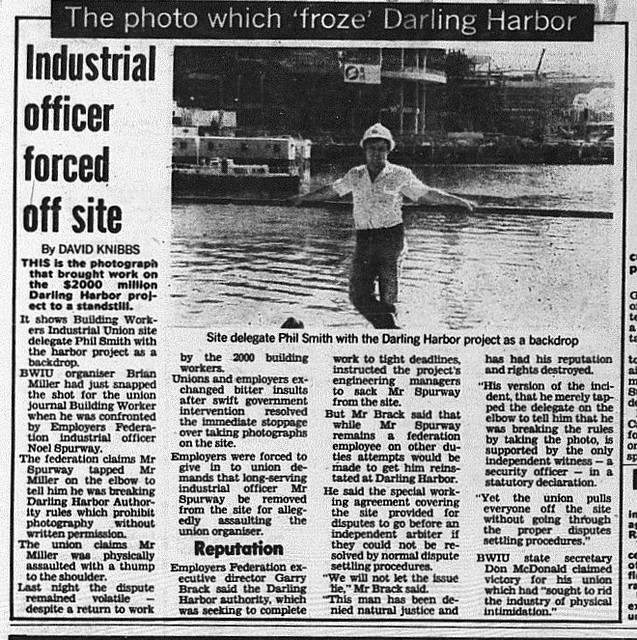
One such dispute arose in 1987 because of a photograph. Phil Smith, a delegate for the Building Workers Industrial Union (BWIU) decided to pose for a photo with the under construction site as his backdrop. The Darling Harbour Authority prohibited photography without permission and was supported by the Employers Federation. Brian Miller, a union organiser for the BWIU took the photo and claimed that he was assaulted by Employers Federation Officer Noel Spurway. 

In response 2000 workers walked off the site and the State Government was forced to intervene in the matter. 

Darling Harbour October 2 1987 daily telegraph 6

Source: Knobs D., 1987. "Industrial officer forced off site". The Daily Telegraph, October 2: 6. 

Monday, 27 December 2021

New Years Eve 25 Years Ago: 1996


NYE December 29 1996 sunday telegraph 71
Above: A poster promoting viewing points for the New Year's Eve fireworks as published in The Sunday Telegraph on December 29 1996.

As custom, our final entry for the year will look back at how Sydney marked New Years Eve 25 years ago.

Our year of focus is 1996.

If you have viewed my entries from previous years, you would have noticed the evolution of how Sydney welcomes the new year in the way that it does today. 

It started in 1989 with a thirty minute fireworks show at 9pm which was at the time a corporate event and launch event for the Festival of Sydney. In the years that followed, the show grew bigger and bigger. In 1993, the first midnight show was held featuring fireworks at Sydney Tower and Darling Harbour. The following year (1994) the SkyShow was broadcast for the first time, though it was it screened on delay.

The 1996 fireworks was the largest fireworks show held in Sydney since the Bicentenary in 1988 and would be a teaser to December 31 1999 and the Sydney Olympics in 2000 when the world would be treated to a special fireworks display as part of the festivities. 

Celebrations were "new-look" with Ric Birch producing the event at an estimated cost of $1.5 million. With the Olympic Games in 2000, he claimed that he would need ten times the amount for the 2000 Olympic Games fireworks display given the area that would need to be covered to provide the best experience for crowds gathered on Sydney Harbour. For Birch and Sydney City Council, this was a test event which they could learn from as they prepared for 2000.

NYE November 28 1996 SMH 3

Source: Totaro, P. 1996. "Sartor's $1.5m cracker for 1997". The Sydney Morning Herald, November 28: 3. 

NYE celebrations December 31 1996 SMH 2

Source: Papadopoulos, N. 1996. "Fireworks a dress rehearsal for 2000". The Sydney Morning Herald, December 31: 2.

Channel Seven had the rights to the fireworks for the 1994 and 1995 SkyShows. Channel Nine began a decade long association as the official TV broadcaster in 1996 and for the first time, the 9pm fireworks was broadcast live right across Australia. 

There was also a short broadcast of the midnight fireworks at Sydney Tower from 11:57pm to 12:02am. Below is the broadcast of the midnight display. Channel Nine's coverage was anchored by Catriona Rowntree and Richard Wilkins. The midnight show focused on fireworks launched from 10 points from in a southward direction from North Sydney to Sydney Tower in the 10 seconds leading to midnight where Sydney Tower exploding in fireworks to resemble an Olympic Torch on the stroke of midnight. 


Some time back, it was possible to view the full 9pm show but I believe copyright restrictions led to its removal. However there is an edited version of the live coverage if the short highlights package was not enough.


2UE provided the live simulcast of the soundtrack featured in the show.

As in previous years, the show lasted thirty minutes. However for 1996, there was a prelude to the main event. At 8:50pm, shells were launched at North and South Head.  Two Riverboat ferries with fireworks sailed from opposite ends of Sydney Harbour. One started at the Gladesville Bridge and the other at the heads before meeting at the Sydney Opera House. The fireworks launching points increased to 25, which included buildings in central Sydney and North Sydney. The main fireworks barges were located near the Sydney Opera House. The now present boundaries for the New Years Eve fireworks were now set as people were encouraged to watch the show from vantage points anywhere along Sydney Harbour or the Parramatta River that had a view of the harbour bridge. People could stay local if they desired.

NYE December 31 1996 daily telegraph 6
Source: Rogers, J. 1996. "A blazing good time". The Daily Telegraph, December 31:6. 

The theme for 1996 was Masquerade. Those attending New Years Eve celebrations were encouraged to wear a mask in the shape of the Sydney Opera House. The masks were distributed with The Sunday Telegraph on December 29 1996.

NYE Decoration included with Sunday Telegraph December 29 1996

The mask was designed by Peter England


NYE December 24 1996 daily telegraph 15

Source: Anon. 1996. "Man behind the mask". The Daily Telegraph, December 24: 15.

Syd Howard was appointed as fireworks producer for yet another year which involved the release of 16 000 individual fireworks shells.

NYE December 17 1996 daily telegraph 18

Source: Anon. 1996. "Sparks will fly for '97". The Daily Telegraph, December 17: 18.

Transport

NYE Public Transport December 27 1996 SMH Metro 28


Source: Sydney Buses, Sydney Ferries & CityRail. 1996. "New Year's Eve Bus, Train & Ferry Services" (Advertisement). The Sydney Morning Herald, December 27: 28 (Metro Liftout).

Comparing transport arrangements for this year with 1996 is ineffective due to the COVID-19 pandemic which has meant that transport arrangements must reflect public health guidelines and COVID-19 safe practices, especially capacity limits on public transport. There was no pandemic in 1996.

Capacity is determined by the placement of green dots. At the time of writing, all seats on public transport could be utilised but limited scope for standing especially on trains. With limitations on standing, all modes cannot operate at the maximum capacity.

For 1996, a "small army" of drivers and staff were given the challenging job of transporting the hordes.

Trains operated throughout the entire evening to ensure no-one was left stranded.


NYE December 27 1996 daily telegraph 23

Source: Phillips, M. 1996. "New year a moving time for the buses". The Daily Telegraph, December 27: 23.

Outside the city

For those who didn't want to travel into the city, Australia's Wonderland provided a whole nights entertainment for just $11.95 after 5pm with entertainment from The Wiggles, John Paul Young and a midnight fireworks show.

Australia's Wonderland Ad December 29 1996 sunday telegraph 12

Source: Australia's Wonderland. 1996. "Happy New Year From Wonderland" (Advertisement). The Sunday Telegraph, December 29: 12. 

Bondi Beach was also another alternative for revellers, though there had been concerns of possible violence.

Fireworks Wrap up
The Daily Telegraph and The Sydney Morning Herald presented glowing reviews of the fireworks which was attended by at least 600 000 people, with 200 000 of those reported at the Sydney Opera House Forecourt. Some estimates by police placed the crowds at one million, the most attended fireworks since the Bicentennary in 1988. I remember there was also international coverage of Sydney's celebrations on news bulletins and programs from around the world. The world had taken interest in Sydney's celebrations. 

Sydney welcomes 1997 january 1 1997 daily telegraph 1-4 (1)
Sydney welcomes 1997 january 1 1997 daily telegraph 1-4 (2)

NYE January 1 1997 SMH 1-2 (1)

NYE January 1 1997 SMH 1-2 (2)

NYE Celebrations January 2 1997 SMH 6 

A Final Word...
I would like to wish you all a safe and wonderful new year. During January, look forward to weekly installments of Remember this?.

Monday, 1 November 2021

1986: Harbourside, Darling Harbour Tenancies Advert

In August 1986, the operators of the Harbourside complex at Darling Harbour published a two page newspaper advertisement in The Sydney Morning Herald on August 6 1986, to invite those who were keen on operating either one of four restaurants or one of the 32 speciality food outlets in the complex, which opened in 1988.

One page was dedicated to text while the second page featured artists impressions of the areas that would be occupied. 

You would not see advertising like it today in a newspaper.

Darling Harbour Ad August 6 1986 SMH (1)

Darling Harbour Ad August 6 1986 SMH (2)

We were promised good dining and they delivered. More than three decades later, they still deliver. For those who want a quick and/or cheap feed, their needs are accommodated with fast food outlets inside the complex.


Monday, 20 September 2021

1988: Monorail Test Runs

Sydney's Monorail network which connected central Sydney with Darling Harbour operated between 1988 and 2013. It was controversial from its conception, construction and while in operation.

The Monorail was supposed to have commenced service in January 1988 as part of Bicentennial Celebrations with Prince Charles and Princess Diana to be the first passengers, but delays saw the monorail commence service in July, 1988.

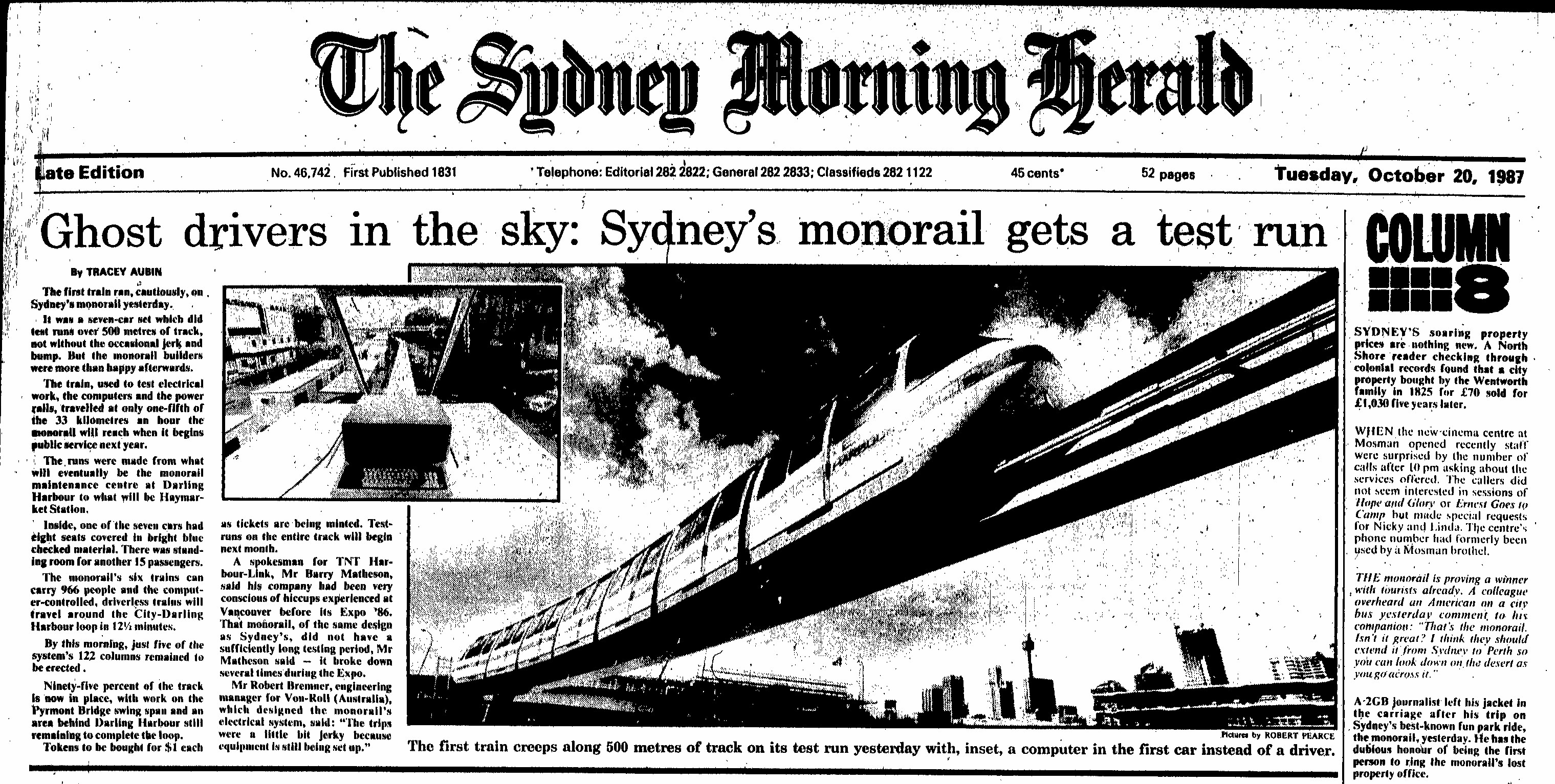
Monorail test run october 20 1987 SMH 1 closeup 

Source: Aubin, T. "Ghost drivers in the sky: Sydney's monorail gets a test run". The Sydney Morning Herald, October 20: 1. 

In October 1987, the Monorail trains began the first of their test runs, using the tracks at their Maintenance Centre at Ultimo and travelling to the Haymarket Station.

Test runs were meant to have been run on the route from November 1987, but did not occur until February 1988. The first test run was on February 13 1988 in Liverpool Street and featured on the front page of The Sun Herald on February 14, 1988 (below). At the time it was anticipated that passengers could use the line from April, three months behind schedule. This did not eventuate. 

 Monorail Test Run February 14 1988 Sun Herald 1 enlarged

Below are another two newspaper clippings relating to test runs conducted soon after.

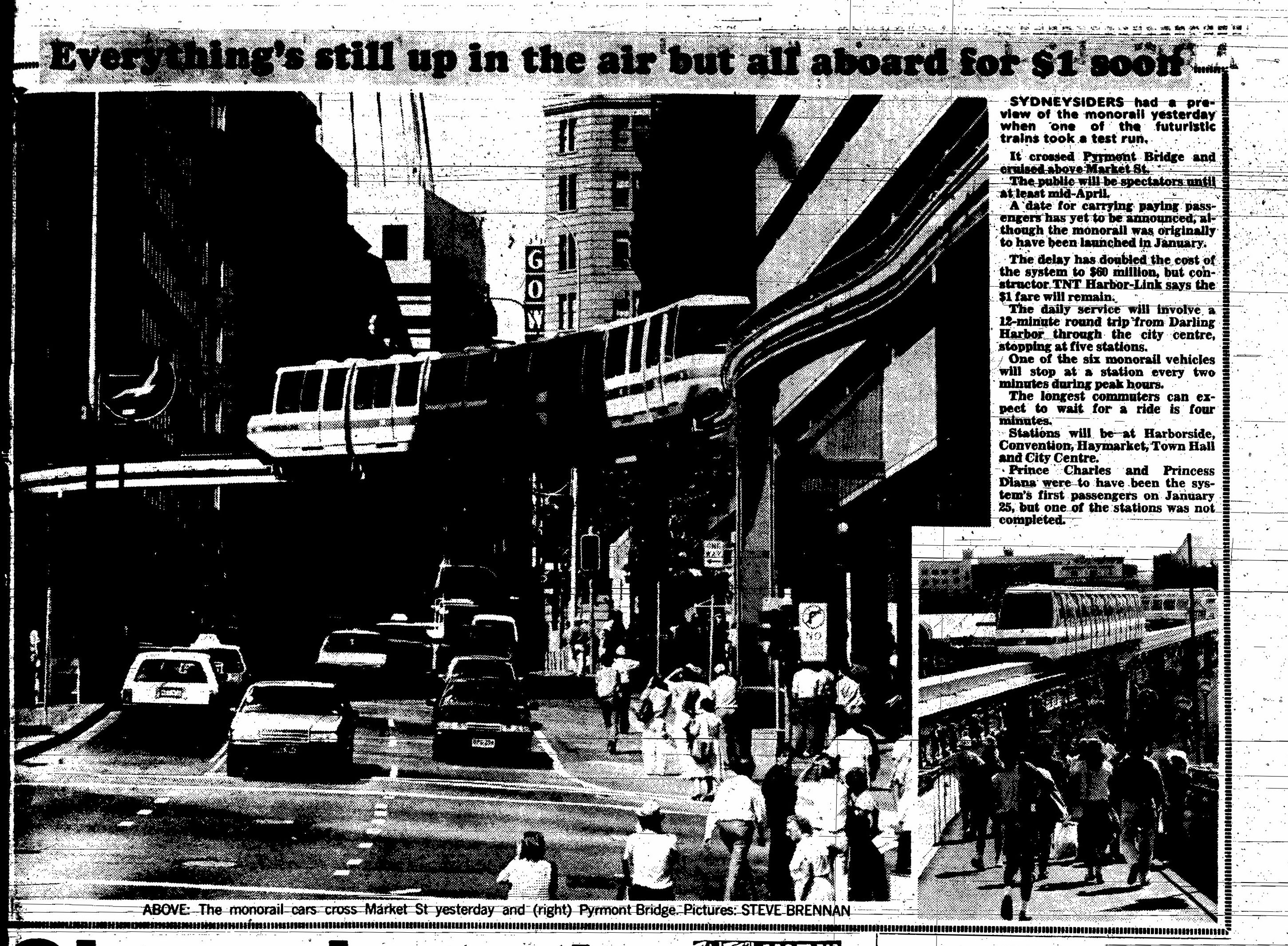
Monorail test february 27 1988 daily telegraph 3

Source: Anon. 1988. "Everything's still up in the air but all aboard for $1 soon". The Daily Telegraph, February 27: 3. 

Monorail Test Run February 24 1988 SMH 1 enlarged

Source: Stevens, R. 1988. Untitled (Photograph). The Sydney Morning Herald, February 24: 1. 

In May, 6000 people were provided with an opportunity to ride the circuit ahead of its opening. 

monorail test run May 16 1988 SMH page unknown


Source: Hewett, T. 1988. "A hum of satisfaction from above". The Sydney Morning Herald, May 16: page unknown. 

James Oram was one of the first journalists to ride the monorail and shared his insights.

monorail march 20 1988 sunday telegraph 17

Source: Oram, J. 1988. "Magic Carpet Ride at 33km/h". The Sunday Telegraph, March 30:17. 

Finally, I published an entry in 2018 that looked at the opening of the monorail in 1988. Click here to view the entry.

Monday, 10 May 2021

NEVER BUILT SYDNEY: Early Scheme for 2 Market Street (1984)

Welcome to Part four of our series of "Never Builts" in Sydney. In 1984, Sydney City Council approved a commercial development for a seven level carpark (2 levels below ground, five above ground) and eight levels of commercial space at 2 Market Street. The proposed tower occupies the site of the current Allianz Centre, completed in 1991. 

Allianz Tower comprises of 21 levels, but the early scheme only comprised of 13 levels. The offices were originally intended to be terraced. 

Architects were James Thiessen & Associates. 


Source: Anon. 1984. "$14m plan combines offices and parking". The Sydney Morning Herald, April 19: 20. 

This is a "never built" that did not deserve to be built. If built, the building would have aged quickly. The eventual building that rose on the site was designed by Crone Partners. The carpark is not as visible from the street even for the above ground levels and offers 40 000sq/m of office space. Major tenants include Allianz and Ampol. 


Monday, 15 February 2021

1987: Powerhouse Museum Construction Feature

In 1987, The Sunday Telegraph published a feature article on the construction of the Powerhouse Museum which was opened the following year (1988).

It is good reading and even provided a background to the decision in 1979 to establish a museum on the site.

Unlike the opposition to completely relocate the museum to Parramatta in recent years (resulting in the State Government deciding to maintain the museum at Ultimo and still proceed with a second branch at Parramatta), some called for complete demolition of the 1899 building. The Power Station had fallen into disrepair after its decommissioning in 1961. 

The article failed to mention that the Power Station had been listed by the National Trust in 1976 or the proposal to base a Museum of Technology in Ryde. 

However the article itself is a good read and provided readers with a preview of some of the exhibits which Sydneysiders and visitors to Sydney have come to love when visiting the museum. 

With concerns that Darling Harbour may not be as popular as successful as some thought, they were hopeful of still pulling in the hordes (estimated to be 2.5 million people per year). 


It is difficult to locate figures for annual attendances, especially in recent years, but would be roughly half of the 2.5 million estimated. However the proposal to relocate the entire museum to Parramatta and then the subsequent decision to retain a museum at Ultimo alongside opening at Parramatta has highlighted that Sydneysiders appreciate the museum. There was passion to retain a museum at Ultimo. At the same time, there was a need to bring the museum into Sydney's west to give even better access to all Sydneysiders to its collections, also suggesting that the museum is appreciated. 


Saturday, 13 February 2021

Property Advert of the Week: The Goldsbrough, Pyrmont (1996)

In 2015, I posted a newspaper advertisement from 1993 for The Goldsbrough Complex at Pyrmont. This week, I share an advertisement that was published in The Sydney Morning Herald on June 22 1996 (Page 16 of the Real Estate Liftout).

  The Goldsbrough of Darling Harbour Ad June 22 1996 SMH 16RE

Monday, 28 December 2020

New Years Eve 25 Years ago: 1995


Source: Anon. 1995. "1995 Sydney Skyshow" (Advertisement). The Daily Telegraph Mirror, December 30:18. 

On Thursday evening, we will mark the end of 2020 and usher in 2021. Due to COVID-19, celebrations have been scaled back and it will be ticketed access only to major viewing sites to allow for social distancing between attendees.

It will be interesting how we will look at this in 25 years from now which is a long way off in the future. Instead of focusing on now or how I may present this years festivities in the future, lets rewind back to 1995 and look at how Sydney welcomed 1996. 

Like 2020, there were challenges and actually threatened the night itself.

Staging an event costs money. The major sponsors from the previous years had pulled out, threatening the show. There was only one show at 9pm.

Sydney City Council intervened to save the now annual tradition while The Sunday Telegraph sponsored the event.  

The Sunday Telegraph prepared a poster for its readers providing details on viewing locations and transport in its edition of December 31.


The SkyShow maintained the traditional launch points - The Sydney Harbour Bridge and one near the Sydney Opera House. The one near the Opera House was shifted eastwards to a point North East of the Sydney Opera House. This opened up even more areas of Sydney Harbour for viewing. 


Source: Dean, A. 1995. "Bang goes another year". The Sydney Morning Herald, December 30:2. 

Syd Howard continued to coordinate the show and managed to keep costs down. It cost only $175 000 compared with $220 000 the year before. Media reports estimated attendance on Sydney Harbour at 500 000 as in previous years.

For those unable to attend (or those who attended but wanted to see it again), Channel Seven broadcast the show on delay at midnight across the nation. The video is below but no sound is featured. Anne Fulwood presented the show from Cremorne Point. Channel Nine would pick up the baton one year later and turn it into a live TV event. 


Darling Harbour provided a very good alternative. In addition to a 9pm fireworks show, there was also a midnight fireworks show with fireworks released from Cockle Bay and Sydney Tower  Entertainment was also provided in Tumbalong Park. Sydney City Mission also encouraged partygoers to support its "Mission 96" fundraiser.


Source: Sydney City Mission. 1995. Untitled (Advertisement). The Sun Herald, December 31:94.

CityRail combined with the State Transit Authority for the first time to produce a combined newspaper advertisement for public transport arrangements. Many bus routes operating to the city were subject to diversions to accommodate for traffic congestion and road closures. Sydney Harbour Bridge remained opened to vehicular traffic during the fireworks but pedestrians were banned. 


Source: CityRail & State Transit Authority. 1995. "New Year's Eve Bus, Train & Ferry Services". The Sun Herald, December 31: 8. 

New Years' Celebrations have become page one news, but our newspapers on January 1 1996 did not feature the celebrations on the cover.

The Daily Telegraph Mirror ran coverage on Page 3. For the paper itself, it was its final day under The Daily Telegraph Mirror before reverting to The Daily Telegraph. 


Police patrols were stepped up at Bondi Beach following a riot on Christmas Day (for more details, read my Christmas entry from last week) but it had been reported of clashes with revellers and police. It was estimated that as many as 100 000 could have converged in the area for the evening.

The Sydney Morning Herald published a photo of the fireworks released from the Sydney Harbour Bridge on Page 2, but focused more on Hogmanay celebrations amongst Sydney's Scottish community and sales of French Champagne.

Finally, I wish all of you a very safe and happy new year.