Source: Shereline Homes Pty Ltd. 1967. "Shereline Homes: Homes of Distinction (Advertisement)." The Daily Telegraph, April 8: 29.
Saturday, 28 February 2015
Property Advert of the Week: Shereline Homes: Homes of Distinction (1967)
This week I share with you, an advertisement from 1967 for Shereline Homes. They had model homes on display at Carlingford, Sylvania and Casula. Homes were priced from around $7500. According to the RBA Inflation Calculator, it would equate to about $89 000 today.
Source: Shereline Homes Pty Ltd. 1967. "Shereline Homes: Homes of Distinction (Advertisement)." The Daily Telegraph, April 8: 29.
Monday, 23 February 2015
NEVER BUILT SYDNEY: International Trade City, Milsons Point (1969)
Architect Harry Seidler was keen to transform Sydney in the 1960's. A decade earlier, he had come up with his housing scheme for McMahons Point. Blues Point Tower was the only tower that saw the light of day in that scheme. By the end of the decade, he had turned his eyes to the other side of Lavender Bay at Milsons Point.
He was asked to be involved in a proposed redevelopment of Luna Park and the adjoining railyards into a major commercial centre for Luna Park (Holdings) Limited.
Source: Anonymous. 1969. "$50 million dollar plan for the Luna Park site: No official proposals made yet." The Daily Telegraph, May 8: page unknown.
Under the scheme, five buildings of 20 levels were to be built and "suspended" on the 12 acres the development would encompass.
It also included a major exhibition centre of about 100 000 square feet, 350 room hotel, apartments, retail space, pedestrian plazas, a public park and parking for 4500 cars.
Harry Seidler had to defend claims that it would desecrate the harbour foreshore. Try doing that 45 years later and there would be massive outrage.
Obviously building the International Trade City would have meant the loss of Luna Park, a notable attraction on Sydney Harbour even in the 21st century as it allows us to experience the delights of Sydney as they have done for decades before.
He was asked to be involved in a proposed redevelopment of Luna Park and the adjoining railyards into a major commercial centre for Luna Park (Holdings) Limited.
Source: Anonymous. 1969. "$50 million dollar plan for the Luna Park site: No official proposals made yet." The Daily Telegraph, May 8: page unknown.
Under the scheme, five buildings of 20 levels were to be built and "suspended" on the 12 acres the development would encompass.
It also included a major exhibition centre of about 100 000 square feet, 350 room hotel, apartments, retail space, pedestrian plazas, a public park and parking for 4500 cars.
Harry Seidler had to defend claims that it would desecrate the harbour foreshore. Try doing that 45 years later and there would be massive outrage.
Obviously building the International Trade City would have meant the loss of Luna Park, a notable attraction on Sydney Harbour even in the 21st century as it allows us to experience the delights of Sydney as they have done for decades before.
Saturday, 21 February 2015
Property Advert of the Week: The maxi plan from Glenvill Homes (1972)
This week, I share with you an advertisement from Melbourne builder Glenvill Homes as they sought to cash in the real estate boom in Sydney. Display homes were on exhibition at Westleigh, near Hornsby.
Source: Glenvill Homes (Australia) Pty Ltd. 1972. "Introducing a whole new way of living ~ Maxi ~ Plan (Advertisement)." The Daily Telegraph, April 8: 47.
Monday, 16 February 2015
1995: NBC & the offending power lines
As we know, NBC was the official American broadcaster for the Olympic Games back in 2000, but there was something they didn't like about Sydney Olympic Park (Homebush Bay as it was known then).
They didn't like the sight of the power lines and put pressure on the Carr Government to get rid of them because they wrecked the views and vistas across the city from the site.
Whether or not it was NBC's that triggered the change, we know for sure they came down. If you are ever at Rockefeller Centre, New York where NBC is based, don't forget to say "Thank you" to them. Trust me the area looks great without them and speaking up did us a favour.
They didn't like the sight of the power lines and put pressure on the Carr Government to get rid of them because they wrecked the views and vistas across the city from the site.
Whether or not it was NBC's that triggered the change, we know for sure they came down. If you are ever at Rockefeller Centre, New York where NBC is based, don't forget to say "Thank you" to them. Trust me the area looks great without them and speaking up did us a favour.
Source: English, B. 1995. "Olympic Eyesore." The Daily Telegraph Mirror, August 30: 4.
Saturday, 14 February 2015
Property Advert of the Week: Huxley Homes House and Land Packages (1993)
This week, I share with you an advertisement promoting house and land packages provided by Huxley Homes in September 1993 in Western Sydney. Note that Campbelltown is spelt as "Campbletown". Model homes were also on display at Homeworld II in Prospect.
Source: Huxley Homes. 1993. "House and Land Packages (Advertisement)." The Daily Telegraph Mirror, September 11: 51.
Monday, 9 February 2015
1969: The original Port Botany Scheme
Source: Anonymous. 1969. "2nd Port for Sydney." The Daily Telegraph, March 19: 3.
During the 1950s and 1960s there were dramatic changes to the way cargo was being transported globally. Cargo was being transported in containers and large cargo ships. Sydney Harbour's port facilities were going to be unable to cope. Hence a second port was needed. During the 1960s, the NSW Government under Robert Askin chose the northern shores of Botany Bay to build a second port for Sydney.
This is the original scheme that was planned for Port Botany, which is vastly different to what we have now. The Airport and Port would have actually been attached to each other. There was also provision for a parallel runway at Sydney Airport to be completed by 1975 but was not built until 1994.
Stage One commenced construction in 1971 and was completed by the end of 1979.
The new terminal had to be built around the Penulyn Estuary in order to preserve it. Given the environmental issues associated with construction of the port, it is unlikely that we will see any further port expansion in Botany Bay. There has been the push to increase cargo movements in Newcastle and Port Kembla and transport it via rail to Sydney.
| Port Botany in 2014. |
Also since the 1970's what was to be the second port for Sydney became the city's first port as cargo terminals in Sydney Harbour were gradually closed, starting with Darling Harbour in the 1980s, East Darling Harbour (Barangaroo) was closed in stages from the 1990s until 2007 while White Bay and Glebe Island were closed in 2008.
I notice as well that there was a plan for a road link from Southern Cross Drive at Mascot to transport traffic directly to Port Botany. That did not get built.
Saturday, 7 February 2015
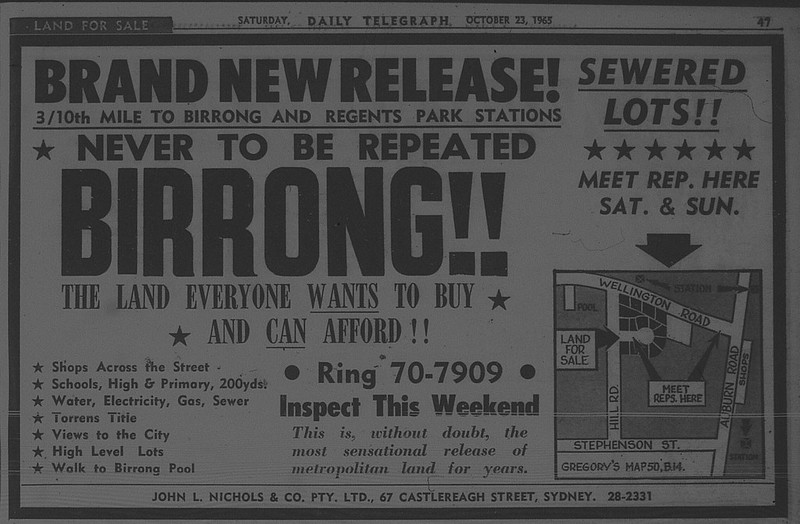
Property Advert of the Week: Birrong Land Release (1965)
This week, I share an advertisement from October 1965 relating to a land release at Birrong in Sydney's south-west. The lots were located Wellington Road, Hill Road and what is now Andrew Place.

Source: John L. Nichols & Co Pty Ltd. 1965. "Birrong!! The Land Everyone Wants to Buy and Can Afford!! (Advertisement)." The Daily Telegraph, October 23: 47.
I've provided a Google Streetview link to Hill Road at the intersection of Andrew Place. Notice the distinct difference in the housing between the side of the road featured in the advertisement and the opposite side of the road. Lots of red brick homes on the sites featured.

Source: John L. Nichols & Co Pty Ltd. 1965. "Birrong!! The Land Everyone Wants to Buy and Can Afford!! (Advertisement)." The Daily Telegraph, October 23: 47.
I've provided a Google Streetview link to Hill Road at the intersection of Andrew Place. Notice the distinct difference in the housing between the side of the road featured in the advertisement and the opposite side of the road. Lots of red brick homes on the sites featured.
Monday, 2 February 2015
NEVER BUILT SYDNEY: Martin Place Towers (1969)
In 1969, Sydney City Council approved a concept plan for redevelopment on the northern side of Martin Place. This plan comprised sites facing straight onto the northern side of Martin Place, George Street up to the current site of Ivy, the current site of the Angel Place Tower, and the Angel Hotel on Pitt Street.
Source: The Civic Roundsman. 1969. "Sydney Keeps on Growing Up: Plans for $50 million buildings." The Daily Telegraph, September 9: 3.
At the time, the cost was projected at $25 million (About $275 million in today's money). Extensive retail space and pedestrian plazas were to be included.
Eight "enterprises " were to be involved including AMP, Colonial Mutual Life Assurance Society (CML) and the University of Sydney.
Building heights were not specified as each site would be developed over time.
But I think about it today, and it actually was good for it to not proceed because it would have meant the loss of significant historical buildings along the northern side of Martin Place and George Street including:
There was a plan back in the late 1980s to build Sydney's tallest tower at 244 metres tall. It was approved and was to be developed by the AMP. The recession of the early 1990s plus the collapse of the property market meant that the site would be empty for the entire decade.
Source: Chancellor, J. 1988. "AMP plans $530 million office development for Sydney." The Sydney Morning Herald, August 13: 37.
Another major highrise development that went up was the CML Building. The 21 level building was completed in 1977 to a height of 88 metres. This included retaining the original building (14 Martin Place).
Finally for those curious about the other proposal on the page, that was an early proposal for Exchange Square which was home to the Stock Exchange until the 1990's when it relocated to the current Exchange Square Building at Bridge Street. It was a two building proposal, but they opted for the one tower which we see today.
Source: The Civic Roundsman. 1969. "Sydney Keeps on Growing Up: Plans for $50 million buildings." The Daily Telegraph, September 9: 3.
At the time, the cost was projected at $25 million (About $275 million in today's money). Extensive retail space and pedestrian plazas were to be included.
Eight "enterprises " were to be involved including AMP, Colonial Mutual Life Assurance Society (CML) and the University of Sydney.
Building heights were not specified as each site would be developed over time.
But I think about it today, and it actually was good for it to not proceed because it would have meant the loss of significant historical buildings along the northern side of Martin Place and George Street including:
- Bank of Australasia Building (1904)
- Challis House (1907, expanded 1938)
- Original Colonial Mutual Building
Photos were taken by the Author.
There was a plan back in the late 1980s to build Sydney's tallest tower at 244 metres tall. It was approved and was to be developed by the AMP. The recession of the early 1990s plus the collapse of the property market meant that the site would be empty for the entire decade.
Source: Chancellor, J. 1988. "AMP plans $530 million office development for Sydney." The Sydney Morning Herald, August 13: 37.
Another major highrise development that went up was the CML Building. The 21 level building was completed in 1977 to a height of 88 metres. This included retaining the original building (14 Martin Place).
Finally for those curious about the other proposal on the page, that was an early proposal for Exchange Square which was home to the Stock Exchange until the 1990's when it relocated to the current Exchange Square Building at Bridge Street. It was a two building proposal, but they opted for the one tower which we see today.
Photo taken by the Author.
Saturday, 31 January 2015
Property Advert of the Week: Leslie Homes Pty Ltd Display Homes (1967)
For our first property advert of the week for 2015, I'll share with you an advertisement promoting some the display homes available from Leslie Homes. They were on display at Villawood, Bass Hill, and Baulkham Hills.
Source: Leslie Homes Pty. Ltd. 1967. "Leslie Homes Pty Ltd (Advertisement)." The Daily Telegraph, April 8: 23.
Monday, 26 January 2015
1972: The Concorde arrives in Sydney
On June 18, 1972, the Concorde made its first visit to Sydney. The Daily Telegraph managed a photo of the plane as it flew 1500 feet above Sydney's CBD by award-winning photographer, Bill McAuley.
Source: Behr, J. 1972. "Concorde Dwarfed by City Towers: Flying Won't Be The Same Again." The Daily Telegraph, June 21: 3.
On that day, it flew to Canberra then onto Merimbula and 500 miles out to sea before returning to Merimbula and Melbourne. The Sydney-Canberra leg took just 18 minutes.
I also came across a photo of it taking off (I think) at Sydney Airport a few months ago on a Sydney history page on Facebook. People parked their cars on General Holmes Drive to get close to the action, something that would not be allowed today. I was hoping it would still be available online for this entry so people can see it.
Over the next quarter of a century, the Concorde's operated by Air France & British Airways would make occasional visits to Sydney, usually for promotional purposes or as part of world tours.
The last visit by a Concorde to Sydney was in 1999 when Air France did a world tour. Here is a video of a takeoff at Sydney Airport uploaded by Youtube member Todd Chapman. It is believed by plane enthusiasts that this flight was on September 24 1999.
Source: Behr, J. 1972. "Concorde Dwarfed by City Towers: Flying Won't Be The Same Again." The Daily Telegraph, June 21: 3.
On that day, it flew to Canberra then onto Merimbula and 500 miles out to sea before returning to Merimbula and Melbourne. The Sydney-Canberra leg took just 18 minutes.
I also came across a photo of it taking off (I think) at Sydney Airport a few months ago on a Sydney history page on Facebook. People parked their cars on General Holmes Drive to get close to the action, something that would not be allowed today. I was hoping it would still be available online for this entry so people can see it.
Over the next quarter of a century, the Concorde's operated by Air France & British Airways would make occasional visits to Sydney, usually for promotional purposes or as part of world tours.
The last visit by a Concorde to Sydney was in 1999 when Air France did a world tour. Here is a video of a takeoff at Sydney Airport uploaded by Youtube member Todd Chapman. It is believed by plane enthusiasts that this flight was on September 24 1999.
Following a fatal crash of an Air France Concorde plane in Paris in July 2000 led to them being pulled out of service with the last Concorde Service in 2003 between New York and London.
Subscribe to:
Posts (Atom)