Showing posts with label aviation. Show all posts

Monday, 17 March 2025

1965 - First Direct Flight from the United States to Sydney

First Non Stop flight from USA to Australia March 9 1965 daily telegraph 17 enlarged

First Non Stop flight from USA to Australia March 9 1965 daily telegraph 17

Source: Anon. 1965. "End of the big hop". The Daily Telegraph, March 9: 17. 

Did you know that this month is sixty years since the first non-stop flight by a commercial jet from the United States to Australia? It was now possible for Australians to fly from Australia to the United States and vice versa without having to stop en route in either direction. It wold mark a significant milestone for Australian aviation

The first non-stop flight did not carry passengers. It was a delivery flight for Qantas who were accepting delivery of a Boeing 707 jet, named the City of Townsville.

To save petrol, the jet was towed to the runway at San Francisco International Airport, where it departed on March 6 1965. Due to crossing the international dateline (adding one day heading west), it landed at Sydney Airport on March 8 1965.

Flight time was 14 hours and 32 minutes, impressive when compared with the 13 hours and 20 minutes used by more prominent and more advanced jets. 

In 2025, flight times (non-stop) to American Cities flying from Sydney Airport are as follows.

Sydney - San Francisco:              13h, 20 min

Sydney - Los Angeles:                 13 h, 40 min

Sydney - Dallas:                           15 hours

Sydney - Houston:                        15 h, 35 min

Qantas introduced non-stop flights from Sydney to Los Angeles in 1984. when Boeing 747 jets could carry a full load of passengers across the Pacific without stopping. They had to use a smaller variant (747SP) which was designed to cover greater distances than other 747 jets operating at the time. 

 First flight from USA to Australia Non Stop March 9 1965 SMH 8

Source: Anon. 1965. "First Flight Non-stop Over Pacific". The Sydney Morning Herald, March 10: 8.

Monday, 18 December 2023

1999: Mark Latham and Badgerys Creek Airport - Feature

In 1999, the Federal Government announced that a second Sydney Airport would be located at Badgerys Creek. This did not imply that approval to build the airport was given. It gave certainty that if a second Sydney Airport was built, it would be at Badgerys Creek. It was not until 2014 that the Federal Government under Prime Minister Tony Abbott announced that construction would go ahead, leading to the new airport due to open in 2026. 

Mark Latham (ALP, Werriwa) may have sat on opposition benches at the time but agreed that Sydney needed the second airport at Badgerys Creek, not to mention that those in his electorate of Werriwa were set to benefit. Latham was also mayor of Liverpool from 1991 to 1994 and identified the benefits that it would bring to it.

Badgerys Creek Airport June 11 1999 daily telegraph 10-11

Source: Latham, L. 1999. "Get ready for take-off from Badgerys Creek". The Daily Telegraph, June 11: 11. 

Monday, 13 September 2021

1974: TAA build another new terminal at Sydney Airport


Last week, I published an entry on the opening of the Trans Australia Airlines (TAA) Terminal at Sydney Airport in 1962.

In the years following the opening of the terminal, growth in jet travel exploded along with the introduction of new innovations in airport design and travel meant that TAA needed to build a new terminal to cater for passenger growth and provide modern facilities for passengers.

In December 1974, TAA opened a new terminal to the north of its 1962 Terminal Building curving around Shiers Avenue. It was three times bigger than the previous terminal building.

Facilities included:

  • Five aerobridges - Passengers no longer had to worry about walking across the Tarmac to board their flight.
  • Faster baggage collection and handling systems
  • Escalators to departure lounges
  • Electronic Information Boards
  • Special Group Convention Lounge
  • Shops (Newsagent and snack bar), Restaurant and Bar

The now former 1962 terminal building was handed over to East-West Airlines. 

Part of the terminal still remains as part of the Qantas (T3) Terminal, home to Gates 16 and 17 as this recent image from Google Maps shows.

Sydney Airport - 2021 - Google Maps - 1974 TAA Terminal Building 

COVID-19 Restrictions have meant that I cannot locate media coverage of the actual opening from the Microfiche reels, but I have included a newsreel (top of page) with this entry but also a newspaper advertisement that was promoting the new terminal from mid 1974. It is likely that a follow-up entry will occur at a future date.

TAA ad 1974

Source: Trans Australia Airlines (TAA). 1974. "For business travellers - TAA flying ahead" (Advertisement). The Daily Telegraph, May 6: 19. 

Monday, 6 September 2021

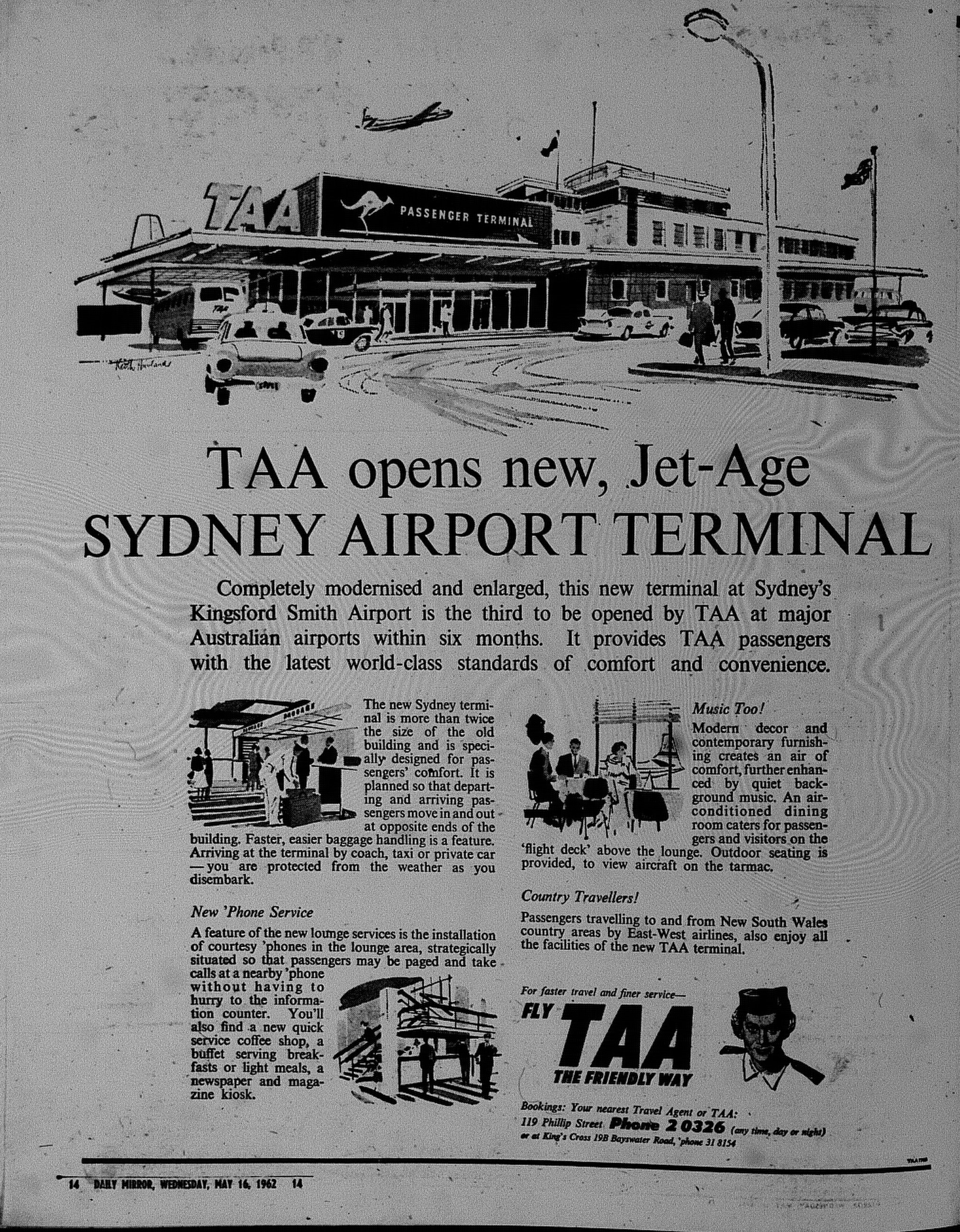
1962: TAA Terminal opens at Sydney Airport

TAA Terminal May 16 1962 daily mirror 14

Source: Trans Australia Airlines. 1962. "TAA opens new, Jet-Age Sydney Airport Terminal" (Advertisement). The Daily Mirror, May 16 1962: 14. 

Trans Australia Airlines (TAA) was an airline established by the Federal Government in 1946 to operate domestic passenger services within Australia. It operated under this name until 1986 when it was renamed Australian Airlines and was merged with Qantas in 1993.

In 1962, TAA undertook a significant upgrade of its terminal at Sydney Airport at a cost of £150 000 ($300 000) which doubled the space of the terminal and improved passenger comfort and capacity. The new layout separated departures from arrivals along with an upgraded baggage handling system. Passengers waiting for flights could purchase a meal, snack or drink from a coffee shop or buffet. In addition there was an airconditioned dining room for passengers and visitors awith a flight deck to view arriving or departing aircraft.

Also the new terminal had a new phone service where passengers could be paged and receive phonecalls at points located around the terminal.

Sydney Airport - 2021 - Google Maps - 1962 TAA Terminal Building
Above: The 1962 TAA Terminal Building as viewed from above on Google Maps, which is currently part of the Qantas (T3) Terminal. 

The Terminal was located in what is now the southern end of the T3 (Qantas) Terminal. In 1974, the terminal was handed over to East-West Airlines after TAA opened a new terminal next to the building on its northern side. However it was intergrated into the T3 Terminal. Gates 18 and 19 are located at the rear of the building. 

Monday, 2 November 2020

1972: The Concorde arrives in Sydney (as covered by "The Sun Herald")

My 2015 entry on the 1972 visit by the Concorde has proven to a popular entry with visitors to this blog. A few months ago, I landed clippings from its arrival on June 18, 1972. Below is coverage from The Sun Herald (19 June, 1972).

20 000 watched proceedings in and around Sydney Airport. There were also a group that gathered to protest citing concerns over noise (and it's sonic boom) that the plane generated. 


Related Entry

Monday, 27 April 2020

MILESTONE: Sydney Airport International Terminal Turns 50 (1970) - Newspaper Supplements

Last week, I presented an entry on the opening of the International Terminal Building at Sydney Airport.

As promised, I would share scans from supplements published in The Australian and The Daily Telegraph. 

The Australian (May 1, 1970)


The Daily Telegraph (May 1, 1970)


Monday, 20 April 2020

MILESTONE: Sydney Airport International Terminal Turns 50 (1970)


Sydney Airport's International Terminal in 1970.
Source: Anon. 1970. "Untitled" (Photograph). The Sydney Morning Herald, May 1: 2 (Air Traveller Feature). 

1970 was a big year for Sydney Airport. Not only did it welcome the "Queen of the Skies" - Boeing's 747 jumbo jet, it also opened a new international terminal complex. Before 1970, the international terminal was located where the Qantas Domestic Terminal (T3) stands today.

Plans were unveiled in 1965. Click here for my 2015 entry which provides further details. Several weeks ago, I posted clippings of one scheme which was to provide both domestic and international services in the one terminal and the eventual design of the terminal considered future domestic terminals at its northern and southern ends.

Above: A sketch of the International Terminal in 1970.
Source: Anon. 1970. "Untitled" (Sketch). The Sydney Morning Herald, May 1: 2 (Air Traveller Feature). 

Construction of the terminal cost $31 million, which was $11 million (5.5 million pounds) over the projected cost. According to the RBA Inflation Calculator, it would cost the equivalent of $365 000 000 in todays money.

Queen Elizabeth II opened the terminal on May 3, 1970.

To accommodate growth in passenger numbers and flights, major extensions to the terminal occurred in 1992 and 2000 with further upgrades in 2010 and 2016. Upgrades to Sydney Airport have become a normal way of life in recent years.

Other works have included the construction of a multi-level carpark, office block and hotel during the 2000's. In 2000, an underground railway station opened, connecting the terminal with the City Circle, Airport and East Hills Railway Lines.

Initially, road access was only via Airport Drive, with a bridge built to link it with Marsh Street, Arncliffe and the Princes Highway in 1972.

Facts of Interest

  • Contained 400 000 square feet or 37 000 square metres of space.
  • Construction of the terminal took six years (three years of site preparation and a further three years for construction).
  • International Restaurant with seating for 200 people plus bars and lounges.
  • Parking for 2500 cars. Parking cost 20 cents per hour up to a maximum of $2 per day. 
  • Fifteen airlines used the terminal in 1970 and could process 14 000 people per hour. Around 70 000 (Needs verification) can be processed per hour in 2020.
  • Shops included a newsagent, duty free store and gift shops. 
Below is a cross section of the terminal as featured in The Sydney Morning Herald. Can you spot the similarities and changes to that of 2020? Unfortunately, there is no longer a public observation deck to enjoy the planes taking off and landing. 


Source: Anon. 1970. "Untitled" (Sketch). The Sydney Morning Herald, May 1: 2 (Air Traveller Feature). 

Next week, I will share newspaper supplements from The Australian and The Daily Telegraph. 

Monday, 2 March 2020

1965: Possible Combined Terminal at Sydney Airport

I recently located a newspaper report relating to a proposal for a combined International-Domestic Terminal at Sydney Airport along those seen today at Tullamarine Airport in Melbourne and Adelaide Airport.

It appears that the northwestern section of the airport had been selected as the site for the new terminal, where the new International Terminal would be built and opened in 1970.

Below is the article from The Daily Telegraph dated June 8 1965.


On the same page, there were also concerns over the development of the modern facilities at Sydney Airport and that Melbourne's new Tullarmarine Airport would be completed before Sydney Airport. Sydney Airport did open ahead of Tullarmarine airport in 1970.

It would have been interesting had the Federal Government gone for the combined terminal option, especially if extensions had to occur in the years ahead. The space where the International Terminal is located is tight as it is today. Imagine sharing it with the Domestic Terminal.

We could have ended up even with separate terminals for separate airlines as seen in numerous airports. Sydney Airport's layout would have made this challenging.

Interesting to note in the article of a possible rail link to where the Domestic Terminals are located today, which was to be linked to a future eastern suburbs railway line. The Airport Line (2000) would eventually see a station built there along with the international terminal. It linked the city, but instead of serving the eastern suburbs, it serves the western suburbs through a direct connection to the East Hills Railway Line.

And a need for two parallel runways. Only one of them became reality as reflected in the third runway (1994).

Monday, 25 November 2019

1989: The first non-stop London to Sydney flight

Just over a week ago (November 15), Qantas conducted a non-stop flight from London to Sydney using a 787 Dreamliner jet. The flight which carried a few dozen passengers was for research purposes as Qantas aims towards providing direct flights from the east coast of Australia to London and New York by 2022.

This flight was thirty years after the very first non-stop London to Sydney flight which was also undertaken by Qantas using a Boeing 747-400 jet. The 18 012km flight took 20 hours, 9 minutes and 55 seconds, arriving in Sydney on August 17 1989.

With the recent test flight involving the 787, it took 19 hours and 19 minutes to traverse the route. A new record.

Below is coverage from The Daily Telegraph from August 18 1989.


Monday, 24 June 2019

1974: Ansett Terminal Upgrade Advertisement

I've decided to turn last weeks entry on Miranda Fair/Westfield Miranda into a series on Westfield as it motivated me to go a "little further" into the evolution of the shopping centre.

In the mid 1970's, Ansett Airlines undertook an upgrade of their terminal (now T2). In 1974, they published a two page spread in The Daily Telegraph to inform travelers of the construction. The scan below is from the edition published on September 2.


The upgrades made it possible for a person to be dropped off in the carpark and go to the gate without venturing outdoors through using a skybridge linked in the carpark. All gates would have aerobridges and facilities would use the latest technology.

Monday, 24 April 2017

1970: The 747 arrives in Sydney


Source: Anonymous. 1970. Untitled (photograph). The Sydney Morning Herald, October 5: 1. 

On October 4, 1970, the first 747 jumbo jet landed at Sydney Airport before a crowd of 10 000 people.  It was the first 747 jet to land in Australia.

The PAN-AM flight from Los Angeles, via Honolulu and Nadi arrived approximately 6:30pm, more than nine and a half hours late due to mechanical problems with the jet. Its arrival would inaugurate PAN-AM's twice-weekly 747 services between Sydney and Los Angeles.


Source: Anon. 1970. Untitled (photograph). The Daily Telegraph, October 5: 1. 

Below is coverage of the arrival as seen by The Daily Telegraph on October 5, 1970. 

Qantas commenced 747 services the following year. The Boeing 747 jet like the Boeing 707's that came into operation just a decade earlier transformed the way that Sydneysiders travel around the world. While the objective by airlines like PAN-AM was to reduce congestion at airports, it had cost benefits for airlines. It could carry up to twice the number of passengers that a 707 could carry. The cost of flying would fall opening up more opportunities for Sydneysiders to see the world, within their budgets.

Earlier in 1970, the International Terminal opened in its current location on the western side of the airport, and the design of the terminal accommodated for the new jets. It also led to the extension of the North-South Runway out into Botany Bay. 

Aircraft noise was already a huge issue in suburbs surrounding the airport, especially in Rockdale. The 747's were noted as being much quieter than 707's. However, the problem would not disappear but worsen as the airport grew in the decades to come and air traffic increased. Up to eighty planes land per hour at Sydney Airport today. 

Monday, 22 June 2015

1965: Sydney Airport's International Terminal is conceived

Sydney Airport's current international terminal has loyally served the city since 1970. As the city has grown alongside that of air travel, it has been expanded several times. This week, I want to go back to when it was conceived. It was in 1965.

On April  1965, the Federal Government announced that a ten million pound (20 million dollars) international terminal would be built at Sydney Airport. The Federal Government had deemed as "Australia's major international airport" and the gateway to Australia. The new terminal would be capable of holding up to thirty-two jets. Twenty would be accommodated within a "loading finger", while twelve would fit in an apron area.

It was aimed to have the terminal opened by no later than "early 1970", which they met.

The terminal was designed with future extensions in mind. This has helped it to grow and cement it as Australia's leading international airport. In 2014, 25.5 million passengers had accessed the international terminal.


Source: Anonymous. 1965. "Sydney's Air Gateway to Australia; £10 million terminal by 1969". The Daily Telegraph, April 2: 3. 

In July 1965, renders were released to the public.


Source: Anonymous. 1965. "Exclusive: First Pictures; New jet terminal for city". The St George and Sutherland Shire Leader, July 7: 1-2. 

Monday, 26 January 2015

1972: The Concorde arrives in Sydney

On June 18, 1972, the Concorde made its first visit to Sydney. The Daily Telegraph managed a photo of the plane as it flew 1500 feet above Sydney's CBD by award-winning photographer, Bill McAuley.


Source: Behr, J. 1972. "Concorde Dwarfed by City Towers: Flying Won't Be The Same Again." The Daily Telegraph, June 21: 3. 

On that day, it flew to Canberra then onto Merimbula and 500 miles out to sea before returning to Merimbula and Melbourne. The Sydney-Canberra leg took just 18 minutes.

I also came across a photo of it taking off (I think) at Sydney Airport a few months ago on a Sydney history page on Facebook. People parked their cars on General Holmes Drive to get close to the action, something that would not be allowed today. I was hoping it would still be available online for this entry so people can see it.

Over the next quarter of a century, the Concorde's operated by Air France & British Airways would make occasional visits to Sydney, usually for promotional purposes or as part of world tours.

The last visit by a Concorde to Sydney was in 1999 when Air France did a world tour. Here is a video of a takeoff at Sydney Airport uploaded by Youtube member Todd Chapman. It is believed by plane enthusiasts that this flight was on September 24 1999.


Following a fatal crash of an Air France Concorde plane in Paris in July 2000 led to them being pulled out of service with the last Concorde Service in 2003 between New York and London. 

Monday, 8 December 2014

1972: Inside the Sydney Airport Control Tower

This week, I share a feature from The Daily Telegraph in late 1972 that took readers inside the old control tower at Sydney Airport. In those days it had recently opened as part of the expansions to the airport during the late 1960's at a cost of $19 million. To build it today would equate to $200 000 000 according to the RBA Inflation Calculator. The control tower operated until 1996 when the current control tower opened on the opposite side of the North-South Runway.

The old control tower could handle up to 45 flights per hour (about half of today's maximum of eighty flights) while boasting that the radar covered the entire state of New South Wales.

The building has been remained idle, but there is the possibility it may be heritage listed in the future.


Source: Behr, J. 1972. "$19m nerve centre." The Daily Telegraph. December 1: 30-31.