Showing posts with label shopping centre. Show all posts

Monday, 31 August 2026

1981: A long wait for the call from the AMP's minaret (Newspaper feature)

Sydney Tower is just weeks away from celebrating its 45th Birthday, but this 1981 newspaper feature focused on delays in its opening. 

It was not meant to open in September 1981, but plans had it opening early that year, except that it was too windy and rainy to warrant an opening. July was also considered as an opening date. 

For retailers in Centrepoint, it was frustrating that they wanted the tower to open as soon as possible to lure tourists to their shops, but they were still optimistic. Sydney Tower would open, and the hordes would come.

Fast forward 45 years, ownership has changed hands. AMP sold the centre and tower to Westfield in 2001, and it was rebranded as Westfield Centrepoint. In 2009, a major redevelopment project merged Westfield Centrepoint, Imperial Arcade and Skygarden into one retail complex. Westfield also acquired Sydney Central Plaza in 2003 and, in recent years, under the Scentre Group, purchased the former David Jones Market Street store, which is now a mixed-use retail, commercial, and residential complex, to expand its footprint in central Sydney. 

Westfield Sydney is regarded as a flagship retail complex within the Scentre Group and has been highly successful in attracting major labels and luxury brands into the centre. A total of 269 retailers trade in the complex

And, as in 1981, the overwhelming majority still have to reach the entrance to Sydney Tower through the centre and navigate the escalators and shops en route. 

Sydney Tower February 28 1981 SMH 42
Source: Lawson, L 1981. "A long wait for the call from the AMP's minaret". The Sydney Morning Herald, February 28:42. 

Monday, 24 February 2020

NEVER BUILT SYDNEY: Imperial Arcade Tower (1960)


Source: Anon. 1960. "360-Feet High Building Plan". The Sydney Morning Herald, April 17: 5.

I recently located an artist's impression for a 36 level office tower that was to be built as part of a redevelopment of the Imperial Arcade (1891) in Pitt Street.

While the site was redeveloped to house a shopping complex of four levels with office space above, the office component was scaled back.

The Imperial Arcade was demolished in 2009 when Westfield merged and redeveloped its CBD shopping centres - Centrepoint, Imperial Arcade and Skygarden into Westfield Sydney.

Monday, 23 May 2016

EVOLUTION OF WORLD SQUARE: The abandoned site (1991)

Last week, I focused on the approval and early stages of construction of the failed World Square development in central Sydney before industrial disputes and financial problems forced the collapse of the project in 1990.

World Square would remain mostly idle for a decade, though by the end of the 1990's the first steps towards the evolution of what we see there today.

The collapse of the World Square project happened to coincide with a property crash in Sydney along with the 1990-91 recession, which stifled demand for development in central Sydney. Over 20 sites in central Sydney would be affected by the recession with projects simply abandoned despite excavation works taking place.

Ipoh felt inclined to let the recession "do its work" and believed it could still turn a profit. Still, nothing happened. The site was now inviting wildlife.

Even building just the podium would do? Could Sydney retailing have been transformed forever?


Source: Nance, J. 1991. World Square project may open in '93". The Sunday Telegraph, July 28: 19. 


In 1993, Sydney was successful in its bid to host the 2000 Olympic Games and the push was on to have the site developed for the games.

Just a year later, there was a proposal to build a major carpark.


Source: Gibson, A. 1994 "From huge hole to carpark". The Sunday Telegraph, January 9: page unknown. 


By 1995, work had begun on the carpark to be built by Grocon containing 600 spaces. This would be the first step in bringing the site to life.


A year later, a new proposal had come to life for two towers. This does not include Hordern Towers which was being developed separately. The corner of Goulburn and Pitt Street would no longer have a tower, but a smaller building comprising of hotel and serviced apartments. 


Source: Totaro, P. 1996. "Tallest Building for our biggest hole. The Sydney Morning Herald, February 14: page unknown. 


Source: Anon. 1996. "Grand plan for empty city square". The Daily Telegraph, March 1: 9. 

Interestingly, this proposal also came up in 1996, but just to develop 680 George Street. 


Source: Skelsey, M. 1996. "Things are looking up in George Street". The Daily Telegraph, November 30: 19. 

Next week, I'll look at Hordern Towers, which would become the first major development on the site to be completed. 

Monday, 16 May 2016

EVOLUTION OF WORLD SQUARE: Kenzo Tange turns World Square into a Lotus Flower (1985)

Continuing on in our series in the evolution of World Square, we move forward to 1985, where a fourth tower is introduced into the World Square development. The idea of introducing a fourth tower was to make the towers form a lotus flower.


Source: Shanahan, S. "Four towers to replace Anthony Horderns". The Sydney Morning Herald, December 2: 2.

In 1986, the Anthony Horderns Building was demolished even though the $1 billion project had yet to be formally approved. In the same year, the NSW Government assumed planning control of the site. Planning and Environment Minister (and future Premier) Bob Carr was handed power to approve the development, which he did in April 1987.


Aubin, T & Coultar, M. 1987. "Approval for World Square". The Sydney Morning Herald, April 7: 3

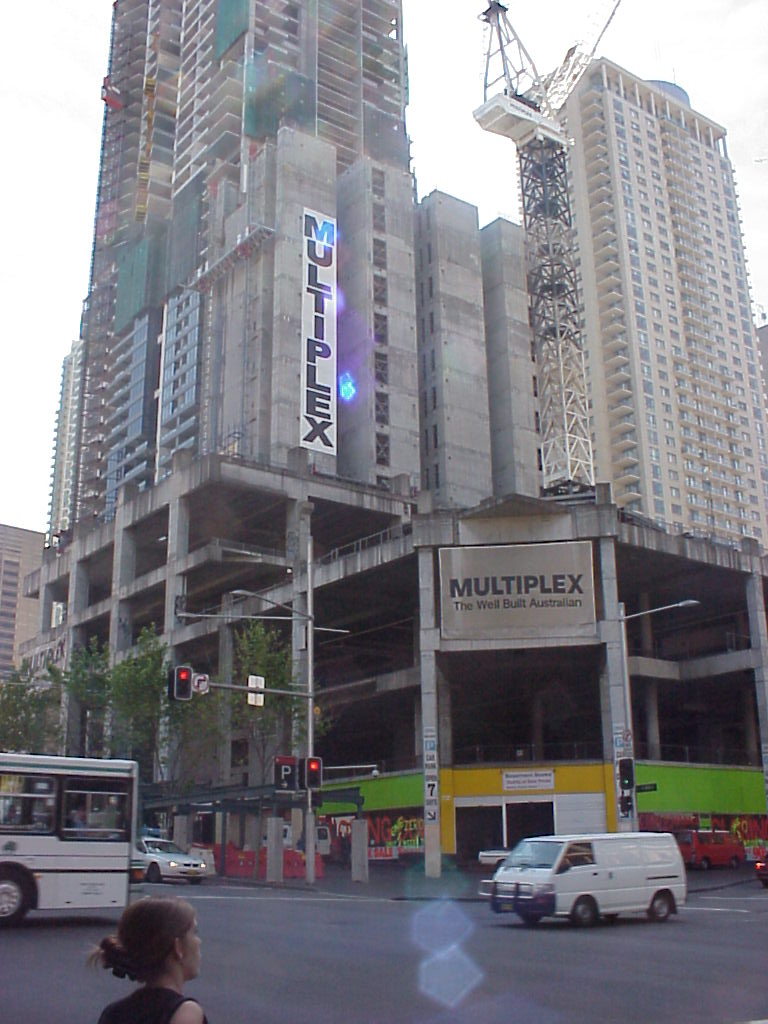
By the end of the decade and the site had been dug to 30 metres below street level. On the corner of George and Goulburn Streets, one of the office towers (George Tower) was well under construction, with work beginning in December 1988. This tower would become 680 George Street.


Above: The office tower at the corner of George and Goulburn Street was under construction in 1990 when work stopped. This was taken in October 2002 just before work recommenced on its construction. Photos were taken by the Author.

However disputes with unions and workers would fuel the collapse of the project in mid-1990 and for over a decade, we would see inactivity at the site.

Next week we will look at the idle years at World Square and Hordern Towers. Then we will move onto the gradual formation of World Square as we see it today.


Monday, 9 May 2016

EVOLUTION OF WORLD SQUARE: Kenzo Tange's Original Scheme (1983)

After last week's post on the original plans for the redevelopment of World Square, I've decided to focus this week on the next major proposal which dates to 1983.

In 1981, Ipoh Gardens Berhad ended up with the site and had planned for a multi-tower development just on the site of Anthony Horderns, including retaining some of its famous facade. There would also be a park in the middle.

Just two years later the proposal was revised. Unlike the scheme proposed in 1981, it would now encompass the entire city block bounded by George, Goulburn, Pitt and Liverpool Streets.

Many will associate Kenzo Tange's involvement with the 1985 scheme, which is highly talked about because of the positioning of towers in the shape of the Lotus flower. You'll find out about that next week.

The scheme according to The Sydney Morning Herald on May 17, 1983, comprised three towers:

Tower 1 - 59 floors (Office & Residential)
Tower 2 - 53 floors (Hotel)
Tower 3 - 38 floors (Office)

The towers would rise over a four-level podium. 


Source: Lawson, L. 1983. "$478m complex could replace Hordern building". The Daily Telegraph, May 18: 9.

Heritage experts were calling at least for the facade of Anthony Horderns to remain but it was argued that it would be too expensive to undertake and that the facade lacked craftsmanship.

Construction was projected to take eight years, though The Sydney Morning Herald reported that it could be completed in six years.


Monday, 1 December 2014

1961: Anthony Hordern's Shopping Centre

This week, I share with you two newspaper advertisements to promote the opening of the Anthony Horderns' Shopping Centre in Central Sydney from December 1961.

It was boasting to be the first "drive-in" shopping centre in Sydney's CBD which had parking levels within the existing structure. Shoppers had 100 shops to choose from.

This was done in response to the opening of "drive-in" shopping centres that were already open in Sydney e.g. Top Ryde or were in the planning stages.

By the end of the decade, there would be no more Anthony Horderns at Brickfield Hill. However, some small shops were allowed to trade until the 1980s when it was pulled down for the World Square development.


Sources:

Anthony Horderns. 1961 "Anthony Horderns' New Drive-In City Shopping Centre (Advertisement)." The Daily Telegraph, December 6: 29.

Anthony Horderns. 1961 "Opens today at 12 noon (Advertisement)." The Daily Telegraph, December 6: 24.