Showing posts with label 1970. Show all posts

Saturday, 25 July 2026

Property Advert of the Week: Stocks & Holdings Projects (1970)

Below is a 1970 newspaper advertisement promoting two projects by Stocks and Holdings Projects that was published in The Sun.

Stocks and Holdings Ad January 2 1970 The Sun 39

Source: Stocks & Holdings Projects. 1970. "Untitled" (Advertisement). The Sun, January 2: 39.

The two projects featured were"

  1. "The Pines" (Manly) - Located at 51-53 The Crescent, Manly
  2. "Trenthurst Place" - Cnr of New & West Street, Balgowlah Heights

Saturday, 27 June 2026

Property Advert of the Week: 122 Windsor Street, Richmond (1970)

The Barrels & Ashes Bar currently resides at 122 Windsor Street, Richmond, but did you know that in 1970 it was listed for sale as a residential property with four bedrooms, 2 bathrooms, and a double garage?

Robin Baker Pty Ltd Ad February 13 1970 The Sun 58
Source: Robin Baker Pty. Ltd. 1970. "Auction Sale" (Advertisement). The Sun, February 13: 58.

Saturday, 20 December 2025

Property Advert of the Week: 73 Milton Street, Ashfield (1970)

Our last Property Advert of the Week entry for 2025 sends us back to 1970, when apartments were on offer at 73 Milton Street, Ashfield, from $13 950, and the complex contained just nine units. 

73 Milton Street Ashfield Ad January 23 1970 The Sun 60 

Source: Rightway Real Estate. 1970. "Ashfield - 73 Milton Street" (Advertisement). The Sun, January 23: 60.

According to the RBA Inflation Calculator, this would equate to paying around $198 000 in today's money. The three-bedroom apartments, which started from $16,300, would be equivalent to spending around $231,000 today.

Property Advert of the Week returns on Saturday February 7.

Saturday, 29 March 2025

Property Advert of the Week: Epping Land Release (1970)

Below is a 1970 newspaper advertisement promoting a land release at Epping near the Epping Aquatic and Leisure Centre. According to the information provided, the lots appeared to encompass Pembroke Street and Raymond Place, a cul-de-sac, and the map features a cul-de-sac.

Blocks were on sale from $13,000, equivalent to spending $ 184,500 today (RBA Inflation Calculator).

 Epping Land Sale Ad December 18 1970 The Sun 58

Source: L. W. Roth & Co. 1970. "Land Sale". The Sun, December 18: 58.

Monday, 24 February 2025

1970: Dividing the Sutherland Shire

Proposed Sutherland Shire split up October 14 1970 The Leader 1
Reasons Given for Shire Cut October 14 1970 The Leader 22
Source: Anon. 1970. "Residents Seek Shire Split-Up". The St George and Sutherland Shire Leader, October 14: 1 & 22.

Residents of the Sutherland Shire take pride in where they live. They love to boast about living in "God's Country" and "The Shire".

One element that has helped shape its identity is its council - Sutherland Shire Council, established in 1906. At its founding, the region was home to 1500 people.

According to the 2021 Census, approximately 230,000 reside in the region.

Fifty years ago, the population of the Sutherland Shire was around 153,000 and was booming as residential estates were built in suburbs across the region, particularly in Engadine, Heathcote, Bonnet Bay, Kareela and Sylvania Waters. 

A group of residents felt it was time for the region to be divided into two local government areas, but why?
  • The Sutherland Shire was no longer a "shire", a title conferred to local government areas in rural areas.
  • Population Growth - The post-war boom increased from around 18,000 in 1939 to over 153,000 by 1970.
  • Geographic Size of the region - It was felt that the region's large size and geographic spread meant that councillors could not understand issues affecting all areas of the Sutherland Shire.
  • Deterioration of Cronulla Beaches
  • Neglect of Kurnell
  • Council workers having to travel long distances from Sutherland to complete jobs across the region.
Which Suburbs would be in Cook Council?
It was to be based on the borders of the Federal Electorate of Cook as it was at the time and comprised of the following suburbs:
  • Burraneer
  • Caringbah
  • Caringbah South
  • Cronulla
  • Dolans Bay
  • Greenhills Beach (future suburb)
  • Lilli Pilli
  • Kangaroo Point
  • Kurnell
  • Miranda
  • Port Hacking
  • Sylvania
  • Sylvania Waters
  • Taren Point
  • Woolooware
  • Yowie Bay
Had the council become a reality, there would be an estimated 89,000 residents based on 2021 Census Data. The remainder of the Sutherland Shire would have around 137,000 residents. 

Sutherland Council Reacts

Shire President Arthur Gietzelt opposed the idea, concerned that it would lead to a doubling of rates for ratepayers across the two councils, duplication of facilities and services, and increased costs in hiring officials, referring to council administrators and managers. It also doubted whether ratepayers could fund projects benefiting locals, such as the Sutherland Civic Centre (completed 1976). Simply Gietzelt felt one large council would be more efficient and better able to provide service for its residents.

What if it became a reality? Would Cook Council still be in existence in 2025?

In 2016, the NSW Government forced a number of Sydney councils to merge. The majority of mergers proceeded. Both Sutherland and Cook Councils would have been forced to merge to reestablish the council on the original (or, as we see it today, current boundaries), citing the creation of the Northern Beaches LGA. According to the 2021 census, it has a population of over 260,000, comprising the former Manly, Warringah and Pittwater Council areas. 
 

Saturday, 2 December 2023

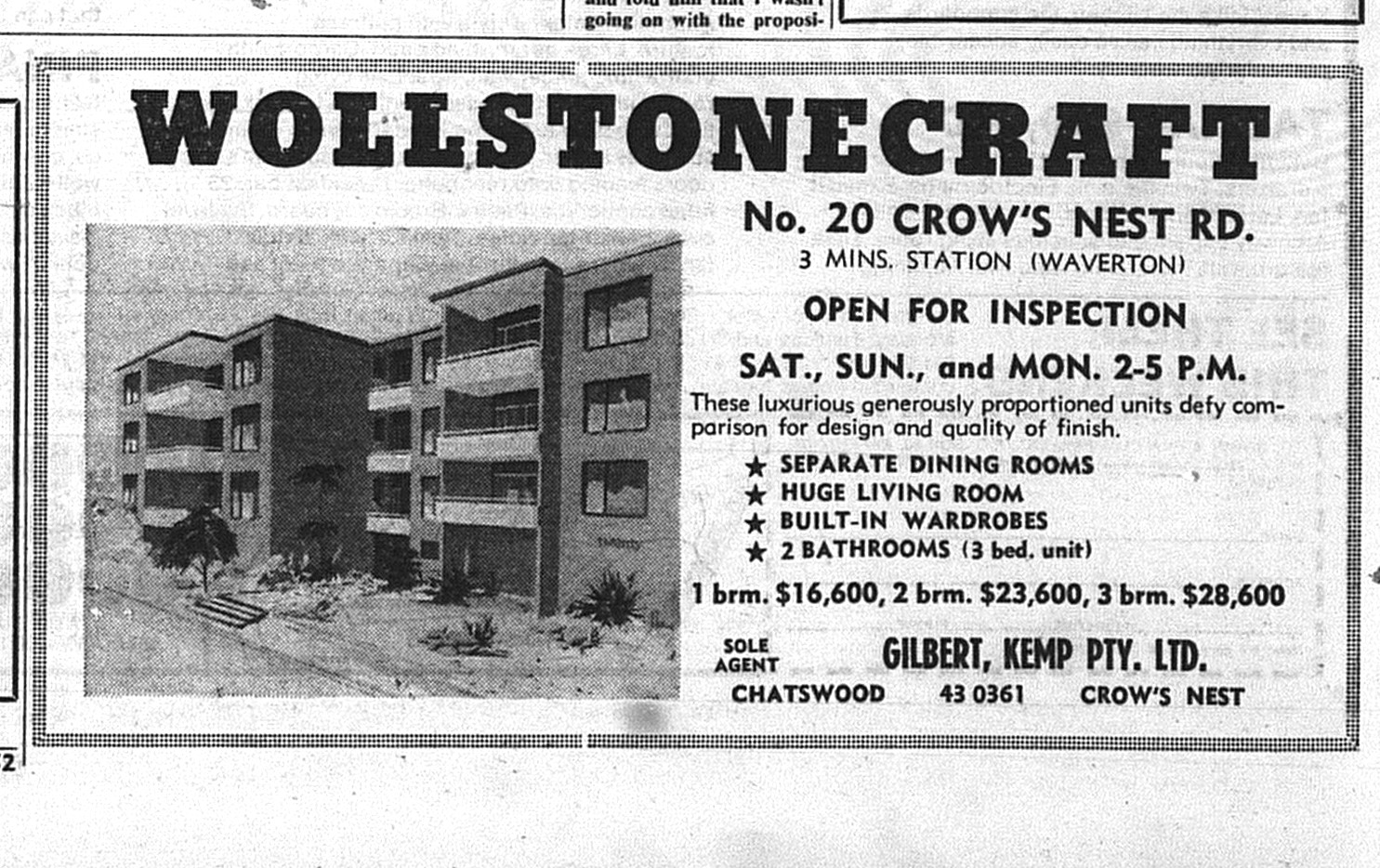
Property Advert of the Week: 20 Crows Nest Road, Waverton (1970)

Below is a newspaper advertisement from 1970 for 20 Crows Nest Road, Waverton. Note that it is advertised as Wollstonecraft. One bedroom apartments were on sale for $16 000, two bedroom for $23 600 and three bedroom apartments from $28 600. 

Wollstonecraft Units Ad June 12 1970 The Sun 52

Source: Gilbert, Kemp Pty. Ltd. 1970. "Wollstonecraft No. 20 Crow's Nest Rd." (Advertisement). The Sun, June 12: 52. 

Monday, 15 May 2023

NEVER BUILT SYDNEY: 1 Oxford Street Hotel (1970)

1 Oxford Street is a 27-level office tower, completed in 1982 that occupies the corner of Oxford Street and Wentworth Avenue.

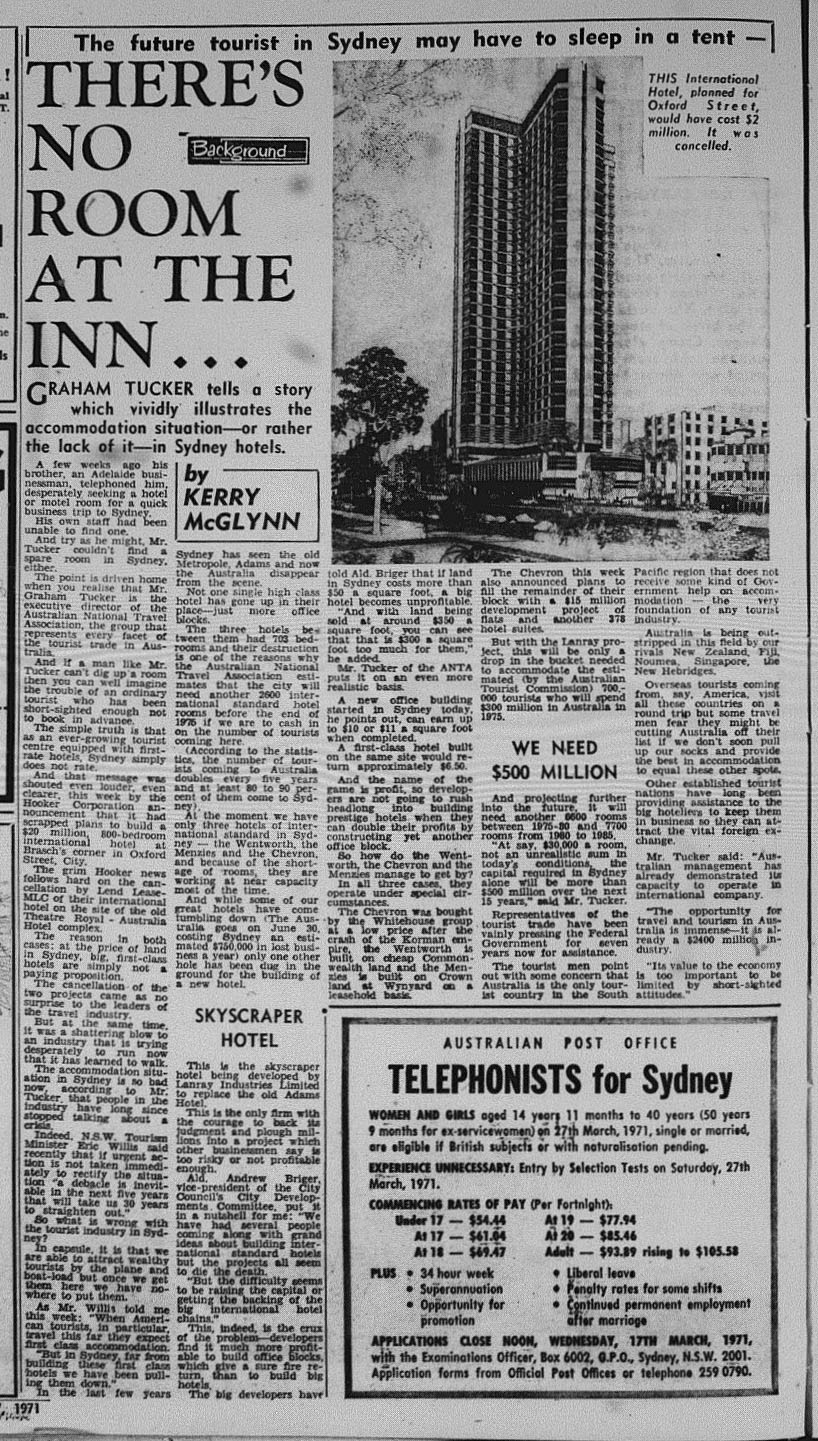
Did you know that early plans for the site called for a hotel tower instead of an office tower? Below is a proposal from 1970.

1 Oxford Street Tower January 7 1970 daily mirror 3

Source: Anon. 1970. "Australia in the 70s: Room for 1100 in a space age hotel". The Daily Mirror, January 7: 3. 

The tower was similar in height with 29 stories rising to around 350 feet (106 metres). The rooms would accommodate a total of 800 guests and also included a convention centre with a capacity of 1100 people along with a rooftop restaurant. The developer Hooker Projects would oversee planning and construction and hoped to sell the tower to a hotelier. In March 1971, Hooker Corporation announced that the hotel would not proceed likely due to financial returns and the price paid for land in Sydney. Its axing was despite increased demand for luxury international hotels in Sydney associated with increased demand for jet air travel.

1 Oxford Street March 7 1971 sunday telegraph 40

Source: McGlynn, K. 1971. "There's no room at the inn...". The Sunday Telegraph, March 7: 40.

Monday, 13 March 2023

1970: The end of the Hotel Metropole

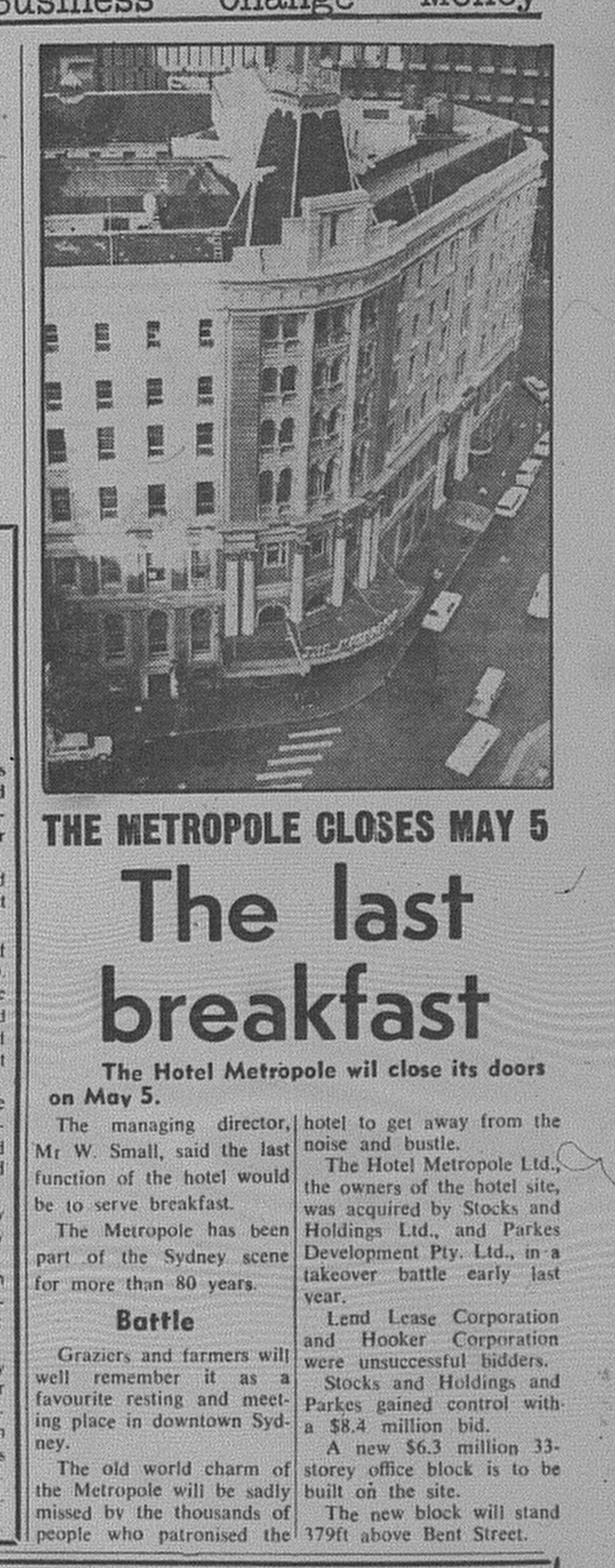
1970 saw the closure of the Hotel Metropole in Bent Street after eighty years of trading. It was a victim of progress that was occurring in central Sydney. The last day of trade was 5 May 1970 with a final breakfast.

  Hotel Metropole Closes April 2 1970 The Sun 50 

Source: Anon. 1970. "The last breakfast". The Sun, April 10: 50.

Prior to its closure, the crockery and cutlery were already being souvenirs by souvenir hunters.

Hotel Metropole Closes May 1 1970 The Sun 21

Source: Anon. 1970. "Hotel's Final Breakfast". The Sun, May 1: 21. 

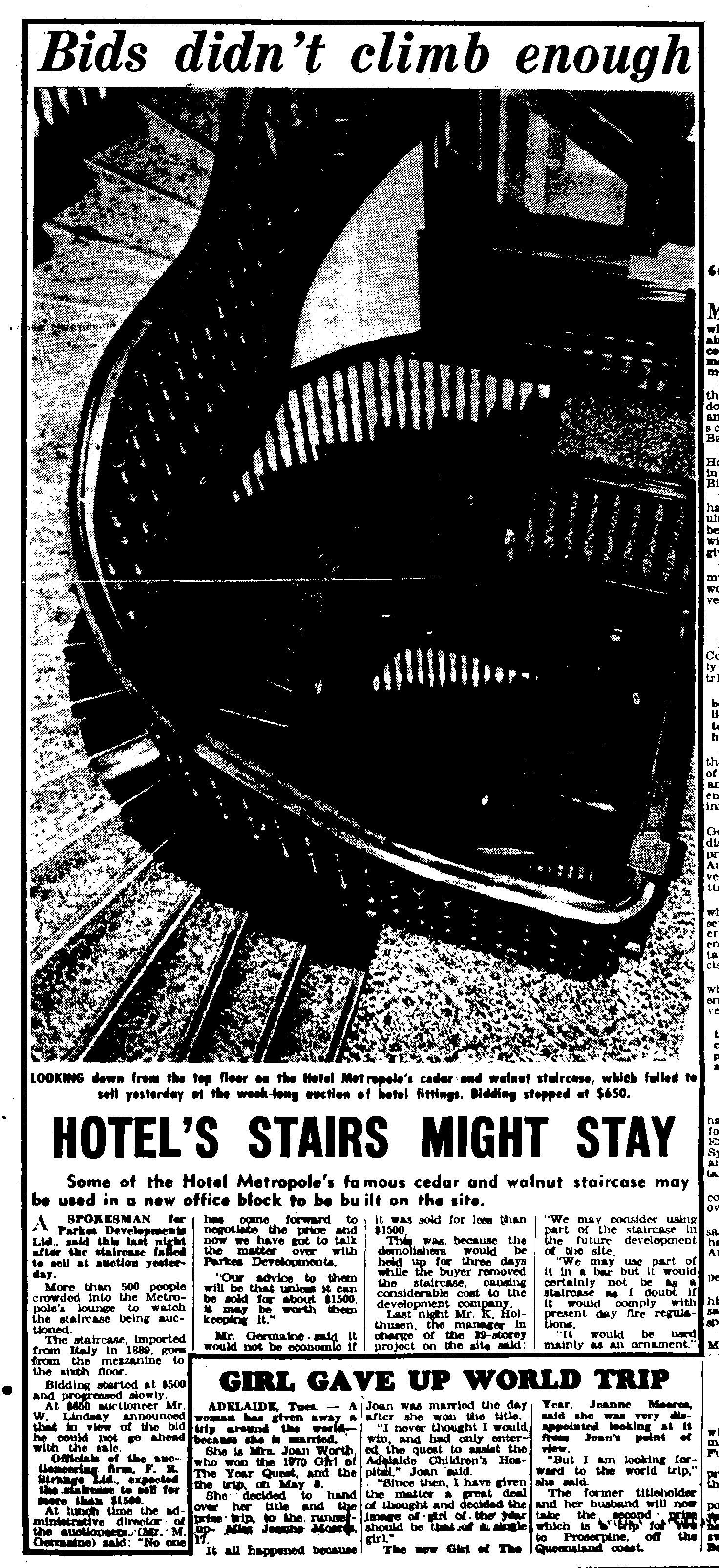
In the auction that followed, the staircase failed to sell. 

Hotel metropole may 20 1970 daily tele 

 Source: Anon. 1970. "Hotel's Stairs Might Stay". The Daily Telegraph, May 20: 3.

Monday, 3 October 2022

1970: No Lovin in our new plaza (Martin Place)

Martin Place Kissing Ban November 24 1970 daily mirror 1

Source: Oram, J. 1970. "No Lovin in our New Plaza". The Daily Mirror, November 24: 1. 

During the trial closure of Martin Place between George Street and Pitt Street in 1970, Sydney City Council raised concerns about kissing and cuddling after several complaints were received by the public to Sydney City Council.

It wasn't just those who wanted to show their affection, but also, "lay-abouts", "no-hopers", hippies and Hare Krishnas raised concern. Referred to in the article as a "religious sect", the Hare Krishnas raised concern as they engaged in "singing, cymbals clashing and bongo drum thumping".  

The view was that Martin Place was only suited to a "better class of people" who did not need to be subject to "molestation or nuisance".

Simply, the vision for who could access Martin Place by some was that people that were seen as either lazy, unemployed, lacked success in their life, held a low position in society or not seen as conforming to what was regarded as acceptable to society were not welcome, along with those who wanted to use the space to show their affections for one another.

It was disappointing to read that some held such a view. Public spaces such as Martin Place are meant to be open for all to use. It is a gathering place for all groups. Consider the protests and rallies that either travel through Martin Place or occur within the space. Music is in fact encouraged yet in 1970, it was being discouraged. 

To quote "lay-abouts", this suggested that the unemployed were not welcome. Perhaps this may have extended to those who had a job but were not seen as productive. Sadly the reference to "no hopers" indicated that those that were seen as "unsuccessful" or were likely to "fail" were not welcome


Monday, 1 August 2022

VISIONS OF SYDNEY: Proposals for Sydney City Council's Strategic Plan (1970)

In 1971, the City of Sydney Strategic Plan was released by Sydney City Council to guide city development and planning through to the year 2000.

As part of formulating the document, proposals were tendered from around the world with ideas on how to make our great city better.

The Daily Mirror published the feature article below summarising the proposals from 1970. For some of those proposals, I have separate clippings which could be explored further in a future entry such as the Woolloomooloo redevelopment scheme.

It envisioned a future Sydney with George Street and William Street being turned into boulevards, a Civic Centre in the southern part of the Sydney CBD along with the proposed redevelopment schemes for Circular Quay (i.e. Gateway Plaza site), The Rocks and Woolloomooloo.

Also there is mention of the closure of Martin Place at the George Street end, which was trialled in 1970 before being made permanent in 1971, and led to the closure of the entire street by the end of the decade.

Sydney Redevelopment Schemes March 16 1970 daily mirror 4-5

Source: Anon. 1970. "Sydney in the 21st Century". The Daily Mirror, March 18: 4-5.

Monday, 18 April 2022

1970: One Way tolling introduced on The Sydney Harbour Bridge

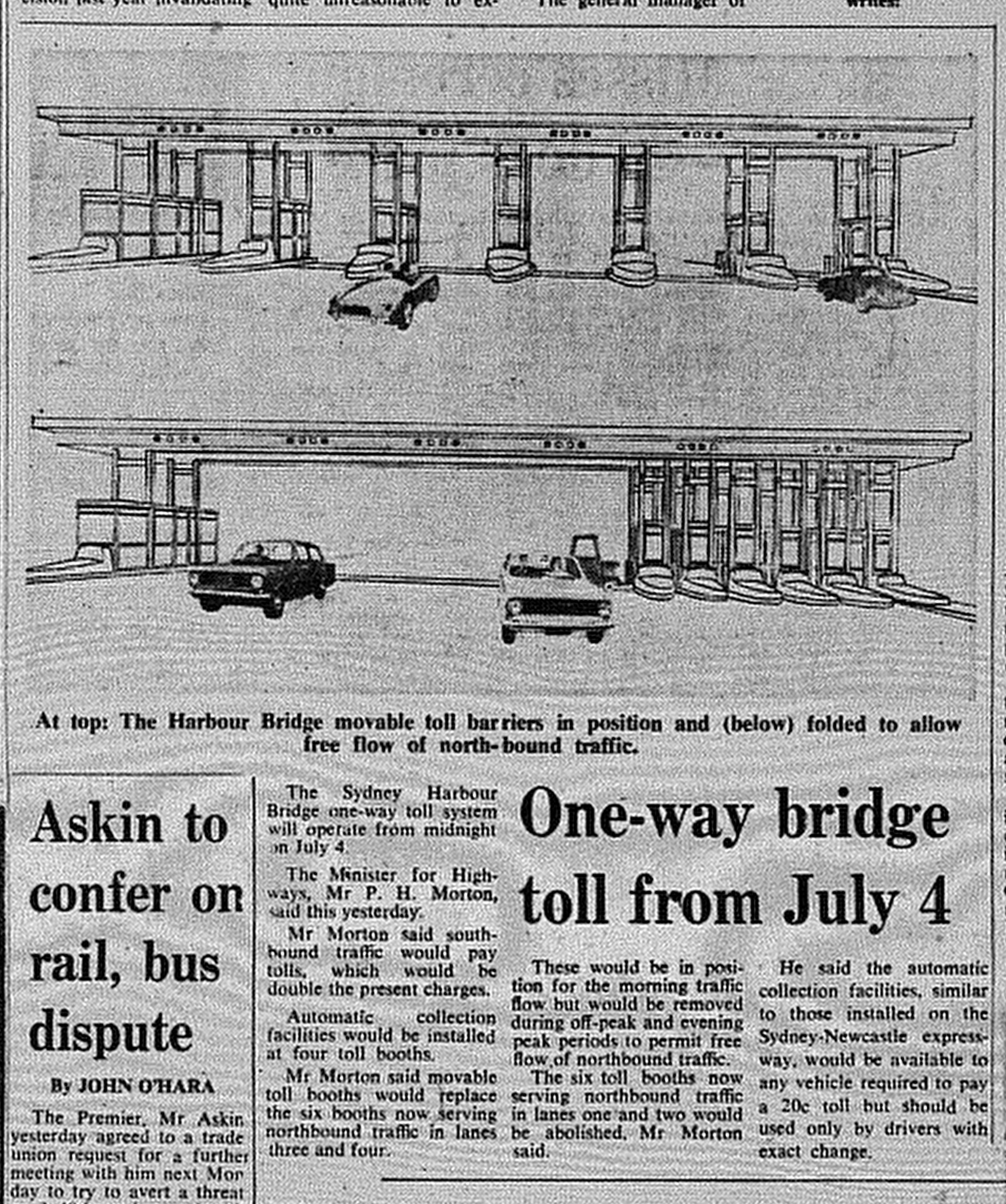
Sydney Harbour Bridge Tollgates June 20 1970 SMH 5


Source:  Anon. 1970. "One-way bridge toll from July 4". The Sydney Morning Herald, June 20: 5. 

From the opening of The Sydney Harbour Bridge in 1932 until 1970, vehicles crossing the bridge had to pay a toll in both directions. By the start of 1970, the toll cost ten cents, equivalent to $1.22 today. Relative to 2022, it was inexpensive, but still attracted complaints from motorists.

One way tolling began on July 4, 1970 with the purpose of improving the flow of northbound traffic especially during peak periods. To compensate for the loss of revenue from north bound traffic, the toll was increased to 20 cents (equivalent to $2.44 today), and would remain at that level until 1987. 

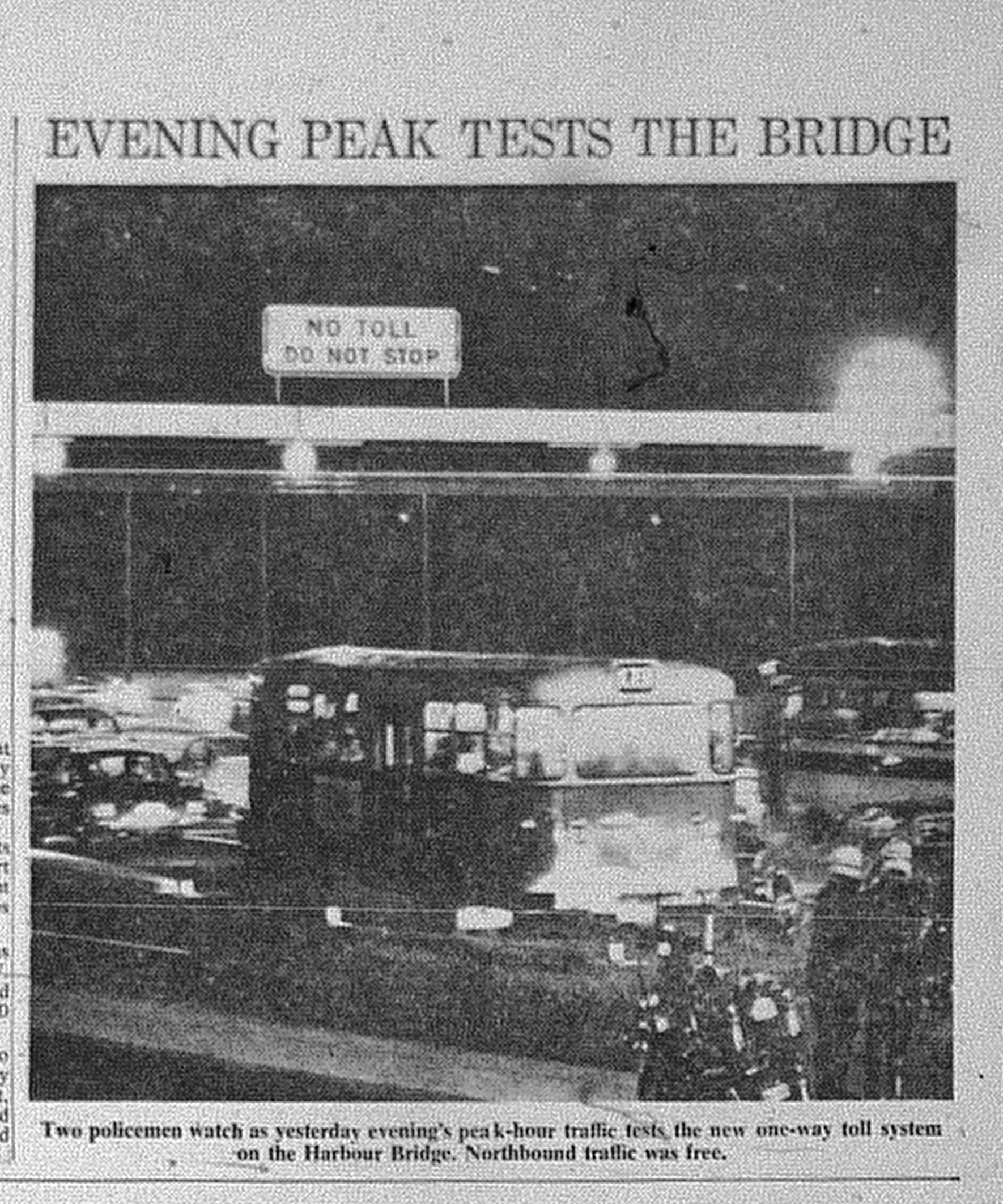
Sydney Harbour Bridge Tollgates July 7 1970 SMH 4
Source: Anon. 1970. "Evening Peak Tests The Bridge". The Sydney Morning Herald, July 7: 4. 

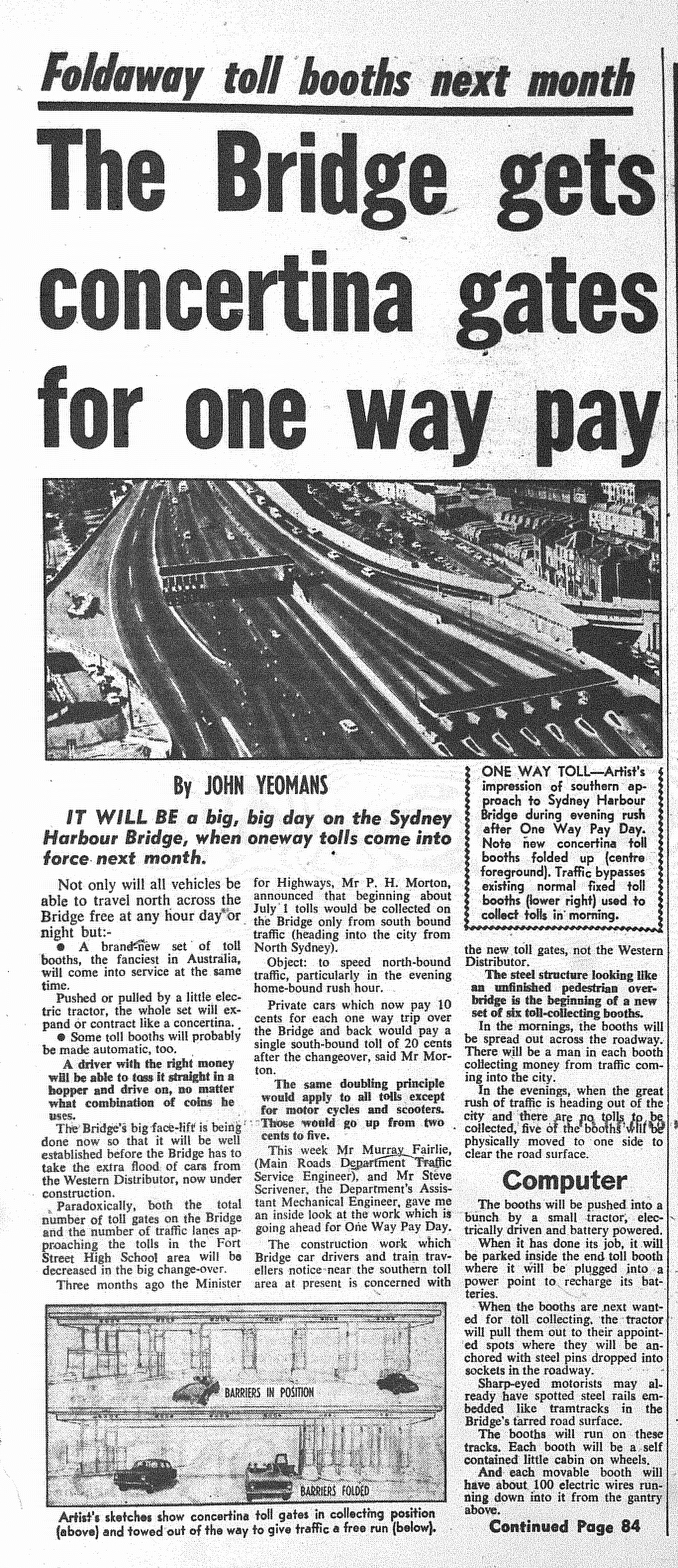
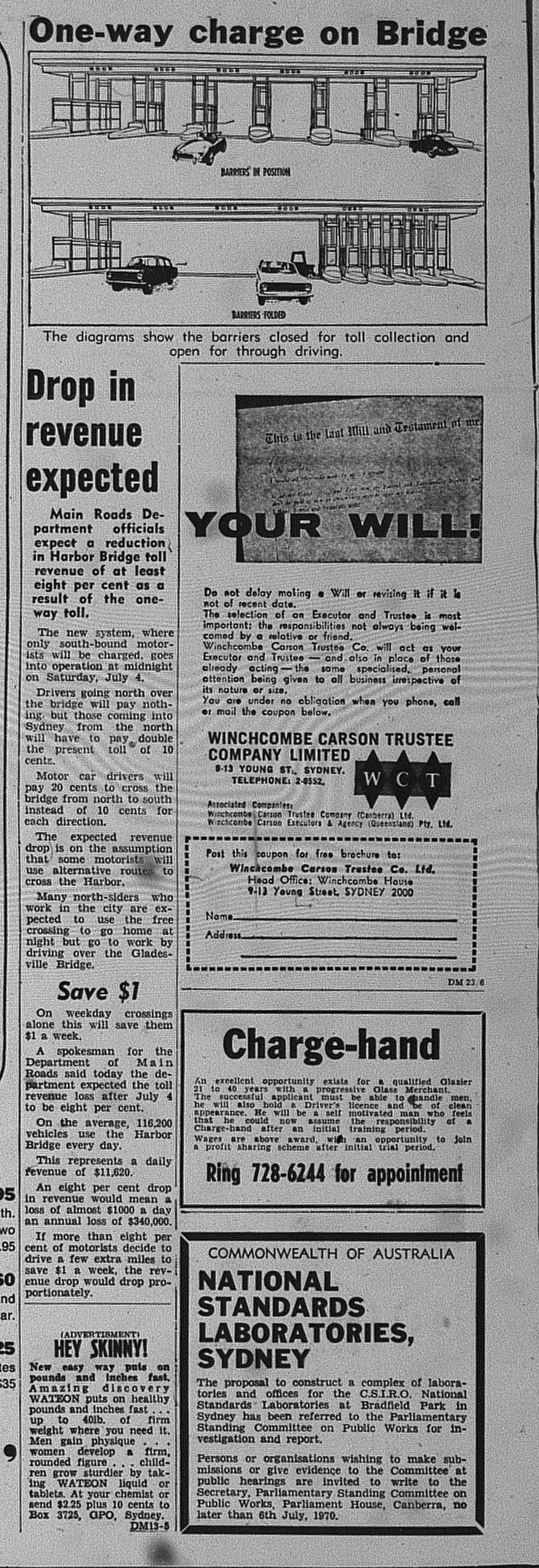
The shift to one way tolling saw the introduction of movable toll barriers that could be folded to allow for the free flow of northbound traffic in the evening, while serving southbound traffic during the morning peak. 

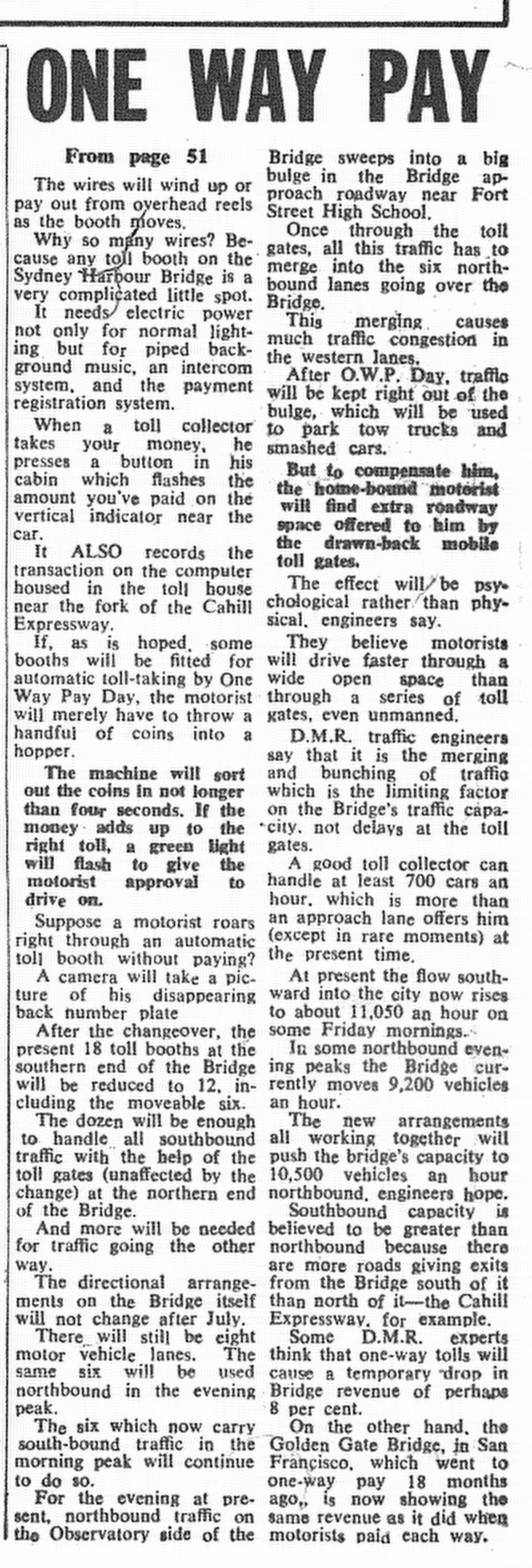
Sydney Harbour Bridge Tollgates June 7 1970 Sun Herald 51

Sydney Harbour Bridge Tollgates June 7 1970 Sun Herald 84
Source: Yeomans, J. 1970. " The Bridge gets concertina gates for one way pay". The Sun Herald, June 7: 51 & 84. 

However the doubling of the southbound toll to twenty cents saw a drop in revenue as some drivers sought to save money travelling via the Gladesville Bridge. This was anticipated as reported by The Daily Mirror.

Sydney Harbour Bridge Tolls June 23 1970 daily mirror 24
Source: Anon. 1970. "One-way charge on Bridge". The Daily Mirror, June 23: 24.

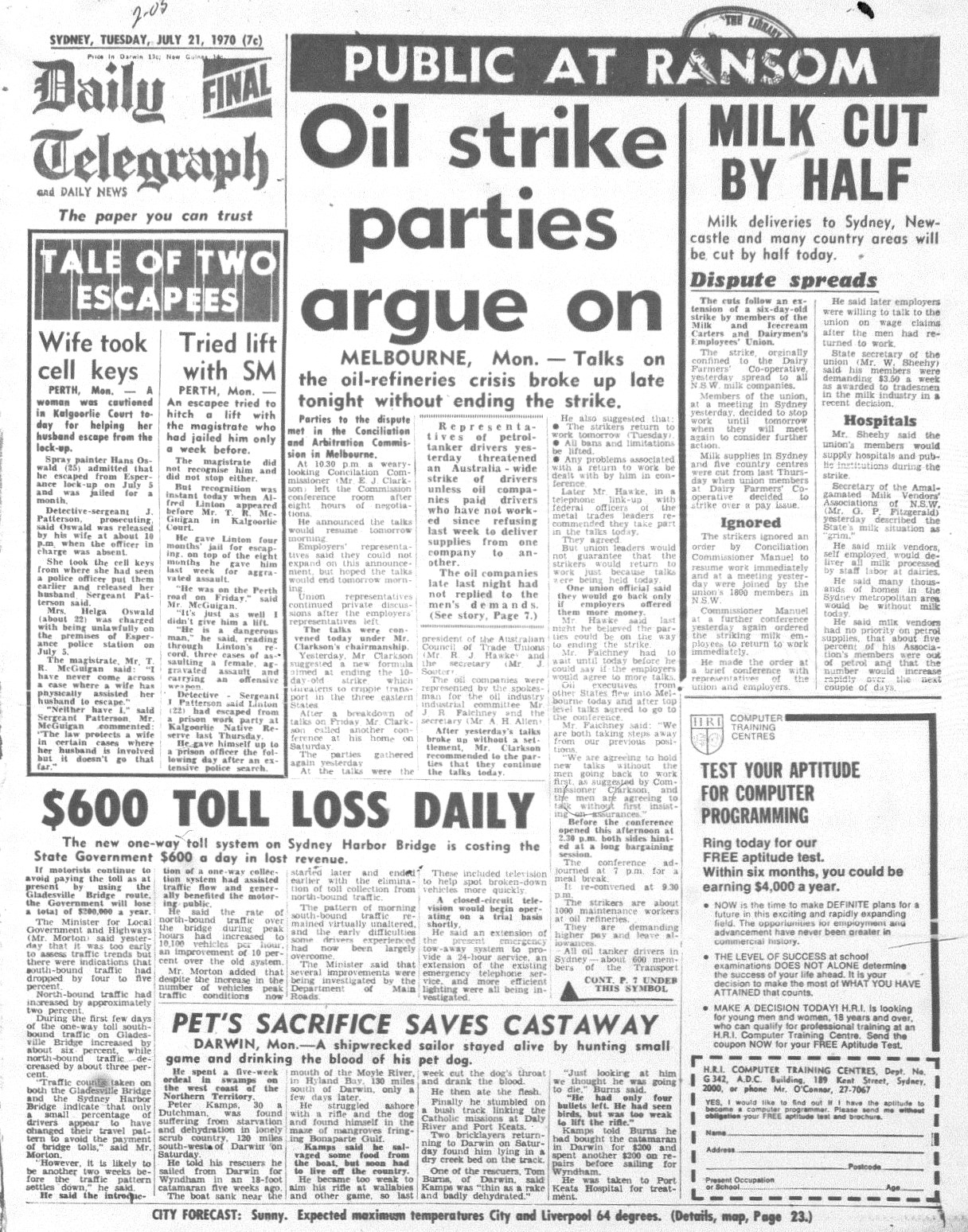
The Daily Telegraph (21 July 1970) reported that revenue from the tolls had decreased by an average of $600 per day, meaning that annual loss of $200 000 in revenue was projected.

Sydney Harbour Bridge Tolls July 21 1970 daily telegraph 1
Source: Anon. 1970. "$600 Toll Loss Daily". The Daily Telegraph, July 21: 1.

The toll booths operated until 2009, when e-tolling was made compulsory for motorists crossing the Sydney Harbour Bridge. However they were not removed until 2016. Below is a video from "Ventia" that was posted on Vimeo.


The RBA Inflation Calculator was used to determine the equivalent value of the tolls in 1970 against that of 2022, adjusting for inflation. 

Monday, 21 March 2022

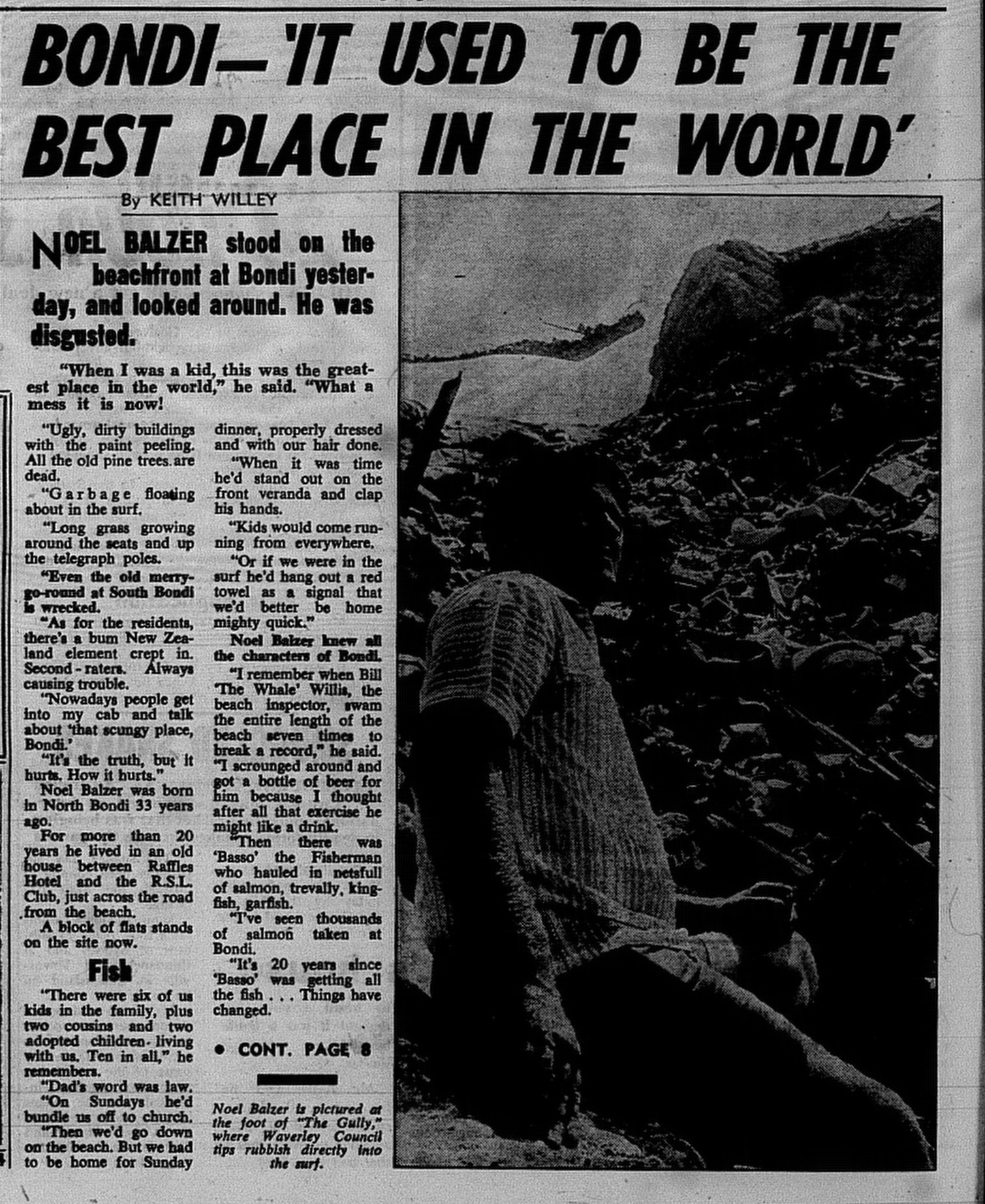
1970: Bondi - "It used to be the best place in the world" - (The Sun Article)

Bondi Beach Feature March 6 1970 The Sun 4 (Page 8 missing) 

Source: Willey, K. 1970. Bondi - It used to be the best place in the world. The Sun, March 6: 4 & 8.

At the start of the 1970's, Bondi did not have the reputation that it holds today. Today, you will hear people say "It's the best place in the world" and Bondi Beach has a very good reputation overseas as one of the great beaches of the world. The Sun published an article on March 6, 1970 focusing on the decline of Bondi. Local resident Noel Balzer shared his recollections of growing up in the suburb and what it was now. 

The "old pine [Norfolk Pine] trees are dead", "garbage floating in the water", dumping of rubbish by Waverley Council into the ocean, litter in the streets, poor maintainence of public amenities and poorly maintained buildings were identified as some of the concerns raised by Balzer. He recalled some of the characters that made up the suburb and was concerned about the anti-social behaviour of New Zealanders that resided in the suburb. 

Bondi would contrinue to struggle through the 1970's and 1980's. The 1980's saw a focus on promoting the suburb to international tourists which increased as the decade progressed. High levels of beach pollution had made the beach increasingly unsafe to swim in, causing illness among swimmers and surfers as they swam in water contaminated with raw sewage and litter. Local residents could smell the stench from their homes. The 1990's saw the completion of the Deep Water Ocean Outfall which improved water quality for swimmers at Bondi. The suburb also became a tourist destination as international hotels opened in Campbell Parade.

The Norfolk Pines have returned, with the first trees planted in 1991, and today are becoming noticable as they slowly grow and mature.

Despite the revival of Bondi, it has come at some cost which I think would not impress Noel Balzer. House prices began rising in the 1980's, which meant that the working class residents which dominated the suburb could no longer afford to remain in the area. The median price of a home in Bondi is just $4 million, when compared with around $1.6 million for a typical Sydney suburb. Rising rents for shopfronts along Campbell Parade has seen many of the essential businesses that serve the suburb leave.

Monday, 22 February 2021

1970: Sydney Construction Feature

For around the past decade, the sight of construction in central Sydney has become part of the city's routine.

In the late 1960's and early 1970's, the sight of construction was also routine in central Sydney as old buildings were demolished for modern skyscrapers.


The Daily Telegraph published a pictorial feature on September 12, 1970 focusing on three sites:
  1. AMP Centre (Bridge Street)
  2. Hilton Hotel - Former site of Adams Hotel
  3. 175-183 Castlereagh Street - 14 storey office tower
Two sites featured are currently undergoing redevelopment. The AMP Centre which was completed in 1976 has been gutted and being redeveloped into a modern office tower. Floorplates are being enlarged to provide modern workspaces for its employees. 

Photo taken by the Author (2021). 

175-183 Castlereagh Street has been demolished as part of the Pitt Street Metro Station development with a modern office tower planned for the site. 

The Hilton Hotel completed in 1973 was renovated in 2004 with a refurbished facade and additional office space. 


Monday, 27 April 2020

MILESTONE: Sydney Airport International Terminal Turns 50 (1970) - Newspaper Supplements

Last week, I presented an entry on the opening of the International Terminal Building at Sydney Airport.

As promised, I would share scans from supplements published in The Australian and The Daily Telegraph. 

The Australian (May 1, 1970)


The Daily Telegraph (May 1, 1970)


Monday, 20 April 2020

MILESTONE: Sydney Airport International Terminal Turns 50 (1970)


Sydney Airport's International Terminal in 1970.
Source: Anon. 1970. "Untitled" (Photograph). The Sydney Morning Herald, May 1: 2 (Air Traveller Feature). 

1970 was a big year for Sydney Airport. Not only did it welcome the "Queen of the Skies" - Boeing's 747 jumbo jet, it also opened a new international terminal complex. Before 1970, the international terminal was located where the Qantas Domestic Terminal (T3) stands today.

Plans were unveiled in 1965. Click here for my 2015 entry which provides further details. Several weeks ago, I posted clippings of one scheme which was to provide both domestic and international services in the one terminal and the eventual design of the terminal considered future domestic terminals at its northern and southern ends.

Above: A sketch of the International Terminal in 1970.
Source: Anon. 1970. "Untitled" (Sketch). The Sydney Morning Herald, May 1: 2 (Air Traveller Feature). 

Construction of the terminal cost $31 million, which was $11 million (5.5 million pounds) over the projected cost. According to the RBA Inflation Calculator, it would cost the equivalent of $365 000 000 in todays money.

Queen Elizabeth II opened the terminal on May 3, 1970.

To accommodate growth in passenger numbers and flights, major extensions to the terminal occurred in 1992 and 2000 with further upgrades in 2010 and 2016. Upgrades to Sydney Airport have become a normal way of life in recent years.

Other works have included the construction of a multi-level carpark, office block and hotel during the 2000's. In 2000, an underground railway station opened, connecting the terminal with the City Circle, Airport and East Hills Railway Lines.

Initially, road access was only via Airport Drive, with a bridge built to link it with Marsh Street, Arncliffe and the Princes Highway in 1972.

Facts of Interest

  • Contained 400 000 square feet or 37 000 square metres of space.
  • Construction of the terminal took six years (three years of site preparation and a further three years for construction).
  • International Restaurant with seating for 200 people plus bars and lounges.
  • Parking for 2500 cars. Parking cost 20 cents per hour up to a maximum of $2 per day. 
  • Fifteen airlines used the terminal in 1970 and could process 14 000 people per hour. Around 70 000 (Needs verification) can be processed per hour in 2020.
  • Shops included a newsagent, duty free store and gift shops. 
Below is a cross section of the terminal as featured in The Sydney Morning Herald. Can you spot the similarities and changes to that of 2020? Unfortunately, there is no longer a public observation deck to enjoy the planes taking off and landing. 


Source: Anon. 1970. "Untitled" (Sketch). The Sydney Morning Herald, May 1: 2 (Air Traveller Feature). 

Next week, I will share newspaper supplements from The Australian and The Daily Telegraph. 

Saturday, 8 February 2020

Property Advert of the Week: Parkridge by Parkes (1970)

This is our very first Property Advert of the Week entry for 2020.

Below is an advertisement from 1970 from Parkes Homes to promote their model home - Parkridge.


Source: Parkes Ideal Homes. 1970. "Parkridge...the house with two faces". The Daily Mirror, April 17: 28. 

Saturday, 29 June 2019

Property Advert of the Week: Neeta Homes advertisement (1970)

Below is a Neeta Homes advertisement that appeared in The Daily Mirror back in 1970. It also promoted their exhibition village on the Epping Highway (Epping Road) at Marsfield. This was located between Sobrano Road and Balacalva Road.


Source: Neeta Homes. 1970. "so far, seven of the family have built Neeta homes (advertisement)". The Daily Mirror, April 10: 58-59.

Monday, 3 June 2019

NEVER BUILT SYDNEY: 1500 unit development in Darlinghurst (1970)

Image sourced from: Frykberg, I. 1970. "1,500 new homes for Cross". The Sydney Morning Herald, June 13: 6. 

In 1970, plans were released for a 1500 unit development on a Darlinghurst site bounded by Darlinghurst Road, Liverpool Street, Forbes Street, and Farrell Avenue.

This included three towers with heights of:

594 feet (182 metres)
548 feet (167 metres)
459 feet (140 metres)

The towers would rise over a landscaped podium with the towers consuming just 25 % of the five and a half hectare site.

Apart from "resort style" facilities, there was also a small retail complex to be built to provide for the residents.

Image sourced from: Anon. 1970. "Plaza plan for the Cross". The Sydney Morning Herald, June 25: 27. 

What would have happened had it been built?

Firstly, the nearby Horizon Tower would not be so lonely!!! It would struggle for attention like it does today.

But I do believe if events had stayed the same, the towers would still dominate the area today and would rather to a testament to bad planning of the period. With development limited, they could remain there uncontested.

Saturday, 25 May 2019

Property Advert of the Week: Sterling Homes - Winston Hills (1970)

Below is an advertisement from 1970 for Sterling Homes. They had display homes on exhibition in Latona Street, Winston Hills.


Source: Sterling Homes & Land. 1970. "It's a Family Affair" (Advertisement). The Daily Telegraph, October 31: 63.


Saturday, 11 August 2018

Property Advert of the Week: Sylvania Heights land release (1970)

Below is an advertisement by Sutherland Council for the sale of 11 home sites at Sylvania Heights dating from 1970. The home sites are located on The Esplanade.


Source: Harvey Real Estate (Sylvania) Pty. Ltd. 1970. "Sewered Land 2nd Release" (Advertisement). The St George and Sutherland Shire Leader, May 20: 64.