Monday, 15 February 2016

1969: Sydney's double decker test train


Source: Anonymous. 1968. "The Train Made to Hold 2096". The Daily Telegraph, December 31: 7. 

Sydney might not have the world's best rail network but visitors to Sydney do like it for its double-decker trains. It is the only Australian city that has them in operation. Ever wondered when they began operation? It was on January 1, 1969. Some might say 1964 when the Tulloch carriages were incorporated into trains carrying single level cars.

However, this train in 1969 was entirely double deck (or bi-level). It set the precedent for the modern fleets that would operate on the Sydney rail network through to this very day. The following year, the first of the famous V set double-decker trains began operation on interurban services. In 1972, the first mass order for double-decker trains for suburban services was undertaken. These trains are what as known as the 'S' Sets and would carry up to 1600 people, about 25 % below what they thought a few years earlier.

These trains are still part of the Sydney Trains fleet, mostly used as surplus trains for major event services, though there are a few timetabled services where the trains still run. Updated versions (the C & K sets) came into service during the 1980s. One notable feature is that they were airconditioned trains. In 1988, the Tangara came into operation.

Since the turn of the Millennium, there have been two major rollouts - Millennium Trains (2002) and the Waratah Trains (2011). The Waratah trains were bought in to replace the remaining S set trains. The final eight car set in the Waratah fleet was delivered in 2014. The double-deckers would see the demise of the single deck trains on metropolitan services with the "red rattlers" phased out by 1993.

However single deck trains will return in 2019 when the North West Rail Link opens between Chatswood and Rouse Hill. Some people question the decision because the single deck trains will lack the capacity that double deckers have. It tells us one thing - Sydneysiders take their double-decker trains for granted. It is a way of life.

Saturday, 13 February 2016

Property Advert of the Week: Neeta City 4 bedroom homes, Greenfield Park (1987)

I recently came across another classic advertisement from Neeta Homes, this time at Greenfield Park near Bonnyrigg. The advertisement, however, lists it as Bossley Park. In 1987, a four-bedroom home could be bought for just $75 000.


Source: Neeta Homes Pty Ltd. 1987. "$75,000 at Fairfield: New 4 bedroom home with garage & carpets" (Advertisement). The Daily Telegraph, March 28: 4.

Monday, 8 February 2016

1966: Introduction of decimal currency in Sydney

To mark fifty years since the introduction of decimal currency in Australia, I've got some clippings from The Daily Telegraph to share, as they reported on the changeover from the pound to the dollar in Sydney. They also had to assume the role of educator, with pages dedicated to explaining how the dollar worked including conversion rates from the pound.


People do like to be strict in terms of any changeover, but some decided to jump the gun. Railway ticket offices were issuing change in dollars and cents at 10pm the night before. When Sydneysiders woke up the next morning, life continued on as if nothing had happened. Banks were permitted to reopen after being closed for four days to prepare for the changeover, and while busy, experienced few problems.

There were some difficulties associated with the transition. For some, it was an opportunity to profit. The Sydney Morning Herald on February 15 reported that a shop had increased the cost of sandwiches from 12 cents to 17 cents.

The transition period went through to 1968. Regulars to this site would note how some real estate advertisements from the remainder of 1966 and 1967 list prices in pounds. This was allowed under the transition. Stores also listed prices in pounds, shillings alongside dollars and cents.


The major newspapers were generally positive. I've included the editorial from The Daily Telegraph on February 14. It was seen as a "new age" for Australia and that it would bring long-term benefit to the nation. The Sydney Morning Herald adopting the conservative view wondered if the conversion would be worth it given the impact of decimalisation like the need to carry two currencies in the interim, supply of new currency and inflation. 

Over the years, there were changes to coins and notes. In 1969, the shape of the fifty cent coin was changed as it caused some confusion with twenty cent coins along with the cost of producing the coins itself. In 1984, the one dollar note was replaced with a coin, followed by the two dollar coin in 1988.  During the early 1990s, one and two cent coins were taken out of circulation, though can still be accepted for payment. There were some additions to banknote denominations. The $5 banknote was introduced in 1967, $50 banknote in 1973 and the $100 banknote in 1984

Between 1992 and 1996, new polymer banknotes were issued for all denominations to remove counterfeiting. This was pioneered by the Reserve Bank of Australia who created the banknotes in conjunction with the CSIRO and the University of Melbourne. The Reserve Bank is planning to update banknotes over the next few years.

On a global level, the Australian Dollar has grown to be one of the world's reserve currencies and one of the most actively traded, due to the stable nature of the economy.

And as a bonus, why not include two television advertisements including the famous Dollar Bill and Company.


Saturday, 6 February 2016

Property Advert of the Week: Panorama Gardens, Banksia (1963)

I came across this one just recently while going through some files. It is for the Panorama Gardens apartment complex at Banksia in Kimpton Street. Apartments were going for 4750 pounds but it did have something not many unit complexes at that time (or dating from that period), a swimming pool.


Source: R. T. Golby Pty Ltd. 1963. "Panorama Gardens" (Advertisement). The St George & Sutherland Shire Leader, November 27: page unknown.

Monday, 1 February 2016

1970: The Indian-Pacific Begins Service

On February 23, 1970, the Indian Pacific Train went into operation and for the first time allowed for uninterrupted rail travel between Sydney, Adelaide, and Perth. Before 1970, one had to take five trains just to cross the country (and via Melbourne) on various gauges. The line completed a century-long vision to construct a rail line to link the eastern and western coasts of the continent. A lavish ceremony was held to mark the commencement of services at Central Station.


Source: Anon.1970. "On the first train to Perth: Indian-Pacific's big send off". The Daily Telegraph: February 24: 3. 

Four days later, the train arrived to a big welcome in Perth with 10000 gathering at Perth Station for its arrival.

It has survived the jet age due to the experience that it is offered to travelers. While one can fly from Sydney to Perth in four and a half hours, a journey by rail allows one to see the many landscapes that shape our nation. The hospitality on board makes the journey a holiday in itself and has become regarded as one of the world's great rail journeys.


Saturday, 30 January 2016

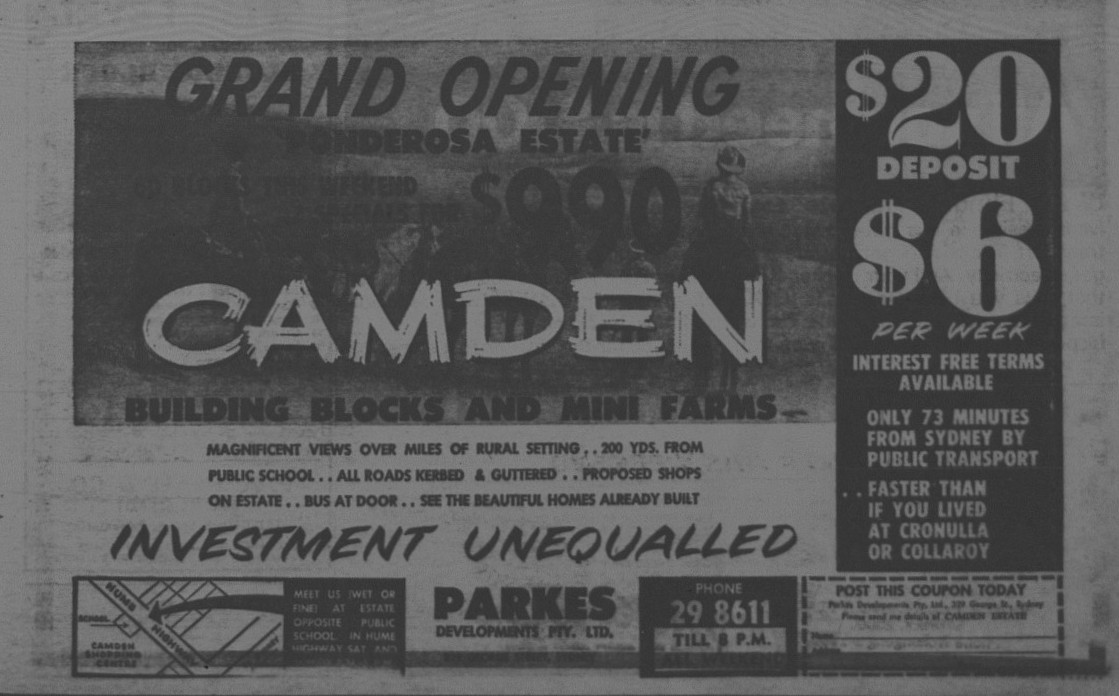
Property Advert of the Week: Ponderosa Estate, Camden (1968)

This week's property advertisement dates from 1968 where a block at Camden in Parkes Ponderosa Estate would cost you just $990. Talk about the mammoth returns one would get today given the area is now part of the urban sprawl of Sydney.

  Camden June 1 1968 daily telegraph 35

Source: Parkes Developments Pty Ltd. 1968. "Ponderosa Estate" (Advertisement). The Daily Telegraph,  June 1, 35.

Saturday, 23 January 2016

Property Advert of the Week: Landcom Rent Attack Television Advertisement (1993)

I'll make this the last television advertisement relating to Real Estate for the time being. This week, I share with you an advertisement that was screened on Channel Ten Sydney in 1993 by Landcom. If you were paying $160 a week in rent, they claimed it was better to buy a home instead. House and Land packages were on sale from $109 000, a good bargain. Wait there is more, how about selecting your choice of land (from a selection of locations) and your builder.


Saturday, 16 January 2016

Property Advert of the Week: Yeramba Estates Television Commercial (1992)

Back in October, I shared a newspaper advertisement published by Yeramba Estates in 1992 for house and land packages on the Central Coast. I managed to find one of the famous ads, which I believe dates back to the start of that year. This one was for the Lakelands Estate. The phone number has changed since 1992 - 9411 5155.


Saturday, 9 January 2016

Property Advert of the Week: Homeworld II Television Advertisement (1993)

I have shared over the course of time some newspaper advertisements for Homeworld II. I was eight years old and can recall very well back in 1993, this television advertisement promised that Homeworld would make "All your Dreams come true". It is through this advertisement how I came to be aware of Homeworld.


Saturday, 2 January 2016

Property Advert of the Week: Neeta Homes House & Land Packages, Rooty Hill (1986)

This week, I've decided to share a television advertisement, this time for house and land packages at Charlotte Road, Rooty Hill. It was developed by Neeta Homes.


Does anyone know what actually happened to Neeta Homes?

Note: Advertisement had been removed from Youtube as of December 2018.