Showing posts with label tollways. Show all posts

Monday, 10 February 2025

1987: Harbour Bridge Toll rises to $1

Sydney Harbour Bridge Toll Increase Ad May 30 1987 SMH 19
Source: NSW Department of Main Roads. 1987. "A dollar well-spent" (Advertisement). The Sydney Morning Herald, May 30: 19. 

In April 1987, the NSW State Government passed the Sydney Harbour Tunnel (Private Joint Venture) Act 1987 which gave formal approval for the construction of the Sydney Harbour Tunnel. 

Sydney Harbour Bridge Toll increase - enlargement April 28 1987 Daily Telegraph 4
Source: Armstrong, D. 1987. "Bridge toll $1 from end of May". The Daily Telegraph, April 28: 7. 

While the Sydney Harbour Tunnel would be tolled, the decision was made that month to increase the toll on the Sydney Harbour Bridge from 20 cents to $1, to aid in funding the cost of construction. The increase would commence on May 31 1987. 

20 cent tolls
Between 1960 and 1970, motorists using the bridge paid a 10 cent toll each way (1 shilling prior to introduction of decimal currency in 1966). For those commuting in both directions, it would total 20 cents per day.

In 1970, the northbound toll was abolished to improve northbound traffic flow and the southbound toll was doubled to 20 cents to compensate for the loss of revenue (Click here to read more about it). 

Therefore for the average commuter, the toll increase in 1987 would be the first increase to the toll since 1960.

How big was the increase?
The increase in the toll was 80 cents, but this represented a 500% increase. The commuter would now pay what was one week of toll payments in one day or five weeks of toll payments during the working week. 

Adjusted for inflation (RBA Inflation Calculator), motorists were paying the equivalent of 58 cents in today's money for a 20-cent toll. The increase to $1 would equate to paying $2.90 today which for many commuters is cheaper than current tolls  ($4.27 in peak periods, $3.20 off-peak and $2.67 for overnight travel).

Toll Collectors Strike
Toll Collectors went on strike on the weekend of May 30 and May 31 1987, delaying the toll increase by one day. They refused a pay increase of 4%, arguing for even higher wages as they felt that they would be at increased risk of abuse from angry motorists and also robberies.

Sydney Harbour Bridge Toll Increase June 1 1987 SMH 1 enlarged
Source: Aubin, T. 1987. "The toll 1987: bricks and hot coins". The Sydney Morning Herald, June 1: 1. 

The Reaction

Given the massive increase in the toll, this was not well received. For some, they responded by refusing to pay the toll, even though they faced fines of $50.

Warnings were given to drivers.

Sydney Harbour Bridge Toll Increase April 29 1987 daily telegraph 7
Source, Armstrong, D. 1987. "Big bills planned for toll evaders". The Daily Telegraph, April 29: 7. 

On day one, traffic volumes during the morning peak hour decreased by nine percent. 44 drivers refused to pay the toll while 14 paid for their tolls using 1 and 2 cent coins only. The general mood to the incerase was not positive

Sydney Harbour Bridge Toll Increase June 2 1987 Daily Telegraph 4 
Source: Grimshaw, P. 1987. "$1 toll slices bridge traffic". The Daily Telegraph, June 2: 4. 

The toll dodgers and those who opted for payment solely in 1 and 2 cent coins were confronted by the toll collectors and police.

Sydney Harbour Bridge Toll Increase June 2 1987 SMH 1 enlarged
Source: Aubin, T & Coultan, M. 1987. "Drivers for who the $1 tolls". The Sydney Morning Herald, June 2: 1. 

There was one backflip with the increase in tolls - 230 incapacitated service-men were exempt from paying the 20 cent tolls, but were required under the toll increase to pay the toll as with all other drivers. This was cancelled and they could continue to drive for free.

Sydney Harbour Bridge Toll Increase June 1 1987 SMH 5
Source: Thomas, C. 1987. "Brereton does a U-turn for angry old diggers." The Sydney Morning Herald, June 1: 5.

Monday, 18 April 2022

1970: One Way tolling introduced on The Sydney Harbour Bridge

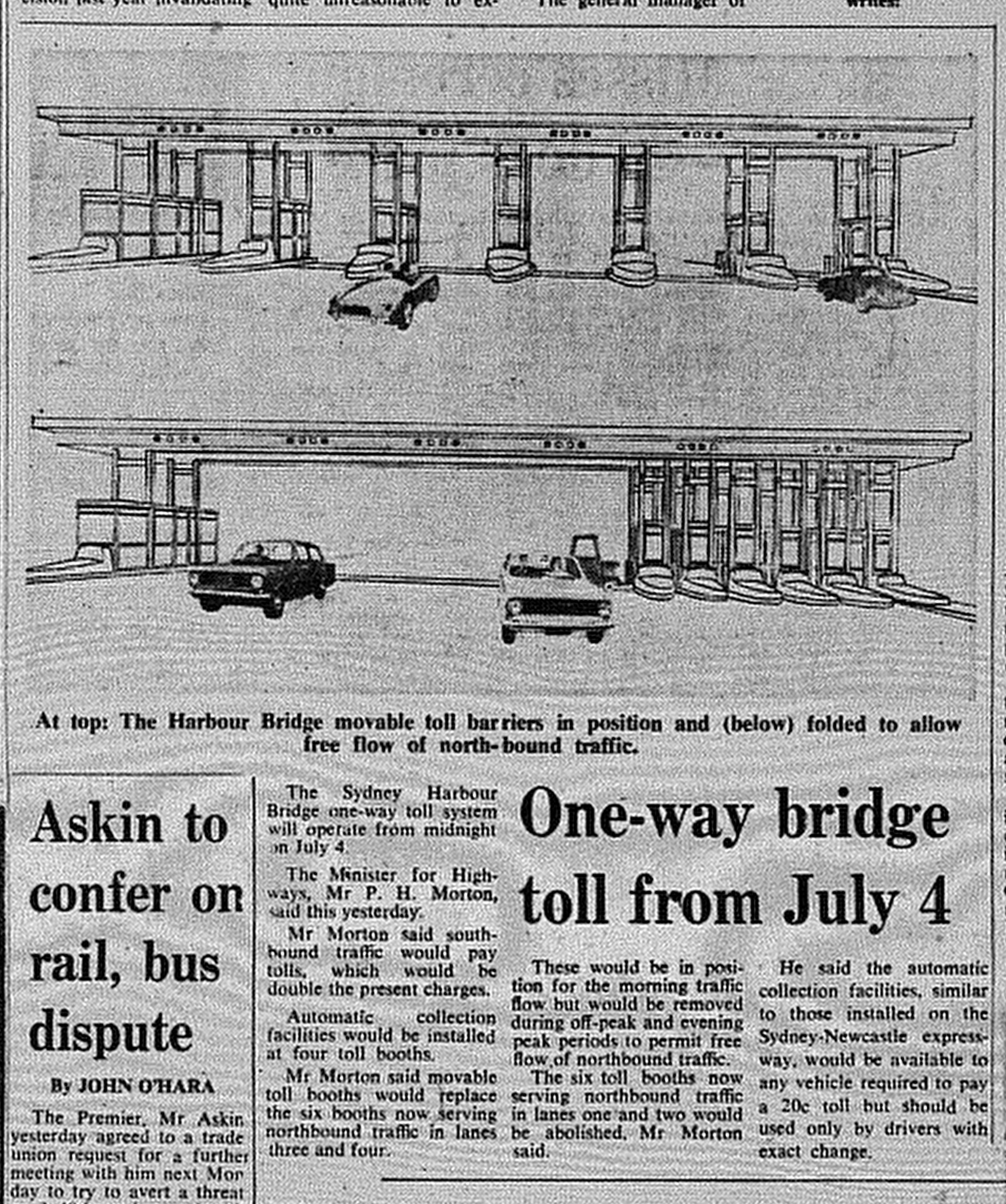
Sydney Harbour Bridge Tollgates June 20 1970 SMH 5


Source:  Anon. 1970. "One-way bridge toll from July 4". The Sydney Morning Herald, June 20: 5. 

From the opening of The Sydney Harbour Bridge in 1932 until 1970, vehicles crossing the bridge had to pay a toll in both directions. By the start of 1970, the toll cost ten cents, equivalent to $1.22 today. Relative to 2022, it was inexpensive, but still attracted complaints from motorists.

One way tolling began on July 4, 1970 with the purpose of improving the flow of northbound traffic especially during peak periods. To compensate for the loss of revenue from north bound traffic, the toll was increased to 20 cents (equivalent to $2.44 today), and would remain at that level until 1987. 

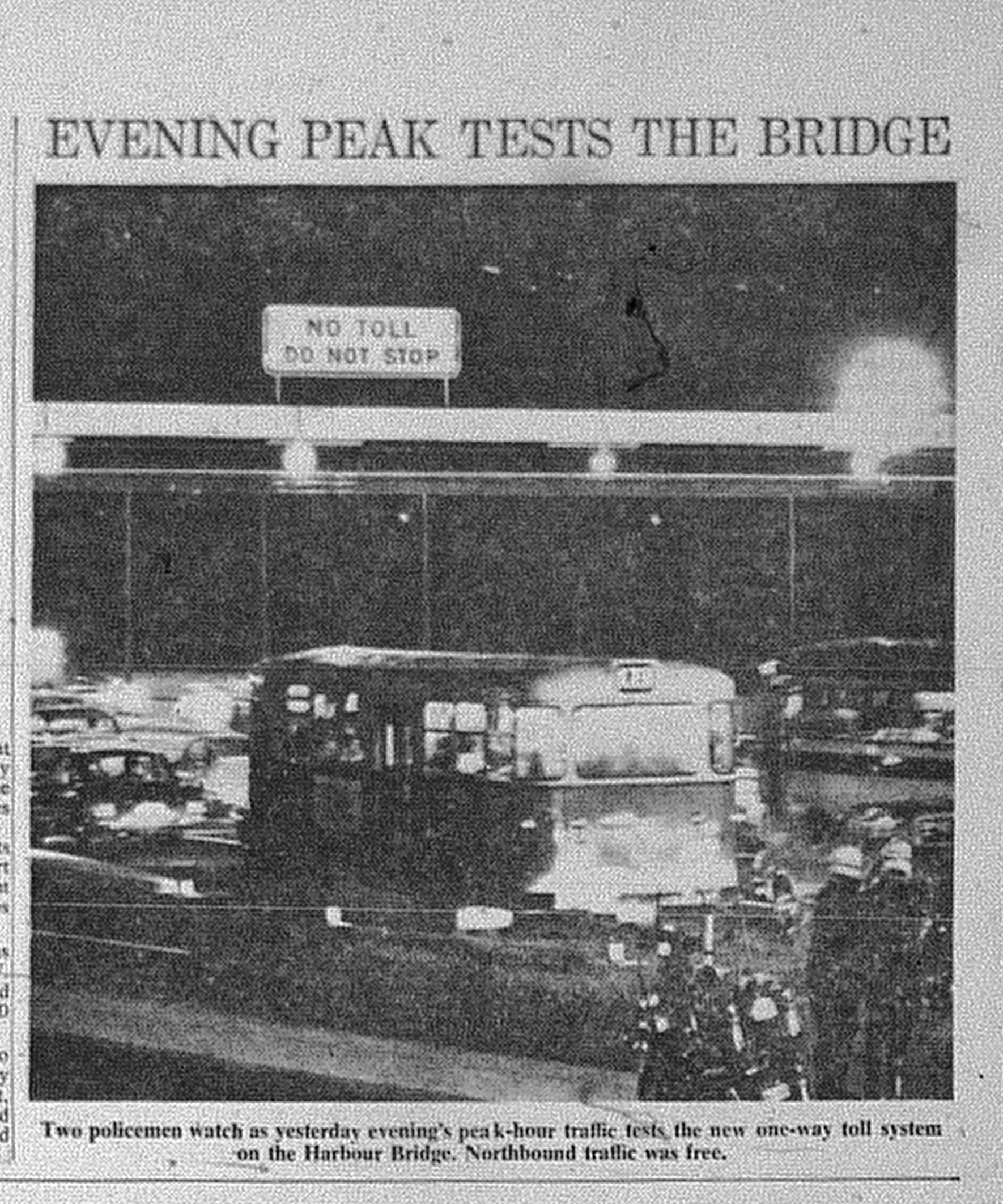
Sydney Harbour Bridge Tollgates July 7 1970 SMH 4
Source: Anon. 1970. "Evening Peak Tests The Bridge". The Sydney Morning Herald, July 7: 4. 

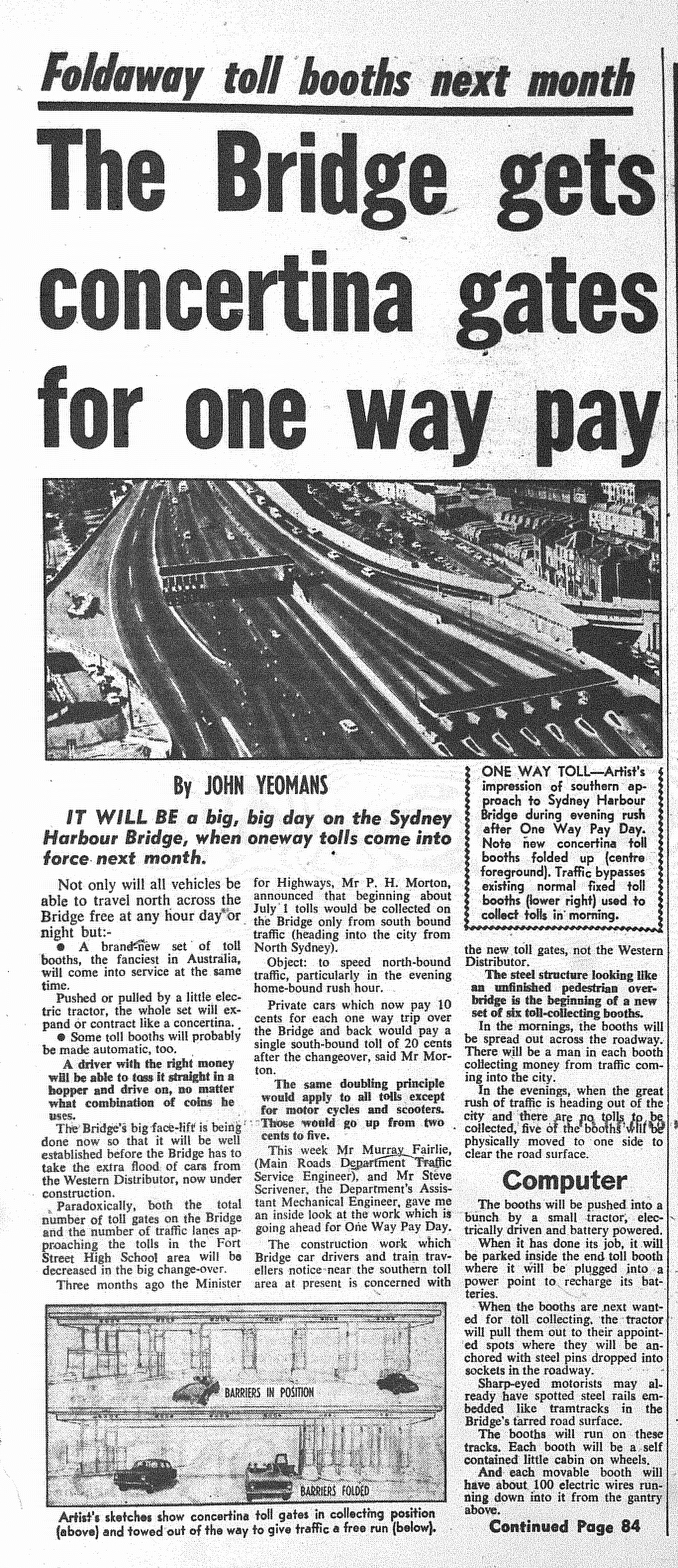
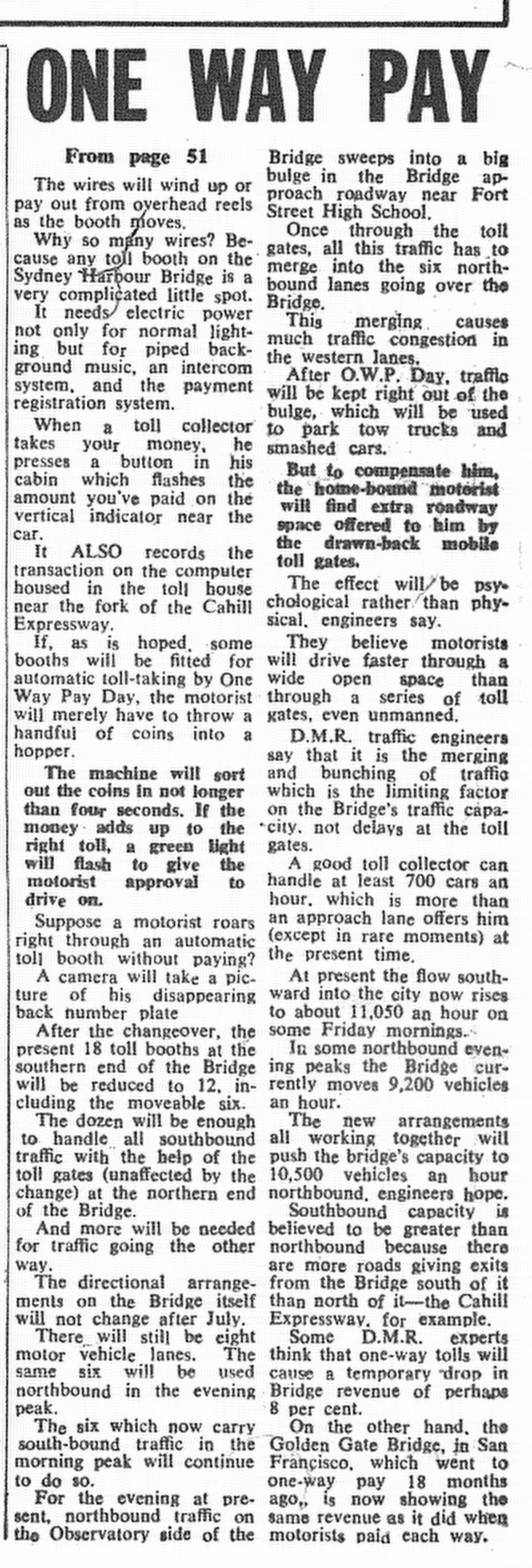
The shift to one way tolling saw the introduction of movable toll barriers that could be folded to allow for the free flow of northbound traffic in the evening, while serving southbound traffic during the morning peak. 

Sydney Harbour Bridge Tollgates June 7 1970 Sun Herald 51

Sydney Harbour Bridge Tollgates June 7 1970 Sun Herald 84
Source: Yeomans, J. 1970. " The Bridge gets concertina gates for one way pay". The Sun Herald, June 7: 51 & 84. 

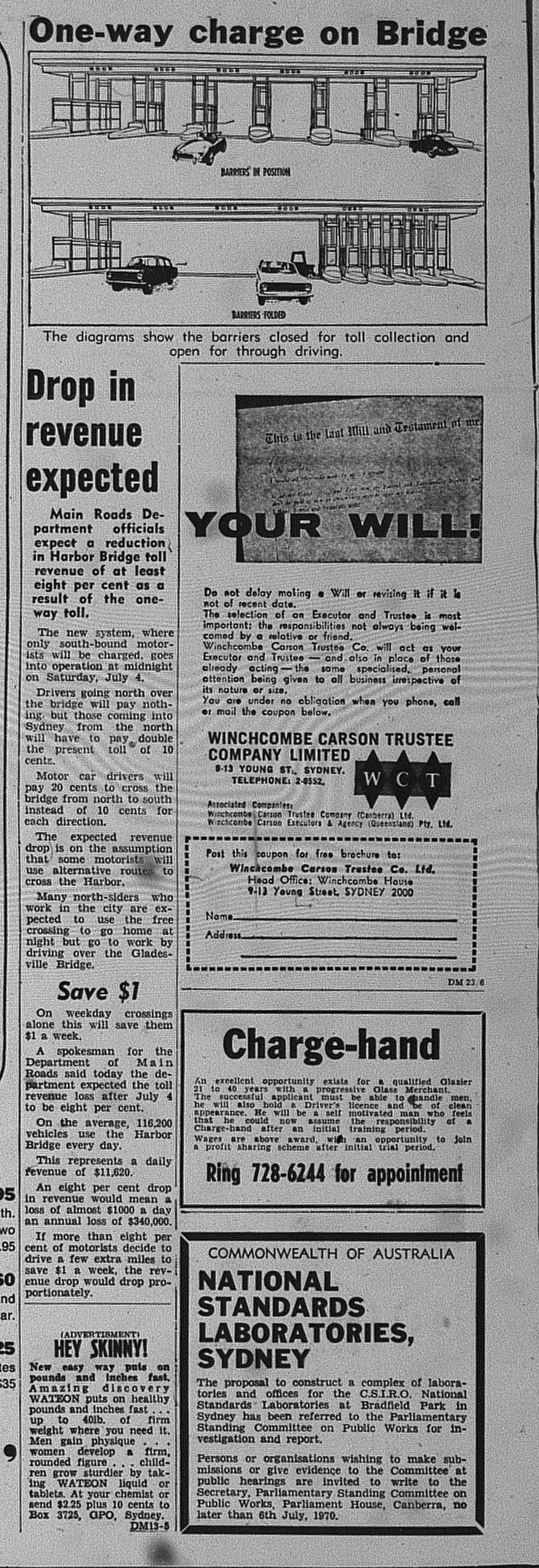
However the doubling of the southbound toll to twenty cents saw a drop in revenue as some drivers sought to save money travelling via the Gladesville Bridge. This was anticipated as reported by The Daily Mirror.

Sydney Harbour Bridge Tolls June 23 1970 daily mirror 24
Source: Anon. 1970. "One-way charge on Bridge". The Daily Mirror, June 23: 24.

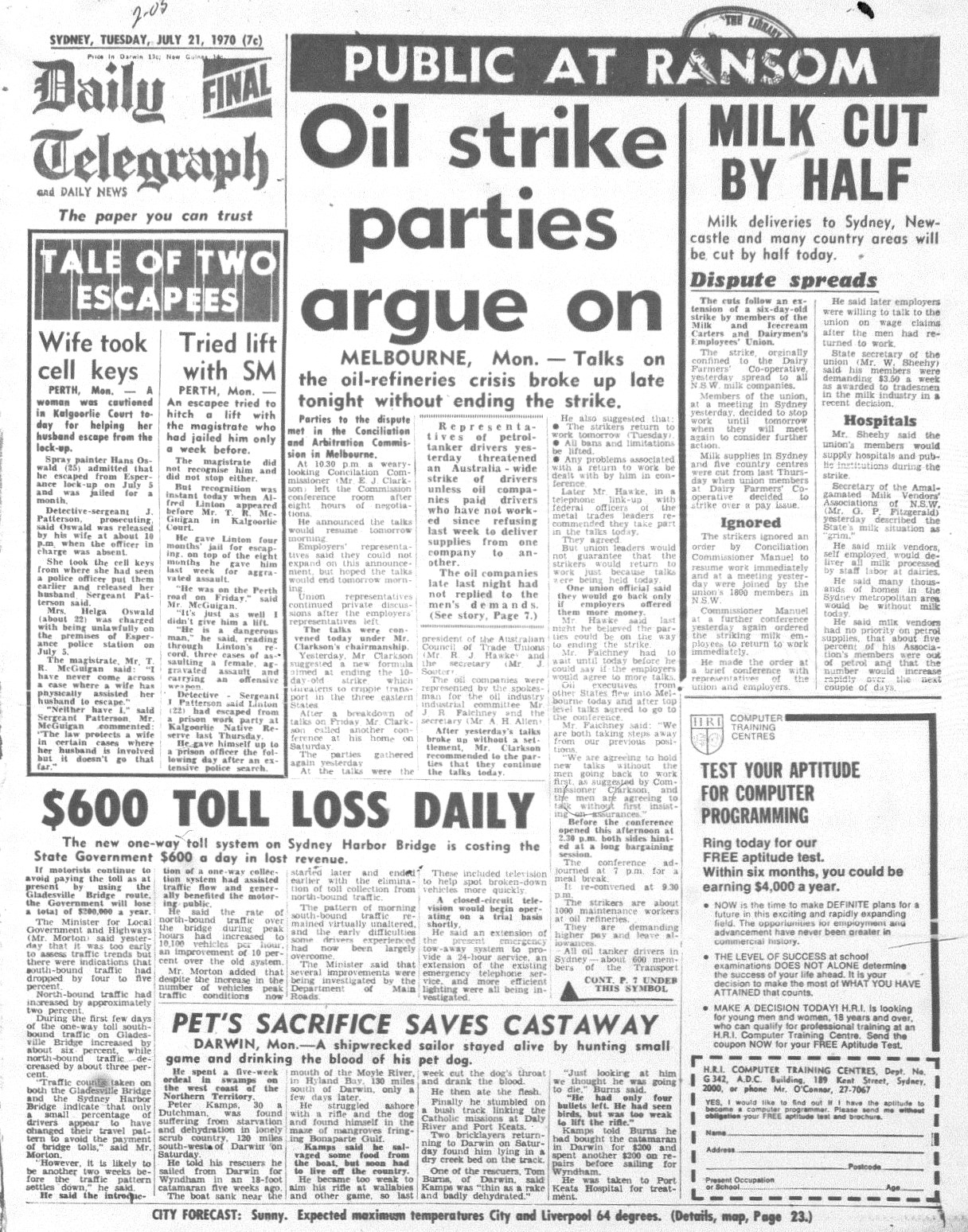
The Daily Telegraph (21 July 1970) reported that revenue from the tolls had decreased by an average of $600 per day, meaning that annual loss of $200 000 in revenue was projected.

Sydney Harbour Bridge Tolls July 21 1970 daily telegraph 1
Source: Anon. 1970. "$600 Toll Loss Daily". The Daily Telegraph, July 21: 1.

The toll booths operated until 2009, when e-tolling was made compulsory for motorists crossing the Sydney Harbour Bridge. However they were not removed until 2016. Below is a video from "Ventia" that was posted on Vimeo.


The RBA Inflation Calculator was used to determine the equivalent value of the tolls in 1970 against that of 2022, adjusting for inflation. 

Monday, 14 August 2017

MILESTONE: The M5 Motorway turns 25 (1992)

Today (August 14) is the 25th Birthday of the M5 Motorway. I have obtained material from the time of opening in 1992.


Source: Interlink Roads Pty Ltd. 1992. "M5" (Advertisement). The Sunday Telegraph, August 9: 48. 

When opened in August 1992, Stage 1 ran from Fairford Road, Padstow to the Hume Highway at Casula. Drivers were charged $1.50. When extended to King Georges Road, Beverly Hills several months later, the toll rose to $2. In today's money, that would be equivalent to $3.64. Excluding GST, motorists pay $4.04 to use the same road at present ($4.60 with GST).

The opening of the M5 was marred by protests. Premier John Fahey left it to his deputy and roads minister Wal Murray to open the road. Driving legend Peter Brock was the first driver on the new motorway. He was the marketing ambassador for its owner Interlink Roads.


Source: Skelsey, M. 1992. "M5 drama as 300 heckle Murray". The Daily Telegraph Mirror, August 15: 7. 

One challenge with new toll roads in Sydney has been the ability to attract traffic upon opening. The M5 was no stranger. Opening Day had virtually no traffic.

Even a year later, it was being criticized for the fact it took people "nowhere"


Source: Allan, C (Editor). 1993. "Making M5 a road to somewhere" (Editorial). The Daily Telegraph Mirror, November 1: 10. 

Not even promoting the motorway as the only way into Sydney worked.


Source: Stapleton, J. 1992. "This way to the M5 but where's the free way?". The Sydney Morning Herald, August 25: 4. 

Fast forward a quarter of a century later and the M5 is one of Sydney's most congested roads. Not even adding second and third lanes (1999 & 2011) in each direction would relieve congestion. The M5 East (2001) connected the motorway to the Orbital network, allowing motorists direct access into central Sydney, Sydney Airport and Port Botany.

Monday, 7 November 2016

1975: F6 Southern Tollway opens

NSW Premier Tom Lewis cuts the ribbon to open the Southern Tollway on July 24, 1975.

Source: Anonymous. 1975. "Lewis Opens Super Road". The Illawarra Mercury, July 25, 3. 

I am currently on a teaching appointment to a school in the Illawarra region and I am dependent on the F6 Southern Freeway (Renamed Princes Motorway) to get me there in just one hour.

I am one of thousands of commuters that are dependent on the freeway to get us from Sydney to Wollongong or vice versa each day, whether it is for work, education (University of Wollongong), to visit family or escape Sydney to visit the Illawarra or South Coast. It acts as a lifeline between the two cities. 

In past years, a trip by car to Wollongong entailed one to navigate the old Princes Highway and then snake their way down Bulli Pass to get into Wollongong. It was not a safe trip either.

Planning for the freeway did begin in the 1930s but World War II halted planning. This was revisited in the 1950s with the vision to build a freeway from Sydney through to Wollongong. A corridor was designated from Waterfall to St Peters and remains untouched, though a number of parks run into the corridor like Scarborough Park at Kogarah. The only section built was Captain Cook Bridge at Taren Point which opened in 1965. Meanwhile, a freeway corridor was reserved in Wollongong, which incorporated Mt Ousley Road which had been built in World War II to improve transport movements from Sydney to the Illawarra.


Source: Anon. 1970. "Toll Road Job to Start Soon". The St George and Sutherland Shire Leader, June 10: 11.

The corridor from Waterfall to Bulli Tops was gazetted in 1952. Approval to construct a km tollway was given in 1970. Construction commenced in June 1970. After delays in construction (original completion was late 1974), the $18 million tollroad was officially opened to traffic on July 24 1975 by NSW Premier Tom Lewis. The premier hailed it as a "masterpiece of design and workmanship". Motorists were charged a toll of 40 cents to drive between Waterfall and Bulli Tops. With a speed limit of 110km/h, a person can cover the entire 22 kilometre freeway in just 12 minutes.


Source: Anon. 1975. "Cars Queue to Try Tollway: Premier Opens Super Shortcut". The Illawarra Mercury, July 25: 3. 


With the route prone to fog, electronic signage was provided to alert drivers to changes in road conditions including variable speed limits. This is shown in the WIN News Illawarra archives which was shown in 2015 to mark its 40th anniversary.


Source: Win News Illawarra. (2015)."Construction of the F6 Freeway. [Online Video]. 21 July 2015. Available from: https://www.youtube.com/watch?v=riqehUWuHdQ. [Accessed: 3 November 2016].

 Tolls were abolished in 1995 to encourage heavy vehicles to use the freeway instead of the Princes Highway which "had a poor accident record", and reduce business costs. 


Source: de Vine, B. 1995. "State Government abolishes F6 charge". The Daily Telegraph Mirror, May 17:5.


Source: Zeller, F. 1995. "F6 a free way ...but Knight shies from M4, M5 pledge". The Daily Telegraph Mirror, July 1: 9. 

In 2000, an interchange was opened at Helensburgh to improve access to the suburb along with Stanwell Park.

As for linking the (now) Princes Motorway into Sydney's network of motorways, the planning continues more than six decades later. The NSW Government has now referred to the southern freeway as "SouthConnex" and is planned to be a priority once the NorthConnex and West Connex projects are completed. Below is a recent report from Seven News relating to the F6 Motorway.


Monday, 26 October 2015

1991: The Harbour Bridge Toll spike

I'm posting this out more for interest's sake this week, because when I came across it, it just took me with a lot of interest, given the debate about tolls in Sydney to access roads.

I recall as a kid during the 1990s that it cost about $2 to cross the Sydney Harbour Bridge (or tunnel) which to many seemed like a small fortune.

That is pretty good compared to three dollars that the Greiner Government was proposing as a way of reducing air pollution in Sydney which was still causing headaches to all.

It was not until 2002 that the toll was increased to $3. There was an increase from $2 to $2.20 in 2000 due to the introduction of the Goods and Services Tax.

The toll is still $3 if you travel between 9:30am and 4pm on weekdays, and rises to $4 during peak periods (as a means of trying to reduce traffic flow). However, travel late at night or on weekends and you now pay a nice $2.50.


Source: Worthington, J. 1991. "Harbor Bridge $3 Toll Tipped".  The Daily Telegraph, November 12: 7.

Sunday, 19 July 2015

1999: Frank Sartor & the Cross City Tunnel

In 1999, planning was underway for the Cross City Tunnel. Sydney City Council was led by Lord Mayor Frank Sartor.

At the time, the Roads and Traffic Authority (RTA) had proposed a 1.6-kilometre tunnel to run under the city from the intersection of Druitt and Kent Streets through to the Eastern Distributor with portals linking through to William Street. Motorists would pay a $2 toll.


Source: Skelsey, M. 1999. "Digging deeper: Sartor pushes $140m city tunnel extension". The Daily Telegraph, April 13: 15.

Frank Sartor commissioned a study to determine whether it should be extended further. Leading architects, Donald Crone, Harry Seidler and Phillip Cox proposed extending it through the eastern end of the Kings Cross Tunnel at Rushcutters Bay. This would also allow the council to fulfil their decades-long vision of turning William Street into a pedestrian boulevard.

In September that year, the tunnel was extended to Kings Cross end of the Kings Cross Tunnel with a $2.50 toll. Three years later, the final route extended it further east to the Rushcutters Bay end of the Kings Cross Tunnel.

As for the boulevard, the opening of the tunnel in 2005 led to an attempt to reduce the number of lanes on William Street. This failed when traffic stayed away from the tunnel due to the initial $3.56 toll. William Street still carries large traffic volumes. As for the council, that vision for William Street, remains a vision.