Showing posts with label motor transport. Show all posts

Monday, 9 December 2024

1982: Introduction of Random Breath Testing (RBT)


In 1978, 1384 people died on New South Wales (NSW) roads and it was the deadliest year on record for road fatalities in the state. At the end of the 1970s and into the early 1980s, around 1300 people were dying on average in road accidents across New South Wales.

Drink-Driving was identified as a significant factor contributing to the death toll, with around 40% of road fatalities resulting from a driver driving under the influence of alcohol. Such deaths were identified as preventable.

In September 1982, the State Government Safety Road Committee recommended the introduction of Random Breath Testing (RBT). It was to be trialled for three years and became permanent in 1985.

RBT September 30 1982 daily telegraph

Source: Grimshaw, P. 1982. "Tough new blitz on roads". The Daily Telegraph, September 30: 1.

RBT commenced on Friday, December 17 1982, and drivers were warned of police presence on the roads.

RBT December 17 1982 daily telegraph 2

Source: Stanley, A. 1982. "Breath test blitz all weekend". The Daily Telegraph, December 17: 2. 

The first tests were undertaken on Parramatta Road at Granville after 7 pm.

RBT December 18 1982 daily telegraph 2
Source: Crosthwaite, R.  1982. "First drivers all under limit". The Daily Telegraph, December 18: 2. 

It was reported that road deaths had started decreasing in the lead-up to the introduction of RBT because it triggered, for drivers, a fear of being caught drink driving. RBT led to the introduction of the booze buses where further testing could occur.

RBT December 16 1982 daily telegraph 5

Source: Stanley, A. 1982. "Publicity on tests hammers fear in drivers". The Daily Telegraph, December 16: 5. 

Below is a newspaper advertisement explaining how RBT would work. It was "quite simple".

RBT Ad December 14 1982 daily telegraph 12

The legacy of RBT

The introduction of RBT has contributed to the overall decrease in the road toll in NSW. By 1985, the annual road toll had dropped to less than 1100. By 2021, the road toll had dropped to 270, the lowest figure since 1923 (COVID restrictions, especially in the second half of 2021, meant fewer vehicle movements), before settling at 349 in 2023.

Other key figures that show the success of RBT include:
  • The share of deaths resulting from drink driving annually has halved from around 40% to as little as 17%.
  • The overall number of deaths as a result of drink driving has decreased by nearly 90% in the past four decades.
RBT has also changed the way that people drink when they are out. One could no longer stop at the pub for a drink on the way home if they were driving or restricted their drinking. On the positive side, it encouraged responsible drinking, and for those who wished to have a drink, consider other options for transport, such as using public transport, having a friend or family member drive who would not drink, or using taxis (and ride-sharing in more recent years).


Monday, 9 December 2019

MILESTONE: The Eastern Distributor turns 20 (1999)


Source: McCabe, K. "Freeing up east's road jams tonight". The Sunday Telegraph, December 19: 48.

This month, the Eastern Distributor will celebrate 20 years of service to Sydney motorists. The motorway was opened on December 19, 1999 although the on and off ramps at William Street did not open until July 23 2000.

The opening of the Eastern Distributor also led to significant changes in traffic flow in inner Sydney. South Dowling Street was reduced from three lanes to two in each direction while Crown and Bourke Streets were restored into two way streets. Crown Street had fed northbound traffic while Bourke Street carried southbound traffic.

This was not welcomed by motorists, some of whom refused to initially pay the one way toll ($3) and continued their old habits believing that there would be a "rat run" on offer. Traffic changes placed priority on local traffic and increased travel time for the "rat runners". Some were not aware of the changes and had to make long detours to reach their destination.

It did lead to rethinking on whether or not toll free routes should offered to motorists. Now it is an  expectation that one should be provided e.g. Parramatta Road acts as a free alternative to the M4 and Westconnex Motorways.

For others, the new motorway was a blessing which meant no longer needing to drive through inner Sydney streets to reach the city or cross the harbour. They could avoid up to 17 traffic lights.

Below is some media coverage from The Daily Telegraph. 


Source: Lipari, K. 1999. "The lights are green, but nobody's moving". The Daily Telegraph, December 24: 6. 


Source: Trute, P. & Luff D. 1999. "Long way home for toll dodgers: But it's a smooth run on the motorway. The Daily Telegraph, December 21, 4 & 5.

Monday, 25 June 2018

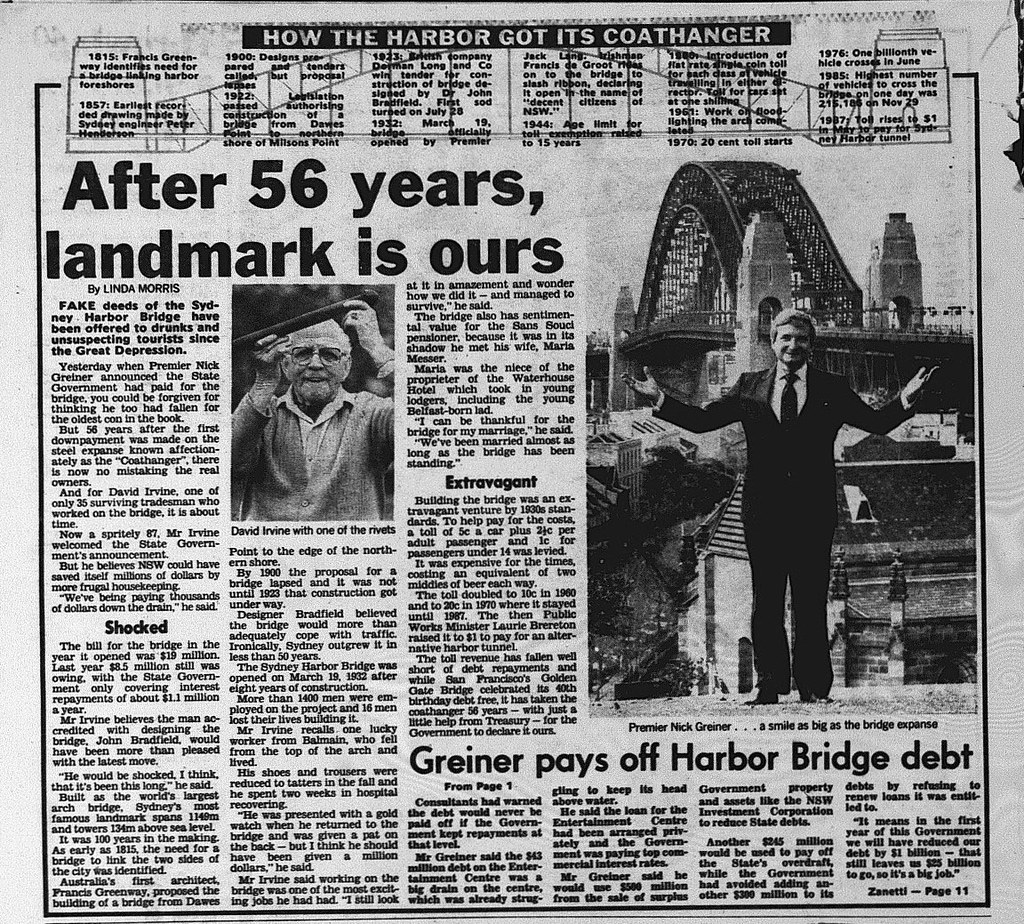
1988: Harbour Bridge debt is finally paid off...but the tolls stayed

After 56 years, the people of NSW finally paid off the cost of building the Sydney Harbour Bridge in 1988. However, the toll was still be levied to pay for the under-construction Sydney Harbour Tunnel.

Fast forward 30 years and the toll revenue is generally used for road projects across NSW. However, there is speculation by some that the current southbound toll ($2.50 to $4 depending on the time of day) could increase.

In Sydney, once a toll goes up on road, its hard to end. Even where it's been abolished (M4), it only has taken a few years for their return.

Below is coverage from the July 25, 1988 edition of The Daily Telegraph.


Monday, 27 November 2017

1970: The Origins of Shorelink

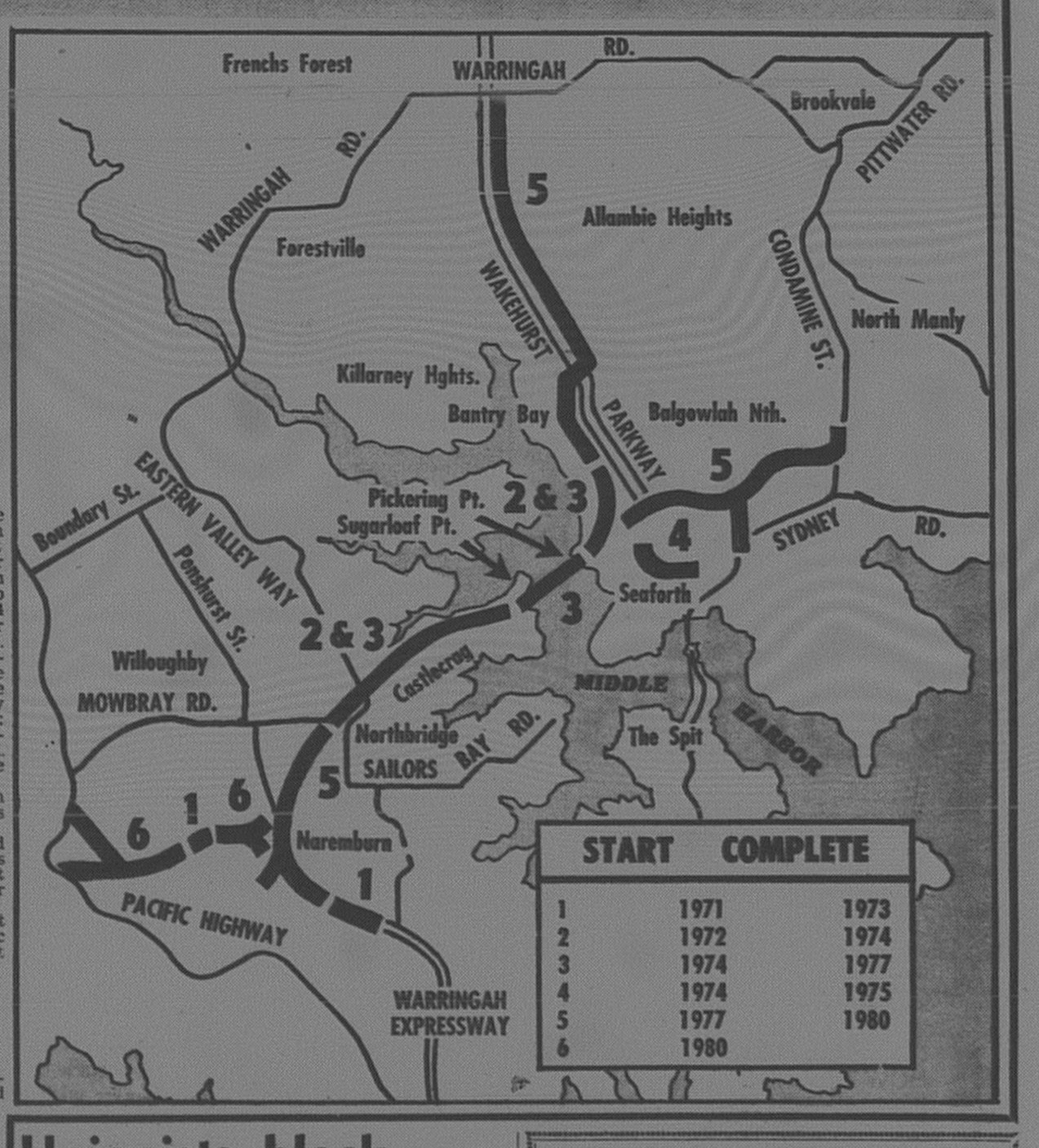
I was having a look at the proposed corridor for the proposed Shorelink tunnel and noticed that the route is virtually identical to that proposed by the NSW Government in 1970.

The only difference between the 1970 and 2017 is that the 1970 proposal was above ground whereas it will be tunneled under this plan.

1970

Middle Harbour Bridge April 3 1970 daily telegraph 3 closeup

Source: Anon. 1970. "Bridge for Middle Harbour". The Daily Telegraph, April 3: 3.

2017

Spit Bridge tunnel map

Source: NSW Government (2017). [image] Available at: http://www.abc.net.au/news/2017-07-18/spit-bridge-tunnel-map/8718496 [Accessed 20 Nov. 2017].

Below is the full article on the 1970 scheme as covered by The Daily Telegraph. This included a proposal for a double-decker bridge over Middle Harbour. The estimated cost was $70 million ($781 million in today's money). Compare it with the estimated $3 billion to be spent with the 2017 scheme which is tunneled. Estimated completion - 1980.


Source: Anon. 1970. "Bridge for Middle Harbour". The Daily Telegraph, April 3: 3.

Monday, 28 August 2017

MILESTONE: Sydney Harbour Tunnel turns 25 (1992)

Another milestone to celebrate this week. This week we celebrate 25 years of service of the Sydney Harbour Tunnel to the citizens of Sydney.

With congestion increasing on the Sydney Harbour Bridge in the 1980s, the need for a second harbour crossing was pushed further.

Plans for a harbour tunnel evolved throughout the 1980s, but it was not until 1986 where concrete plans were proposed. Initially, the tunnel was to run from Hickson Road, Millers Point and run west of the Harbour Bridge. Like the final plans, it would meet the Warringah Freeway at Mount Street, North Sydney.


Source: Coultan, M. 1986. "Tunnel: how pipedream will become pipeline". The Sydney Morning Herald, March 14: 1. 

Several months later, the proposal we see today was conceived in an attempt to reduce construction costs. While the motives might not be just, the decision had a long run outcome - The Harbour Tunnel would form a piece in what has evolved into Sydney's orbital network of freeways. Under the Hickson Road plan, this would not be possible.


Source: Coultan, M. 1986. "Slimmer Harbour tunnel to save $35 million. The Sydney Morning Herald, December 17: 1 & 2. 

There was one proposal that was tendered by a firm that for around $100 million, four lanes could be constructed above the existing road deck to increase road capacity. This was published in The Daily Telegraph Mirror on August 27, 1992, in a special supplement to mark the opening of the tunnel.


Plans to proceed with construction were announced by the NSW State Government on April 27, 1987. This included increasing the Harbour Bridge toll from 20 cents to $1 to fund its construction. It rose to $2 by 1992.

Kirribilli residents objected to the tunnel, particularly as the air ventilation stack would be located at Bradfield Park. Today, anyone using the park would be unaware of its presence, landscaped into the terrain.

Transfield and Kumagai Gumi were awarded the contract to construct the tunnel. Construction largely took place off-site with tunnel sections built at Port Kembla, before being towed into Sydney where they were sunk into place at the bottom of Sydney Harbour. Official work commenced in 1988.

On August 29, 1992, NSW Premier John Fahey officially opened the tunnel. The opening was marred by protestors that wanted to disrupt the event. The following day, the public was invited to walk through the tunnel. The walk acted as a fundraiser for charity.


Source: Wilkins, M. 1992. "Light at the end of the tunnel...Greenies 'crash' the party". The Sunday Telegraph, August 30: 4.  

The tunnel was opened to traffic at 3am on August 31, 1992. It survived its first peak hour test without glitches.


Source: de Vine, B & Toy, N. 1992. "It's Perfect: Tunnel opens with dream run". The Daily Telegraph Mirror, August 31: 1 & 2. 

Like any expansion to a road, a new road will only take the pressure off an existing road for a short period of time before traffic levels return to previous levels. It's not uncommon for traffic on the Warringah Freeway to be banked "past the channel nine tower" at Willoughby in morning peak hour irrespective of whether you are bridge-bound or tunnel bound. Add the congestion once you cross the bridge, and trek down the Eastern Distributor towards Sydney Airport. An estimated 200 000 cars crossed the Sydney Harbour Bridge daily at the time of opening in 1992. Today, it is estimated to be around 165 000 cars that cross the bridge. When combined with RMS data of approximately 90 000 cars that access the Harbour Tunnel, 245 000 cars cross the harbour each day. 

Statistics of Interest:

  • Construction costs amounted to $560 million.
  • Estimated savings in travel time - 10 minutes.
  • 4500 workers involved in construction along with 300 contractors.

The Daily Telegraph Mirror to mark the opening provided its readers with a special poster outlining construction. 


Monday, 14 August 2017

MILESTONE: The M5 Motorway turns 25 (1992)

Today (August 14) is the 25th Birthday of the M5 Motorway. I have obtained material from the time of opening in 1992.


Source: Interlink Roads Pty Ltd. 1992. "M5" (Advertisement). The Sunday Telegraph, August 9: 48. 

When opened in August 1992, Stage 1 ran from Fairford Road, Padstow to the Hume Highway at Casula. Drivers were charged $1.50. When extended to King Georges Road, Beverly Hills several months later, the toll rose to $2. In today's money, that would be equivalent to $3.64. Excluding GST, motorists pay $4.04 to use the same road at present ($4.60 with GST).

The opening of the M5 was marred by protests. Premier John Fahey left it to his deputy and roads minister Wal Murray to open the road. Driving legend Peter Brock was the first driver on the new motorway. He was the marketing ambassador for its owner Interlink Roads.


Source: Skelsey, M. 1992. "M5 drama as 300 heckle Murray". The Daily Telegraph Mirror, August 15: 7. 

One challenge with new toll roads in Sydney has been the ability to attract traffic upon opening. The M5 was no stranger. Opening Day had virtually no traffic.

Even a year later, it was being criticized for the fact it took people "nowhere"


Source: Allan, C (Editor). 1993. "Making M5 a road to somewhere" (Editorial). The Daily Telegraph Mirror, November 1: 10. 

Not even promoting the motorway as the only way into Sydney worked.


Source: Stapleton, J. 1992. "This way to the M5 but where's the free way?". The Sydney Morning Herald, August 25: 4. 

Fast forward a quarter of a century later and the M5 is one of Sydney's most congested roads. Not even adding second and third lanes (1999 & 2011) in each direction would relieve congestion. The M5 East (2001) connected the motorway to the Orbital network, allowing motorists direct access into central Sydney, Sydney Airport and Port Botany.

Monday, 15 May 2017

1997: M2 Motorway opens to the Public

In 1997, those in the booming North West suburbs now had a motorway that would make travel much easier, but yet they were reluctant to use it despite the reductions in travel time that it promised.


Source: Hilferty, T & Walsh, P. 1997. "M2 Chaos: Traffic anger as tollway opens". The Daily Telegraph, May 26: 1 & 2. 

 And then there were those who opposed it because it involved the loss of trees and vegetation. They were vocal from the planning stages and even on opening day wanted to spoil the celebrations. While for others, it was the fact one had to pay for the toll ($2.50).

Three months later, people still stayed away.

  
Source: Gibson, B. 1997. "Going nowhere fast". The Daily Telegraph, August 9: 15. 

Eventually, the motorway did fill up with traffic and would form a piece of the Sydney Orbital network. Early in 2006, the M7 allowed drivers on the M2 a direct link through western Sydney down to the M5 Motorway and Hume Highway. In 2007, the Lane Cove Tunnel connected the M2 to the Gore Hill and Warringah Freeways.

During 2011 and 2013, an additional lane was added in each direction with improvements to on and off ramps.

Currently, the NorthConnex Project will connect the M2 Motorway to the M1 Motorway. This will be completed in 2019. Drivers will no longer need to use Pennant Hills Road or the Pacific Highway if driving in or out of Sydney.