
Source: G. L. H. Young Pty. Ltd. 1966. "Winston Hills. New Oakdale Estate". The Daily Telegraph, March 26: 40.
Note: Advertising in pounds, shillings and pence was permitted for two years following the introduction of decimal currency in 1966.


This weeks advertisement is from my collection of real estate advertisements for the suburb of Wattle Grove. This one was published in The St George and Sutherland Shire Leader in 1993 to promote a new land release. Blocks of land could be purchased for as low as $60 000.
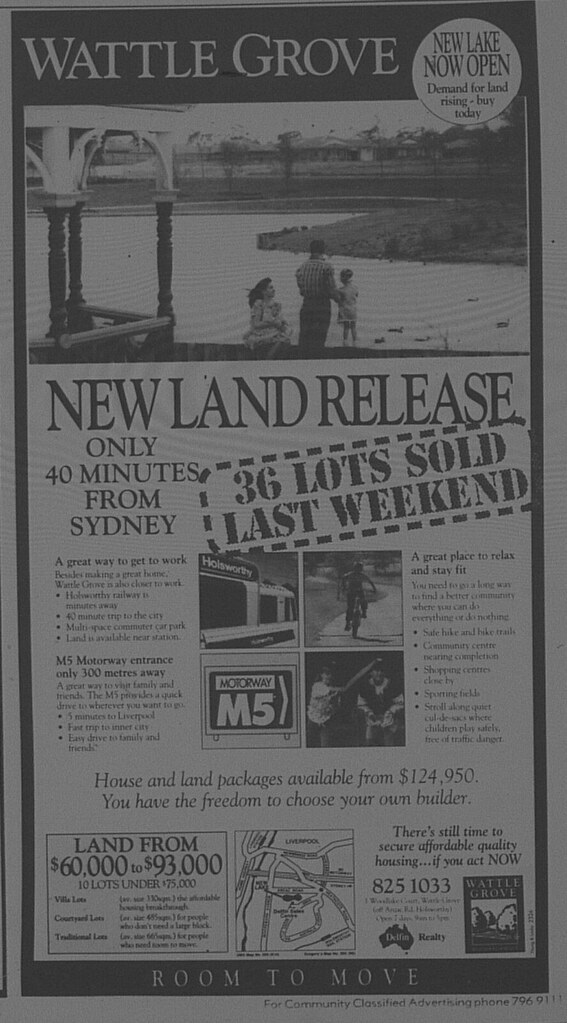
Source: Delfin Reality. 1993. "Wattle Grove" (Advertisement). The St George and Sutherland Shire Leader, April 13: 6.
 |
| Photo taken by the Author (2021). |
The King George Tower (commonly known as the American Express Building) at the corner of George and King Street's was designed by John Andrews. The office building completed in 1976 rises to a height of 131 metres or 32 storeys. In 1983, it won the John Sulman medal.
It was an innovative building for its time, particularly for attempts to promote energy efficiency and facing the corner of two city streets.

Source: Totaro, P. 1996. "Tower branches out into $60m greenhouse". The Sydney Morning Herald, March 12: 5.
Two decades later, building owners AMP Capital and Industry Superannuation Property Trust decided to upgrade the building to make it Sydney's first "bio-climatic" tower. The idea was to ensure that it remained innovative by incorporating new technologies to boost energy efficiency.
Gardens would be placed at various levels on the south west corner of the tower while innovative glazing would replace the polycarbonate sunshades. Both would work in tandem to control the temperatures inside the building.
Shops that were located underground were moved up to street level, reflecting the desire of Sydney City Council to boost street activity and improve the streetscape.

Source: Susskind, A. 1998. "Architect sees prized tower turned into a 'joke'". The Sydney Morning Herald, April 16: 3.
As the refurbishment neared completion in 1998, architect John Andrews expressed his dismay telling The Sydney Morning Herald that he tried to "avoid looking at it" and that Sydney City Council was "gutless" for approving it and allowing it to be "ruined". However those associated with the refurbishment claimed that articles had been written about it and that there was an interest by university students and architectural firms for tours.
Current owners, Investa and Brookfield recently undertook another refurbishment of the tower. The podium was renovated and the gardens have disappeared. They have maintained the focus on energy efficiency and environmental sustainability. In addition a six level mixed retail and commercial annex was constructed.
There will be those who will not agree with the renovations as some buildings are to be preserved in their original shape or form but modern skyscrapers do need the ability to evolve with the times and to respond to the needs of businesses that seek office space. 388 George Street also faces competition in attracting tenants to city towers, especially with the options available at Barangaroo and soon to be at Circular Quay. 388 George Street is a building that seeks to reflect current innovations and I see that as the years progress, it will be a building that adapts to the times.
Below are photos of the recently renovated podium taken by yours truely.


In 1996, the chimney at the former Nestle Factory in Abbotsford was demolished as part of the redevelopment of the site into a new medium density development - Abbotsford Cove. The factory operated between 1918 and 1991.
Below is an article from The Daily Telegraph reporting on the demolition.

Source: Seymour, T. 1996. "Old chimney falls from grace". The Daily Telegraph, September 2: 3.
The Chimney was demolished on September 21 1996 with the public invited to attend. Peter Wilkin, a student from Abbotsford Public School pressed the trigger. An estimated 1000 people attended and were treated to a sausage sizzle and entertainment.

Source: Banks, A. 1996. "Down the chimney". The Sunday Telegraph, September 22:39.
Canada Bay Council Local Studies Collection have published a photo of the demolition. They claim it was circa 1995, which contradicts the newspaper reports.

Source: van Gerwen, A. 2012. Abbotsford Cove. Image. https://www.flickr.com/photos/canadabayconnections/7174613344/in/photolist-bVZJsQ-bVZLA5. Accessed 17 February 2021.
Nestle no longer produce their products in Sydney, they maintain a corporate presence at Rhodes and a distribution centre is located at Arndell Park.

 |
| Full Citation Below |
In 2016, I published an entry on the opening of Westfield Burwood in 1966. This year, the complex will turn 55. Below is a clipping from The Daily Telegraph in July 1964 relating to the announcement of plans by Westfield to construct the centre. One eventual tenant (Mark Foys) was reported to have announced that they would open a store in the new centre.

Source. Anon. 1964. "£2m. Plan for Burwood". The Daily Telegraph, July 1:9.
This was not the final scheme. In June 1965, The Sydney Morning Herald reported that the planned shopping centre had enlarged to encompass more of the block, which would be the built design. Additional retail space was added along with an office block facing Burwood Road.


Source: Anon. 1965. "Myer's Gets Store Site Sought by Mark Foy's". The Sydney Morning Herald, June 17: 1.
Despite three years of negotiations, Mark Foys was unsuccessful to act as the anchor for the new centre. Farmers (owned by Myer) was successful in securing the lease for 100 000 square feet of space (up from 80 000 square feet in the previous scheme). Mark Foys had to settle for a smaller space within the centre.
Related:
MILESTONE: Westfield Burwood opens (1966)
Below is a newspaper advertisement featuring model homes on offer from Archer Homes dating from 1965.

Source: Archer Homes Pty. Ltd. 1965. "See the value and build with Archer" (Advertisement). The Daily Telegraph, April 10:22.
The homes featured in the advertisement were:
"Camden" (Pendle Hill)
"Sylvan" (Sylvania Heights)
"Pacific" (Villawood)
More than fifty five years later, the "Camden" is still standing at 568 Great Western Highway, Pendle Hill, along with the "Sylvan" at 378 Princes Highway, Sylvania Heights.
 |
| Hotel InterContinental Sydney. Photo taken by the Author (2020). |
The Hotel InterContinental Sydney is one of the best hotels to stay with a five star rating. It has been open since 1984 and was built on the site of the former Treasury Building, which was incorporated into the hotel.
In 1988, its owner - English Tycoon and owner of the hotel Lord Alistair McAlpine purchased the adjoining Transport House (1938) for $69 million dollars, outbidding Sid Londish and a Japanese consortium.
He bought the building because he was worried that a future development of the site would block the views of the Opera House and Sydney Harbour which allowed the hotel to charge a premium for its a visitors. This was his justification for the price. Londish only bid $45 million.
 |
| Transport House as viewed from Phillip Street. Photo taken by the Author (2021). |
His vision was to incorporate Transport House into the InterContinental Hotel. Today, it is still owned by the hotel but provides office space. It has been listed by the NSW Government on the State Heritage Register. In 2019, there was a proposal to build a ballroom atop the building, but Sydney City Council raised heritage and visual concerns.
Looking back at McAlpine's decision, it has proven to be a wise decision. Apart from rental on the office space in Transport House and the ability to extend the hotel onto the site, the hotel has never had to worry about the loss of harbour views. It has allowed for the hotel to continue to charge a premium and remain as one of the leading hotels for visitors to Sydney. Imagine the loss of income from rooms had he not bought the building, and the impact would be more than $69 million in the long term.
And also it saved another old building from potential demolition.

