Monday, 21 November 2022

SYDNEY RETAILING: Midnight Shopping (1987)

Pitt Street Mall September 25 1987 The Sun 5

Source: Anon. 1987. "Midnight Mall A Smash Hit". The Sun, September 25:5.

In 2022, its possible for Sydneysiders to shop very late in the evening, though the offerings are limited. Selected Woolworths and Coles Supermarkets can trade until midnight. Several Kmart stores trade 24 hours. 

It has aided those who work outside of normal business hours or shift workers or those in desparate need of something and cannot wait until the following morning.

Pitt Street Mall September 22 1987 daily mirror 15 

Source: Anon. 1987. "Midnight Bonanza" The Daily Mirror, September 22: 15.

Thirty five years ago, Sydney took a bold step in retail trading hours when for the first time, retailers were allowed to trade until midnight.

It was a one-off event - 24 September 1987. Retailers in the Pitt Street Mall were allowed to trade until midnight that evening as it was the first thursday evening of trading since the mall's opening on 19 September 1987.

Normally on a Thursday evening, retailers would close at 9pm, which meant that shoppers could shop an extra three hours.

And shoppers in the Pitt Street Mall were also treated to live entertainment.

Pitt Street Mall opens September 25 1987 daily telegraph

Source: Anon. 1987. "Pitt St Mall jam-packed on party night". The Daily Telegraph, September 25: page unknown.

The night was a great success. Shoppers relished the opportunity for the extra late trading and entertainment. Retailers were impressed. Grace Bros' City Store recorded a single day trading record with over $1 million in sales, The Mid-City Centre reported that their daily sales were up 40%.

Pitt Street Mall September 25 1987 daily mirror 8

Source: Phillips, B. 1987. "It's Mall Mania!". The Daily Mirror, September 25: 8.

Related Entry

Saturday, 19 November 2022

Property Advert of the Week: Kirrawee Land Release (1962)

Below is a 1962 newspaper advertisement promoting a land release at Kirrawee in the vicinity of Duneba Avenue. Blocks were available from £995 ($1990) to £1795 ($3590). Adjusted for inflation (RBA Inflation Calculator) this would equate to between $30 500 and $55 000.

Kirrawee April 14 1962 daily telegraph 49

Source: Parkes Developments Pty. Ltd. 1962. "Fantastic Engineered Project at Kirrawee" (Advertisement). The Daily Telegraph, April 14: 49.

Monday, 14 November 2022

SYDNEY MEDIA: Rupert Murdoch buys "The Daily Telegraph" and "The Sunday Telegraph" (1972)

 "You will never get your grubby hands on my Telegraphs Rupert. You know that"

Sir Frank Packer in "Power Games" (2013).
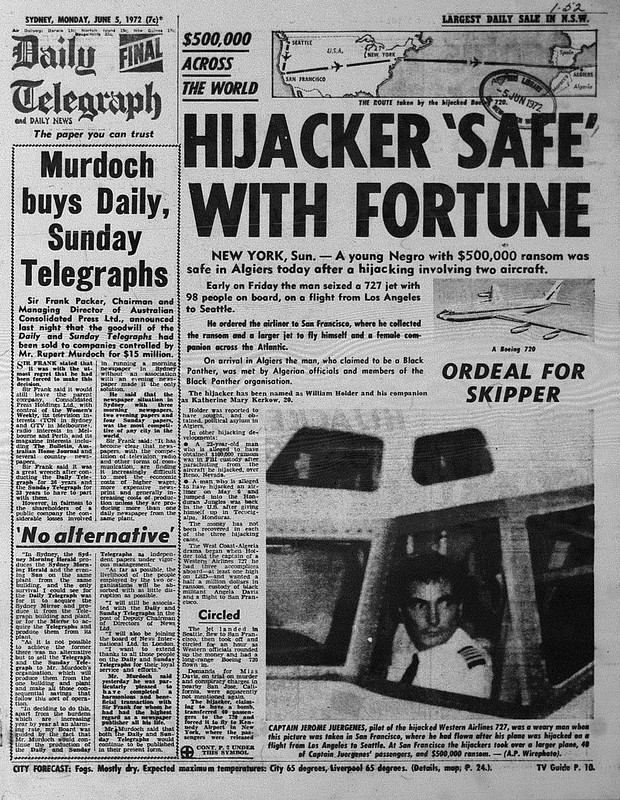
Packer sells Daily Telegraph June 5 1972 daily telegraph 1
Above: The Daily Telegraph becomes the news on 5 June 1972 on the front page of its own newspaper.

Whether or not the conversation happened is an unknown as per any TV Drama based on historical events, but it suggested for Rupert Murdoch, owning The Daily Telegraph would be his jewel in the crown and also control of Sydney's competitive newspaper market.

Murdoch began his newspaper empire with now defunct The News (Adelaide) in 1952. In 1960, he bought the ailing afternoon newspaper The Daily Mirror which was at the time owned by the Fairfax Family. Four years later, he founded The Australian, originally based in Canberra but moved its head office to Sydney in 1967.

By the mid 1960's The Daily Mirror had overtaken The Sun as Sydney's most circulated afternoon newspaper and was second overall in daily newspaper circulation in Sydney. The Daily Telegraph (morning newspaper) had a higher circulation but the margin had narrowed to 4000 by 1972. 

Between 1967 and 1972, The Daily Telegraph recorded a daily circulation drop of 24 000 copies daily. 

Why Sell?

The Daily Telegraph and The Sunday Telegraph were part of Sir Frank Packer's Consolidated Press Holdings which included the Nine Network (TCN9, Sydney & GTV9, Melbourne) magazines such as The Australian Women's Weekly and The Bulletin, along with a number of regional newspapers and radio stations. 

Unfortuantely, the "Telegraph's" were incurring financial losses in the early 1970's. Apart from rising costs of newsprint, wages and production costs, Consolidated Press Holdings did not own a evening newspaper which could have kept production costs down. Fairfax were producing both The Sydney Morning Herald and The Sun at Broadway, ensuring that the presses were constantly in use.

It meant that either Packer had to buy The Daily Mirror from Murdoch which was highly unlikely to in order to ensure The Daily Telegraph and The Sunday Telegraph could survive or sell his papers to Murdoch.

On 4 June 1972, Packer sold the papers to Murdoch for $15 million. Kerry Packer led the negotiations for the sale on behalf of his father.

Daily Telegraph Sold to Murdoch June 5 1972 The Australian 1 enlarged Daily Telegraph Sold to Murdoch June 5 1972 The Australian 1  

The following day, it was revealed to the world. The Daily Telegraph (top of page) and The Australian (above) published identical articles to announce the sale. 

The Sydney Morning Herald also ran a major feature on Page 1 while The Daily Mirror kept it off Page 1. Interestingly, The Sun did not make a mention of it. 
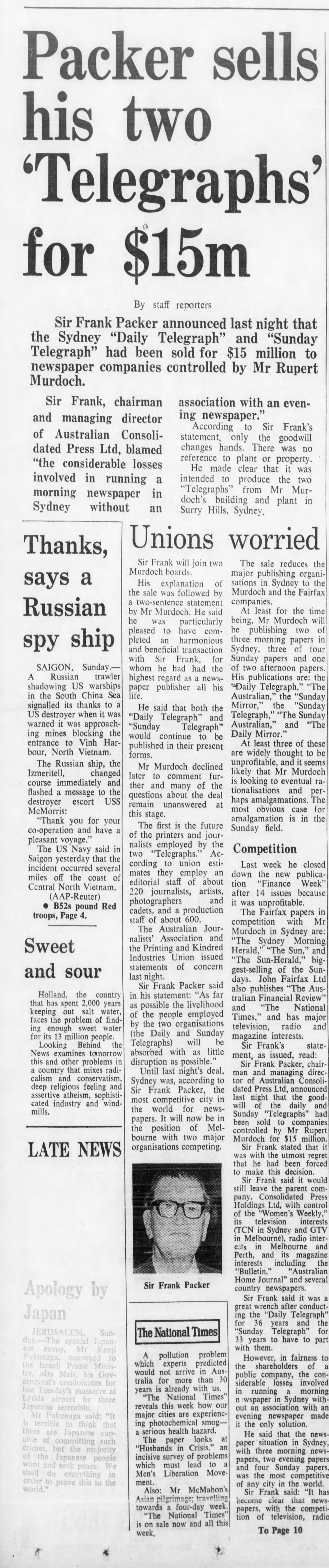
Sale of Daily Telegraph June 5 1972 SMH 1 enlarged Sale of Daily Telegraph June 5 1972 SMH 1

Sale of Daily Telegraph June 5 1972 SMH 10 

  What happened next?

Daily telegraph relocates june 17 1972 daily telegraph 10 

From 19 June 1972, The Daily Telegraph and The Sunday Telegraph moved to 2 Holt Road, Surry Hills where they have remained to this day. In 1994, the printing presses were relocated to their present site at Chullora.
New Sunday Telegraph Ad June 9 1972 daily telegraph 10-11

The Sunday Australian was absorbed into The Sunday Telegraph. While the newspaper would remain a Sydney newspaper, the paper would be available nationally each Sunday. In 2022, The Sunday Telegraph is still printed and distributed in Victoria and Queensland in addition to NSW.


Saturday, 12 November 2022

Property Advert of the Week: United Homes Advertisement (1963)

Below is a 1963 newspaper advertisement from United Homes. Three model homes are featured in the advertisement:

  • Kent - Three Bedroom Home with the option of a garage.
  • El Rancho - Three or Four Bedroom Home with the option of a garage
  • Triple 70 - Three bedroom Home with the option of a garage

Prices ranged from £3 395 ($6 790) to £3 495 ($6 990). According to the RBA Inflation Calculator, the homes retailed at the equivalent of $105 000 in todays money. 

United Homes Ad April 5 1963 daily mirror 18-19

Source: United Homes. 1963. Untitled (Advertisement). The Daily Mirror, April 5: 18-19. 

Monday, 7 November 2022

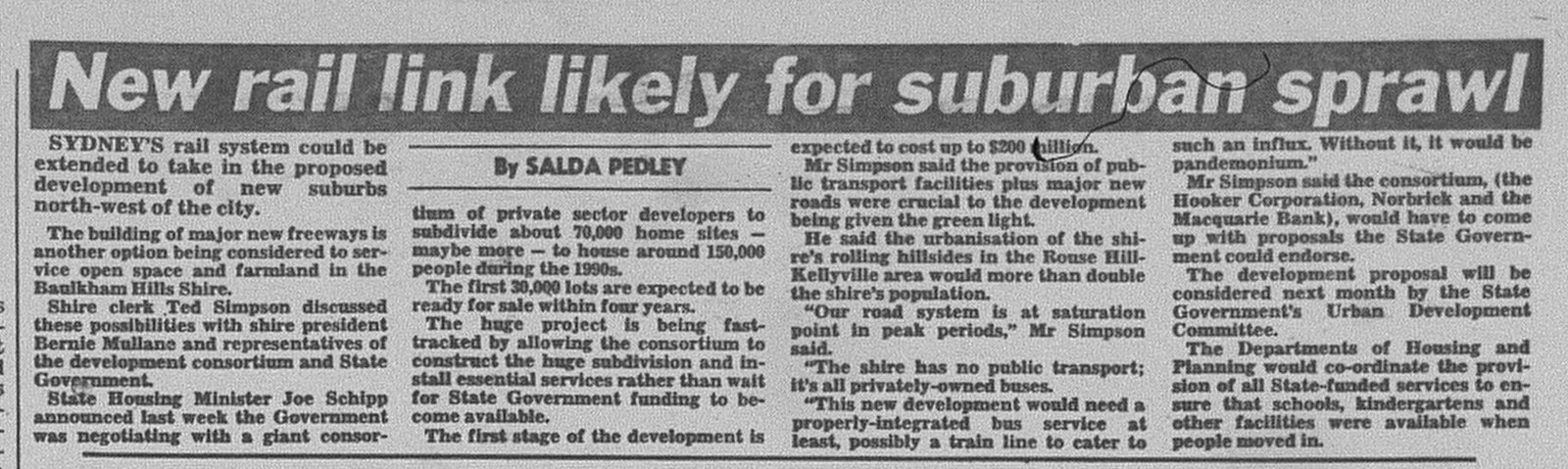
1988: Early mention of a proposed North-West Rail Link.

I found an article from The Sunday Telegraph that was published in 1988 focusing on transport options for our North-Western Suburbs including Rouse Hill and Kellyville. 

At the time, Rouse Hill and Kellyville were semi-rural suburbs with planning underway to develop them into new suburbs.

North West Rail Line October 23 1988 Sunday Telegraph 11

Source: Pedley, S. 1988. "New rail link likely for suburban sprawl". The Sunday Telegraph, October 23: 11. 

Baulkham Hills Shire Council (Hills Shire) had met with representatives of the NSW Government and property developers to discuss transport options to serve the new estates.

Being considered was construction of "major new freeways". This would have included construction of the Castlereagh Freeway which evolved to become the M2 Motorway and part of the Western Sydney Orbital. 

Also it mentioned that "Sydney's rail system could be extended to take in the proposed development of new suburbs north-west of the city".

I highlighted could because it meant that a rail line was a possibility. However no mention of possible routes is given.

Council was prepared to approve the developments subject to a commitment that the transport projects proceed.

As a minimum, council was prepared to accept a "property integrated bus service" to serve the new estates.

It was disappointing though, that there were no possible routes suggested for the rail link because that would have had the debate going.

Related entries

Saturday, 5 November 2022

Property Advert of the Week: Lane Cove North (1999)

Below is a newspaper advertisement for apartments in the "Lane Cove North" development in Lane Cove from 1999. The development is located where Mowbray Road meets Lane Cove Road, though road access is only possible from Mowbray Road. Three Bedroom Apartments were on sale from $387 500 and Three Bedroom Townhouses (including Study) were on offer from $465 000.

The townhouses featured in the architects drawing in the advertisement are located in Goodlet Close.

Lane Cove North June 5 1999 SMH 11RE

Source: Anon. 1999. "Lane Cove North...Live Amongst Nature" (Advertisement). The Sydney Morning Herald, June 5: 11RE (Real Estate Liftout). 

Monday, 31 October 2022

SYDNEY DEPARTMENT STORES: Demise of the Hordern Tree (1974)

Last week, I shared an entry on the end of Anthony Horderns focusing on the takeover of the company by Waltons in 1970. This week, I will focus on the demise of The Hordern Tree at Razorback Ridge near Camden.

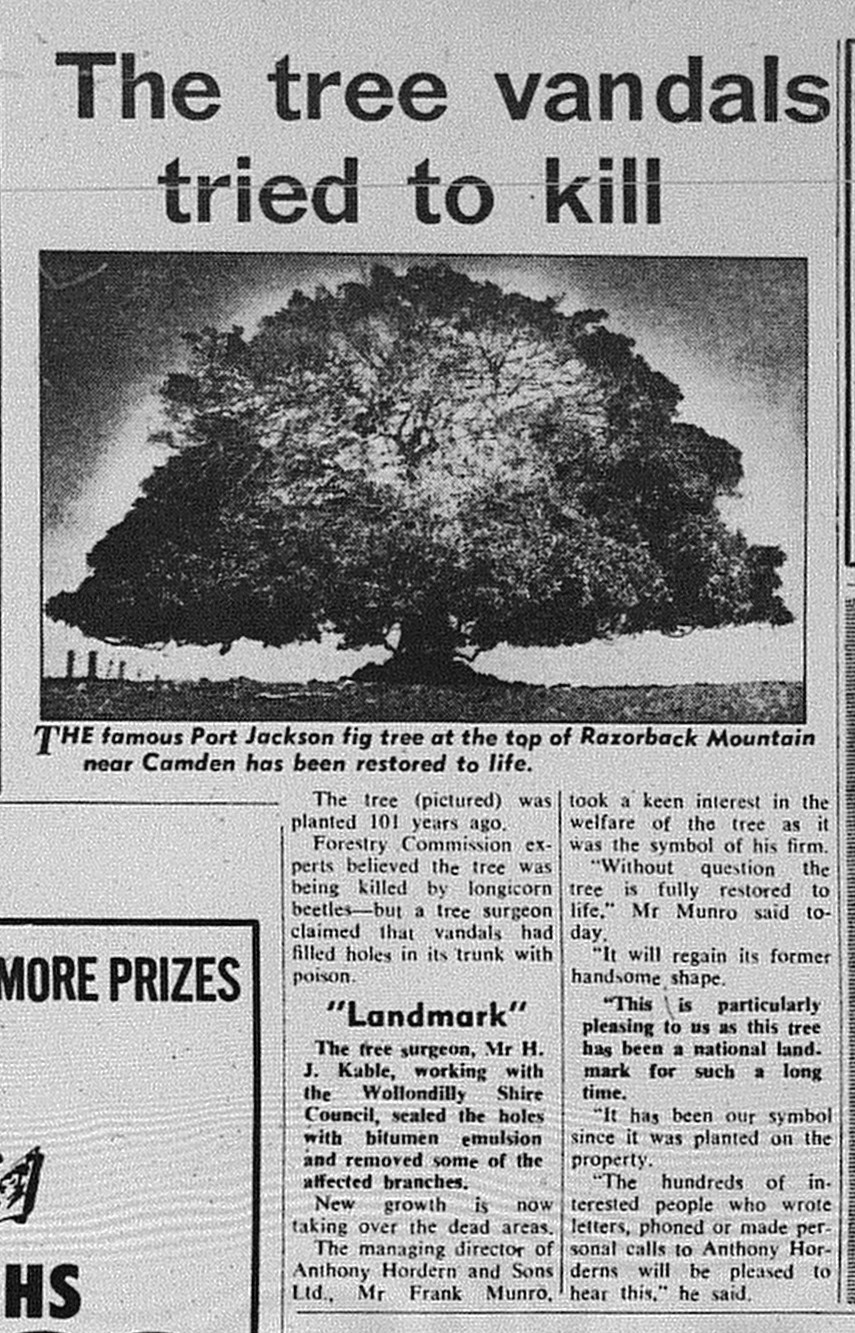
Anthony Hordern's motto was "While I live I'll grow" and this was symbolised by a budding tree on the crest of their coat of arms. An oak tree at Razorback Ridge near Camden bore a striking resemblence to the tree and Anthony Hordern arranged with landowners in the 1920's to have the company motto plced at that location.

The 1960's was not kind to the Anthony Hordern's. It lost trade as rival department stores opened suburban stores along with the rise of shopping centres reducing the need for shoppers to trek to central Sydney to do their shopping.

In 1967, tree vandals tried to posion the tree but it was unsuccessful.

  Horderns Tree May 10 1967 The Sun 31

Source: Anon. 1974. "The tree vandals tried to kill". The Sun, May 10:31. 

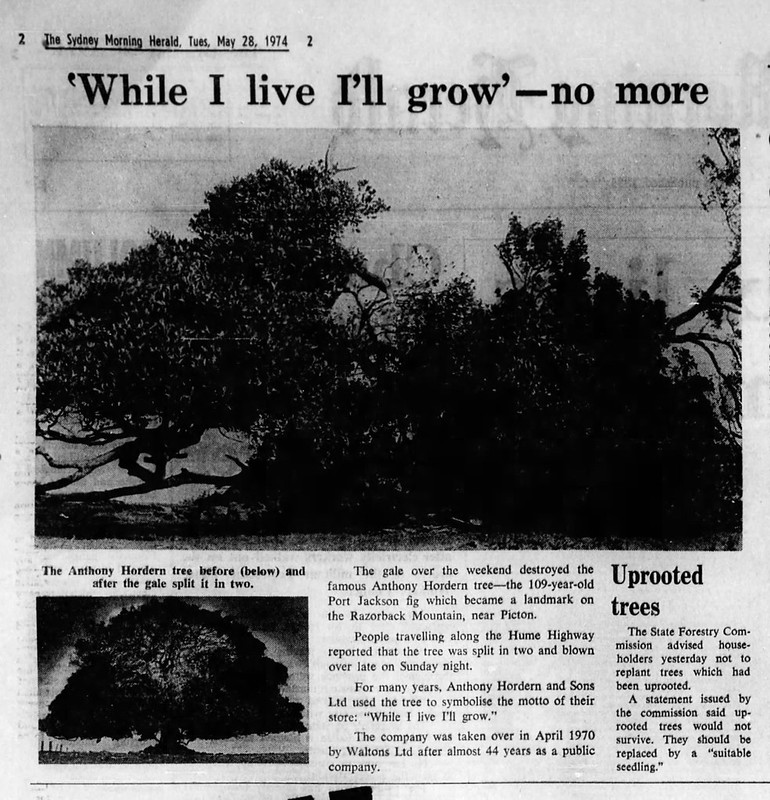
However, the "Sygna" storm of 1974 would finally claim the tree when it split in two. This came months after Horderns Mid City store was closed by its owner - Waltons (Click here to read more about their takeover from 1970) the previous year. It is believed that the demise of the tree was linked to the end of the Anthony Hordern's Department Store chain. 

Hordern Tree Destroyed May 28 1974 SMH 2

Source: Anon. 1974. "'While I live I'll grow' - no more". The Sydney Morning Herald, May 28: 2. 

Saturday, 29 October 2022

Property Advert of the Week: Cheltenham Heights Estate, Pennant Hills (1968)

Some readers may have thought that this advertisement would focus on a housing estate within the suburb of Cheltenham. 

Even I was fooled when coming across it and was even being fooled again in preparing this entry.

Below is a newspaper advertisement that was published in The Daily Telegraph on 14 December 1968.

Blocks were on offer in the estate for $5250 which is equivalent to $68 522 today (RBA Inflation Calculator)

Cheltenham Heights Ad December 14 1968 daily telegraph 47

Source: Hooker-Rex. 1968. "New Release! 25 Blocks". The Daily Telegraph, December 14: 48. 

Going by the map provided and current maps, Boundary Road would be what is Kurrajong Street, Pennant Hills today.

Cheltenham Heights Estate - Pennant Hills-2022-10-26 October-Google Maps 

I believe that the name was given because the estate borders Cheltenham but there is no direct road access from the estate to Cheltenham.

Monday, 24 October 2022

SYDNEY DEPARTMENT STORES: The end of Anthony Horderns' (1969)

The demise of Sydney department store chain Anthony Horderns' extends for a longer period of time than what this entry will focus on.

This entry will focus on the sale of Anthony Horderns' in 1969 which marked the end of its existence as a department store chain.

In November 1969, the Brickfield Hill store which had traded for a century closed. This generally went unreported by the newspapers. I could not even find any "closing down" advertisements.

The following month saw its compeitors rival for control:

  • Buckinghams Holdings Limited (Buckinghams) - $6 million offer
  • Waltons Limited - $9.3 million offer

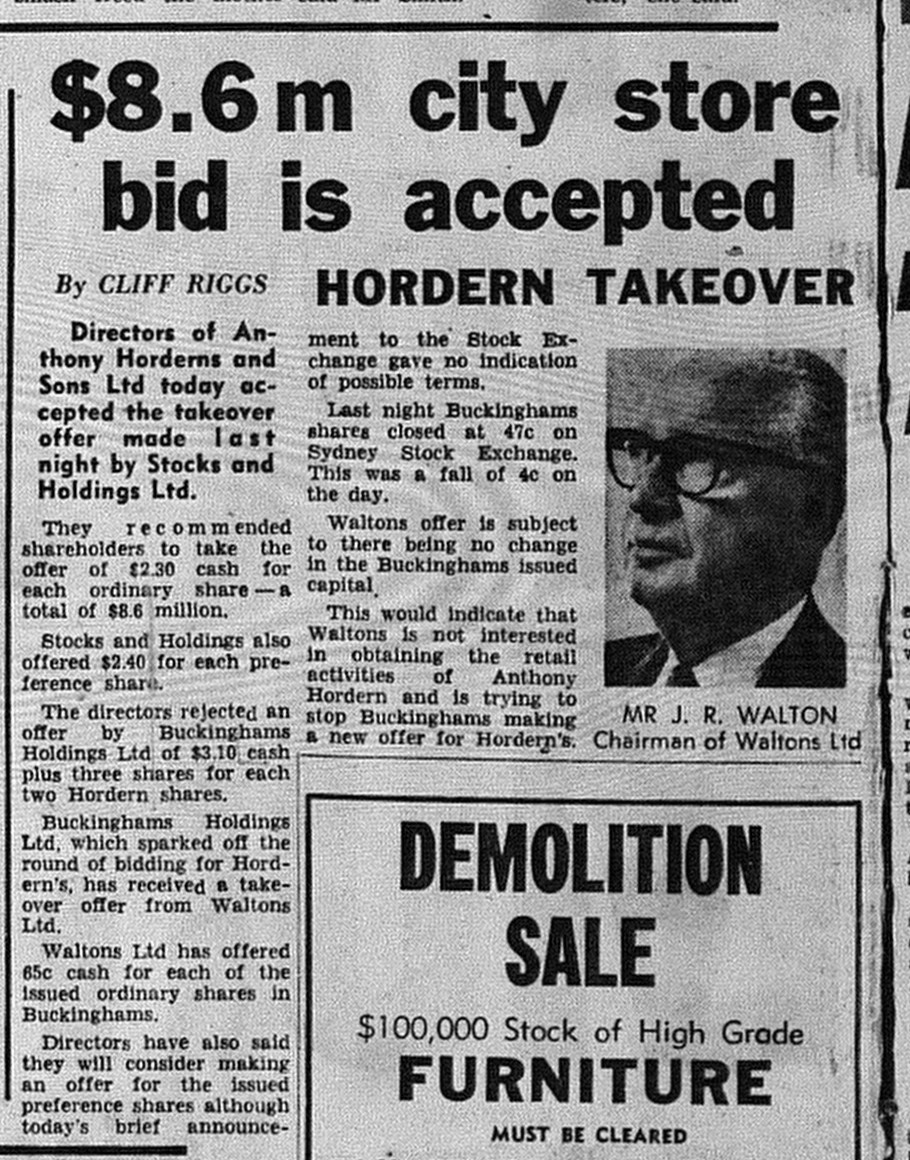
Developer Stocks & Holdings also joined in the frenzy, offering $8.6 million for the company.

  Anthony Horderns Takeover December 3 1969 daily mirror 2 

Source: Riggs, C. 1969. "$8.6m city store bid is accepted". The Daily Mirror, December 3: 2. 

This proposal had been accepted by the company. 

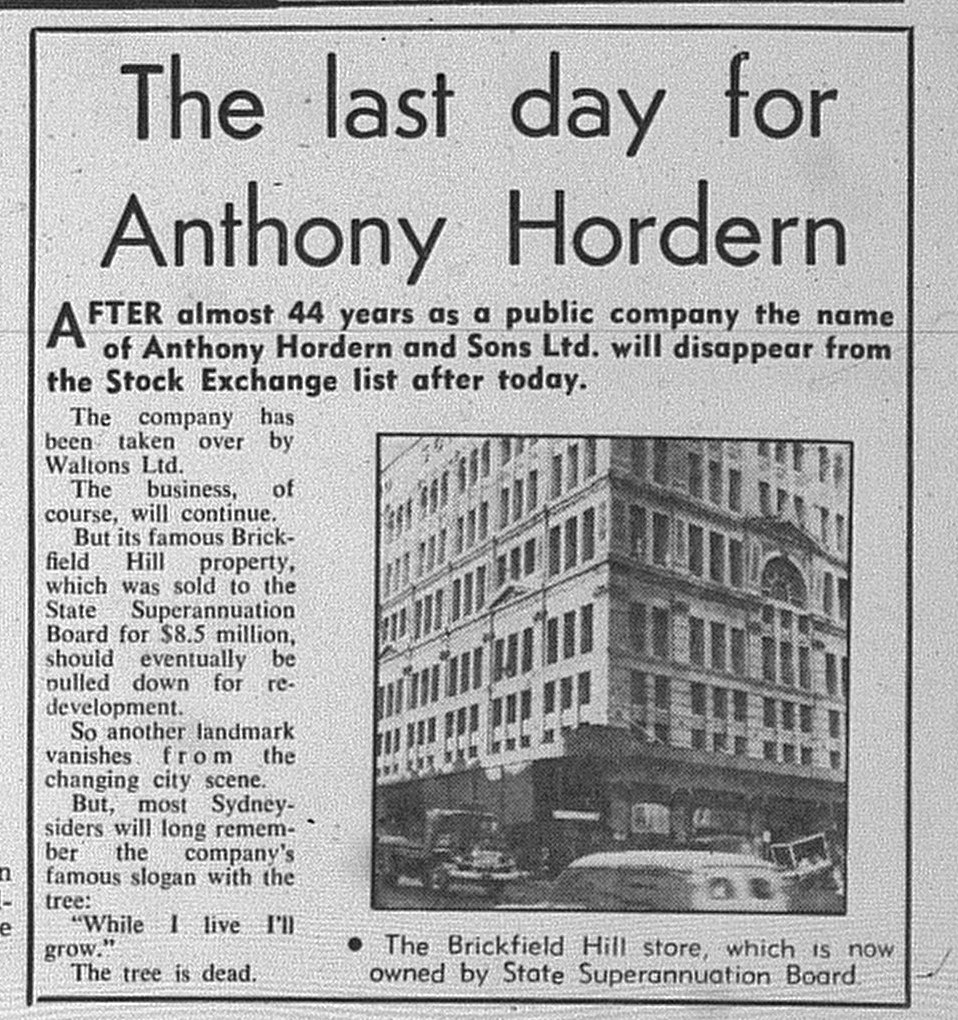
As the fight for control ensued, the company sold its Brickfield Hill site for $8.5 million to the State Superannuation Board.

  NSW gov buys Anthony Horderns Site December 24 1969 daily telegraph

Source: Anon. 1969. "Hordern's Site Owner Named". The Daily Telegraph, December 24: 1. 

On 5 January 1970, Waltons gained majority ownership, when it accquired 36% of the company from its rival bidders - Buckinghams and Tjuringa Securities. 

  Waltons takeover of Anthony Horderns January 5 1970 The Sun 26

Source: Anon. 1970. "Waltons claims victory". The Daily Mirror, January 5: 26.

Shares in the company (Anthony Hordern & Sons Limited) were delisted from the Sydney Stock Exchange on 8 April 1970, completing the take over process

Anthony Horderns delisted from ASX April 8 1970 The Sun 68

Source: Anon. 1970. "The last day for Anthony Hordern". The Sun, April 8: 68.

Hordern's Mid City Store closed in 1973. 

Saturday, 22 October 2022

Property Advert of the Week: Willoughby Homes - "The Victoria" (1966)

Below is a newspaper advertisement promoting "The Victoria" by Willoughby Homes from 1966. This model home was on offer for £4159 ($8318). 

Willoughby Homes Ad October 15 1966 daily telegraph 28

Note: Goods and Services could be sold in pounds, shillings and pence for a two year period following the introduction of decimal currency in 1966.

Source: Willoughby Homes Pty. Ltd. 1966. "The Victoria" (Advertisement). The Daily Telegraph, October 15: 28.