Showing posts with label Anthony Horderns Department Store. Show all posts

Monday, 24 April 2023

NEVER BUILT SYDNEY: Anthony Horderns Brickfield Hill Redevelopment (1964)

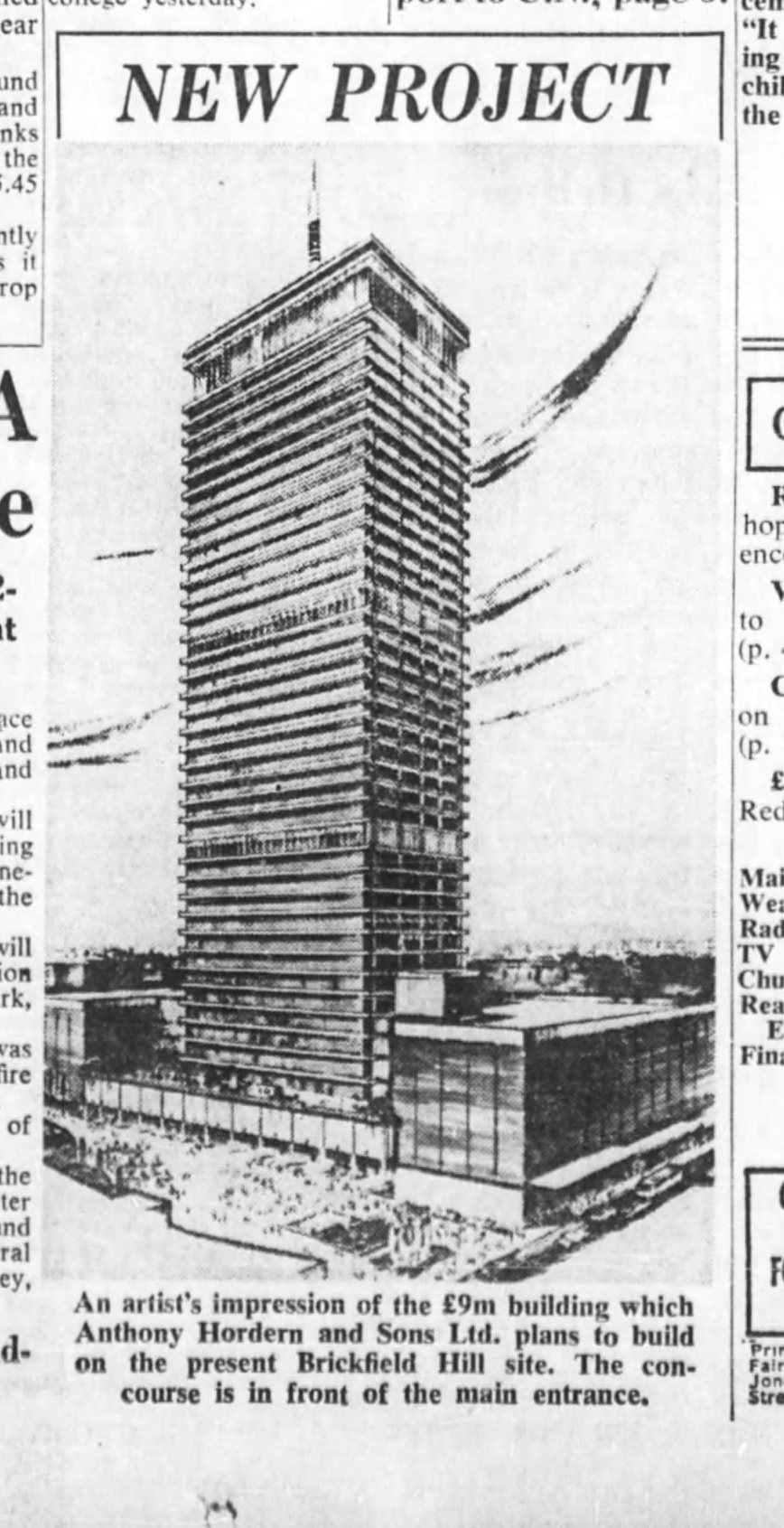
Anthony Horderns Redevelopment October 31 1964 SMH 1 tower render
Above: A render of the proposed 42-level tower as part of the redevelopment of the Anthony Horderns site at Brickfield Hill (World Square).Full Citation Below.


Welcome to a new series of Never Built Sydney focusing on the buildings and developments that were proposed for Sydney but never went ahead or alternate schemes for existing developments.
In 2016, I posted an entry on a mid 1960's proposal from Anthony Hordern & Sons to redevelop their existing store at Brickfield Hill (now World Square). Since then, I found more clippings about the proposed tower and can share more information.

At the time of the original posting, I mentioned that the plans were dated from 1965, when they were unveiled in 1964. 

The redevelopment proposal was conceived in response to the decline in trade at the Brickfield Hill store associated with the increased appeal of suburban shopping malls appearing across the Sydney metropolitan region. The company was operating at a financial loss. 

Anthony Horderns Redevelopment October 31 1964 SMH 1 closeup 
Source: Anon. 1964. "Anthony Hordern Plans a £9m Building on City Site". The Sydney Morning Herald, October 31: 1. 

In addition, there was a push by local and state governments to revive the southern end of the Sydney CBD, and this project was seen as a catalyst for future development in that section of the city. Given concerns about lost trade, increased commercial and residential development within that area would in turn attract more customers. 

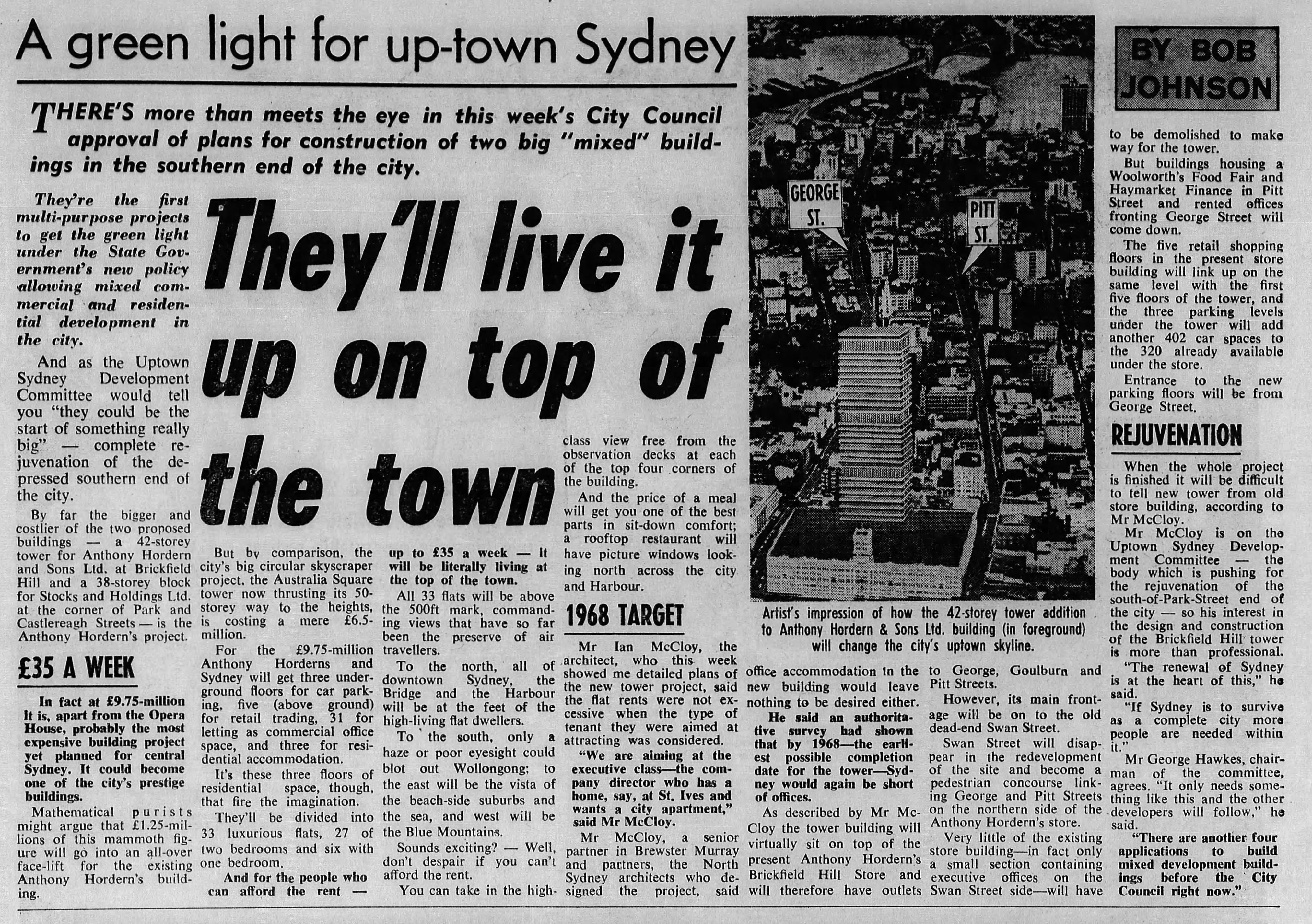
To attract trade, a forty-two-level tower comprising office space and apartments was planned for the rear of the existing building (Liverpool Street side) facing Swan Street. It was projected to rise 527 feet (161 metres) from the George Street end of the tower. Swan Street itself would be redeveloped into a pedestrian "concourse" linking George and Pitt Streets. 

In 1965, it was reported that the tower would be complete by 1968 at the earliest. 

Anthony Horderns Redevelopment September 26 1965 Sun Herald 45 
Source: Johnson, B. 1965. "They'll live it up on top of the town". The Sun Herald, September 26: 45. 

The estimated cost of construction was $20 million. According to the RBA Inflation Calculator this would be equivalent to around $295 million today. 

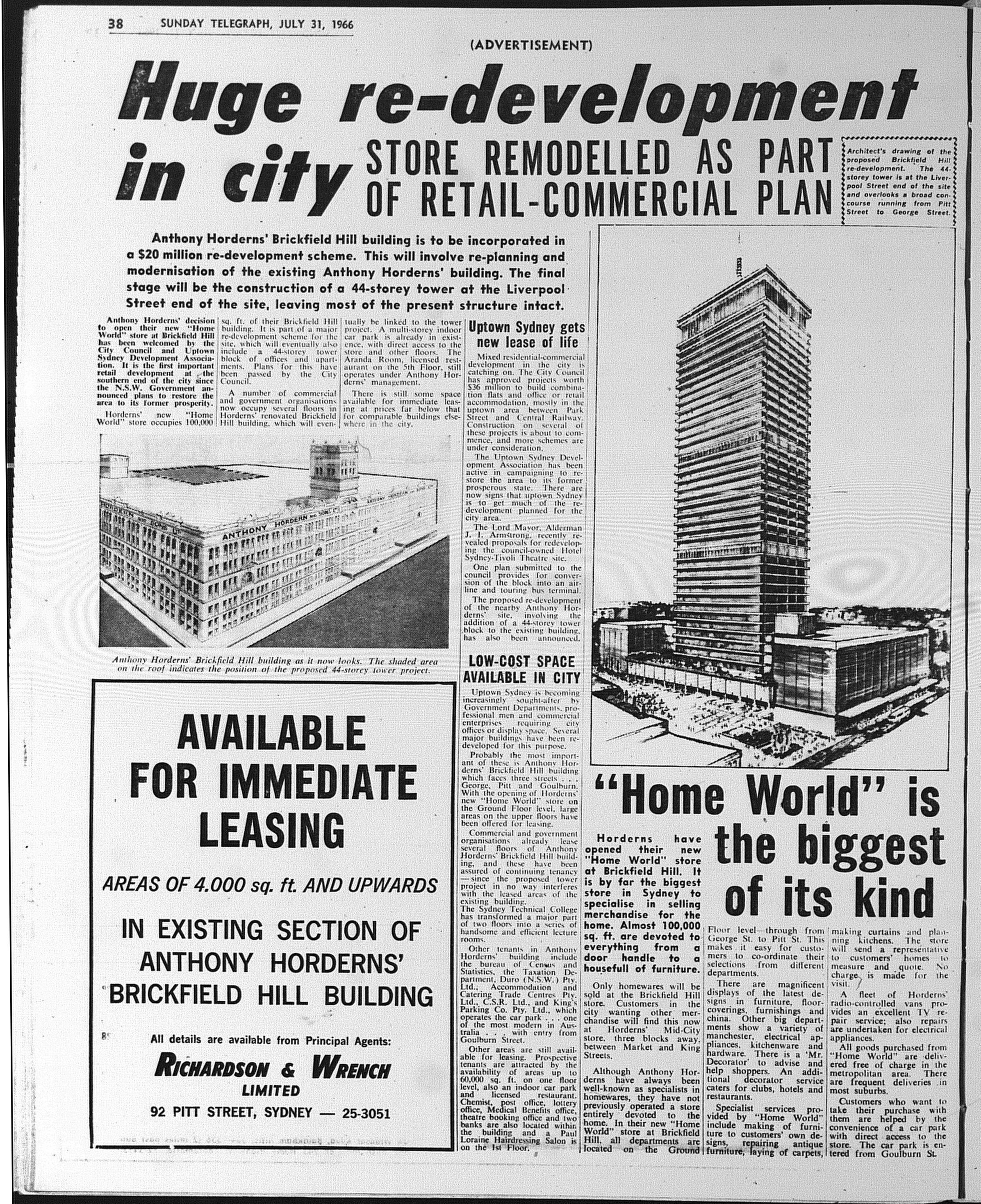
There was an advertising campaign in 1966 to promote the redevelopment, but nothing was mentioned about it after that date. 

This advertisement (below) was published in The Sunday Telegraph on 31 July 1966.

Anthony Horderns redevelopment July  31 1966 sunday telegraph 48

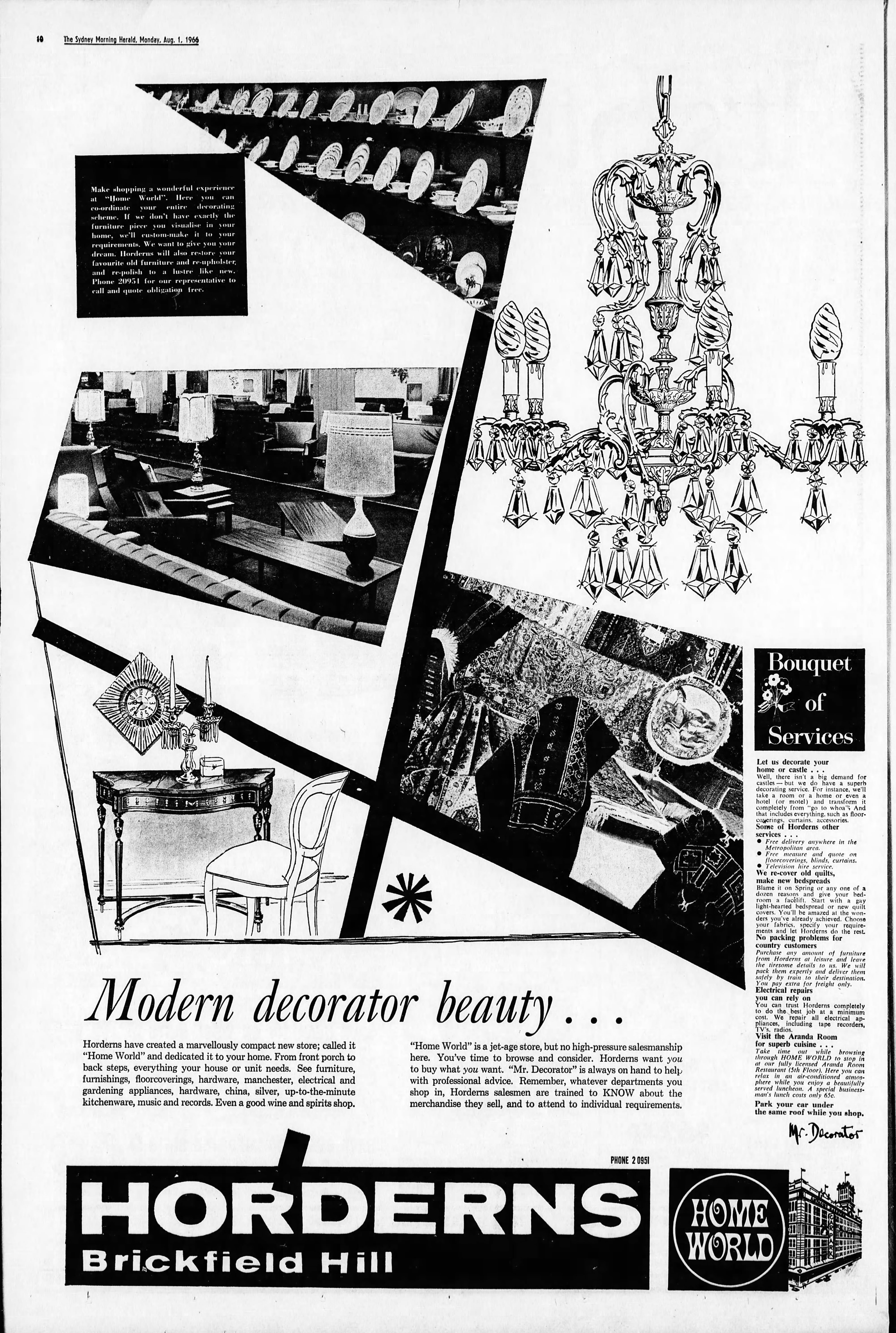
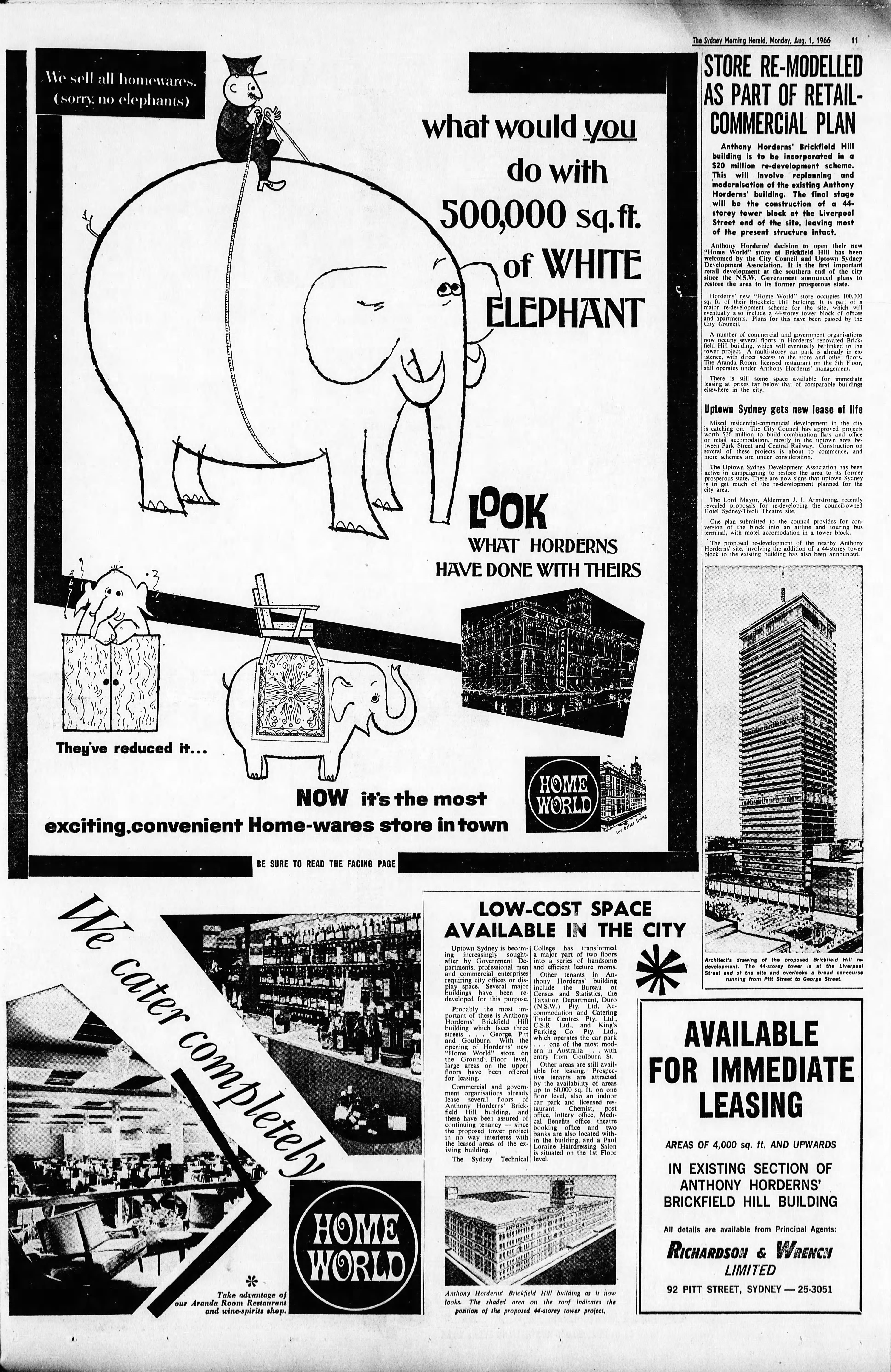
The Sydney Morning Herald published a two-page spread on 1 August 1966. 

Anthony Horderns Advertisement August 1 1966 SMH  (1)

Anthony Horderns Advertisement August 1 1966 SMH  (2) 

Anthony Hordern & Sons continued to struggle. In 1969, the Brickfield Hill site was closed and the company itself was taken over by Waltons Ltd. in 1970 (Click here to view my entry on the end of Anthony Horderns). The takeover did not include the purchase of the site at Brickfield Hill which was sold separately. 

This tower was one of several "Never Builts" for what is now the site of World Square. You may find the following entries of interest. 


Monday, 31 October 2022

SYDNEY DEPARTMENT STORES: Demise of the Hordern Tree (1974)

Last week, I shared an entry on the end of Anthony Horderns focusing on the takeover of the company by Waltons in 1970. This week, I will focus on the demise of The Hordern Tree at Razorback Ridge near Camden.

Anthony Hordern's motto was "While I live I'll grow" and this was symbolised by a budding tree on the crest of their coat of arms. An oak tree at Razorback Ridge near Camden bore a striking resemblence to the tree and Anthony Hordern arranged with landowners in the 1920's to have the company motto plced at that location.

The 1960's was not kind to the Anthony Hordern's. It lost trade as rival department stores opened suburban stores along with the rise of shopping centres reducing the need for shoppers to trek to central Sydney to do their shopping.

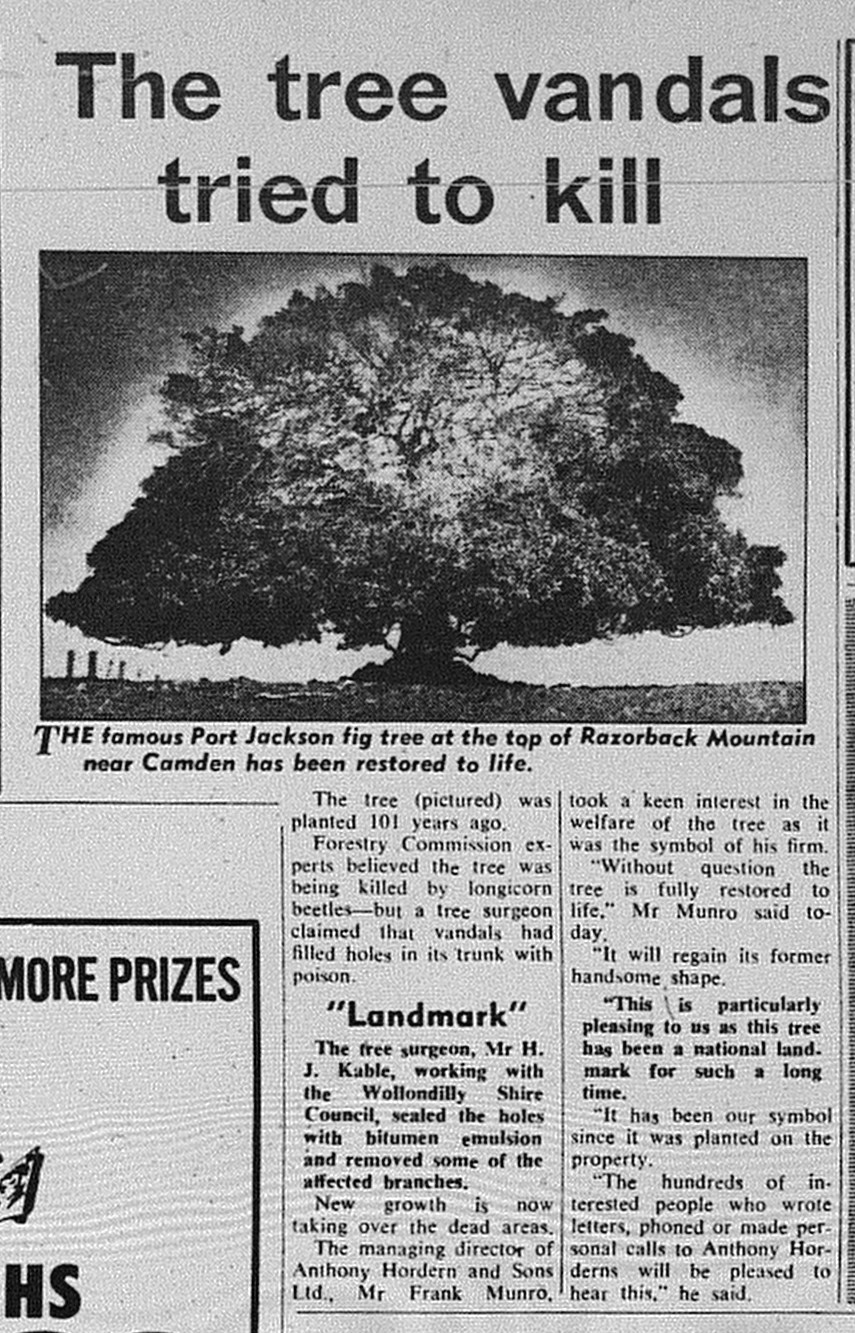
In 1967, tree vandals tried to posion the tree but it was unsuccessful.

  Horderns Tree May 10 1967 The Sun 31

Source: Anon. 1974. "The tree vandals tried to kill". The Sun, May 10:31. 

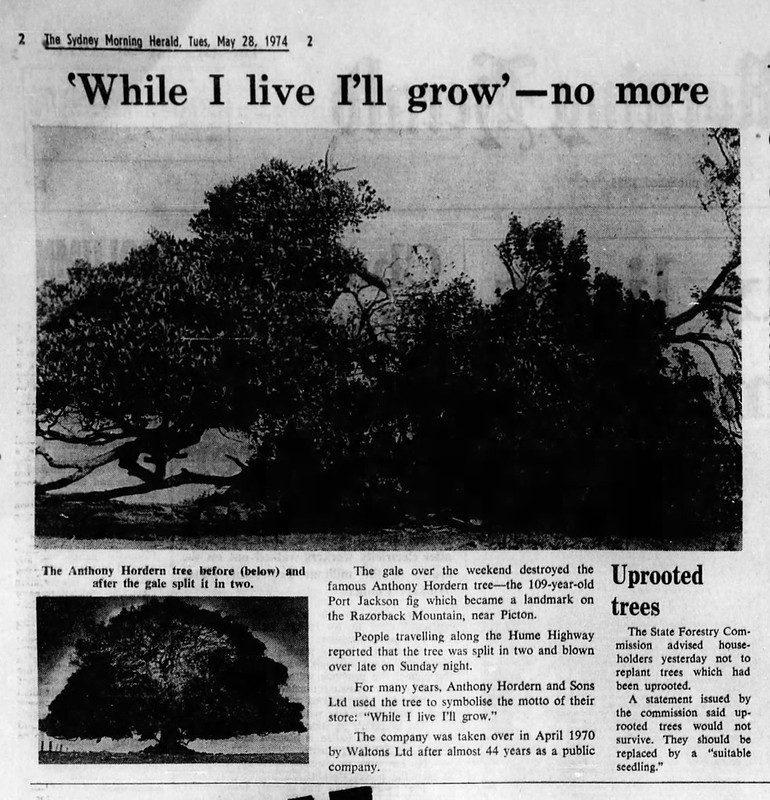
However, the "Sygna" storm of 1974 would finally claim the tree when it split in two. This came months after Horderns Mid City store was closed by its owner - Waltons (Click here to read more about their takeover from 1970) the previous year. It is believed that the demise of the tree was linked to the end of the Anthony Hordern's Department Store chain. 

Hordern Tree Destroyed May 28 1974 SMH 2

Source: Anon. 1974. "'While I live I'll grow' - no more". The Sydney Morning Herald, May 28: 2. 

Monday, 24 October 2022

SYDNEY DEPARTMENT STORES: The end of Anthony Horderns' (1969)

The demise of Sydney department store chain Anthony Horderns' extends for a longer period of time than what this entry will focus on.

This entry will focus on the sale of Anthony Horderns' in 1969 which marked the end of its existence as a department store chain.

In November 1969, the Brickfield Hill store which had traded for a century closed. This generally went unreported by the newspapers. I could not even find any "closing down" advertisements.

The following month saw its compeitors rival for control:

  • Buckinghams Holdings Limited (Buckinghams) - $6 million offer
  • Waltons Limited - $9.3 million offer

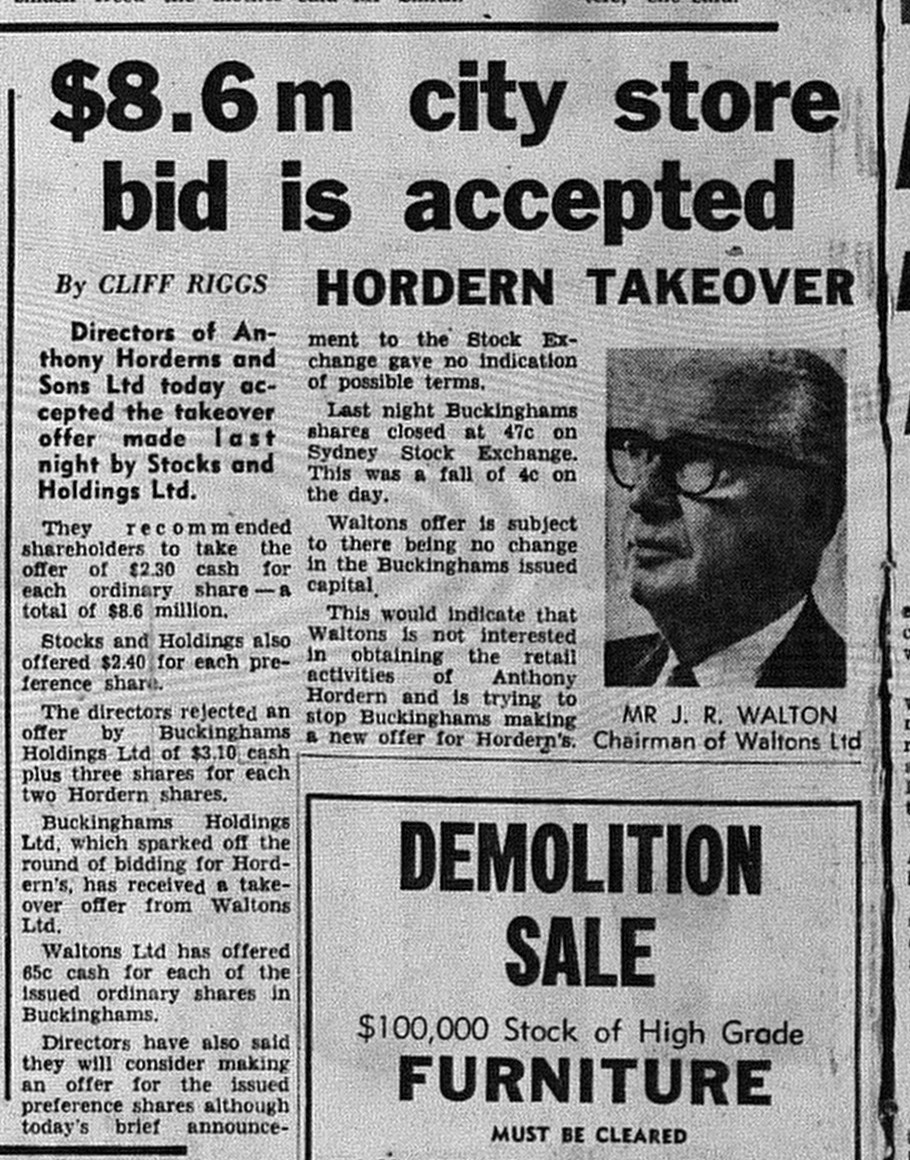
Developer Stocks & Holdings also joined in the frenzy, offering $8.6 million for the company.

  Anthony Horderns Takeover December 3 1969 daily mirror 2 

Source: Riggs, C. 1969. "$8.6m city store bid is accepted". The Daily Mirror, December 3: 2. 

This proposal had been accepted by the company. 

As the fight for control ensued, the company sold its Brickfield Hill site for $8.5 million to the State Superannuation Board.

  NSW gov buys Anthony Horderns Site December 24 1969 daily telegraph

Source: Anon. 1969. "Hordern's Site Owner Named". The Daily Telegraph, December 24: 1. 

On 5 January 1970, Waltons gained majority ownership, when it accquired 36% of the company from its rival bidders - Buckinghams and Tjuringa Securities. 

  Waltons takeover of Anthony Horderns January 5 1970 The Sun 26

Source: Anon. 1970. "Waltons claims victory". The Daily Mirror, January 5: 26.

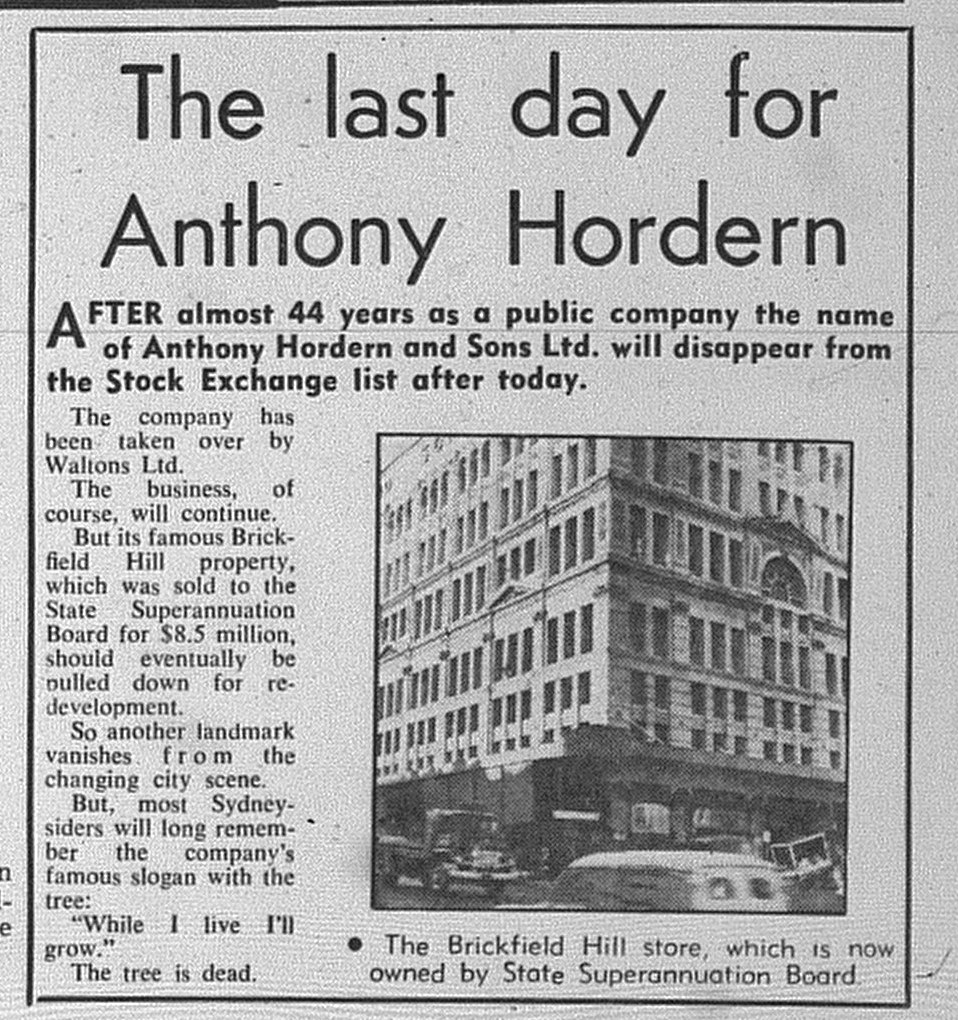
Shares in the company (Anthony Hordern & Sons Limited) were delisted from the Sydney Stock Exchange on 8 April 1970, completing the take over process

Anthony Horderns delisted from ASX April 8 1970 The Sun 68

Source: Anon. 1970. "The last day for Anthony Hordern". The Sun, April 8: 68.

Hordern's Mid City Store closed in 1973. 

Monday, 9 November 2020

1985: The end of the Anthony Horderns Building

In 1985, NSW Environment Minister (and future Premier) Bob Carr announced that the Anthony Horderns Building would be demolished, but the Mark Foys building would be protected.

The argument was that the building had become "derelict", was built with "sub standard materials" and "poor workmanship". Given its uses over the years (even as a carpark in its later years), the reasoning behind its demolition has to be questioned.

It also allowed for Ipoh to proceed with their proposal to redevelop the site and the block bounded by George, Liverpool, Pitt and Goulburn Street into World Square. 

Demolition of the Anthony Horderns building occurred the following year.


Source: Glascott, J. 1985. "Hordern emporium for demolition". The Sydney Morning Herald, February 25: 5. 


Monday, 18 July 2016

Evolution of World Square Postscript: New finding

A fortnight ago, I mentioned that our series on World Square had concluded, but there is a postscript. From time to time, there is always something new that can be found once the research is presented. Just recently, I came across a 1965 proposal to build a 38 level tower right atop the Anthony Horderns Building.

How did I come across it? The Sydney Morning Herald has given its archives for 1955-95 a huge makeover and provides more thorough search results on anything that one wants to find.  Simply playing around with the upgraded features gave me access to articles that I would not have found under the old website.

I had thought that the first World Square scheme was from 1973, but getting to where it is now was a process that spanned forty years, not the thirty or twenty years that I may have once thought.

The idea for a tower built above Anthony Horderns was a simple idea and was seen as a way of trying to renew the southern end of the city, which newspapers were highlighting that year. It went as far as reporting that it was unsafe to venture in the streets around there. The plan included three floors of underground parking, five floors of retail, 31 levels of office space and three floors of apartments at the top of the building.

It could have been the best of both worlds, but I think the 38 storey tower would appear dated against other city buildings, not to mention the fact it might have warranted a heritage listing today as one of the first major highrises down that end of the city.

They were optimistic that it would be ready by 1968.

Source: Johnson, B. 1965. "A green light for up-town Sydney". The Sun Herald, September 26: 45.

Monday, 16 May 2016

EVOLUTION OF WORLD SQUARE: Kenzo Tange turns World Square into a Lotus Flower (1985)

Continuing on in our series in the evolution of World Square, we move forward to 1985, where a fourth tower is introduced into the World Square development. The idea of introducing a fourth tower was to make the towers form a lotus flower.


Source: Shanahan, S. "Four towers to replace Anthony Horderns". The Sydney Morning Herald, December 2: 2.

In 1986, the Anthony Horderns Building was demolished even though the $1 billion project had yet to be formally approved. In the same year, the NSW Government assumed planning control of the site. Planning and Environment Minister (and future Premier) Bob Carr was handed power to approve the development, which he did in April 1987.


Aubin, T & Coultar, M. 1987. "Approval for World Square". The Sydney Morning Herald, April 7: 3

By the end of the decade and the site had been dug to 30 metres below street level. On the corner of George and Goulburn Streets, one of the office towers (George Tower) was well under construction, with work beginning in December 1988. This tower would become 680 George Street.


Above: The office tower at the corner of George and Goulburn Street was under construction in 1990 when work stopped. This was taken in October 2002 just before work recommenced on its construction. Photos were taken by the Author.

However disputes with unions and workers would fuel the collapse of the project in mid-1990 and for over a decade, we would see inactivity at the site.

Next week we will look at the idle years at World Square and Hordern Towers. Then we will move onto the gradual formation of World Square as we see it today.


Monday, 9 May 2016

EVOLUTION OF WORLD SQUARE: Kenzo Tange's Original Scheme (1983)

After last week's post on the original plans for the redevelopment of World Square, I've decided to focus this week on the next major proposal which dates to 1983.

In 1981, Ipoh Gardens Berhad ended up with the site and had planned for a multi-tower development just on the site of Anthony Horderns, including retaining some of its famous facade. There would also be a park in the middle.

Just two years later the proposal was revised. Unlike the scheme proposed in 1981, it would now encompass the entire city block bounded by George, Goulburn, Pitt and Liverpool Streets.

Many will associate Kenzo Tange's involvement with the 1985 scheme, which is highly talked about because of the positioning of towers in the shape of the Lotus flower. You'll find out about that next week.

The scheme according to The Sydney Morning Herald on May 17, 1983, comprised three towers:

Tower 1 - 59 floors (Office & Residential)
Tower 2 - 53 floors (Hotel)
Tower 3 - 38 floors (Office)

The towers would rise over a four-level podium. 


Source: Lawson, L. 1983. "$478m complex could replace Hordern building". The Daily Telegraph, May 18: 9.

Heritage experts were calling at least for the facade of Anthony Horderns to remain but it was argued that it would be too expensive to undertake and that the facade lacked craftsmanship.

Construction was projected to take eight years, though The Sydney Morning Herald reported that it could be completed in six years.


Monday, 1 December 2014

1961: Anthony Hordern's Shopping Centre

This week, I share with you two newspaper advertisements to promote the opening of the Anthony Horderns' Shopping Centre in Central Sydney from December 1961.

It was boasting to be the first "drive-in" shopping centre in Sydney's CBD which had parking levels within the existing structure. Shoppers had 100 shops to choose from.

This was done in response to the opening of "drive-in" shopping centres that were already open in Sydney e.g. Top Ryde or were in the planning stages.

By the end of the decade, there would be no more Anthony Horderns at Brickfield Hill. However, some small shops were allowed to trade until the 1980s when it was pulled down for the World Square development.


Sources:

Anthony Horderns. 1961 "Anthony Horderns' New Drive-In City Shopping Centre (Advertisement)." The Daily Telegraph, December 6: 29.

Anthony Horderns. 1961 "Opens today at 12 noon (Advertisement)." The Daily Telegraph, December 6: 24.