This week, we remain in 1999 and in central Sydney. However, we head down to the southern end of the city, where Di Jones was promoting apartments in the The Souther Cross Towers at the corner of Goulburn Street and Wentworth Avenue. They say 5% is a good yield on an investment property today, but what about 7.5%.
Source: Di Jones Real Estate. 1999. "The Southern Cross Towers" (Advertisement). The Sydney Morning Herald, June 5: 22RE (Real Estate Liftout).
The Games of the 31st Olympiad are well underway in Rio De Janiero, Brazil. We were treated to an impressive opening ceremony on Saturday morning. This week lets relive our ceremony from when we hosted the Games of the 27th Olympiad in September 2000.
Sydney's Opening Ceremony on September 15 lasted four hours and involved more than 10 000 performers. Stockmen on Horses opened the ceremony with a procession which culminated in them forming the Olympic rings. After the VIP's and the anthem was sung, viewers were treated to the story of a young girl visiting the beach. She falls asleep and then is taken on a trip through time as the story of Australia. The young girl was Sydney school student Nikki Webster. She now runs a dance school based at Leichhardt.
The cauldron was lit by Cathy Freeman who would go on to win gold in her pet event - the 400 metre race in Athletics a week and a half later. Legends including Dawn Fraser and Betty Cuthbert were tipped as favourites by bookies to receive the honour. Fraser and Cuthert joined Shane Gould, Raylene Boyle, Shirley Strickland De La Hunty and Debbie Flintoff King in relaying the flame around Stadium Australia. However, there was an epic blunder when technical problems saw the lit cauldron stop on its ascent for four minutes.
Performers included John Farnham and Olivia Newton-John who performed a duet - "Dare to Dream". Vanessa Amorossi performed "Heroes Live Forever" while Tina Arena performed "The Flame" to welcome the Olympic Flame into the stadium. Julie Anthony with support from Human Nature performed the best ever rendition of Advance Australia Fair and for a change, both verses were sung.
10 000 Athletes from 199 countries plus 4 Individual Olympic Athletes from East Timor participated in the Parade of Athletes. As hosts, Australia marched into the stadium at the end of the parade with a team of 632 athletes, receiving a big welcome from the 110 000 assembled.
Governor General Sir William Deane (as the Queen's representative in Australia) officially opened the Olympics.
Eight former Olympic Champions from Australia were involved in the raising of the Olympic Flag.
The ceremony was broadcast on Channel Seven and this was the most watched television event in Australian History with around 11 million watching that evening.
As a bonus, why not include the Closing Ceremony as well. This had to be our biggest concert ever with a plethora of stars including Slim Dusty, Midnight Oil, Paul Hogan, Savage Garden and Kylie Minogue.
This was also the first closing ceremony where the show was taken out of the main stadium - a 20-minute fireworks finale on Sydney Harbour featuring a river of fire from the Stadium down the Parramatta River into Sydney Harbour. One million attended the display itself, which at the time was the biggest fireworks show in history. It involved five fireworks companies from around the world. The "best ever" Olympics had finished with a bang.
Sydney did set one new innovation that Beijing was happy to do for their opening ceremony in 2008 - A big fireworks finale to end off the show. They were not afraid to take out of the stadium and into the surrounding area. London also followed Sydney's lead. Melbourne did it for their Commonwealth Games in 2006.
It was moments like this in the Sydney Olympic Games that would help reinvigorate the Olympic Movement which was battling corruption associated with the successful bid for the 2002 Olympic Games in Salt Lake City, Utah. Sydney was seen as vital to the future of the Olympic Movement and this city gave it a shot in the arm.
The Olympic Cauldron at Cathy Freeman Park. Photo was taken by the Author (2006).
After my entry on Caltex House earlier this week, our property advertisement of the week is on the buildings reincarnation into the Stamford on Kent apartments.
Source: Jones Lang LaSalle. 1999. "Stamford on Kent: High on Life" (Advertisement). The Sydney Morning Herald, June 5: 18 (Real Estate Liftout).
For decades, Sydney had a very strict 46 metre (150 feet) height limit for buildings in the city centre. It was implemented because it was as high as fire ladder could go.
Source: Anonymous. Caltex House. Year Unknown. City of Sydney Archives, Sydney. Accessed July 29, 2016. http://www.photosau.com.au/cos/scripts/ExtSearch.asp?SearchTerm=030522
In 1957, Caltex House in Kent Street broke this height limit to become the tallest building in Sydney (and Australia). The 20 level/72 metre tower (measured from the rear laneway) set a precedent for future high rise development in central Sydney. This was achieved through a loophole in planning policy. The height of the building was based on the Kent Street side, and not Jenkins Lane at the rear of the building. Jenkins Lane was 12 metres lower than Kent Street.
Construction had begun at the start of the previous year and when completed was five months ahead of schedule.
The building was designed by architect Harry Nichols and was built by Civil & Civic Constructions.
Some facts of interest include:
*Australia's first all-concrete building.
*Fastest lifts in Australia at the time - It could travel 700feet in a minute. You could travel for instance from level 5 to 15 in just fifteen seconds.
*300 000 sq/feet of office space.
*First office block in Australia to be fully air-conditioned.
*14 shops at ground level.
*Capacity for 2000 workers.
*During construction, a new floor was added every 14 days, twice as fast as any building under construction at the time.
The following year, Caltex House lost the tallest building in Australia title to ICI House in Melbourne (20 storeys/84 metres). In 1962, the AMP Building would become Sydney (and Australia's) tallest building at 26 levels of 115 metres tall.
Source: Skelsey, M. 1996. "Suburb of Units in city centre". The Daily Telegraph, September 27: 26.
However, in the late 1990s, the building was converted into the Stamford on Kent Apartment Tower. Approval was given in 1996, but the final design would differ. An additional eight floors were added to the tower. This was completed in 1999.
Above: Photos of the Stamford on Kent was taken by the Author (2008).
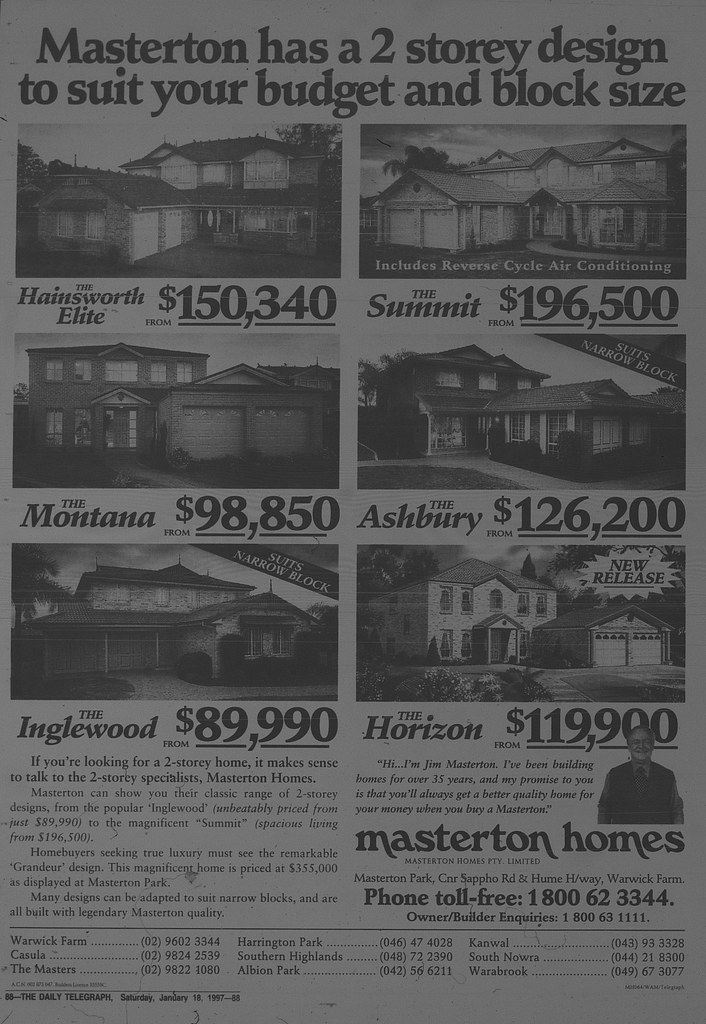
This week, I share with you an advertisement for Masterton Homes dating back to 1997.
Source: Masterton Homes Pty. Ltd. 1997. "Masterton has a 2 storey design to suit your budget and block size" (Advertisement). The Daily Telegraph, January 18: 88.
This week, I thought I'd share a feature report on Bruno Grollo, that was written by Mark Skelsey of The Daily Telegraph in late 1998. Grollo was the head of Grollo Constructions (now Grocon).
At the time, he was in Sydney to attend the final concrete pour of their first project in Sydney - 1 Martin Place. It included the restoration of the famous GPO Building. Behind the stone facade, would rise a 25 level office and hotel complex. 1 Martin Place would open to the public less than a year later.
Source: Skelsey, M. 1998. "Grollo has high hopes for Sydney". The Daily Telegraph, December 11: 35
Grollo was keen to see if Sydney could end up with its own Grollo Tower, which believe it or not was at the same time he had won approval to build his 120 level, 560 metre tower in Melbourne which at the time would have been the world's tallest skyscraper.
The article mentions that Sydney's height limits (Capped at 235 metres) was due to the need to protect the views from Sydney Tower, which from what I am aware of, is not correct. From my understanding, Sydney's current height limits have stemmed from the need to allow sunlight to penetrate into city streets, public spaces and parklands.
This article from 1995 explains why:
Source: Skelsey, M. 1995. "The sky's not the limit: New city plans could reign in high-rise boom ". The Daily Telegraph Mirror, February 3: 14.
Earlier this month, Sydney City Council announced that it is proposing to increase the city's height limit from 235 metres to a maximum 310 metres., Already, there are proposals that are testing the waters for taller towers in central Sydney, with negotiations currently taking place between developers and the council. One proposal is for a 248 metre office tower at Circular Quay and a 260 metre apartment tower above the Event Cinemas complex in George Street.
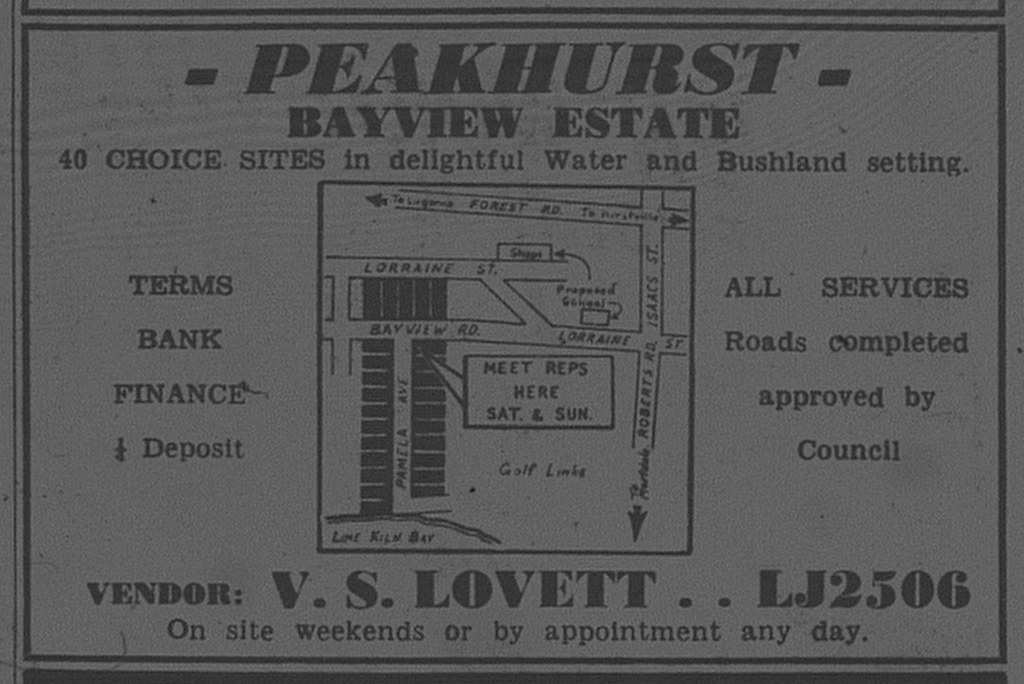
This week, I share with you a real estate advertisement by V.S. Lovett promoting the sale of forty housing blocks at Peakhurst. This is now the suburb of Peakhurst Heights.
Source: V.S. Lovett. 1962. "Bayview Estate" (Advertisement). The Daily Telegraph,
A fortnight ago, I mentioned that our series on World Square had concluded, but there is a postscript. From time to time, there is always something new that can be found once the research is presented. Just recently, I came across a 1965 proposal to build a 38 level tower right atop the Anthony Horderns Building.
How did I come across it? The Sydney Morning Herald has given its archives for 1955-95 a huge makeover and provides more thorough search results on anything that one wants to find. Simply playing around with the upgraded features gave me access to articles that I would not have found under the old website.
I had thought that the first World Square scheme was from 1973, but getting to where it is now was a process that spanned forty years, not the thirty or twenty years that I may have once thought.
The idea for a tower built above Anthony Horderns was a simple idea and was seen as a way of trying to renew the southern end of the city, which newspapers were highlighting that year. It went as far as reporting that it was unsafe to venture in the streets around there. The plan included three floors of underground parking, five floors of retail, 31 levels of office space and three floors of apartments at the top of the building.
It could have been the best of both worlds, but I think the 38 storey tower would appear dated against other city buildings, not to mention the fact it might have warranted a heritage listing today as one of the first major highrises down that end of the city.
They were optimistic that it would be ready by 1968.
Source: Johnson, B. 1965. "A green light for up-town Sydney". The Sun Herald, September 26: 45.
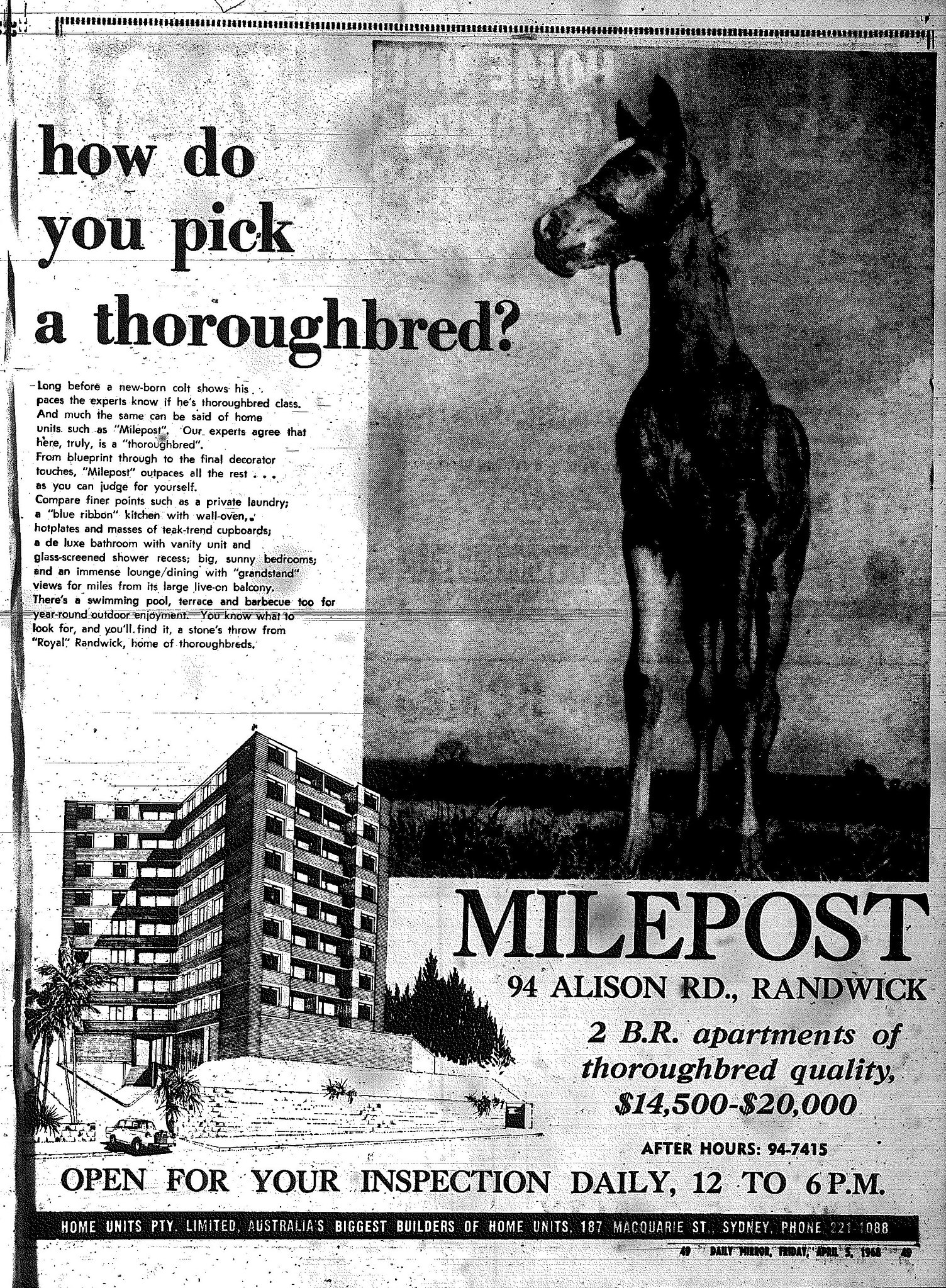
This week, we head to Randwick where $14 500 bought you an apartment at 94 Alison Road with views to Randwick Racecourse. In recent times, apartments have been fetching at least $700 000 on the market. One sale netted the vendor $850 000 last year.
Source: Home Units Pty. Limited. 1968. "Milepost". The Daily Mirror, April 5: 49.
School holidays means sharing something interesting and odd. This clipping from 1963 contains an illustration of new navigation beacons for Sydney Harbour to mold in with the architectural style of the Sydney Opera House. I can see that they were space-age inspired as well. I have never seen these at all so presumably, they have gone to the "Never Built" pile. They would have been an interesting sight on Sydney Harbour no matter what.
Source: Anon. 1963. "Sydney's New Harbour Lights." The Daily Telegraph, November 9, 3.