Showing posts with label Manly. Show all posts

Saturday, 25 July 2026

Property Advert of the Week: Stocks & Holdings Projects (1970)

Below is a 1970 newspaper advertisement promoting two projects by Stocks and Holdings Projects that was published in The Sun.

Stocks and Holdings Ad January 2 1970 The Sun 39

Source: Stocks & Holdings Projects. 1970. "Untitled" (Advertisement). The Sun, January 2: 39.

The two projects featured were"

  1. "The Pines" (Manly) - Located at 51-53 The Crescent, Manly
  2. "Trenthurst Place" - Cnr of New & West Street, Balgowlah Heights

Saturday, 28 February 2026

Property Advert of the Week: Stock & Holdings double page spread (1968)

This week, I am posting a double-page spread from Stocks & Holdings Projects, which appeared in The Sun on August 2, 1968. The double-page spread features three advertisements:

  • Ocean View Units (Maroubra Beach) - With spectacular views of the ocean, Maroubra Beach, Sydney CBD and the Blue Mountains.
  • Woodlyne Park Estate (Baulkham Hills)
  • The Pines, Manly

Stocks and Holdings Ad August 2 1968 The Sun 52-53

Sources:

Maroubra Beach Units
Stocks & Holdings Projects. 1968. "Maroubra Beach Ocean View Units (Advertisement). The Sun, August 2: 52 & 53. 

Baulkham Hills Land Release
Stocks & Holdings Projects. 1968. "Woodlyne Park" (Advertisement). The Sun, August 2: 52. 

The Pines, Manly
Stocks & Holdings Projects. 1968. "The Pines, Manly" (Advertisement). The Sun, August 2: 52. 

Saturday, 24 September 2022

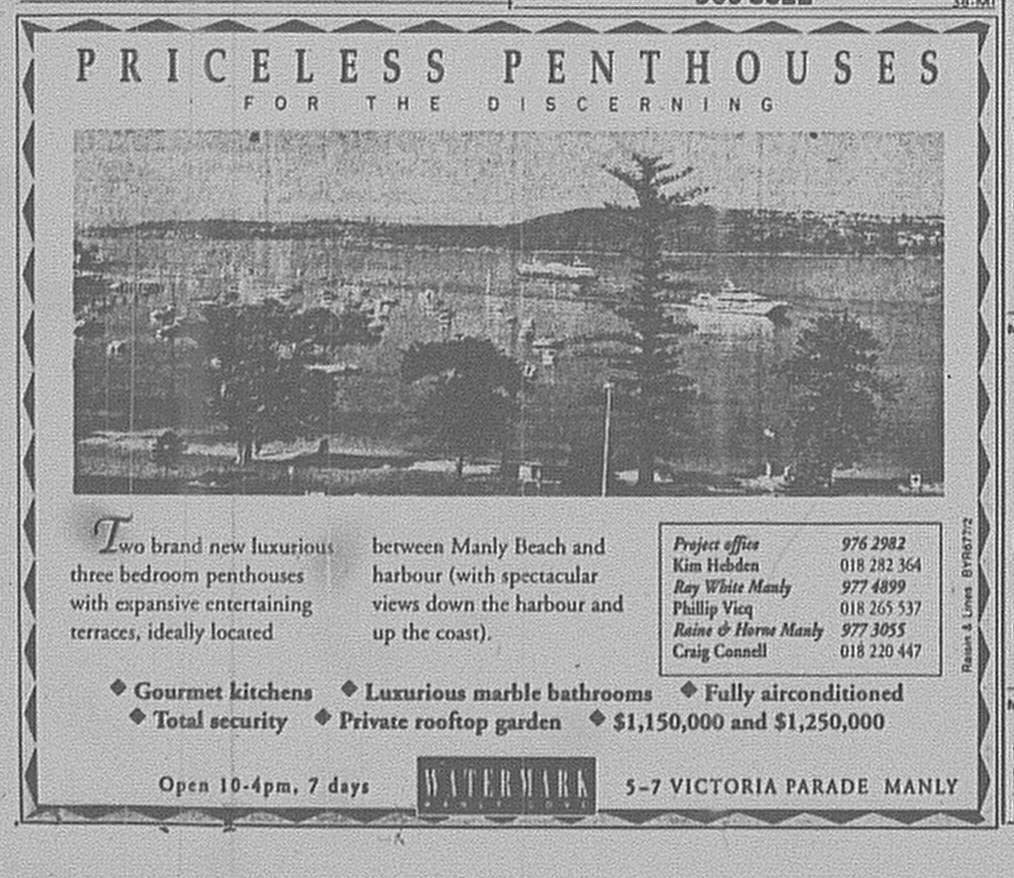
Property Advert of the Week: Watermark Manly Cove (1995)

This week, we head over to Manly. 5-7 Victoria Parade had two luxurious penthouses on offer for either $1.15 million or $1.25 million in 1995.

Watermark Manly June 24 1995 SMH 80 

Source: Anon. 1995. "Watermark Manly Cove" (Advertisement). The Sydney Morning Herald, June 24: 80.

The apartments are located two blocks from The Corso and Manly Wharf . Beaches were short stroll away on either side with views of Manly Cove and the Sydney CBD on offer. 

One of the two apartments advertised was reportedly sold for $5.5 million last year. 

Saturday, 8 June 2019

Property Advert of the Week: 7 Osborne Road, Manly (1966)

Below is an advertisement from 1966 promoting units in the "Hirondelle" complex at 7 Osborne Road in Manly.


Source: Sheila Merry. 1966. "Manly...Home Units" (Advertisement). The Sun, October 7: 66. 

Monday, 30 July 2018

1982: The arrival of Sydney's Freshwater Class Ferries

The Manly Ferry Freshwater moored at Manly Wharf in 2011. Photo taken by the Author. 

The Freshwater Class Ferries at present are the pride of Sydney's ferry fleet as they operate on the Circular Quay to Manly run.

They have served us proudly since 1982, and acted as the replacements for the aging steamers which had served the run for nearly 70 years.

But how did we end up with them?

It began in 1971. The Manly run was privately run by the Port Jackson & Manly Steamship Company and not part of the Sydney Ferries Network. The company was bought by Brambles Industries. Brambles increased fares, reduced services and retired the Bellubera. It was intended that the Baragoola would also be retired during this time. For regular commuters, it was feared that Ferry services from the city to Manly may be scrapped altogether.

At the time, patronage on the Manly run was decreasing due to increased car ownership, completion of new Spit Bridge in 1958 and the introduction of direct bus services from the Manly-Warringah region to the city.

Two years later (1974), the NSW Government assumed control of the Manly run.

However the Government wanted only two of the three steamers to operate - Baragoola, North Head and South Steyne. When the South Steyne was destroyed by a fire in August 1974, only two steamers were left.

During the decade, the cost of servicing the steamers had become a concern. With two steamers, no ferries were available in the event of a breakdown or if withdrawn for maintainence. Two Lady Class Ferries - Lady Wakehurst & Lady Northcott (both now retired) were reconfigured for the Manly run during their construction.

In 1975, it was announced by NSW Transport Minister Wal Fife that two new Manly Ferries would be in operation within three years.

The election of the Wran Government in 1976 led to the ideas that would shape the Freshwater Class Ferries, though construction did not begin until 1980:

  • Twin hulls to allow for an easy turnaround and to accommodate the swells as they cross the Harbour Heads.
  • Capacity for 1200 (slightly lower than the steamers).
  • Mechnical Gangways (Required upgrades to wharves at Circular Quay and Manly to accomodate them. It meant that they could be configured according to tide levels.

The Freshwater was the first ferry to enter service in December 1982. This was followed by the Queenscliff (1983) , Narrabeen (1984) and Collaroy (1988). The remaining steamers were withdrawn with the Baragoola in 1983 and North Head in 1985. 

The Collaroy was unique in that was configured to operate ocean cruises, which it did between 1988 and 1991. It has since been reconfigured for harbour services only. The Collaroy also managed to have open air decks on its second level, which were eventually phased onto the remaining member's of the fleet in the early 2000's.

The anticipated growth in patronage did happen and has established itself as it as "must do" for any tourist to Sydney, providing a cheap way to explore Sydney Harbour. On board, one will receive a comfortable experience. Recent renovations have resulted in contemporary furniture, free Wifi and even TV screens to catch up on your favourite show.

Upgrades to the Freshwater Class have improved commuter comfort. Photo taken by the Author (2011) onboard the Freshwater
As for when they will retire? Thats unknown. Will we see a 5th member join or will they ultimately be taken over by a new class. The old steamers lasted up to 70 years before they sailed into history.

Monday, 12 June 2017

1974: The end of the Manly Harbour Pool

Manly's famous Harbour Pool had served the people of Sydney well since 1931, but in May 1974 it fell victim to the 'Sygna' Storm.

The bathing closure was located to the west of Manly Wharf and its walkway allowed a person to walk directly from the wharf to Marineland (Oceanworld). It even had a popular diving board and floating platforms for swimmers.

On the Weekend of May 25 and 26 1974, the harbour pool was battered by strong swells as the 'Sygna' Storm pummelled the NSW coast. The swells had surged through the heads causing chaos in harbourside suburbs.

The damage occurred during the evening of May 25 when the worst of the storm unleashed its fury. It was not until daylight that the magnitude of the damage became apparent. Page 1 of The Manly Daily on May 28 1974, summarises the carnage.


Much of the walkway had completely collapsed into Manly Cove and had washed up onto the beach. Whatever was left had buckled. Within weeks, the remnants had been demolished. Page 16 from the same edition of the paper published the famous photo of the buckled remains of the walkway.
  

 A netted swimming enclosure replaced the harbour pool which remains to this day.

There have been calls to rebuild the harbour pool such as in 1984 but was deemed to be "cost prohibitive". However in 2012, a group lodged their case for the rebuilding of the harbour pool, but with an eco-friendly twist that preserved the aquatic environment yet encouraged tourism.


Monday, 8 May 2017

1990: The Jetcats enter service

In 1990, the Greiner Government introduced the Jetcat ferries into operation on Sydney Harbour. This stemmed from the decision of NSW Transport Minister Bruce Baird in 1988 to replace the aging
hydrofoils.


Source: Nicholson, L. 1988. "Costly hydrofoils will be scrapped". The Daily Telegraph, August 22: 9.

The Jetcats promised a modern and more reliable service for Ferry Commuters. For the government, the costs of servicing the Jetcats would be lower. In addition, there was the promise of more comfort for commuters. There were plans to eventually expand the service to Gladesville but also operate as far as Port Kembla and Newcastle.


Source: Morris, L. 1990. "Jetcat to oust the hydrofoils". The Daily Telegraph, April 30: 15. 

The first Jetcat to enter service was The Blue Fin. It ended up with its name after the public was asked to name the new ferry.


Source: Anon. 1990. "Blue Fin slices time to Manly". The Sunday Telegraph, April 29: page unknown.


Source: State Transit. 1990. "Name Your Own $5m. Catamaran" (Advertisement). The Daily Telegraph, March 21: page unknown. 

The Blue Fin commenced operation on July 16, 1990, after three months of trials. Below is a preview article from The Daily Telegraph.


Source: Riddell, A. 1990. "Anchors away for new Jetcat". The Daily Telegraph, July 16: 12. 

 The hydrofoils after 26 years of service ran their last service in March 1991 after another two Jetcats - Sir David Martin and Sea Eagle were bought into service. During their first decade of service, The Jetcats were actively used. In fact, they were seen as a fifth ferry on the Manly run, replacing the regular ferries late at night and early in the morning. It was argued that with fewer crew required (and commuter demand), operating late night services would keep costs of operating the broader Manly Ferry service down. If existing ferries broke down, the Jetcat fleet would act as a substitute (as a trio), like in 2004 when two Manly Ferries - Collaroy and Queenscliff were out of service for maintenance. In the final years of service, Jetcats were restricted to peak hour operations only.

Sadly, The Jetcat fleet had a shorter life than their predecessors. Jetcats were withdrawn from service on December 31, 2008. It was argued that costs had increased along with declines in revenue. They were lucky not to have been pulled out of service earlier, when the Carr Government (1995-2005) introduced Supercats to the Sydney Ferries Fleet but had struggled to cope with the swells at the Heads of Sydney Harbour. Manly Fast Ferries (2009) currently operate High-speed services between Manly and Circular Quay, but have expanded to provide services from Manly to North Sydney, Darling Harbour, Pyrmont Bay, and the Eastern Suburbs. Sydney Fast Ferries also operated services between 2010 and 2015, when they were the tender to operate the high-speed service.

Monday, 5 January 2015

1965: The Manly... Sydney's first Hydrofoil


Source: Anon. 1965. "A Newcomer and a Veteran." The Sydney Morning Herald, January 8:1.

This Wednesday, it will be fifty years since the start of a public transport revolution in Sydney and bought the Manly Peninsula closer than ever to Sydney.

On January 7 1965, the first hydrofoil went into service on Sydney Harbour between Manly and Circular Quay. It was known as the "Manly", named after the suburb the hydrofoil was to serve.

Why a hydrofoil service? In the 1960s, the Manly-Circular Quay ferry service was privately run by the Manly & Port Jackson Steamship Company. Its fleet of ferries was ageing and at the same time, it needed to increase patronage on the route.

It came up with the idea of offering a premium high-speed service and a hydrofoil would be its answer.

For 128 000 pounds, they acquired the "Manly". It had seating for 72 people. This was only half the capacity of the five hydrofoils that would join in the following years, and less than a third of the capacity of it's 1980's namesake and the "Sydney", which joined the fleet at that time.

It was built in Japan by Hitachi and arrived in Sydney on December 31, 1964.


Source: Anonymous. 1965. "Introducing... The Manly Flyer." The Daily Telegraph, January  1:3. 


Source: Anonymous. 1965. "Hydrofoil High-Jinks: Exciting New Vessel Skims Over Harbor." The Daily Telegraph, January 2: 3. 

When it began service, commuters found that the trip took only 15 minutes, compared to 30-35 minutes for the regular ferries. As it was the only hydrofoil, it only operated at peak times.

Curious Sydneysiders queued up to experience it for themselves on the first day of operation on January 7, 1965. Special harbour excursions were organised to allow the public to experience the new ferry before commencing the first commuter services that evening.


Source: Anonymous. 1965. "1000 Take trips in Hydrofoil." The Daily Telegraph, January 8: 3. 

When the Fairlight arrived the following year, the Manly spent the first three months of 1967 doing cruises around Port Phillip Bay in Melbourne. That failed, and she returned to Sydney, rejoining the fleet.

It operated until  1979 when it was sold. It ended up operating on the Great Barrier Reef and today is believed to be a cafe on the shores of the Murray River minus its foils.

An interesting fact was that the hydrofoil itself was allowed to operate as far south as Jervis Bay and as far north as Port Stephens.

The hydrofoils would be a presence on Sydney Harbour for a quarter of a century until 1991 when they were retired from service following the introduction of their successors - The Jetcat's. However, the Jetcat's did not survive as long. They were removed from service on New Year's Eve, 2008 and Sydney Ferries (who took control of the Manly services in 1974) did not replace them.

Instead, the State Government decided to allow private operators to operate the high-speed service. This returned the route to what it was back in 1965, privately operated. Manly Fast Ferries (operated by Bass & Flinders Cruises) commenced their service in 2010, followed by Sydney Fast Ferries the following year. However, Sydney Fast Ferries is the official operator (since 2011) and has access to the public ferry berths at Circular Quay and Manly. Manly Fast Ferries did have space in 2010-11 before having to hand over space to Sydney Fast Ferries. The downside to this is that the operators are allowed to set their own fares and don't accept Opal Cards.

Even with the turbulence that the Manly Ferries have had over the decades, those living on the northern beaches are very dependent on their ferries, not to mention loyal. For some, paying that little extra to get to and from work each day makes a big difference in their day, whether it may mean getting to work on time, or home to spend time with the kids at the end of the day.

And there is a choice as well. Some are happy with the regular service and for many a chance to see and enjoy their harbour.

Finally, here is a newsreel feature from 1965 on the hydrofoil.

Monday, 6 October 2014

NEVER BUILT SYDNEY: Manly Wharf Transport Interchange Terminal (1969)

Back in june, I shared with you a plan to redevelop Manly Wharf with a high rise hotel. Here is a proposal from 1969 that called for a major transport interchange at Manly Wharf to replace the existing facilities. Apart from wharves and a bus terminal, they wanted also wanted helipads and a railway station. It mentions that the railway station would serve a heavy rail line running north from Manly to Newport.


Source: Anonymous. 1969. "Manly's next front door? Crisis on North Shore, says MLA ," The Daily Telegraph, March 18: 9.

Monday, 30 June 2014

NEVER BUILT SYDNEY: Manly Wharf's highrise tower (1996)

It has been the dream of some to build highrise at Manly Wharf like this plan floated back in 1973 by Manly MP Douglas Darby.


Source: Owens, W. 1973. "Mr Darby builds a travel dream: Rocket trains to Manly," The Sun Herald, October 21:39. 

But moving two decades later, Manly Wharf Pty Ltd led by Robert Magid had a six storey hotel planned for the famous wharf with about 200 rooms. He also wanted to upgrade the retail complex, which had opened just six years earlier (2 level complex).


Source: Morris, L. 1996. "Opponents of wharf plan 'parochial'," The Sydney Morning Herald, June 17: 9. 


Source: Smith, F. 1996. "Wharf hotel lands Magid in hot water". The Australian Financial Review, June 19, 41.

Sue Sacker, Mayor of Manly Council did not support the concept opting for a two-level hotel. She felt there were too many rooms despite arguments from Magid that 200 rooms were needed to make it financially viable. In addition, she was concerned about the influence of developers in Manly. Yet council wanted to rejuvenate Manly particularly the Corso. I look at the scheme and six storeys isn't that high when you compare it with other high rises in Manly not to mention nearby buildings. The benefits were there for Manly including more hotel accommodation and that also helps tourism within greater Sydney. Federal Tourism Minister John Brown was right about the NIMBY sentiment expressed by locals given people wanted to visit the area and needed to "share".

By December, the hotel height was scaled back with the hotel to be two storeys except for a section of the site where six floors would remain.


Source: Skelsey, M. 1996. "Developer enlists sports stars to help sell proposal to residents: $40m hotel for Manly Wharf," The Daily Telegraph, December 14:17. 

Unfortunately for Mr Magid, Manly Council knocked back the development application. In 1996, they had passed a development control plan that regulated development around Manly Cove. State Legislation was put forward (and passed) the following year by Independent MP Dr Peter McDonald which was known as the Manly Cove Development Control Bill.

The only change that happened to the wharf was an upgrade of existing facilities and that it is now the single level we see. Aldi is an anchor tenant and retailers cater primarily to a commuter crowd. There are bars like the Manly Wharf Hotel and Bavarian Bier Cafe to cater to visitors and locals alike.


But I ask the "What if" question had this been approved by Manly Council. I think there would have been engineering challenges in building this project and the cost of building would have been a big challenge. The financial viability of the developer would have come into question and perhaps it was another fantasy scheme like the one from 1973.

For the time being, high rise above Manly Wharf will be nothing but a fantasy.

Updated November 10 2018 with rescan of article.