Monday, 12 June 2017

1974: The end of the Manly Harbour Pool

Manly's famous Harbour Pool had served the people of Sydney well since 1931, but in May 1974 it fell victim to the 'Sygna' Storm.

The bathing closure was located to the west of Manly Wharf and its walkway allowed a person to walk directly from the wharf to Marineland (Oceanworld). It even had a popular diving board and floating platforms for swimmers.

On the Weekend of May 25 and 26 1974, the harbour pool was battered by strong swells as the 'Sygna' Storm pummelled the NSW coast. The swells had surged through the heads causing chaos in harbourside suburbs.

The damage occurred during the evening of May 25 when the worst of the storm unleashed its fury. It was not until daylight that the magnitude of the damage became apparent. Page 1 of The Manly Daily on May 28 1974, summarises the carnage.


Much of the walkway had completely collapsed into Manly Cove and had washed up onto the beach. Whatever was left had buckled. Within weeks, the remnants had been demolished. Page 16 from the same edition of the paper published the famous photo of the buckled remains of the walkway.
  

 A netted swimming enclosure replaced the harbour pool which remains to this day.

There have been calls to rebuild the harbour pool such as in 1984 but was deemed to be "cost prohibitive". However in 2012, a group lodged their case for the rebuilding of the harbour pool, but with an eco-friendly twist that preserved the aquatic environment yet encouraged tourism.


Saturday, 10 June 2017

Property Advert of the Week: Moore Park Gardens (1999)

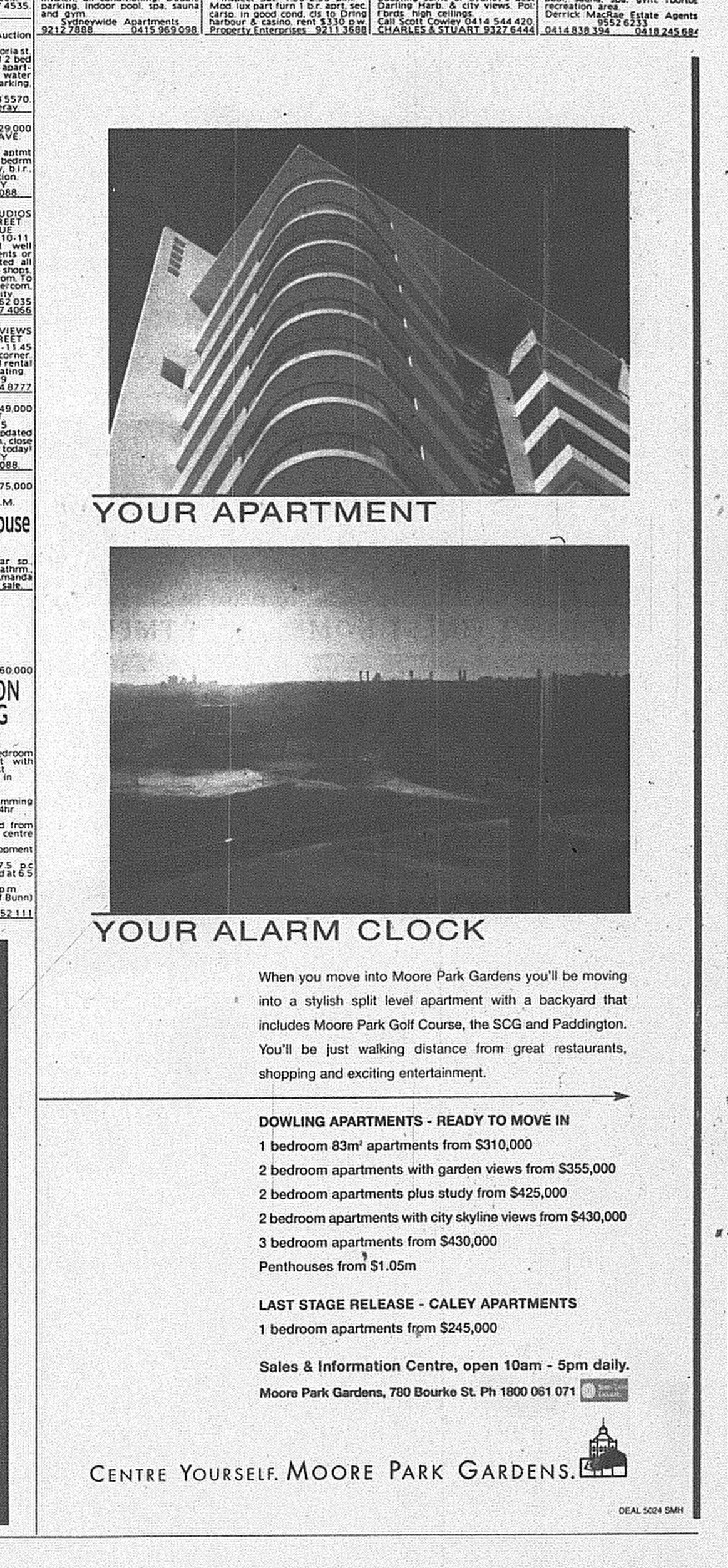
This week, I share an advertisement from 1999 for the Moore Park Gardens complex at Redfern East. 

Moore Park Gardens June 5 1999 SMH 19RE

Source: Jones Lang La Salle. 1999. "Your Apartment...Your Apartment Clock". The Sydney Morning Herald, June 5:19RE (Real Estate Liftout).

Monday, 5 June 2017

1971: The forerunner to the Proposed Wynyard Pedestrian Network

Back in 2014, I shared an article in relation to the proposed double-decker pedestrian walkways for Wynyard in 1972.

I have found a clipping from the previous year that featured in The Sydney Morning Herald when the proposal was tabled with Sydney City Council which shows an even more extensive network of walkways than what has eventuated.


Source: Frizell, H. 1971. "New deal for hurried Harold". The Sydney Morning Herald, November 2: 9.

For instance, there would have been a second underground walkway under George Street near Martin Place. Australia Square was envisioned to be linked (it never did) through to Wynyard. Even the walkways under the Western Distributor were to form the network. Sadly the Western Distributor walkways were never connected. It was envisioned that the old tram tunnels under Wynyard would be a pedestrian underpass. As we know it is a parking station today. We also get a mention of a proposal to close Pitt Street from King to Park Streets between 12pm and 2pm. We did get a 24/7 pedestrian mall in Pitt Street (From King to Market Streets) in 1987.


Saturday, 3 June 2017

Property Advert of the Week: Rockwall Gardens (1997)

This week, we head to Potts Point. In 1997, apartments were for sale in the Rockwall Gardens complex in Macleay Street. 

Rockwall Gardens Ad SMH May 24 1997 15RE

Source: Colliers Jardine. 1997. ""Rockwall Gardens" (Advertisement). The Sydney Morning Herald, May 24:  15RE (Real Estate Liftout). 

Monday, 29 May 2017

1992: Introduction of Sunday Trading

Last week, we explored the introduction of Saturday afternoon trading in NSW in 1984. As the decade rolled on, pressure was being applied by some retailers to allow shops to trade on a Sunday. A number of major retailers had been flouting a loop hole in trading laws to allow them to trade.

This was led by Electrical and Whitegoods chains like Harvey Norman and Norman Ross. the argument was simple - Sunday provided time for people to buy goods that they needed for their homes.

Meanwhile, illegal Sunday trading continued as The Sydney Morning Herald highlighted in 1985. Hardware chains were trading on Sundays in order to compete with smaller operators, who were allowed under legislation to trade.


Source: Howlett, S. 1985. "Sunday Trade is Booming". The Sun Herald, April 2: 28. 

By late 1987, Premier Barrie Unsworth announced that he would explore allowing Sunday trading in parts of Sydney. The Greiner Government was elected the following year and took it a step further. It deregulated retail trading hours from Monday to Saturday. Furniture, Electrical and Hardware Stores were permitted to trade from 10am to 4pm on Sundays.


Source: Taylor, T. 1988. "The shop counter revolution". The Sunday Telegraph, October 23: 4. 

Other retailers could exemptions from Sunday trading laws. In 1988, Grace Bros was allowed to open their CBD store on a Sunday. It had become the first department store in Australia to trade on a Sunday. 


Source: Coles Myer Ltd. 1988. "Our City Store is open Today and Every Sunday 10am-4pm (Advertisement). The Sunday Telegraph, December 11: 30 & 31. 

However they were unsuccessful in gaining approval for another six of their stores to open.


Knowles, C & Bowditch, D. 1988. "Grace Bros bid to open Sundays". The Daily Telegraph, November 16: 8. 

The Sydney Morning Herald did foresee that Sunday trading for all retailers was inevitable as shown in this editorial from late 1988.

In December 1989, retailers were given permission to trade on the two Sundays leading up to Christmas, after successfully persuading the NSW Government to change its decision on keeping shops closed. I posted them in a Christmas feature several years back if you wish to browse through them. The public voted with their feet (and wallets).

This was repeated through 1990 and 1991.

During 1992, Sunday Trading was introduced throughout Sydney. It began with major shopping centres or retail precincts like the Sydney CBD, Parramatta, and Chatswood and expanded through regions across the metropolitan area. By the end of the year, Sunday trading was available in all suburbs. The argument by big retailers was that it was shoppers, not the law that should determine when a shop should be open. The State Government also passed legislation that finally led to deregulation of standard retail hours.

For your interest, I have also included another editorial relating to Sunday trading as The Sydney Morning Herald saw it in 1992.

For the first time too, Post Christmas sales could also commence on a Sunday as December 27 was the first day that trade could be allowed after Christmas. It happened that December 27 fell on a Sunday that year.

When you look at Sunday trading 25 years later, shoppers have voted with their feet. How hard is it to find a place to park your car on a Sunday if you are at a major shopping centre? There are some that would prefer that the shops still stay close on a Sunday on either religious or social grounds i.e. give time for people to be with loved ones, but its each of us that has the choice.

Sunday Trading was generally between 10am and 4pm, though it has now been extended to 5pm. Supermarkets and other major retailers initially had to stick to those hours, but gradually were relaxed.


Saturday, 27 May 2017

Property Advert of the Week: Plaza Apartments Rockdale (1997)

Here is a treat for those in southern Sydney this week - An old advertisement for the first tower in the Plaza Apartments in Rockdale in 1997. For those of you not familiar with southern Sydney, the Plaza Apartment towers are located directly above Rockdale Plaza. It is actually one of the first shopping centres in Sydney where apartment blocks were built directly above the complex.


  Plaza Apartments Rockdale Ad May 24 1997 SMH 27RE

Source: City Freeholds. 1997. "Plaza Apartments" (advertisement). The Sydney Morning Herald, May 24: 27RE (Real Estate Liftout). 

Monday, 22 May 2017

1984: Introduction of Saturday afternoon retail trading

Older readers would recall well the days when shops were required to shut at noon on a Saturday and in shops and shopping centres across the city, the battle was on to get the shopping done in the morning.

I would love those readers to share their stories of those battles.

By the 1980s, retailers had found loopholes in trading law that had allowed them to trade seven days a week provided that they were a "small" business. However, if a major retailer sold identical goods on a Sunday, they could be fined. Shoppers wanted more time to shop as well.

Electrical and furniture stores like Harvey Norman, Joyce Mayne, and Norman Ross were trading on Saturday afternoons and Sundays, yet were not subject to prosecution under state law.  If Grace Bros, Waltons or David Jones opened during those hours, they would be prosecuted.

This was used by the unions to oppose further extensions to trading hours.

In 1983, the State Government passed legislation to allow all retailers to trade on a Saturday afternoon along with a second evening of late night trading during the week. It was proposed to be implemented from February 1984, but it was not until August that retailers were allowed to trade on Saturday afternoons.

The winners from extended trading hours were:

  • Shoppers - No need to rush on a Saturday to complete their shopping. They could take their time to purchase, but also have more options.
  • Major retailers - Opportunities to earn more income, even if it meant that the costs of operating stores were higher.
The losers were:
  • Retail workers - Unions argued that workers would lose time to spend with their families and even threaten full-time jobs. From an employment perspective, however, there would be scope for more jobs to be created. Longer hours would increase the demand for labour.
  • Small businesses - With fewer employees, small businesses like corner shops could trade on Saturday afternoons and Sundays without competition from big retailers.
The Sydney Morning Herald wrote a feature following the first weekend of Saturday afternoon trading in August 1984, and for small businesses, it wasn't a good day. Shoppers seemed happy though.

Source: Hill, R. 1984. "Big stores happy, but not the small shops". The Sydney Morning Herald, August 13: 3. 

However, one exception was David Jones, who decided to introduce Saturday afternoon trading from the following Saturday (August 18).

With retailers allowed to trade all day Saturday, the push would soon be on for trading on Sundays.


Saturday, 20 May 2017

Property Advert of Week: Tulong Place, Gymea Land Auction (1972)

This week, I share an advertisement for blocks of land in Tulong Place, Gymea, dating back to 1972.

  
Source: Harvey Real Estate (Caringbah) Pty. Ltd. 1972. "Land Auction". The St George and Sutherland Shire Leader, October 4: 62.

Monday, 15 May 2017

1997: M2 Motorway opens to the Public

In 1997, those in the booming North West suburbs now had a motorway that would make travel much easier, but yet they were reluctant to use it despite the reductions in travel time that it promised.


Source: Hilferty, T & Walsh, P. 1997. "M2 Chaos: Traffic anger as tollway opens". The Daily Telegraph, May 26: 1 & 2. 

 And then there were those who opposed it because it involved the loss of trees and vegetation. They were vocal from the planning stages and even on opening day wanted to spoil the celebrations. While for others, it was the fact one had to pay for the toll ($2.50).

Three months later, people still stayed away.

  
Source: Gibson, B. 1997. "Going nowhere fast". The Daily Telegraph, August 9: 15. 

Eventually, the motorway did fill up with traffic and would form a piece of the Sydney Orbital network. Early in 2006, the M7 allowed drivers on the M2 a direct link through western Sydney down to the M5 Motorway and Hume Highway. In 2007, the Lane Cove Tunnel connected the M2 to the Gore Hill and Warringah Freeways.

During 2011 and 2013, an additional lane was added in each direction with improvements to on and off ramps.

Currently, the NorthConnex Project will connect the M2 Motorway to the M1 Motorway. This will be completed in 2019. Drivers will no longer need to use Pennant Hills Road or the Pacific Highway if driving in or out of Sydney.

Saturday, 13 May 2017

Property Advert of the Week: Wattle Grove (1992)

Some time ago, I posted an advertisement for new homes at Wattle Grove dating to 1995. This week, here is another advertisement for Wattle Grove, dating back to 1992.

Wattle Grove Ad January 18 1992 Daily Telegraph 50

Source: Wattle Grove. 1992. "Total Lifestyle on Display Now". The Daily Telegraph Mirror, January 18: 50.