I was five years old in 1989, but too young to understand the talk about Sydney's dirty beaches at the time. Older readers might remember the weekly beach reports telling you if it was clean to swim or not. I have a number of clippings that talk about the issue.
During 1989, beach pollution had become a major issue with swimmers complaining of various infections that resulted from swimming in the water.
Source: Mealey, E & Craig, O. 1989. "Beachside doctors tell of surf victims". The Sun Herald, March 12: 6-7.
Surfers were also prepared to boycott events at Sydney beaches and even lifesavers were unwilling to rescue swimmers.
Source: Feneley, R. 1989. "Surfies boycott Sydney's oceans of filth". The Daily Telegraph, January 7, page unknown.
At the time the deep water ocean outfalls were under construction at the Sewage treatment plants at North Head, Bondi & Malabar. Instead of sewage being directly discharged into the sea from the cliff tops, the sewage would be pumped through pipes that extended to four kilometres off the coast. The sewage would be diluted and dispersed further out to sea.
These works had been commissioned by the Water Board in 1984 in response to the rising occurrence of pollution at Sydney beaches. The clifftop pipes meant that the effluent easily washed onto city beaches, making it unsafe for swimming. Currents sent it drifting up and down the coast resulting in pollution at other beaches.
Below is an advertisement educating the public on the ocean outfalls.
Source.: Water Board. 1989. "We are committed to ending pollution of Sydney's beaches (Advertisement)". The Daily Telegraph, January 16, 12.
A Waterboard Study during that year found that only one beach was safe for swimming. It was Elouera at Cronulla. South Curl Curl Beach was the most polluted.
Source: Olsen, S. 1989. "Pollution report lists just one clean beach". The Daily Telegraph, November 24, 3.
The outfalls at Malabar was completed in September 1990, North Head in December 1990 and Bondi in September 1991.
Since then, water quality at Sydney beaches has improved dramatically as the sewage is less likely to be swept onto the beaches.
It was interesting this past week to have a look at the Beachwatch reports online and noting that the coastal beaches were generally safe for swimming with the exception of Boat Harbour due to the possibility of contamination.
However though when it rains, you are generally advised to avoid swimming for a day at coastal beaches (two days elsewhere) due to stormwater run-off.
I have other clippings, and hopefully in the future can comment further and add to what is here.
Monday, 8 June 2015
Saturday, 6 June 2015
Property Advert of the Week: Bridgeport Ad (1997)
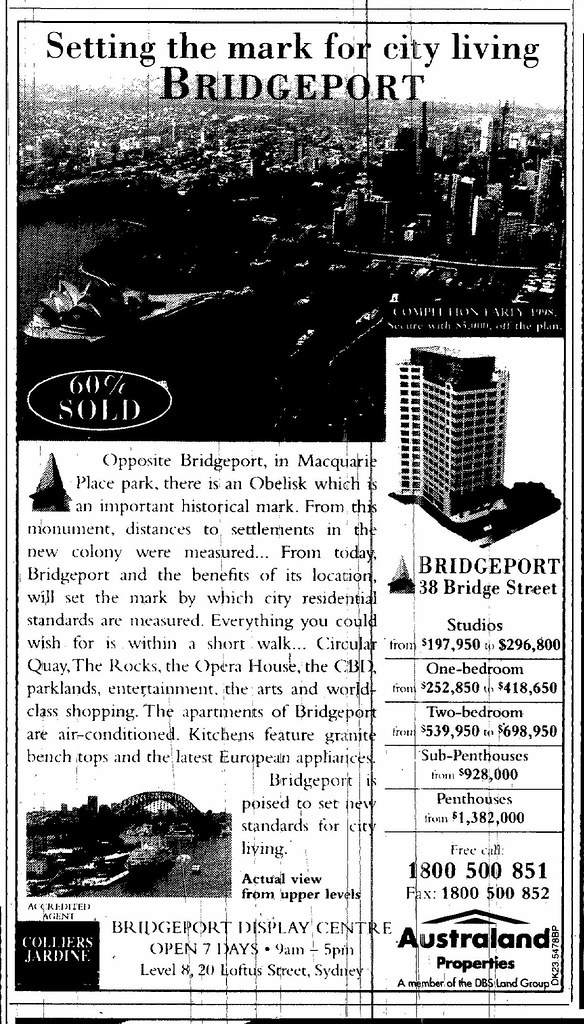
This week, our property advert of the week is for the Bridgeport Apartments at Bridge Street in central Sydney from 1997. Apartments were selling solidly in the tower. As of July 1997, 60 % of apartments had been sold. Studios started at just under $200 000, with Penthouses on sale from $1.382 million.
Source: Australand Properties. 1997. "Setting the Mark for City Living Bridgeport (Advertisement)". The Sydney Morning Herald, July 5: 14 [Real Estate lift out].
Monday, 1 June 2015
1967: Rare photo of the view from level 43 of Park Regis
In 1968, the Park Regis building was completed and was the first major high-rise apartment tower to be built in the Sydney CBD. This week, I share a photo of the view from the tower when it was under construction in 1967, showing the spectacular view looking north from level 43. Obviously, that view has been blocked as city towers rose in the decades that follow.
Source: Anonymous. 1967. "View from the 43rd floor". The Daily Telegraph, November 4: 3.
I have managed to collect some material on the tower itself, yet have struggled to find reports relating to the initial proposal. At this stage, I cannot provide a more comprehensive feature.
In the 1960's there was a push to encourage unit development in central Sydney which was largely commercial, particularly in the southern sections of the city. Unit development in the Sydney CBD didn't begin to gain momentum until the 1980s.
At the time of completion it did break some records for its time:
Source: Anonymous. 1967. "View from the 43rd floor". The Daily Telegraph, November 4: 3.
I have managed to collect some material on the tower itself, yet have struggled to find reports relating to the initial proposal. At this stage, I cannot provide a more comprehensive feature.
In the 1960's there was a push to encourage unit development in central Sydney which was largely commercial, particularly in the southern sections of the city. Unit development in the Sydney CBD didn't begin to gain momentum until the 1980s.
At the time of completion it did break some records for its time:
- Tallest residential building in the southern hemisphere - 45 levels or 136 metres tall. It held the record until 1983 when the 47 level Peninsula Towers at Surfers Paradise, Queensland took the record by one metre (137 metres tall).
- Second tallest building in Sydney after Australia Square Tower (46 levels, 170 metres tall).
- Remained the tallest apartment tower in Sydney until 1996 when the 46 level (168 metres tall) The Peak Apartment tower was completed at Haymarket.
Saturday, 30 May 2015
Property Advert of the Week: 1 Hosking Place (1996)
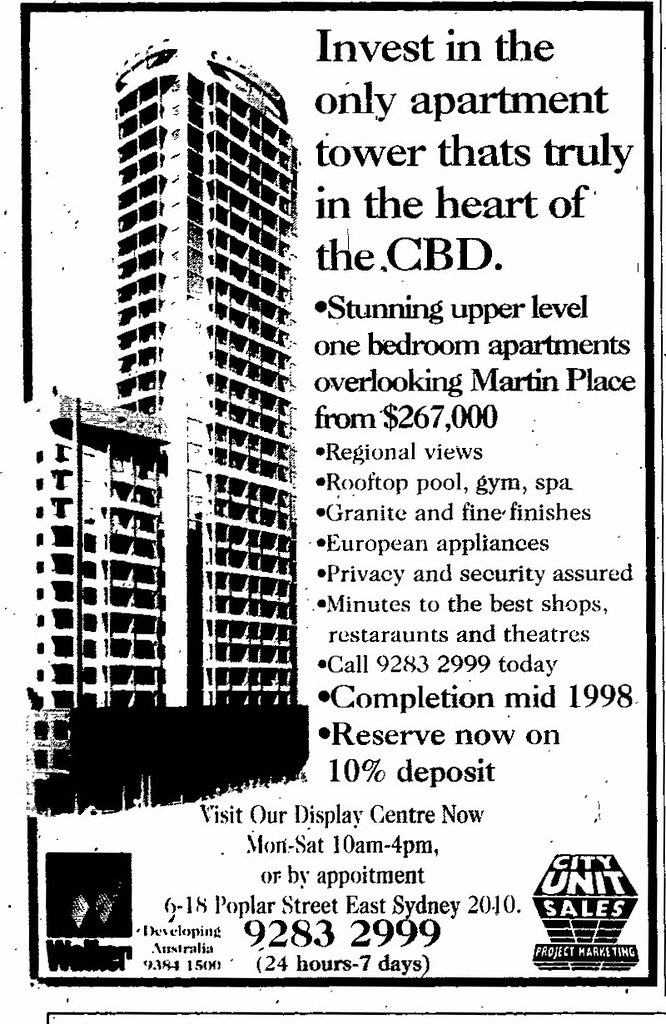
This week's property advert takes us to 1996, when apartments in 1 Hosking Place (just behind Martin Place) were on sale for those who needed an abode in the heart of Sydney's financial district. Apartments were selling off the plan from $267 000.
.
Source: Walker Corporation. 1996. Untitled (Advertisement). The Sydney Morning Herald, November 9: 21 (Real Estate Liftout).
.

Source: Walker Corporation. 1996. Untitled (Advertisement). The Sydney Morning Herald, November 9: 21 (Real Estate Liftout).
Monday, 25 May 2015
SYDNEY TRANSPORT: Captain Cook Bridge Opens (1965)
| The Captain Cook Bridge as seen from Taren Point. The gates to the former punt are still there five decades later. |
On Friday (May 29), it will be fifty years since the Captain Cook Bridge was officially opened. Before 1965, there was only one bridge spanning the Georges River that linked the Sutherland Shire with Sydney - Tom Uglys Bridge at Sylvania. The original three-lane bridge was opened in 1929. Two punts were also in operation. One was downstream at Sans Souci at the end of Rocky Point Road, linking the suburb with Taren Point. There was also the Lugarno Ferry at Lugarno.
The end of World War II fuelled a population boom in the Sutherland Shire. The land was subdivided into new housing estates. By 1961, the region had a population of 112,000. Yet there was one road crossing. At Tom Uglys Bridge, Sylvania motorists were forced to wait in long queues to access the bridge, particularly at weekends. Each lane was carrying as much, if not more, traffic than a typical lane on the Sydney Harbour Bridge.
The St George and Sutherland Shire Leader was first published in 1960, and its lead story on its launch edition on June 29 1960, called for a bridge to replace the punt at Sans Souci. It would form a section of the proposed (and still is) Southern Expressway linking Wollongong with Sydney.
|
|
| Page 1 of the first edition of The St George & Sutherland Shire Leader in June 1960 was calling for a new crossing over the Georges River. |
Source: Anonymous. 1961. "Jumping-off Point". The St George and Sutherland Leader, August 9: 1.
Construction began in 1962. John Holland was named as the winning tender.
Source: Anon. 1962. "New Bridge Goes Up". The St George and Sutherland Shire Leader, July 25: 1.
Here is a photo of construction from 1964 taken by Craig Birdsell as seen from Sylvania.
Source: Birdsell, Craig. 1964. "Untitled (Photograph)."
Just months before opening, the spans met.
Source: Anon. 1965. "Bridging Distance". The Daily Telegraph, January 14: 11.
Below is a rare aerial of the completed bridge and punt taken days prior to the bridge opening.
Source: Anonymous. 1965. "Named for Captain Cook". The Daily Telegraph, May 27, 5.
The bridge was opened to traffic on May 29 1965, after it was officially opened by NSW Governor Sir Eric Woodward. Five thousand people attended. A number of plaques were unveiled. They are located at both ends of the bridge and in the middle of the bridge.
The public was invited to walk over the bridge before motorists could finally use the bridge. In fact, that afternoon, the normally busy Tom Uglys Bridge was deserted as people wanted to see the new road for themselves, leading to significant congestion on the bridge approaches which lasted for the entire weekend.
Source: Anonymous. 1965. "Having a Look at the Bridge". The Daily Telegraph, May 31: 7.
On that same day, the punt operated for the last time before being move upstream to Lugarno where it provided the punt service until 1974, one year after the opening of the Alfords Point Bridge.
I've also included the front page from The Propeller, which I scanned several years back to mark the opening of the bridge.
Updated November 2018 with the addition of a newspaper clipping.
Saturday, 23 May 2015
Property Advert of the Week: Lend Lease Housing Village Advertisement (1962)
Here is a property advertisement straight out of a local rag (St George and Sutherland Shire Leader) from 1962. Though the demonstration village was out at Carlingford, locals in Sydney's south were given an invitation to check out the homes that they could build, including the three-bedroom Beachcomber.
Source: Lend Lease Homes. 1962. "Lend Lease Homes at the 1962 Demonstration Village Carlingford (Advertisement)". The St George and Sutherland Shire Leader, February 1: 10.
Monday, 18 May 2015
1994: Rap Jumping in Sydney
For a while in the 1990s one building in Kings Cross was happy for people to let people engage in rap jumping where they abseil down a building as if they were walking, abelt at a 90-degree angle. It was at the Hotel Crest (currently Hotel Mercure Sydney Potts Point). The concept of rap jumping was used by Australian troops in the Vietnam War and allows gunmen to fire while abseiling down a cliff. Macka Mackail, a former SAS officer was operating the business.
However, if you want to rap jump off a building, Urban Central at Southbank in Inner Melbourne offers it, and from my knowledge, the only highrise building in Australia that currently offers it.
Source: Wockner, S. 1994. "Rap jumping craze is a full-frontal business." The Daily Telegraph, January 25: 5.
Saturday, 16 May 2015
Property Advert of the Week: The Wharf at Woolloomooloo (1997)
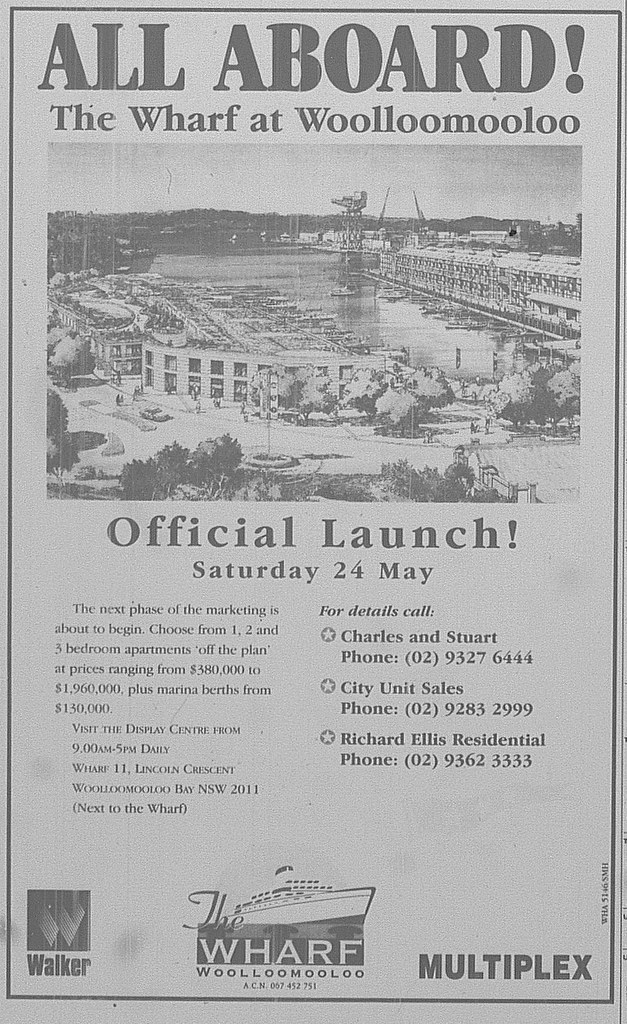
In 1997, apartments were placed on sale at Woolloomooloo's famous finger wharf as the building was converted into a hotel and residential complex. This is one of the official newspaper advertisements from that time promoting the official launch. Apartments started at $380 000.
Source: The Wharf Woolloomooloo. 1997. "All Aboard! The Wharf at Woolloomooloo (Advertisement). " The Sydney Morning Herald, May 24: 19 [Real Estate Lift out].
Monday, 11 May 2015
NEVER BUILT SYDNEY: Original Wales Bank Scheme (1964)
At the eastern end of Martin Place and directly opposite to the headquarters of the Reserve Bank of Australia is the Westpac Building.
Today I will share a clipping relating to the evolution of the building that occupies the site.
In 1964, a 20 level building was proposed, which would have been according to The Sydney Morning Herald as about the same height as the Reserve Bank Building directly opposite. It would have been a "giant" for Sydney but today would be a "dwarf" against the 70 and 80 levels that some Sydney towers are or will be.
Source: Anonymous. 1964. "Office Giant for City." The Sydney Morning Herald, November 6: 3.
However, in 1967, we saw the conception of the eventual design. The tower would end up being 30 levels or 119 metres tall.
Source: Anonymous. 1967. "381ft over Martin Place". The Daily Telegraph, December 8: 9.
It was completed in 1970 and would be the headquarters for the Wales Bank (rebranded Westpac) until 2006 when it relocated its headquarters to in Kent Street.
The building has been upgraded since. The podium was enlarged. Westpac still has offices in the complex. However, a development application has been lodged with Sydney City Council to demolish the structure and replace it with a taller tower. Hassall has designed a 35 storey (139 metre) tower. The tower would also overhang St Stephens Uniting Church, though the plans have been criticised by those associated by the Church.
Today I will share a clipping relating to the evolution of the building that occupies the site.
In 1964, a 20 level building was proposed, which would have been according to The Sydney Morning Herald as about the same height as the Reserve Bank Building directly opposite. It would have been a "giant" for Sydney but today would be a "dwarf" against the 70 and 80 levels that some Sydney towers are or will be.
Source: Anonymous. 1964. "Office Giant for City." The Sydney Morning Herald, November 6: 3.
However, in 1967, we saw the conception of the eventual design. The tower would end up being 30 levels or 119 metres tall.
Source: Anonymous. 1967. "381ft over Martin Place". The Daily Telegraph, December 8: 9.
It was completed in 1970 and would be the headquarters for the Wales Bank (rebranded Westpac) until 2006 when it relocated its headquarters to in Kent Street.
| The tower as seen from Sydney Tower. Photograph taken by the Author. |
![]() |
| The proposed tower to replace the existing Westpac Building. Sourced from the Skyscrapercity Forums. |
Saturday, 9 May 2015
Property Advert of the Week: Panania Golf Course Estate - Milperra (1967)
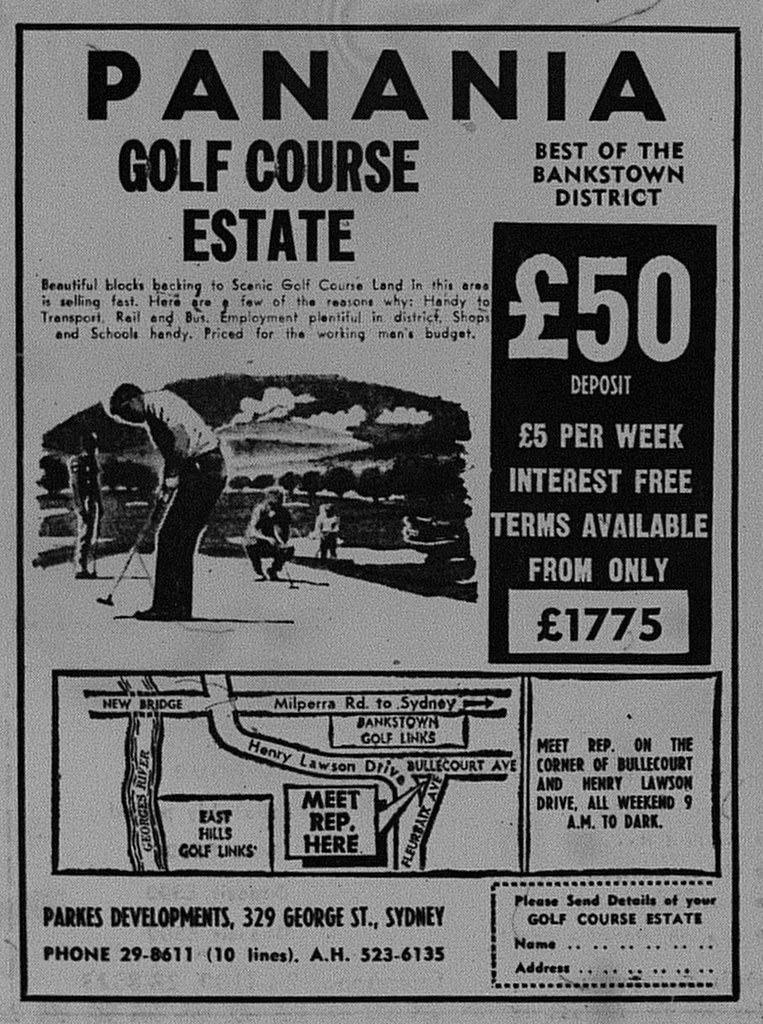
This week's property advertisement dates all the way back to 1967. This time it is from Milperra where blocks of land were on sale from 1775 pounds ($3550). In today's money that represents a bargain at $39 815 according to the RBA inflation calculator. The blocks back onto the Bankstown Golf Club. So going by this advertisement, the land for sale was in what is now Inghram Avenue, Whittle Avenue and Keysor Place in Milperra.
Note again, that in 1967 housing advertisements were allowed to be advertised in pounds as part of the transition from pounds to dollars in 1966 for a two year period.
Source: Parkes Developments. 1967. "Panania Golf Course Estate (Advertisement)". The Daily Telegraph, April 1: 41.
Subscribe to:
Posts (Atom)