Showing posts with label 1994. Show all posts

Monday, 24 March 2025

1994: Closure of the original Yagoona McDonalds

McDonald's Yagoona is Australia's first McDonald's restaurant, opening in 1971. It closed in 1994, following restaurants opening in Bass Hill and Bankstown, which took away business from the Yagoona store. In 2021, McDonald's reopened on the site, with a contemporary design incorporating historical elements from its first incarnation.

McDonalds Yagoona August 23 1994 daily telegraph 7

Source: Mason, D. 1994. "Original Macs faces the chop". The Sunday Telegraph, August 23: 7. 

The closure of any McDonald's restaurant was rare back in that time. Since 2000, the closure of McDonald's restaurants has increased, but it is still outnumbered by store openings. Some closures result from a decision to relocate or in some instances beyond their control, e.g. McDonald's Pitt & Park Street closed to make way for the Sydney Metro around 2017. 

Another decision to close the restaurant was that the facilities in other stores were more modern, which was difficult to achieve on the site at the time.

After closure, it was converted into a building for commercial use. According to Google Streetview, extensions to the original restaurant were "tacked on" before the redevelopment back into a McDonald's restaurant which saw the demolition of the structure and the modern restaurant that occupies the site today.


Monday, 25 November 2024

1994: Demolition of St Margaret's Convent, Ryde

Between 1892 and 1992, the religious order Little Company of Mary ran Mount St Margaret's Hospital, a psychiatric hospital along with a convent on the site.

In the 1990s, the site was redeveloped into an aged care precinct comprising an aged care home (Calvary Ryde) and a retirement village (Dalton Gardens). Calvary Health Care manages them, which is owned by the religious order Little Company of Mary, which is associated with the Catholic Church. 

Below is an article from The Sunday Telegraph dated June 12 1994 focusing on demolition of the former buildings on the site on June 11 1994. The convent building was demolished by implosion and Sister Louise (Little Company of Mary) pressed the plunger. Demolition was undertaken by Power Demolitions.

St Margarets Convent Ryde June 12 1994 sunday telegraph 3
Source: Harris, S. 1994. "Holy Smoke!". The Sunday Telegraph, June 12: 3. 

Saturday, 16 November 2024

Property Advert of the Week: Landcom Ad (1994)

Below is a 1994 newspaper advertisement from Landcom. Homesites were on offer at St Helens Park, Currans Hill, Mount Annan, Ambarvale, Eagle Vale, Narellan Vale, Cecil Hills, Casula, Cabramatta, Menai, Bangor, Parklea, Hassall Grove, Cranebrook, Castle Hill, Glenhaven, Beacon Hill and Oatlands.

Landcom Ad June 4 1994 daily telegraph 65 

Source: Landcom. 1994. " "First choice for homebuyers" (Advertisement). The Daily Telegraph Mirror, June 4: 65.

Monday, 27 May 2024

East Circular Quay Redevelopment (Series): Residential Scheme unveiled (1994)

East Circular Quay June 1 1994  daily telegraph 11 enlarged
Sourced from: Gruzman, N. 1994. "Folly at the quay". The Daily Telegraph Mirror, June 1: 11. 

This entry focuses on the redevelopment of East Circular Quay in 1994. This year (2024) marks thirty years since the plans for the eventual buildings for the sites owned by Colonial Mutual Limited (CML) and Mirvac were unveiled. 

This does not include 71 Macquarie Street (the former Coca-Cola Amatil building), which would not be subject to redevelopment for another twenty-five years. There will be a separate entry towards the end of the series on its conversion into a luxury apartment complex as it completes the redevelopment of the block from a commercial block into a residential, tourism, and dining precinct.

Last week, I focused on the shift towards potential residential redevelopment of the sites, but the "why" as to the change from commercial to residential was not covered, and as the clippings below will show, there is still no explanation. It can only be speculated as to why the changes occurred, which was reflective of current economic conditions, the property market and Sydney City Council advocating for residential development in central Sydney. 

In May 1994, CML unveiled their plans to redevelop their site. While not explicitly mentioned, Mirvac's proposed (and eventual) building for their site was also unveiled. 

What was proposed?

East Circular Quay May 28 1994 daily telegraph 8 
Source: Skelsey, M. 1994. "Luxury units in plan for Quay". The Daily Telegraph Mirror, May 28: 8.

CML proposed two residential buildings for their site with Mirvac also proposing their own residential and hotel building for their site. Buildings ranged from 12-15 levels. By having two buildings on the CML site, the gap allowed for people to be able to view into the Royal Botanical Gardens and Government House from Circular Quay.  

As many as 320 apartments and a 57-room hotel were proposed. Retail space would be provided at street level (both East Circular Quay and Macquarie Street), along with a three-screen cinema, rehearsal space, and an office for the Australian Chamber Orchestra. A colonnade along East Circular Quay would allow people to walk undercover to the Sydney Opera House. 

It was estimated that apartments would cost an average of $750,000 for a one-bedroom unit to $3.5 million for penthouse-style units.

The architect was Andrew Andersons of Peddle Thorp.

Approval

East Circular Quay September 1 1994 SMH 3
Source: Cook, D. "All clear tipped for Quay proposal". The Sydney Morning Herald, September 1: 3.

The Central Sydney Planning Committee approved both developments on September 1, 1994, by a majority vote (8-1). 

East Circular Quay September 2 1994 SMH 5

Source: O'Brien, G. 1994. "Circular Quay plans get go-ahead". The Sydney Morning Herald, September 2: 5.

The critics had their say...
It would not receive a universal welcome. Architect Neville Gruzman, in a radio interview on 2BL (702 Sydney), attacked the scheme stating that he was "terribly disappointed that CML - a mutual life company supposed to care for people - should (propose) a great wall, walling off the Quay from the Botanic Gardens" and that "The architects ought to be ashamed of themselves ... I'm disgusted with what they're trying." (The Australian Financial Review, June 1 1994).

He also wrote a feature for The Daily Telegraph Mirror.

East Circular Quay June 1 1994  daily telegraph 11
Source: Gruzman, N. 1994. "Folly at the quay". The Daily Telegraph Mirror, June 1: 11. 

The series continues next week.

Additional Source:

Tabakoff, N. 1994. "Gruzman attacks gardens 'wall'". The Australian Financial Review, June 1: 41.

Entries in this series
  1. East Circular Quay Redevelopment (Series): The first apartment block proposal (1979)
  2. East Circular Quay Redevelopment (Series): Opera Garden Centre Scheme (1984)
  3. East Circular Quay Redevelopment (Series): Unilever House Hotel Conversion (1986)
  4. East Circular Quay Redevelopment (Series): Opera Garden Centre Scheme Revisited (1986)
  5. East Circular Quay Redevelopment (Series): Unilever House Hotel Conversion (1987)
  6. East Circular Quay Redevelopment (Series): CML's 1990 Scheme
  7. East Circular Quay Redevelopment (Series): CML's Bennelong Centre (1991)
  8. East Circular Quay Redevelopment (Series): East Circular Quay Redevelopment (Series): The Revolving Office Tower Scheme (1991)
  9. East Circular Quay Redevelopment (Series): East Circular Quay 'Ideas Quest' (1992)
  10. East Circular Quay Redevelopment (Series): Mirvac Hotel Scheme - 61 Macquarie Street (1992)
  11. East Circular Quay Redevelopment (Series): New Planning Guidelines unveiled (1993)
  12. East Circular Quay Redevelopment (Series): The shift towards residential development (1993) 

Tuesday, 31 December 2019

New Years Eve 25 Years ago: 1994

Today is New Years Eve and this entry will look at how Sydney marked the arrival of 1995.

How Sydney celebrated New Years Eve in the 1990's was big compared to the decades before it, but would pale in comparison to today. It has become an annual custom when looking at entries from the 1990's to highlight the "big changes" that have occurred since.

But each year represents a step in the evolution of New Years Eve Celebrations in Sydney.

In previous entries, the key developments in the modern evolution of New Years Eve Celebrations in Sydney have occurred:

1989 - Introduction of a major New Years Eve spectacular on Sydney synchronized to a musical soundtrack, simulcast on radio.
1990 -  First launch of fireworks from the Sydney Harbour Bridge as part of the New Years Eve Fireworks (First major launch for any fireworks show was Australia Day, 1988 which was the Bicentenary of Australia. At the 75th Anniversary of the Royal Australian Navy in 1986, fireworks were released only from underneath the road deck). Alcohol Free Zones were introduced.
1993 - Reintroduction of midnight fireworks displays in Central Sydney at Darling Harbour and Sydney Tower.

New Years Eve fell on a Saturday in 1994 which gave people an excuse to go out that Saturday evening.

What was new for New Years Eve in 1994?

The Skyshow (9pm fireworks) was telecast for the first time on Channel Seven. It was a delayed broadcast from 11:55pm to 12:30am. It also screened in Brisbane at 12:15am local time. 2DAY FM played the soundtrack live as the fireworks exploded above. Those attending were encouraged to bring a portable radio with them.

As with previous years, the fireworks were released near the Opera House and from The Sydney Harbour Bridge.


Above: Enlargement of the fireworks locations in central Sydney as published in The Sydney Morning Herald on December 31, 1994.
A midnight display was provided at Darling Harbour and fireworks were released from Sydney Tower to welcome in 1995.

The Sun Herald (January 1, 1995) featured the Sydney Harbour Bridge exploding in fireworks on Page One.


The Sunday Telegraph (January 1, 1995) decided not to feature the fireworks from Sydney Harbour on Page One, opting for a photo of the midnight fireworks show at Darling Harbour.


Attendances according to reports in both newspapers put the estimated crowd attending festivities at one million. The previous year reported either 1.5 million or 350 000 depending on what newspaper you read (either The Daily Telegraph Mirror or The Sydney Morning Herald ). We can say that New Years Eve 1994 was the first to crack the one million mark for attendance.

The newspapers didn't report on anything extraordinary on the festivities. Police were happy with behaviour and there was the usual crack down on drunks with "some arrests".

Public transport was encouraged. There were no delays compared to the year before but extra services were provided as per usual on all modes. There were diversions and changes to routes to accomodate road closures and congestion. Below is a State Transit advertisement as published in The Daily Telegraph Mirror on December 31, 1994.


On reflection, it appeared that Sydney now had begun to establish a New Years Eve tradition of a mid evening fireworks show on Sydney Harbour and Midnight fireworks at Darling Harbour and Sydney Tower. The people of Sydney had warmed up to a major celebration of the arrival of the New Year. It also had attracted visitors from regional areas, around the nation and around the world.

As the 1990's continued, it would remain the same until the move to midnight celebrations in 1998.

Tune in next year for New Years Eve 1995.

I wish you all a very Happy New Year.


Tuesday, 24 December 2019

Christmas Snapshot: 1994

Merry Christmas everyone!!!

It is an annual custom to wind the clock back 25 years to remember how Sydney marked Christmas. This year it is 1994.

Usually, I have been able to share retail advertisements for Christmas, but at the time of going through the reel did not collate them.

Still, I have plenty to share.

Carols in The Domain was held on Saturday. Crowds in 1994 were reported to be 120 000, but I think the figure was more 100 000. For safety reasons, to attain that capacity is difficult today. 


Source: Gora, B. 1994. "Carols celebrate the spirit of Christmas". The Sunday Telegraph, December 18: 51.  

With Christmas Eve on the last Saturday before Christmas (Fell on a Sunday), the carols were held earlier than usual -  December 17.

The Sunday Telegraph was published on Christmas Day. Traditionally, newspapers do not publish on this day in Sydney.

Below is Page One plus a feature on those who had to spend the day working. We should be grateful to those who do have to work so that we can enjoy the day and keep essential services running.


As in 2019, NSW was affected by drought. I remember that it rained on Christmas Day in 1994. The rain stretched inland in parts of the state. The drought ended the following year. Could we see this in 2020? Below is coverage from The Daily Telegraph Mirror (26 December 1994).


The rain did not spoil celebrations for those at Bondi Beach (see above) with backpackers converging on the beach to celebrate the day together.

Finally, I wish you all a very Merry Christmas.


Saturday, 30 November 2019

Property Advert of the Week: St Andrews Tower, Raleigh Park (1994)

Below is an advertisement for St Andrews Tower which is part of the Raleigh Park complex at Kensington.


Source: Mirvac & Westfield. 1994. "St Andrews at Raleigh Park" (Advertisement). The Sydney Morning Herald, May 12, 48.

Saturday, 23 November 2019

Property Advert of the Week: Chequers Burwood (1994)

In 1994, $380 000 bought you a home in the Chequers complex at Burwood. 


Source: Mirvac Projects. 1994. "Chequers" (Advertisement). The Sydney Morning Herald, May 12: 48.


Monday, 27 May 2019

1994: When Tony Abbott was elected as MP for Warringah & Bronwyn Bishop won MacKellar

At the Federal election over a week ago, Tony Abbott's political career came to an end when he lost the seat to Independent Candidate Zali Stegall.

According to the results from the Australian Electoral Commission, Abbott lost a third of his vote from the 2016 Federal Election with a 20% swing to Stegall. 

While people will be talking about his loss for a long time, why not look back at when he won election as the MP for Warringah back in 1994.

Why was the by-election called?

The member for Warringah - Michael MacKellar announced on January 21, 1994, that he would resign from Federal Parliament to accept a role at Plastics, Chemicals and Allied Industries Association of Australia.

MacKellar had served the electorate for 24 years.

Selecting the Liberal candidate for Warringah

It was rumoured that Senator Bronwyn Bishop would run as she was building a support base within the electorate. She ended up contesting MacKellar.

Abbott won preselection for the seat of Warringah on February 20, 1994, for the Liberal Party,  defeating Peter King (later became MP for Wentworth from 2001-2004),

The result

The by-elections in Warringah and MacKellar was held on March 26, 1994. The Labor party did not field a candidate in either seat.

Abbott won Warringah with 55 % of first preferences and a two-party preferred vote of 59 %. He pledged his loyalty to Liberal Party leader John Hewson. Before contesting the seat, Abbott was a staffer to Hewson and head of Australians for a Constitutional Monarchy.

Bishop had a tougher battle, winning on preferences. She would remain as the member for MacKellar until 2016 when she lost preselection to Jason Falinski as the Liberal Candidate for the 2016 Federal Election. This came after she resigned as speaker in the Abbott after charging taxpayers $5 500 for a 2015 helicopter charter flight from Geelong to Melbourne.

Below is full coverage of the by-election results from the March 27, 1994 edition of The Sunday Telegraph. 


Monday, 8 April 2019

Royal Easter Show Flashback: 1994

One of the best times of the year for Sydney is Easter Show time when the country visits the city. It has become a custom to post a snapshot of a previous Easter show from a generation ago.

This year I will look back at 1994.


Source: Royal Agricultural Society of NSW. 1994. "The Royal Easter Show" (Advertisement). The Daily Telegraph Mirror, March 25: 25. 

Dates: March 25 - April 5, 1994

Admission & Transport:

Prices remained unchanged from 1993.

Adults - $13
Children - $7
Concession - $10

Showlink tickets were available combining a return rail fare with show entry. Free shuttle buses also ferried showgoers from the city to connect with CBD rail and bus service. 

Special evening tickets $5 were available for the first week of the show.

In 2019, it will cost $43 for adults if purchased at the gate, $27 for Children and $33 for concession. However, discounts apply if purchased online or at a Woolworths Supermarket. Public transport is also included. For an adult, assume it will cost around $10-$15 for transport to and from Sydney Olympic Park.

Attendance: 870 000 (up from 855 000 in 1993).

Good Friday (April 2) was the busiest day at the 1994 Royal Easter Show.
Source: Allport, B. & Blackburn, R. 1994. "Show a real traffic stopper". The Daily Telegraph Mirror, April 2: 5. 

Highlights
  • Robosaurus was the evening highlight in the Main Arena (Returned in 1999 and 2010). 
  • The Easter Show Parade occurred on March 24 through central Sydney.
  • Russia was the guest nation.
Below is a preview feature on Robosaurus.


Source: Benson, B. "Dinosaur the star of the show". The Daily Telegraph Mirror, March 24: 18. 

Showbags

Nearly 200 Showbags were on sale from $2 through to $10. This year 358 are on offer and retail for up to $40.

I was fortunate to find a showbag review from The Daily Telegraph Mirror that children from Paddington Public School took part in. Today its the children from the Children's Hospital that perform the road test. In the road test, showbags including Jurassic Park, Mega Dolls, Candyman and the Magic Bag were given the highest ratings. Triple M and Coca Cola were recommended as value for money showbags.


Source: de Vine, B. 1994. "The fun of the show is in the bag". The Daily Telegraph Mirror, February 15: 14-15. 

Below is an assortment of Showbag advertisements. This year has seen a huge shift with a significant reduction in advertising space for showbags in the preview guide. Showbag contents will need to be viewed online, whereas until last year, the contents were publically listed in the advertisement.

Note in 1994, you also had each individual showbag and its contents at least printed in print form.

Mega Bags - Many of them continue to be available 25 years later.


Candy World - I am of the view that the Mars bags etc seemed better back then than now. You get little in their showbags and doesn't seem to change.


Nestle - Bertie Beetle bags in 2019 will still cost just $2, though there are more pricey bags if you want more of them. Many of the Nestle Favourites have always been part of the bag offering at the show,


Triple M Showbag


An assortment of bags on offer below.


I am assuming that this is from Bensons, which I see as the leader in showbags. On offer including Cadbury bags, Terminator 2, Beverly Hills 90210 and Jurassic Park.


Gag Magic -  Another popular seller at the show of the years.


Monday, 5 November 2018

SERIES: The Evolution of the Citigroup Centre - Park Tower Scheme II (1994)


The citation is featured below.

Last week, I looked at the Park Tower proposal from 1990 for the former site of Waltons. The start of the 1990s saw Sydney (and Australia) enter the "recession that we had to have". Business confidence had been dampened reducing demand for office space. In addition, the property market had collapsed while the city experienced an oversupply in office space as existing projects were completed.

The excavated site from 1987 would spend most of the decade laying dormant and had become one of the most prominent of the 22 or so building sites that lay vacant across the city.

By the middle of the decade, Australia had slipped out of recession.

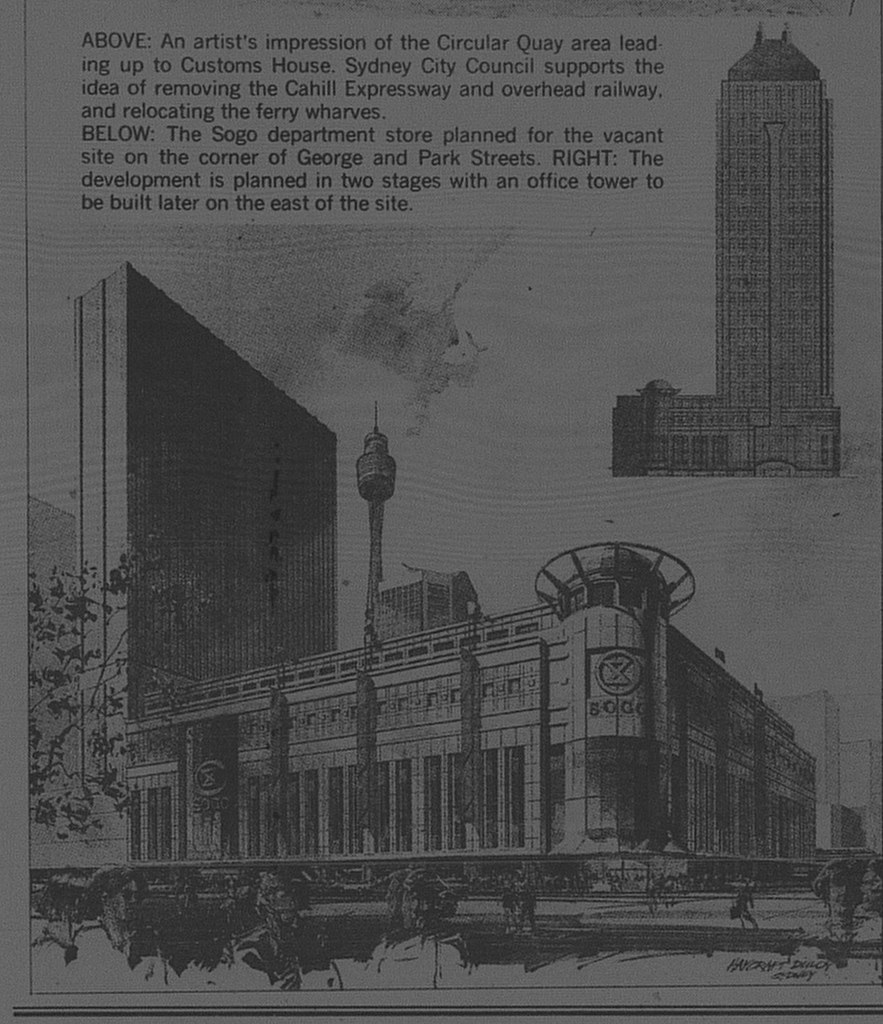
In 1994, Kumagai Gumi and Sogo unveiled their latest proposal. I don't have details about the number of floors but I would believe it would around 48 levels, consistent with their 1990 scheme but also for the eventual 2 Park Street tower that we see today.

It is this scheme that would form the basis for the tower that would eventually be built, noting the height, setbacks at the top of the tower but also the addition of two spires; which would be reduced to one in the final approved scheme

The artist's impressions were from an article in The Daily Telegraph Mirror that was published in April 1994.


Source: Jones, M. 1994. 'New Sydney to be 'living work of art'. The Daily Telegraph Mirror, April 19: 5.

The complex was proposed to be built in two stages with the retail podium in stage one including a Sogo Department store with the office tower to be built later.

By September, there was speculation that commencement of construction of the department store would commence.


Source: Reeves. 1994. "Department store set to fill eyesore hole". The Sydney Morning Herald, September 20: 9.

But despite the plans, the site would remain dormant for longer. Next week, we will see the light emerge when I post about the tower we see today and the accompanying Galeries Victoria.

Previous Schemes

Monday, 22 February 2016

1994: Phillip Cox slams Sydney Architecture

This week, I share an article from The Daily Telegraph in 1994 where Phillip Cox raises concerns that Sydney's reputation was being destroyed by poor architecture and urban planning. With the city recently handed the rights to the Olympics for the year 2000, the change needed to be done then.


McDougall, B. 1994. "Architect lashes city's ugly legacy". The Daily Telegraph, March 15: 4. 

Cox outed East Circular Quay (yet to be redeveloped), Cahill Expressway, Walsh and Lavender Bays for major surgery. East Circular Quay was redeveloped along with Walsh Bay, but has thrived. Walsh Bay has established itself as a cultural centre and the Barangaroo Development will propel it further.  The Cahill Expressway and Lavender Bay were (and still are) untouched.

A vision for Sydney was needed. I feel that this message is still ignored to this day. We need to ask ourselves where we want to head as a city? Do we want to be a centre for business? Do we want to be a centre for culture or focus on lifestyle? These are questions that must be answered.

He did raise some valid ideas like utilising the space in and around the Cahill Expressway to reduce its scale. The State Government recently indicated plans to redevelop the area with the areas at street level to be the focus.

And the Civic Improvement Squads could be a possible alternative to the dole, provided it gives people real skills needed for the workplace.

Saturday, 4 July 2015

Property Advert of the Week: The Masters Display Home Expo - Elizabeth Hills (1994)

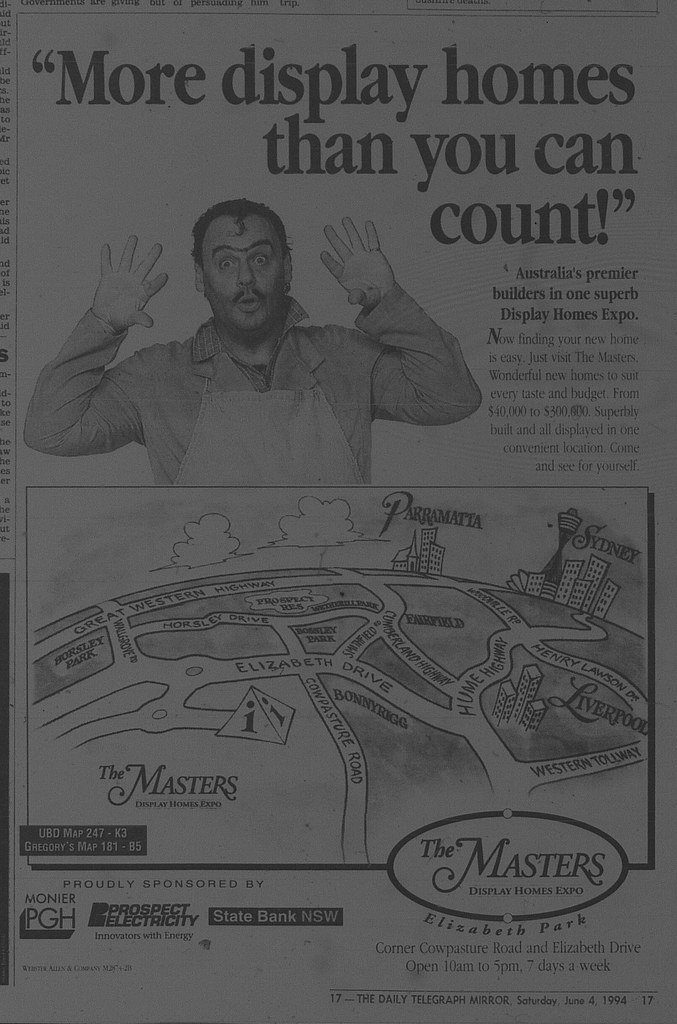
Our property advertisement of the week takes us back to 1994, when Con the Fruiterer was enticing people to check out the display homes available at Elizabeth Hills.

Masters Housing Ad June 4 1994 daily telegraph 17

Source: The Masters Display Homes Expo. 1994. "More display homes that you can count (Advertisement)".  The Daily Telegraph Mirror, June 4: 17.

Monday, 18 May 2015

1994: Rap Jumping in Sydney

For a while in the 1990s one building in Kings Cross was happy for people to let people engage in rap jumping where they abseil down a building as if they were walking, abelt at a 90-degree angle. It was at the Hotel Crest (currently Hotel Mercure Sydney Potts Point). The concept of rap jumping was used by Australian troops in the Vietnam War and allows gunmen to fire while abseiling down a cliff. Macka Mackail, a former SAS officer was operating the business.


Source: Wockner, S. 1994. "Rap jumping craze is a full-frontal business." The Daily Telegraph, January 25: 5.

However, if you want to rap jump off a building, Urban Central at Southbank in Inner Melbourne offers it, and from my knowledge, the only highrise building in Australia that currently offers it.

Monday, 6 April 2015

1994: John Fahey's Vision for Circular Quay

The NSW Election as we know was held recently and one face that you might have recognised during election night coverage and at the Liberal Party Election Launch was former Premier John Fahey (1992-1995).

One topic of regular discussion on Circular Quay during the 1990s was what to do with the Cahill Expressway and to redevelop the precinct. Then Prime Minister Paul Keating wanted it to be pulled down as the recently opened Sydney Harbour Tunnel provided the "first and only opportunity" for it to be removed. In July 1994, he attacked the State Government led by John Fahey for not embracing the opportunity. For the state government, the $450 million cost of demolishing the roadway plus redirecting cars and trains was too cost prohibitive. The money was better off being spent on transport infrastructure across New South Wales.

Keating accused them of lacking vision while branding the roadway an "eyesore". He went further and also said that the state government was unfit to showcase the city for the 2000 Olympic games. Federal government money was offered to make it happen. Still, the answer was "no". Fahey told The Daily Telegraph in its edition of July 14, 1994, that he had made requests for Federal assistance but was ignored.

Fahey wrote exclusively for The Sunday Telegraph the following week (July 17) where he revealed his vision for Circular Quay which included:
  • Replacing Wharf 4 with a public walkway.
  • Reconstruction of the remaining wharves to open up to the harbour.
  • Relocation of bus and taxi stands to allow for the new square.
The cost of works was projected at $40 million. A design competition would also be held. 

While he felt that the Cahill Expressway needed to be pulled down in the long term, it needed to stay for the time being citing demolition costs and redirecting cars and trains as mentioned.  Instead, they proposed an upgrade of Circular Quay. One feature was to include an archway as part of improving the concourse area for Circular Quay railway station and creating an open space linking Customs House with the Quay. No outdoor cafes would be in this area. 


Source: Fahey, J. 1994. "My vision for our Quay: Main feature an archway promenade." The Sunday Telegraph, July 17: 4-5. 

While the archway never became a reality, our wharves did get their makeover, Wharf 4 is still with us and a public square was built outside Customs House. Footpaths along Alfred Street were also enlarged. It was all completed by the Olympic Games in 2000. Those in Sydney at the time would remember it was one of the official CBD live sites broadcasting Olympic events.


The public square at Customs House was one feature of Fahey's 1994 vision that became a reality.
Photo taken by the Author. 

Still, in 2015, there are calls to pull the Cahill Expressway down, but nowhere near the attention it did receive two decades before.