Showing posts with label construction. Show all posts

Monday, 30 October 2023

1990: Old Fairfax Building demolition collapse

Old Fairfax Building Collapse August 9 1990 daily telegraph 1 enlarged
Source: Anon. 1990. "Building crashes on city workers". The Daily Telegraph, August 9: 1. 

Walking down Hunter Street in 2023, one may notice that the former Hunter Connection Office Building is being demolished as part of the new Hunter Street Metro Station construction. A new building will replace the 21-level/89-metre building from 1986.

Directly opposite is 20 Hunter Street, a 16-level office building constructed by Leda Holdings and completed in 1998. Initially, the tower was to have preserved the facades of the four buildings occupying the site, including the old Fairfax Building.

Leda Tower Hunter Street January 13 1990 SMH 38 enlarged 

Source: Anon. 1990. Untitled. In Paul Pottinger and Jonathan Chancellor, "Rest of unsafe facade to come tumbling down", The Sydney Morning Herald, August 14 1990: 27. 

Just before 1pm on August 8 1990, scaffolding and brickwork from two buildings collapsed onto Hunter Street, injuring seven people. Given the magnitude of the damage, it is amazing that no one was killed, including one construction worker who fell twenty metres. The other six injured comprised of five pedestrians and a motorist. 

Below is coverage from The Daily Telegraph from 9 August 1990.

Old Fairfax Building collapse August 9 1990 daily telegraph 4-5

I have enlarged the photographs for your viewing.

Old Fairfax Building Collapse August 9 1990 daily telegraph 4-5 enlarged B

Old Fairfax Building Collapse August 9 1990 daily telegraph 4-5 enlarged A

This photograph shows which facades collapsed. Old Fairfax Building Collapse August 9 1990 daily telegraph 4-5 enlarged C 
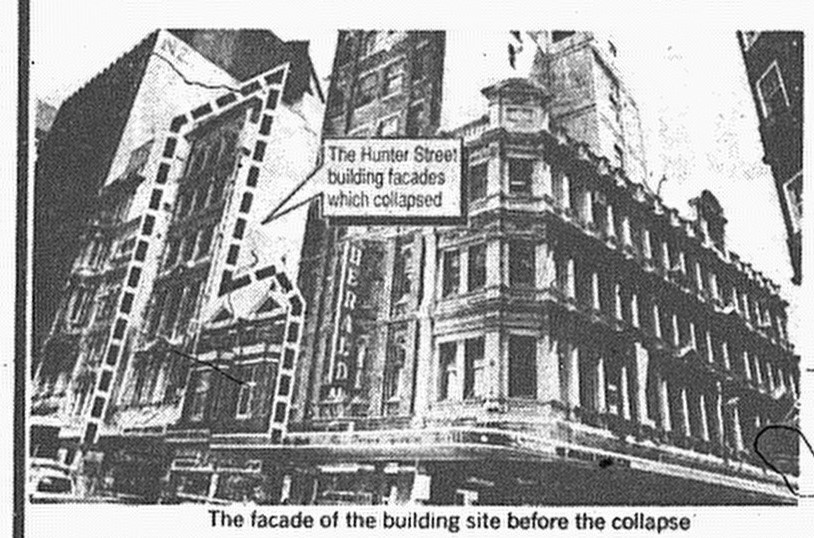
After the collapse in 1990, the facades were demolished and not incorporated into the building that was built. 
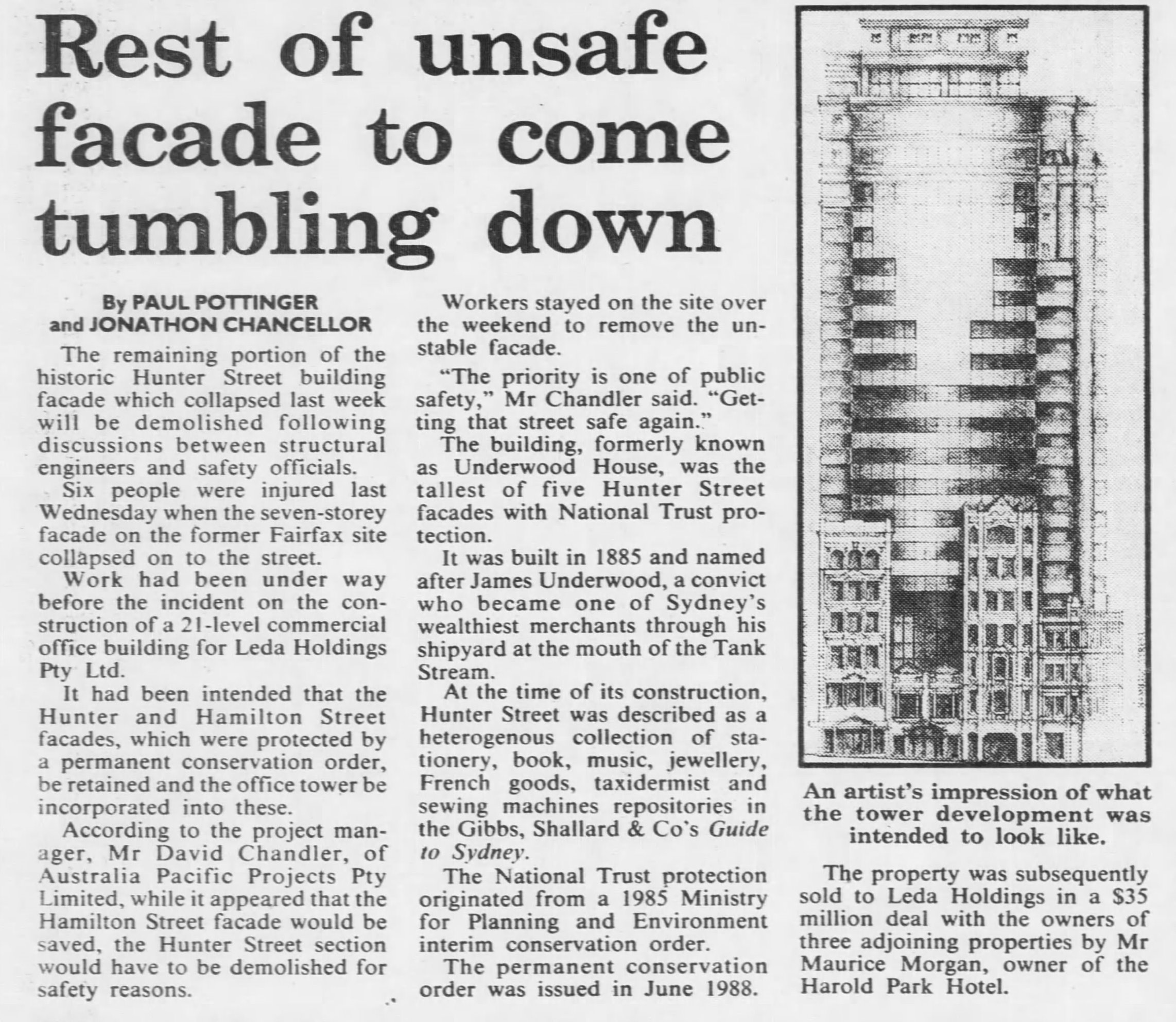
Leda Holdings Hunter Street Tower August 14 1990 SMH 27

Source: Pottinger, P. & Chancellor, J. 1990. "Rest of unsafe facade to come tumbling down". The Sydney Morning Herald, August 14:27.

Monday, 24 January 2022

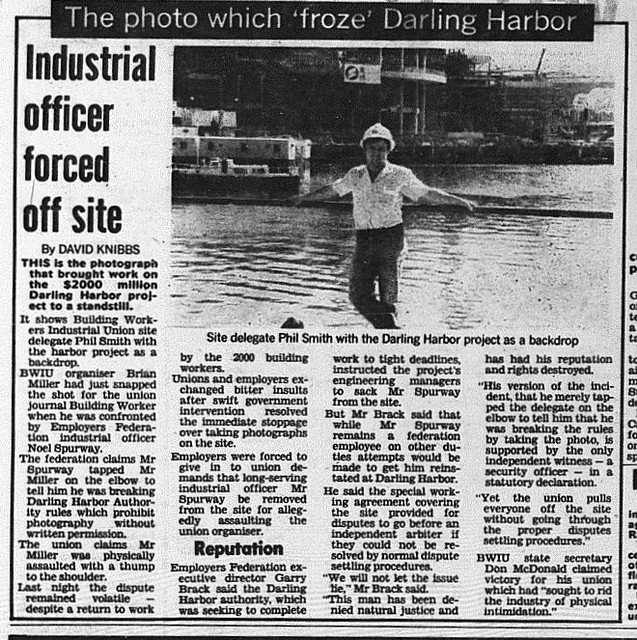
Remember This? The photo that caused industrial action (1987)

The Darling Harbour Redevelopment Project in the 1980's would normally arise in a normal posting. I have considered doing a Darling Harbour Redevelopment series focusing on the 1980's redevelopment of the site from a Goods Yard and Port into the tourist and cultural centre that it is today.

But there is one clipping that has caught my eye which warrants a stand alone entry because it was related to the industrial action that contributed to the late delivery of the buildings and attractions that shape Darling Harbour.

One such dispute arose in 1987 because of a photograph. Phil Smith, a delegate for the Building Workers Industrial Union (BWIU) decided to pose for a photo with the under construction site as his backdrop. The Darling Harbour Authority prohibited photography without permission and was supported by the Employers Federation. Brian Miller, a union organiser for the BWIU took the photo and claimed that he was assaulted by Employers Federation Officer Noel Spurway. 

In response 2000 workers walked off the site and the State Government was forced to intervene in the matter. 

Darling Harbour October 2 1987 daily telegraph 6

Source: Knobs D., 1987. "Industrial officer forced off site". The Daily Telegraph, October 2: 6. 

Monday, 6 December 2021

1968: The Opera House lights up for the first time

In 1968, the Sydney Opera House was still five years from completion, yet were allowed to admire the building even in its incomplete form at night.

  Sydney Opera House - lit for first time August 6 1968 daily telegraph 7

Source: Anon. 1968. "And now we see it in lights". The Daily Telegraph, August 16: 7.

Monday, 22 November 2021

2000: What to do with Sydney's vacant construction sites

In our Olympic year (2000), Sydney had to be looking its best i.e. tidy and looking nice and appealing to our global visitors. 

There was one problem that faced Sydney Lord Mayor Frank Sartor and Sydney City Council and it was impossible - reactivating empty construction sites.

A decade earlier saw Australia in economic recession. The property market was amongst the biggest victims as shown in the empty construction sites that remained in the city. Some construction sites such as 2 Park Street (Citi Tower) and Angel Place had developments completed in time or were close to completion.

World Square was around 75% undeveloped with Hordern Towers occupying a quarter of the site at the corner of Pitt and Liverpool Streets. The current sites of Ivy at Wynyard, Frasier Suites (George, Bathurst and Kent Streets), Emporio Tower (Sussex, Liverpool and Day Streets) were empty.

Vacant Sites in Sydney CBD April 12 2000 SMH 9 

Source: Morris, L. 2000. "Sartor threatens whole lot of trouble". The Sydney Morning Herald, April 12: 9.

The site of Frasier Suites (former Regent Theatre) became home to temporary shops. Other sites simply received new hoardings. Meriton had just commenced its construction of World Tower at the corner of Liverpool and George Streets and was trying to complete as much as it could before September.

Sydney CBD Holes in the ground July 4 2000 SMH 3

Source: Jamal, N. 2000. "New event in store for holes in the ground: Olympic aesthetics". The Sydney Morning Herald, July 4: 3. 

Building Holes July 4 2000 daily telegraph 13

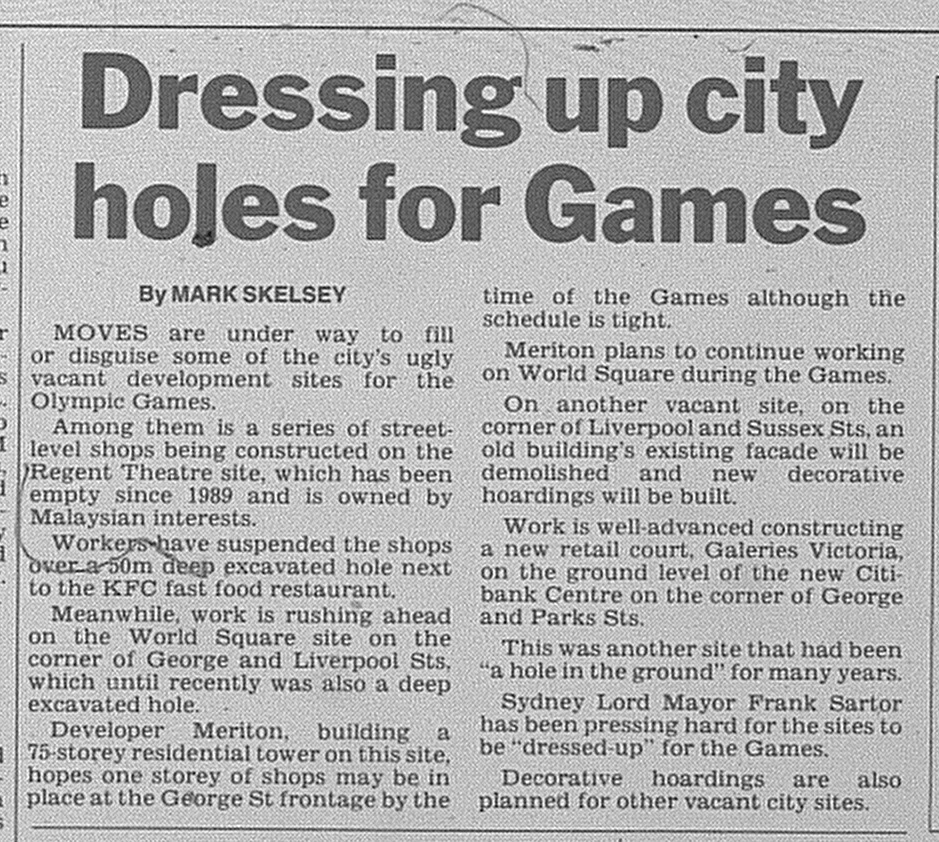
Source: Skelsey, M. 2000. "Dressing up city holes for Games". The Daily Telegraph, July 3: 13.

Monday, 16 August 2021

1971: Art on Construction Hoardings

In recent times, hoardings on city streets at construction sites feature historical images of central Sydney which have been provided by Sydney City Council. It has given pedestrians something of interest to look at as they walk past, learning about the city's past and how it looked at different points in history.

Fifty years ago, it was not photos that were on hoardings, but rather artworks as this article below shows. 

Hoarding Art March 21 1971 Sun Herald 13

Source: Ford, R. 1971. "Gay hoardings brighten the scene". The Sun Herald, March 21: 13. 

Monday, 22 February 2021

1970: Sydney Construction Feature

For around the past decade, the sight of construction in central Sydney has become part of the city's routine.

In the late 1960's and early 1970's, the sight of construction was also routine in central Sydney as old buildings were demolished for modern skyscrapers.


The Daily Telegraph published a pictorial feature on September 12, 1970 focusing on three sites:
  1. AMP Centre (Bridge Street)
  2. Hilton Hotel - Former site of Adams Hotel
  3. 175-183 Castlereagh Street - 14 storey office tower
Two sites featured are currently undergoing redevelopment. The AMP Centre which was completed in 1976 has been gutted and being redeveloped into a modern office tower. Floorplates are being enlarged to provide modern workspaces for its employees. 

Photo taken by the Author (2021). 

175-183 Castlereagh Street has been demolished as part of the Pitt Street Metro Station development with a modern office tower planned for the site. 

The Hilton Hotel completed in 1973 was renovated in 2004 with a refurbished facade and additional office space. 


Monday, 30 January 2017

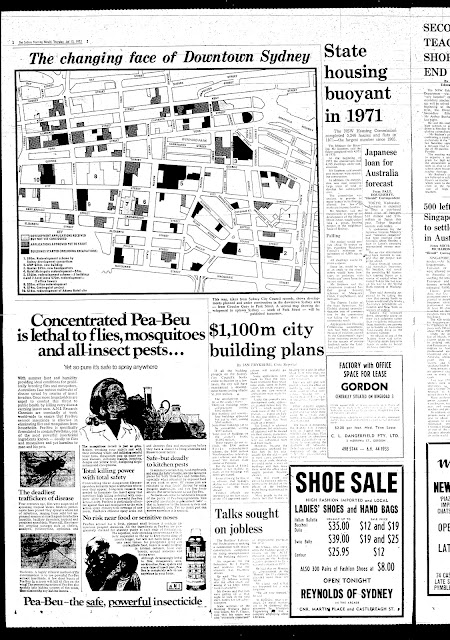
Remember this: The changing face of downtown Sydney (1972)

This is the last entry of our "Remember this" series. We are in the midst of a huge building boom in downtown Sydney. In the early 1970s,  we saw a similar transformation take place though it would have been even more dramatic than the boom we are experiencing today.


Source: Frykberg, I. 1972. "The changing face of Downtown Sydney". The Sydney Morning Herald, January 13: 2. 

Monday, 7 September 2015

1973: Hundreds of City Buildings facing the bulldozer

In 1973, some thought Sydney's high-rise boom was not going to abate, and hundreds of old city buildings were facing their hour of doom.

Four decades later, it is interesting to note a number of featured buildings that faced doom, only to be spared the wreckers ball, like Central Baptist Church, ANZ Bank Building and Stawell House. The Regent Theatre survived for another fifteen years before facing the wreckers in 1989. In fact, the ANZ Bank Building and Stawell House are now heritage listed so they will never be pulled down.

City buildings like those in the article were initially saved because of the liquidity crisis that sent city developers to the wall that same year. Some went bust. The boom had also created an oversupply of office space in central Sydney, which meant that city development would crawl slowly for about a decade.  The economic reforms of the Hawke Government (1983-1991) would fuel the next wave of city development. Add the Green Bans and anti-development groups, and more buildings would find themselves saved from the wreckers. 

In 1973, at least a billion dollars was to be spent on new city developments, which is the equivalent of $8 billion in today's money. At the moment, roughly two billion dollars is being spent on building developments in central Sydney, and we think that is a mammoth amount.


Source: "Our Civic Reporter". 1973. "150 City Buildings Face Wreckers: Offices, flats, cinemas and parking planned". The Sydney Morning Herald, June 28: 3. 


Monday, 15 June 2015

1995: The ANZAC Bridge is joined together

This week will be 20 years since the two spans of what was then known as the Glebe Island Bridge was joined together. Below is an article from the afternoon edition of  The Daily Telegraph on June 20 1995, when the two spans finally met. The bridge was opened to traffic less than six months later.


 Source: Sheridan, P. 1995. "Together at last - our new bridge". The Daily Telegraph, June 20: 1.

Monday, 13 April 2015

Filling the city's holes in the Ground: Victoria Towers (1996)

From time to time, I'm going to look at the sites in central Sydney that were abandoned during the recession of 1990-91 when the property market in Sydney collapsed. This led to the cancellation of a number of developments. It would take some sites up to fifteen years to be developed.

One of those holes in the ground in the early 1990's was the site of the Sydney Catholic Club at 199 Castlereagh Street in the city. The original Catholic Club building had been demolished in 1989.


Source: Skelsey, M. 1993. "$100m tower to boost city living." The Daily Telegraph, November 6: 14. 

In September 1993, property developer Leda Holdings was given approval by Sydney City Council to construct a 39 level apartment tower, rising to 120 metres above street level. The building would contain 252 apartments plus a rebuilt Sydney Catholic Club (now known as the Castlereagh Club). It was one of the first high rise apartment towers approved in the 1990's for central Sydney and would set a precedent for future high rise residential tower development. Residents also had access to the latest trends in residential facilities for its time including a gym, pool and 24-hour concierge service.

As the above article from The Daily Telegraph mentions from November 1993, Leda wanted to "cash in" on the trend towards high rise living, particularly as Sydney's CBD lacked apartments despite high demand from business executives and overseas investors. At the time, only 6000 people were reported to be residing in central Sydney. Meanwhile, Sydney City Council wanted to entice people to live in the city to help it become more lively and dynamic but, also to fill in those empty holes in the ground. It was a win-win for all. Apartments went on sale in early 1994 with construction underway not so long afterwards. The tower was completed in 1996. Below is an advertisement advertising apartments for sale in mid-1994. Apartments were on sale from $219 000.


Source: Leda Holdings Limited. 1994. "Victoria Tower (Advertisement)." The Sydney Morning Herald, June 12: 129. 

Last week, yours truly went into the city and managed to take two photos of the building.


Monday, 25 August 2014

1969: Shape of the new Mascot

A photo and short article from 1969 documenting progress on the new International Terminal Building at Sydney Airport.


Source: Anonymous, 1969. "Shape of the new Mascot," The Daily Telegraph, June 24: 7.  

Wednesday, 25 June 2014

2004: Breakfast Point takes shape

During the early 2000's one of the many new residential developments that were taking shape along the Parramatta River was Breakfast Point. Now it is a suburb in its own right.

Here is a photo that I snapped that year.


Monday, 2 June 2014

1989: A Hole lot of work

An interesting report from The Daily Telegraph in 1989, where it looks at the early stages of the construction of the failed World Square project in central Sydney. Demolition work had begun on the former site of the Anthony Horderns department store three years earlier in 1986. Now the entire site was a hole in the ground. A year later, disputes led to the collapse of the project. By then the basement levels were under construction and a lift core for one of the four proposed towers was well above ground. It was not until the late 1990's that work would resume on the site (well part of it at least) with the construction of the first tower known as Hordern Towers, a hotel and residential apartment tower at the corner of Liverpool and Pitt Street. 

Construction work on the four towers and shared retail podium was estimated to cost about $1.5 billion. Completion was set for 1992, a quite ambitious goal given the scale of the project. 


Source: Deegan, L. 1989. "A hole lot of work: City digs deep for a $1.5 billion job," The Daily Telegraph, March 8:17.